Topics and Tacos: A Workshop Template for First-Gen Students
At Susquehanna University, first-generation college students make up about a third of our student population. I serve on a First-Gen Working Group at SU, and our purpose is to increase awareness and support for these students. When I was asked to serve on the group, I began researching how I could help first-gen students at the library. Most of what I read was that first-gen students tend to avoid asking for help. They assume everyone else knows how college and libraries work, so they try to tough it out on their own.
I decided to break down that barrier and make first-gen students feel more comfortable with the librarians. My hope was that if they saw how friendly we were, then they would be more likely to come to us for help. To accomplish this, I designed a workshop intended for first-gen, first-year and second-year students. I hosted the workshop in the fall ahead of midterms and in the spring before finals. Both workshops were held around dinner time for about an hour. In the fall, we offered walking tacos, and in the spring, we had pizza. While any first- or second-year student could come to the workshop, first-gen students were given priority.
I opened the workshop by discussing some general new services and initiatives the university had implemented for first-gen students. The students were generally not aware of these services, and they were happy to learn about them. After this, I walked them through a paper prompt I had adapted from Teaching Information Literacy: Threshold Concepts Lesson Plans for Librarians (2015, p. 51). So many students were struggling due to pandemic learning, and while many of them had visited the library with their basic English class, they still didn’t seem sure of the overall research process.
I helped them identify key parts of the paper prompt, and from there, we used Mentimeter to create a word cloud of potential keywords we could search in the library databases. For this activity, I gave them two broad terms, “social media” and “self-esteem,” and they had to submit more specific topics related to those concepts. Once we had some keywords, I demonstrated how we could enter two of these terms into an advanced search. From there, we talked about how to narrow down our topic based off the results we found in our search. I also showed them how to limit the results to peer-reviewed sources or filter by a date range. Once we had determined a research topic together, I gave the group tips on getting the citations and permalinks for the articles to refer to later.
We ended the workshop by encouraging students to share any assignments they were currently working on for a class. Some students didn’t have any, so they finished their food and left. Other students staid for quite a while and allowed us to work one-on-one with them to help identify a topic for their paper and to search for relevant sources. Many of the students who attended expressed how helpful the workshop was, and they recommended we offer it each semester. They were also happy to hear that the library supported first-gen students, and they seemed more comfortable interacting with us as the workshop went on. Hopefully, this meant they would be more eager to come to us for help in the future. We plan on hosting the workshop each fall, as the fall workshop was better attended than the spring one.
References
Bravender, P., McClure, H., & Schaub, G. (Eds.). (2015). Teaching information literacy: Threshold
concepts lesson plans for librarians. Association for College and Research Libraries.
Thanks to Steven Bell for his recent Connect & Communicate Series presentation, “Five Revolutions for Advancing Cultures of Openness in Higher Education: Looking Beyond 2022.” The recording is now available on the C&CS YouTube channel.
Whether you attended live or view the recording, please take a minute to fill out the evaluation form. Your feedback is very important to us, as we are required to submit evaluation data as part of our LSTA grant application.
Faculty Perspectives on Mis/Disinformation
Shortly after I wrote in a previous post about my work with the Pitt Disinformation Lab, I read a related article: Faculty Perspectives on Mis- and Disinformation across Disciplines by Dr. Laura Saunders. The article discusses her survey of higher education faculty to discover their understanding of mis/disinformation in their disciplines and how they address it in their classes.
Saunders’ survey was answered by 86 respondents in a variety of disciplines, and she conducted follow-up interviews with only 6 of the respondents, so she cautions that it’s a small sample size. Not surprisingly, over 90% of respondents agreed or strongly agreed with the statement “I am concerned about the impact of mis/disinformation on social media” and similar responses were received to a question about the news media. However, when respondents were asked whether there was concern about these issues in their fields, the answers varied widely, as illustrated by this figure from the article:
FIGURE 3
I am concerned about the impact of mis/disinformation in my field/discipline
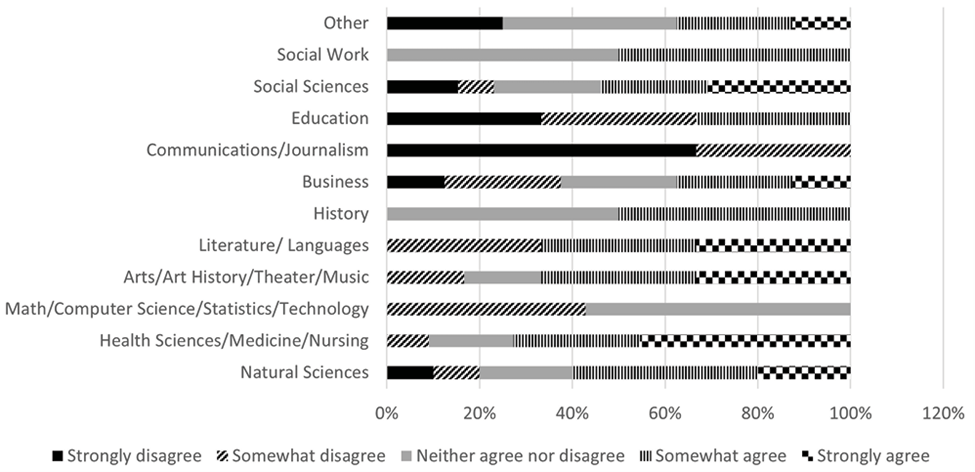
When first seeing this, I looked at the Communications/Journalism line several times to make sure I was reading it correctly. Over 60% of respondents strongly disagreed that it’s an issue in their discipline?! Even given that this percentage translates to 3 or 4 people, it’s still a remarkable result. I emailed Dr. Saunders to solicit her comments on this finding and she said, “ I completely agree with you about the oddness of these results. …the respondents might have been reading the question a little differently than I intended– for instance, maybe they were thinking about the spread of misinformation by trained journalists or by communications/journalism instructors as opposed to whether misinformation is spread in this field in general…although that seems a bit of a stretch as well. And certainly there are trained journalists and reporters who do purposefully or inadvertently spread misinformation.” Unfortunately, since no one from Communications/Journalism was available for a follow-up interview, Dr. Saunders couldn’t get more clarification on this result.
The article also discusses faculty interaction with librarians on mis/disinformation. The vast majority of all respondents have not worked with a librarian to specifically address the topic in their classes. However, Saunders notes that respondents’ most popular method of addressing mis/disinformation in their classes is “requiring students to cite trustworthy sources in assignments.” Assisting with this, of course, is often a focus of our instruction sessions, so perhaps in faculty’s mind we are addressing the issue. While some of the skills used to find academic research are helpful when assessing the veracity of information on Facebook, I believe they’re not identical.
Any effort on our part to integrate discussions of mis/disinformation in class instruction sessions requires among the most precious of resources on a college campus: time. Using a portion of our already-constrained instruction time to focus on these issues rather than how to use our catalogs or understand a citation won’t be welcomed by all faculty. That said, I think it’s a topic worth exploring and about which I hope to have conversations with my faculty in preparation for this fall’s classes.
In her message to me, Dr. Saunders noted that she conducted a parallel survey of academic librarians, an analysis of which she hopes will be published soon. I look forward to that article and to reading others about how we can address mis/disinformation.
Just a reminder that the second meeting of the Summer 2022 series of Virtual Journal Club will take place this Thursday, July 21. We will discuss:
Dawes, L. (2019). Faculty perceptions of teaching information literacy to first-year students: A phenomenographic study. Journal of Librarianship and Information Science, 51(2), 545– 560. https://doi.org/10.1177/0961000617726129
Let us know if you would like to a link to our Zoom meeting!
Have a great day,
Melissa, Alex, and Rebecca
What makes a teacher?
Several years ago a librarian colleague said, “I teach, but I don’t teach, you know?” in a conversation about using peer observation to reflect and improve upon our teaching. At the time, this statement did not make any sense to me. Even considering there might have been a little bit of defensiveness in response to the idea of peer observation, that statement confused me at face value. How can you teach but not teach?
It’s been years and I think I finally found the answer. Or at least a perspective on how some librarians feel about their identities as teachers. A couple of weeks ago, my summer reading group read the article “Am I a Teacher because I Teach?” In the literature review, Kirker cites a study of British librarians and how they viewed their roles as teachers. That study categorized the four identities as:
- “teacher-librarians” (teachers who teach)
- “learning support” (teachers who do not teach)
- “librarians who teach” (non-teachers who teach) or
- “trainers” (nonteachers who do not teach)
When I read this, I thought of my former colleague. Although I was a newish librarian at the time, I was very confident in my teacher-librarian identity. This was based on my coursework in graduate school, the enormous number of one-shots I did as an adjunct librarian at a community college, and the role I eventually held at that institution alongside my colleague. I have a new role where I actually don’t teach many one-shots and I still consider myself a teacher-librarian. Even though my former colleague had been in the profession much longer than I, they still did not identify as a teacher. They likely would use any of the categorizations above except for “teacher-librarian.”
One of the participant’s in Kirker’s study discusses how librarians are not teachers because students are not accountable to us in the same way as their professors. We do not give out grades, we don’t require excused absences, we do not develop the same connections with students as their semester-long professors, and, in the end, we are not experts in subject content. Besides the relationship-building aspect, much of this is true. But I don’t think this is how we should define our teaching identity.
I think the final section of Kirker’s article can help us consider our identity: “student learning is the core of teaching in the academy.” We may need more professional development and training in pedagogy or more support from our academic colleagues, like course instructors. However, if we are invested in student learning then we can consider ourselves teachers.
I’m interested in hearing from you about this topic. Do you consider yourself a teacher?


 Adam Balcziunas
 Alex K.
 Alexandrea Glenn
 Andrea Pritt
 aprilnkelley
 Ashley Purvis
 Bethann Rea
 blj13
blj13 Brendan Johnson
 Amanda Boyer
 Bret Stiffler
 Bonnie Powers
 Christopher Lemery
 clarewithers
 clblibrarian
 Kelly Clever
 Charlotte M. Johnson
 colemanluzerne
 CRD of PaLA
 crdvirtualjournalclub
 cre5314
 csgarth
 Erin B.
 danajkerrigancv
 denisewetzel1
 Darren G. Poley
 elm43
elm43 Heather Burychka
 James D'Annibale
 Annie Jansen
 Jill Hallam-Miller
 jennifercribbs
 Jenn Monnin
 Jen Hasse
 Jessica Showalter
 johnmeier1
 Julie Durci
 Kelly Safin
 Kim Karim
 Kristen Seikaly
 Kayla Van Osten
 Cecelia Lasley
 librarianjsmith
 Linda Neyer
 mabogino1
 Matthew McNelis
 Meg Massey
 Maggie Savidakis-Dunn
 Rebecca
 miskatoniclibrarian
 Maureen Bentz
 Michele G. Anfuso
 Nicole Miyashiro
 paulmcmonigle
 Rob Sieczkiewicz
 ronlmccoll
 Sam Bardarik
 shannahollich
 smartin592
 Ula Lechtenberg