“Stay Hungry. Stay Foolish.”
With the passing of Steve Jobs, I, like many others, have been thinking about his life, work, and legacy. In his 2005 Stanford University Commencement Speech, Jobs urged the graduates to “Stay Hungry. Stay Foolish.” He had read the phrase on the back of a catalog many years before and the saying had stuck because it particularly resonated with him.
You may wonder what all of this has to do with academic librarianship. How does Steve Jobs, considered by many to be a visionary genius, a presenter/marketer par excellence, a noted driven perfectionist — how could he relate to what we do as librarians? I think that the connections and lessons-to-be-learned are readily apparent by reading and pondering some of his notable quotes. The quotes below and many more can be found at <http://blogs.wsj.com/digits/2011/08/24/steve-jobss-best-quotes/>.
When you’re a carpenter making a beautiful chest of drawers, you’re not going to use a piece of plywood on the back, even though it faces the wall and nobody will ever see it. You’ll know it’s there, so you’re going to use a beautiful piece of wood on the back. For you to sleep well at night, the aesthetic, the quality, has to be carried all the way through.” [Playboy, Feb. 1, 1985]
[Strive for excellence in everything you do or attempt to do.]
“Being the richest man in the cemetery doesn’t matter to me … Going to bed at night saying we’ve done something wonderful… that’s what matters to me.” [The Wall Street Journal, May 25, 1993]
[Take pride in what you do.]
“You can’t connect the dots looking forward; you can only connect them looking backwards. So you have to trust that the dots will somehow connect in your future. You have to trust in something — your gut, destiny, life, karma, whatever. This approach has never let me down, and it has made all the difference in my life.” [Stanford commencement speech, June 2005]
[Imagination is key.]
“When I was 17, I read a quote that went something like: “If you live each day as if it was your last, someday you’ll most certainly be right.” It made an impression on me, and since then, for the past 33 years, I have looked in the mirror every morning and asked myself: “If today were the last day of my life, would I want to do what I am about to do today?” And whenever the answer has been “No” for too many days in a row, I know I need to change something.“Remembering that I’ll be dead soon is the most important tool I’ve ever encountered to help me make the big choices in life. Because almost everything — all external expectations, all pride, all fear of embarrassment or failure — these things just fall away in the face of death, leaving only what is truly important. Remembering that you are going to die is the best way I know to avoid the trap of thinking you have something to lose. You are already naked. There is no reason not to follow your heart.” [Stanford commencement speech, June 2005]
[In other words, “Stay Hungry. Stay Foolish.”]
PaLA 2011 – CRD Sessions
While the 2011 PaLA Conference is still fresh in everyone’s mind, I wanted to share some photos that I took of some of the presenters.

Larissa Gordon
Larissa Gordon had the honor (or was it the horror?) of presenting the first CRD session at the conference. She talked about how the librarians at Arcadia University are collaborating with the Program Coordinators for the First Year Seminars and English 101 to establish Information Literacy goals and Student Learning Assessments for both of these courses. Larissa’s PPT slides: Assessment as a Collaborative Activity
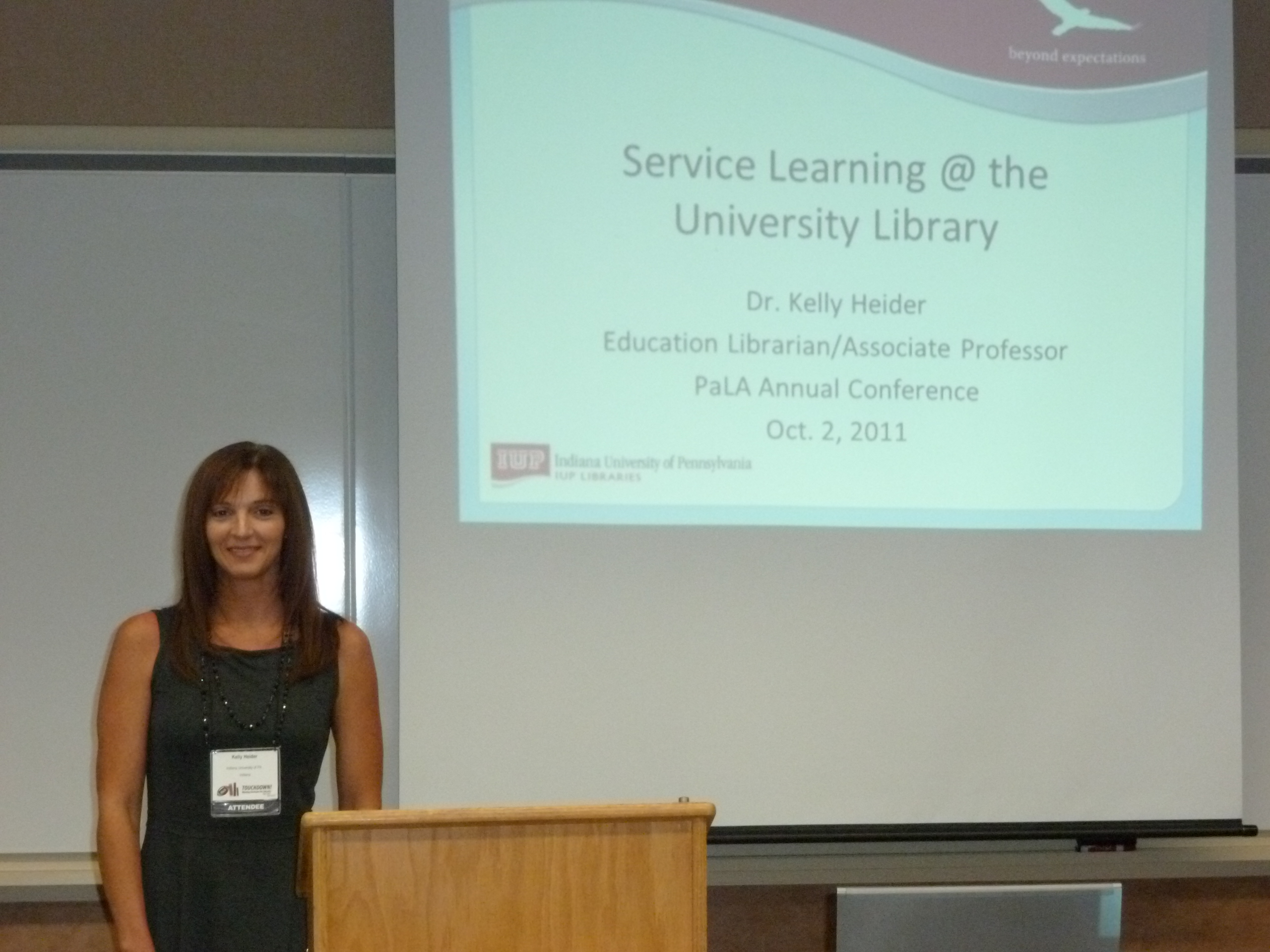
Dr. Kelly Heider
Dr. Kelly Heider, the Education Librarian at Indiana University of Pennsylvania, spoke about Service Learning and more specifically about a Service Learning opportunity that the IUP library offers to education majors, Wild about Books. The best part about this session was that attendees were given the opportunity to brainstorm about how they could develop their own Service Learning Programs.

Kristen Yarmey-Matthew Ciszek-Tara Fay
A Safe Space on Campus was the topic of the presentation given by Kristen Yarmey, Digital Services Librarian, and Tara Fay, Faculty Specialist, The University of Scranton; and Matthew Ciszek, Head Librarian, Penn State Shenango. A copy of their slides can be found on Slide Share: http://www.slideshare.net/kristenyt
Unfortunately, attendance at Sunday’s sessions was less than expected. I guess that a lot of people have good intentions and indicate that they will attend, but then get a later start than they intended or become involved in some other aspect of the conference.
Monday featured two CRD sessions at each time slot so apologies to the presenters in the three sessions that I missed.
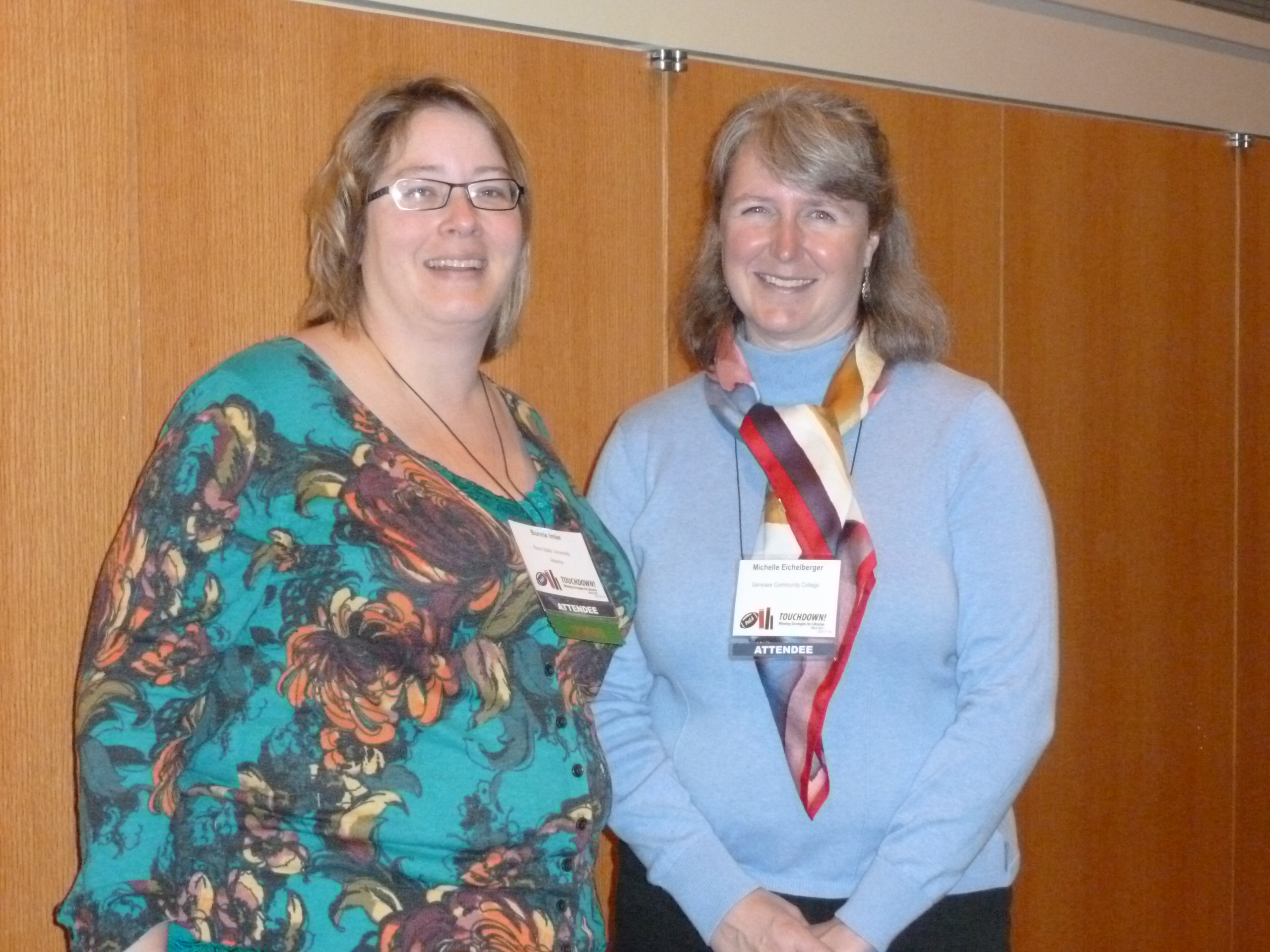
Bonnie Imler-Michelle Eichelberger
Bonnie Immler, Information Technology Librarian, Penn State Altoona, and Michelle Eichelberger, Systems and Electronic Services Librarian, Genessee Community College, presented the results of their research that used video screen capture with undergraduate students. Here are their PowerPoint slides: UndergradResearchBehavior.
Also in this time slot was A Librarian’s Guide to Near Field Communication presented by Sheli McHugh and Kristen Yarmey. A copy of their slides can be found on Slide Share: http://www.slideshare.net/kristenyt
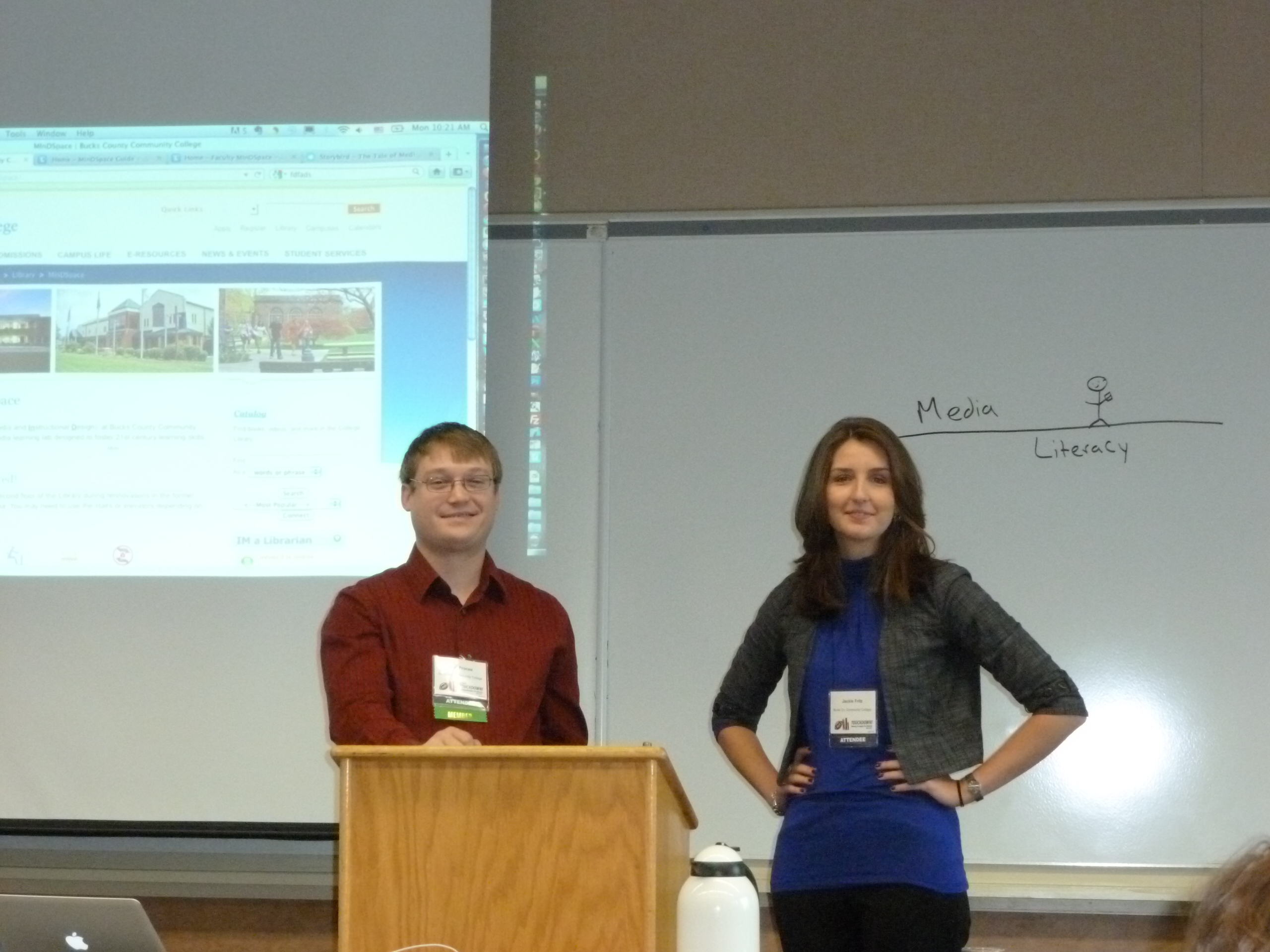
Paul Process-Jacqueline Fritz
Walking the Information Media Tightrope, presented by Paul Proces, New Media Librarian, and Jacqueline Fritz, Faculty Liaison, Learning Technologies, focused on the media literacy program at Bucks County Community College. To learn more, visit the Media and Instructional Design Space (MInDSpace) on the college’s Web site.
Russell Hall, Reference Librarian at Penn State Erie, shared the results of his survey of Academic library managers in his session titled, Nature, Nurture and the Pennsylvania Academic Library.
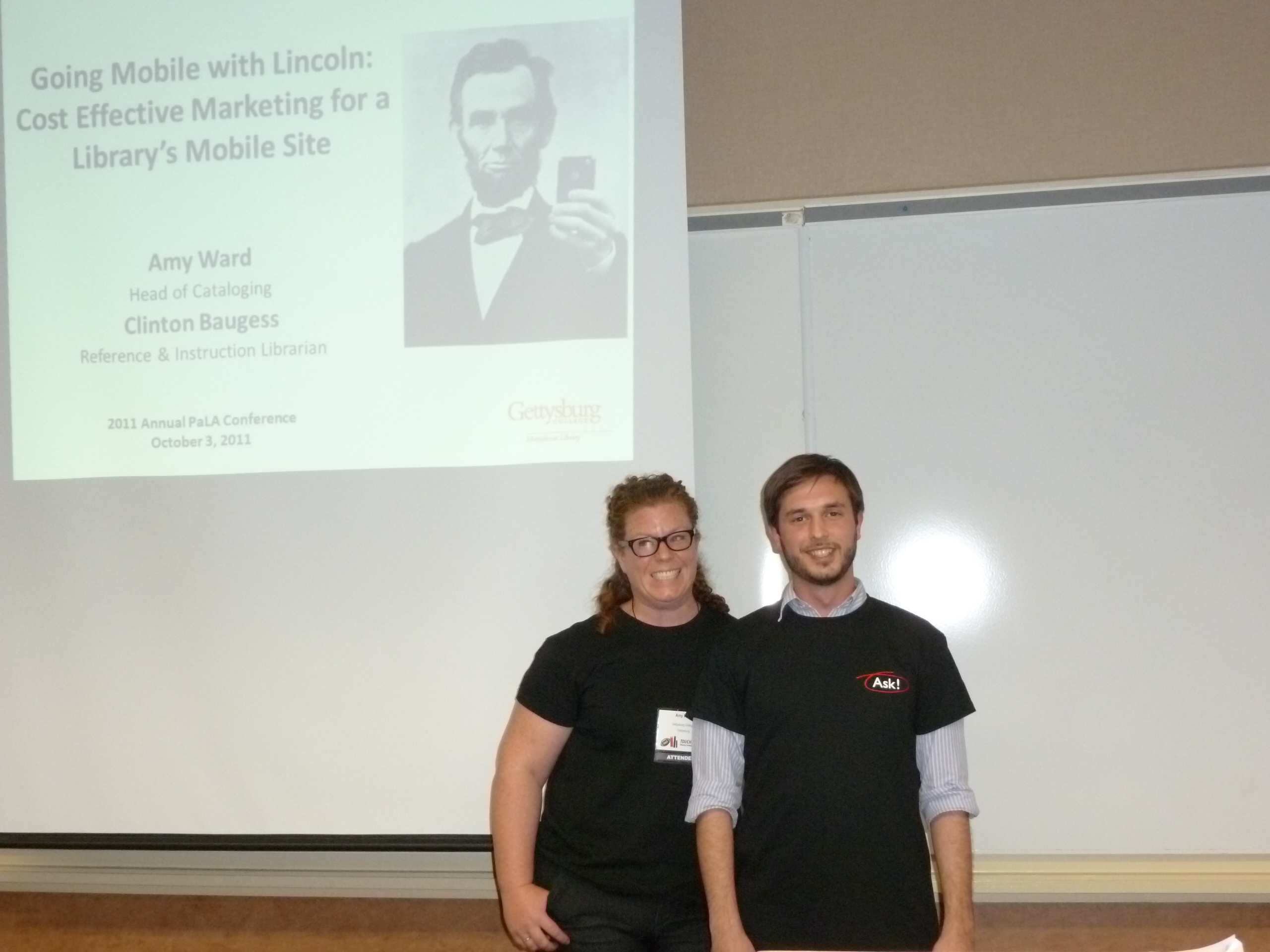
Amy Ward-Clinton Baugess
In their session, Going Mobile with Lincoln, Amy Ward, Cataloging Librarian, and Clinton Baugess, Reference & Instruction Librarian, shared how the Musselman Library at Gettysburg College created a marketing campaign to promote accessing the library’s website through mobile devices. After their presentation, they provided attendees with an opportunity to identify who their target audience would be and how they would create their own marketing campaign.
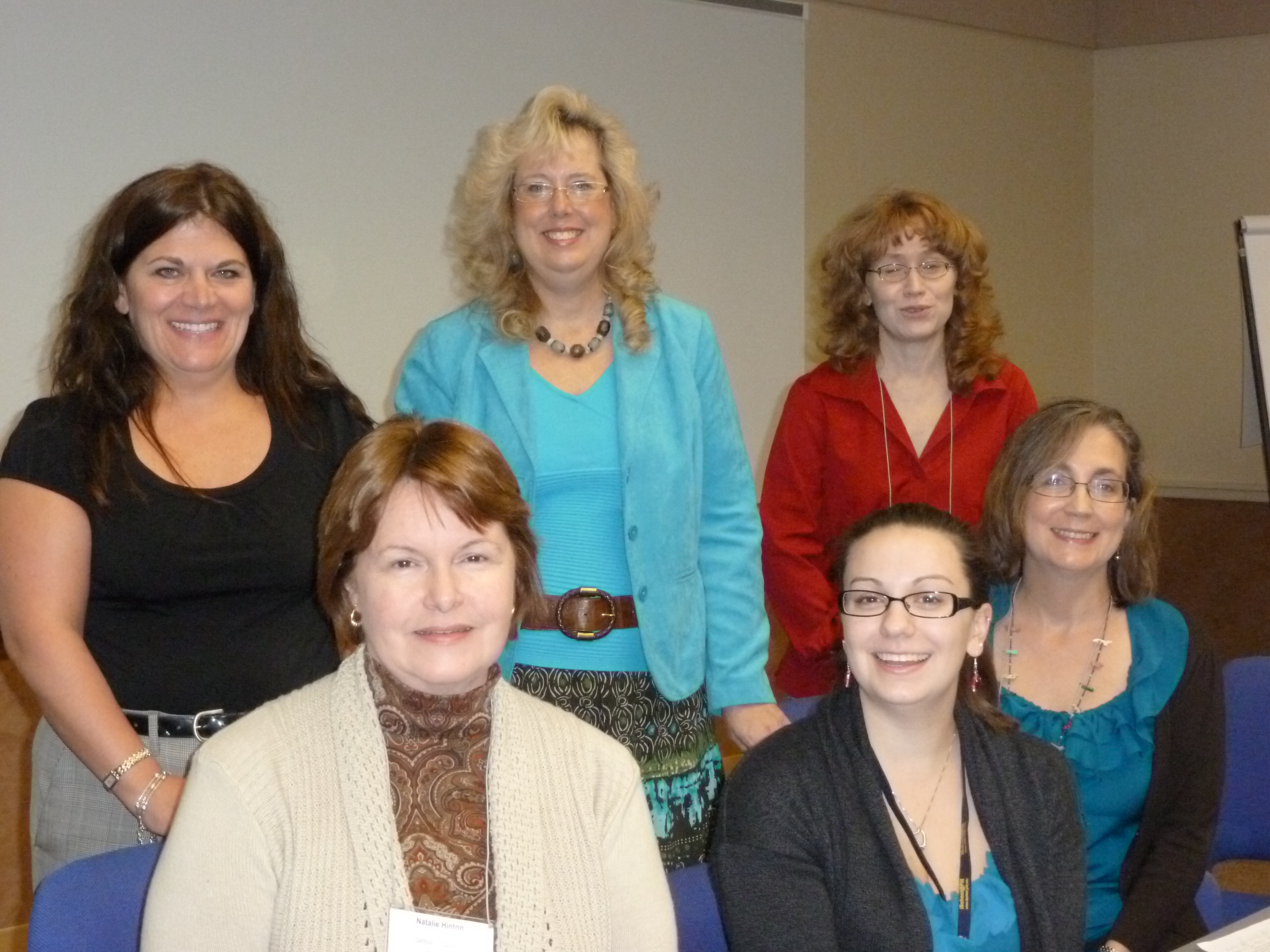
Gaining Insight Presenters
Librarians Ronalee Ciocco, Natalie Hinton, and Kaitlyn Lynons from Gettysburg College, and Theresa McDevitt, Michele Corcoran, and Beth Farabaugh from Indiana University of Pennsylvania shared ways that they used to successfully gain insight about their patrons’ viewpoints, including surveys, focus groups, usability testing, and floor plan drawing.
In the session, Demonstrating the Value of Academic Libraries, Rachel McMullin, Humanities and Information Literacy Librarian at the Green Library shared how West Chester University is collaborating with academic departments to assess information literacy using rubrics. For more information, go to her Information Literacy Research Guide. Melissa Gold, Science Librarian at Millersville University explained how she created a curriculum for the Ganser Library using the process of curriculum mapping. Here are her PowerPoint slides: Curriculum Mapping. Colleges and Universities have recently begun to utilize online Assessment Management software. Scott anderson, Information Systems Librarian, explained how the Ganser Library Millersville University is using WeaveOnline and Dick Swain, Director of Library Services, showed how West Chester University is using TracDat and LibPAS.
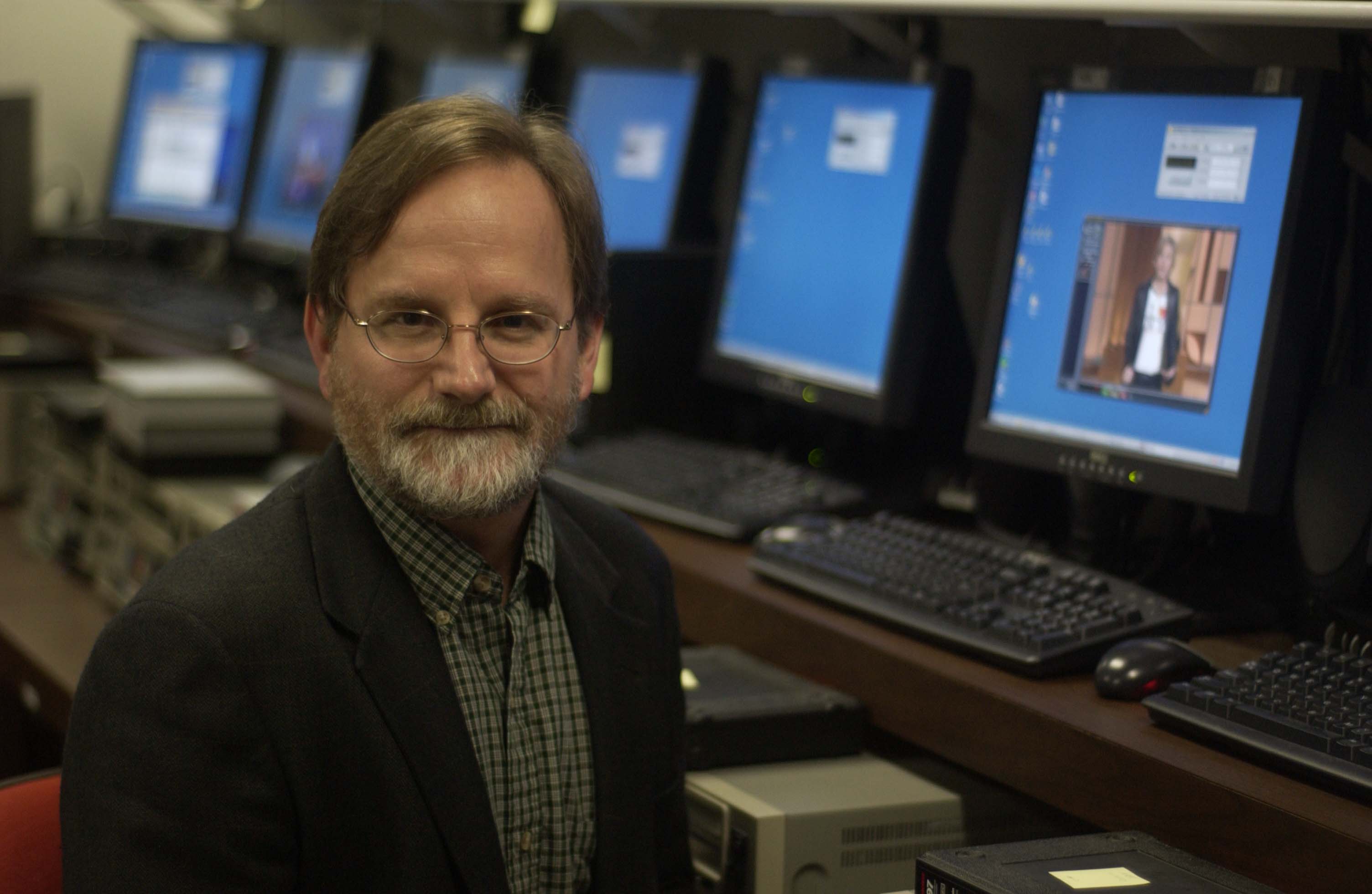
Marshall Breeding
One of the highlights of the PaLA Conference each year is the College & Research Division Luncheon and this year was no exception. I had the honor of meeting and introducing Marshall Breeding, Director for Innovation Technologies and Research at the Vanderbilt University Libraries. His presentation titled, Beyond the ILS: Introduction and Future Directions, described the emerging products and services for library automation that aim to address the new realities that include increased emphasis on delivering access to electronic resources and digital collections.
Wednesday morning featured Donna Mazziotti, Public Services Librarian, and Teresa Gretano, English Professor, from The University of Scranton in a session titled, Rethinking Information Literacy. Based on the research that they gleaned from a course that they co-taught on Rhetoric and Social Media, their presentation made a case for an updated definition of Information Literacy that takes into consideration the effects of social media practices on students’ information seeking behavior.
Darla Bressler and Kathryn Yelinek, Reference Librarians at Bloomsburg University, presented Shush No More: Accommodating Noise in Today’s Library. There session featured time for attendees to discuss what has/hasn’t worked for other libraries. Here is a link to their PowerPoint slides: Shush No Moreand to their Sush No More Handout.
PaLA 2011 – Reorganizing the future
I’m still coming down from the high of attending the 2011 Pennsylvania Library Association Annual Conference earlier this week. Gathering with friends and colleagues from around PA always results in opportunities for networking, learning, and fun. I found the pace of this state conference to be very pleasing – it was much less hectic than a larger conference (like ALA for example) with more time to linger between sessions and chat with new acquaintances.
I’ll probably be posting my session notes on my personal blog Library Scenester, but I wanted to take a moment here on the CRD blog to post about one particular #pala2011 event: a focus group. I recently found out that a PaLA Ad Hoc Committee on Reorganization has been formed to investigate options for the future structure of PaLA. During the conference, committee members held a number of focus groups (mainly with graduates of the PA Academy of Leadership Studies – PALS) to gather feedback on ideas for re-visioning. Some thoughts:
- I think it is incredibly forward thinking of the organization to be investigating viable options for the future. Many professional library organizations are seeing a decline in membership as new/potential/existing members consider the benefits versus costs. In order to continue existing in a meaningful way, associations need to take the lead directly from their membership body. They need to investigate new options for the changing professional realities within libraries (new jobs, etc) and evolving needs regarding professional development. So hats off to whoever within PaLA decided that this was going to be a priority.
- I’m not sure what other types of activities the committee has planned, but seeking input from new library leaders is a great starting point. The PALS graduates are a highly-capable bunch of motivated individuals who have been librarians for five years or less. They have the enthusiasm and creative thinking necessary to restructure traditional organizations into leaner, more flexible entities.
- I am pleased to report that the 15-person committee includes 6 academic librarians. Academic librarians have an opportunity to participate in the reorganization discussion and mold PaLA into an association that responds to and supports the needs of higher education. This is a chance for everyone who has ever said “PaLA is for public libraries” to contribute ideas.
Should we keep chapters? Divisions? Roundtables? Should certain aspects of PaLA be more transparent, and if so, how? Should the website be different? What has been challenging? What has been rewarding? What future directions should we be investigating as a state-wide group? These are all questions that intrigue me. Particularly when thinking about the responsibilities of academic librarians – how can we help PaLA and how can PaLA help us? The sky is the limit.
What barriers have you encountered? Ask your colleagues why they are not members. How can we strengthen our association through reorganization? I would love to hear your thoughts and I hope that someone from the PaLA Ad Hoc Committee on Reorganization will post a comment regarding their future plans for gathering feedback so that all of our voices can be heard.
Who Says Wikipedia Isn’t Trustworthy?
On Oct 2nd a letter to the editor of the Chronicle of Higher Education was posted to the Chronicle’s Website which argues against the information that librarians and faculty typically tell students about Wikipedia. The letter was written by a librarian. The letter begins “Perhaps nothing illustrates more clearly the extent to which “education” can become indoctrination than the knee-jerk reaction of instructors and students to the use of the Wikipedia as a source of information.” That reaction, according to the author of this letter, is that students should never use it as a source.
To me, this letter is a reminder that our job as educators is to teach students how to think for themselves. So, rather than telling them never to use Wikipedia (or another source) perhaps we should do as the author of this letter suggested and have them “find and evaluate critically information in the Wikipedia?” This might be a nice idea to include in a lesson on website evaluation!
What do you think? How else might you use Wikipedia in a library session to teach critical evaluation? Do you already do something different?
Knowledge Commons
The September 2011 issue of College & Research Libraries News features an article by CRD Board member Val Lynn. Her article, “A knowledge commons needs assessment: Building for the future at Penn State,” documents how the Penn State-Hazleton Library surveyed their constituents as part of the planning process for future space enhancements in the library.


 Adam Balcziunas
 Alex K.
 Alexandrea Glenn
 Andrea Pritt
 aprilnkelley
 Ashley Purvis
 Bethann Rea
 blj13
blj13 Brendan Johnson
 Amanda Boyer
 Bret Stiffler
 Bonnie Powers
 Christopher Lemery
 clarewithers
 clblibrarian
 Kelly Clever
 Charlotte M. Johnson
 colemanluzerne
 CRD of PaLA
 crdvirtualjournalclub
 cre5314
 csgarth
 Erin B.
 danajkerrigancv
 denisewetzel1
 Darren G. Poley
 elm43
elm43 Heather Burychka
 James D'Annibale
 Annie Jansen
 Jill Hallam-Miller
 jennifercribbs
 Jenn Monnin
 Jen Hasse
 Jessica Showalter
 johnmeier1
 Julie Durci
 Kelly Safin
 Kim Karim
 Kristen Seikaly
 Kayla Van Osten
 Cecelia Lasley
 librarianjsmith
 Linda Neyer
 mabogino1
 Matthew McNelis
 Meg Massey
 Maggie Savidakis-Dunn
 Rebecca
 miskatoniclibrarian
 Maureen Bentz
 Michele G. Anfuso
 Nicole Miyashiro
 paulmcmonigle
 Rob Sieczkiewicz
 ronlmccoll
 Sam Bardarik
 shannahollich
 smartin592
 Ula Lechtenberg