Call for Volunteers
 Happy Monday-after-Thanksgiving! I hope you’re feeling rested and refreshed. If you’re like me, you spent part of your holiday playing professional catch-up, reading articles, blog posts, books, what-have-you, and mentally mapping out a research project or two. For someone who enjoys librarianship, this isn’t work; it’s a labor of love. However, I admit to moments of wanting to chuck the whole thing and live “off the grid.” I think most of us feel at times the work we do is not valued by others, and I am no exception. Support from others is needed to stay positive and engaged, and at these moments my husband is my best friend and therapist. (Thank you, dear!)
An administrator on my campus recently told me in conversation that, in his opinion, faculty are very good at what they do but not very good at explaining how it contributes to the University’s mission. Faculty (and librarians are faculty on my campus) are often so involved, he said, in their own disciplines/silos that they do not see the bigger picture. I’m sure this has always been true in higher ed, but now it seems we must see the bigger picture and think of terms not only of contributing to our institutions’ missions but also of building the perception that we contribute to them.
How to do this? To begin, we can follow Megan Oakleaf’s advice in her recent editorial for College & Research Libraries, “Do the Right (Write) Thing”:
Librarians might begin their value research by asking themselves the questions, “What part of my job makes the biggest difference in the lives of students, faculty, or administrators at my institution? In what ways does my work impact their ability to meet their goals, outcomes, or missions?” Once librarians articulate library value in these terms, they might also ask themselves, “Do I have evidence of my impact? How might I gather that evidence in an ethical and purposeful way? Who might I share that evidence with?”
Once we’ve thought that through, we need to collect our evidence, write it up, and present it to our decision-makers to support our requests for resources, staff, and so on. Oakleaf again:
To institutional decision makers, small-scale, local studies can be just as convincing, and sometimes even more compelling, than large-scale studies involving other institutions… Even the major disadvantage of local studies, the perception or reality of “self-serving” results, can be counteracted by following ethical, responsible research practices and by clearly stating all study limitations.
Finally, we need to share our “small-scale, local studies” to support and learn from each other. There are many ways to do this in our growing professional literature. For example, the blog In the Library with the Lead Pipe publishes peer-reviewed blog posts that are indexed in LISTA. Another growing area is that of open access journals. A quick perusal of the Directory of Open Access Journals (DOAJ) reveals over 120 open access library and information science journals, including the following:
code{4}lib
Collaborative Librarianship
Communications in Information Literacy
D-Lib Magazine
Evidence Based Library and Information Practice
Interdisciplinary Journal of E-Learning and Learning Objects (IJELLO)
Issues in Informing Science and Information Technology (IISIT)
Issues in Science & Technology Librarianship: A Quarterly Publication of the Science & Technology Section, Association of College & Research Libraries
Journal of Information Literacy
Journal of Library Innovation
Journal of the Medical Library Association
Kansas Library Association College & University Libraries Section Proceedings
Library and Information Research
Library Issues
North Carolina Libraries
Virginia Libraries
Whatever the format, these publications/blogs do a wonderful job of supporting the profession and continuing the conversation among librarians about how to demonstrate our value as a profession. The CRD Board would like to join this conversation. At its last meeting the CRD Board officially approved the concept of a CRD-sponsored, online, peer-reviewed (or peer-invited), open access journal for PA librarians. The Board agreed to form an ad hoc committee to explore the concept and develop a plan. The intent is the journal will publish articles on “small-scale, local” research being done by Pennsylvania librarians (academic, public, school, or special) and possibly contain short videos of individuals giving presentations or demos, similar to JoVE (Journal of Visualized Experiments). At this point, we have no limits in mind (OK, some limits — there are not unlimited funds : ).
As incoming CRD Chair, I will form an ad hoc committee to explore how to proceed, considering things like scope, audience, frequency, platform, costs, indexing, etc. I am seeking at least 6 volunteers, PaLA members, who have an interest in and/or expertise with writing, using social media, publishing, or designing. If you are interested in volunteering, please send me a brief email at lsn5383 (at) gmail (dot) com detailing your interest and background by December 17th. I anticipate the committee will start up at the end of January, meeting primarily online using Skype. If you have any questions or comments, you can either post them here or contact me by email. Thanks!
Library Journal/ Temple University: #futurelib11


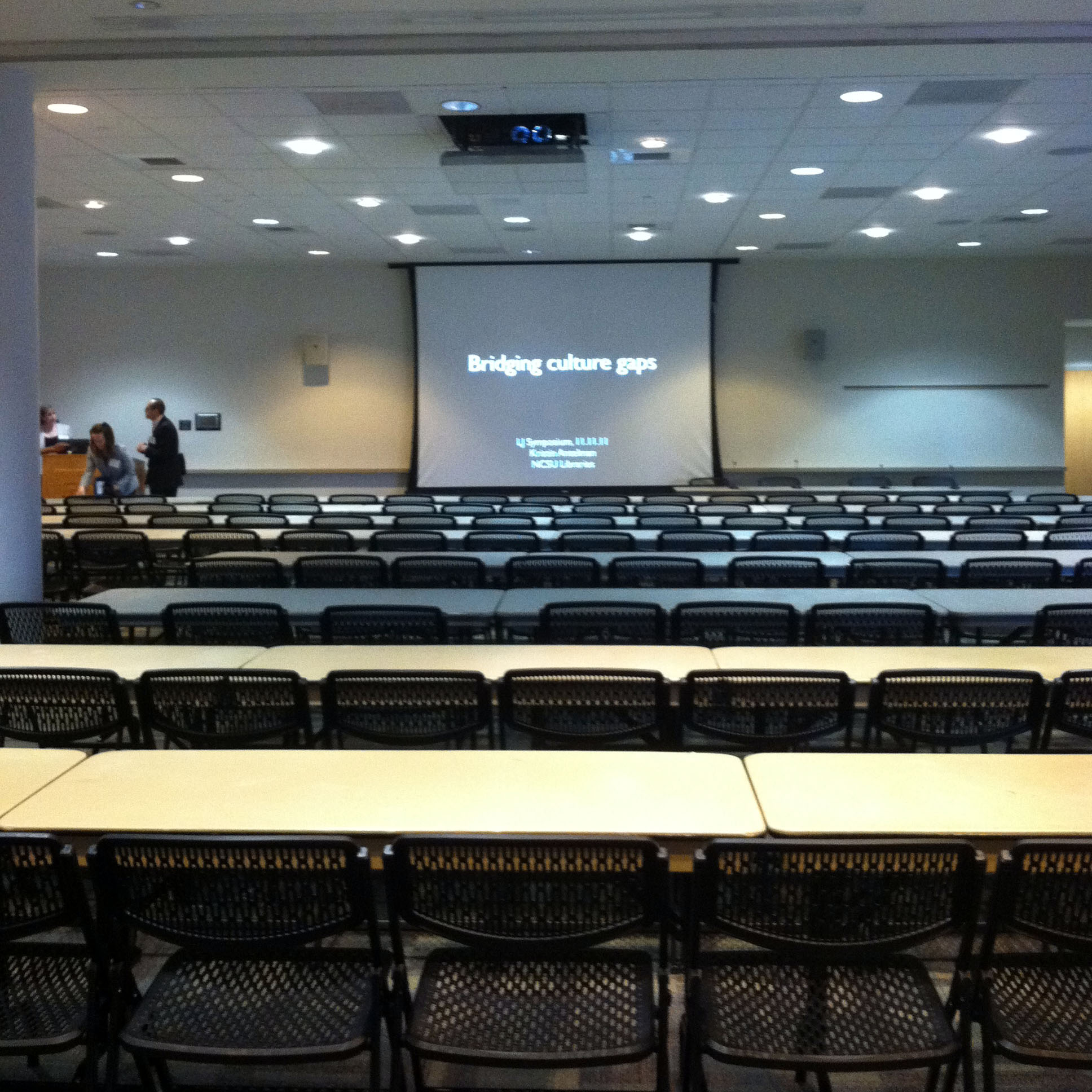
Last Friday I participated in a panel discussion during the LJ/Temple Academic Library Symposium in Philadelphia. I really enjoyed the smaller, more intimate setting of this one day conference. The organizers did a great job of inviting a wide variety of front lines, new, and more experienced librarians and administrators to reflect on some really tough issues within the field.
I took some notes during Kristin Antelman’s keynote address on bridging culture gaps. Antelman is the Associate Director for the Digital Library at North Carolina State University and I found her talk to be inspiring and a good framework for the rest of the event:
- Gap: Everybody vs IT – communication style, constrained resources, decision making process
- Gap: Everybody vs administration
- What preconceptions do we bring? Agendas & past experience. Organizational myths with meaning attached
- Where is the real power/influence within the organization? Doesn’t necessarily align with positional power
- Information & trust = keys to bridging the gaps
- Scary gap: Library as a symbol – there is a common understanding of the purpose of libraries but also stereotypes relating to librarians as “guides” through information overload. We “can’t build on sand”
- Scary gap: Library as brand – google “library” = books
- Organizational culture – competing values framework by Cameron & Quinn, adhocracy (new term for me)
- New leaders want to move from hierarchy to autocracy, that’s the biggest gap
- Organizational life is not static, could be cyclical
- Do we have a strong or weak organizational culture?
- Assess gaps and set goals. Be in perpetual beta, ask forgiveness, choose “either/or” not “both/and”
- Can there be a shared vision if there is not a shared understanding?
- Some projects never leave the gate because people want assurance up front that it will be a success (how do we change this expectation?)
- Consensus model is unwieldy, inclusiveness hinders progress
- People who aren’t contributing – how do we deal with this?
- Affinity group or team based approach instead of committees – opt into a project
To read recaps/reviews by other presenters and attendees, check out the following blog posts
- Academic Library Summit: Bridging the Gaps, by Courtney Young, Head Librarian and Associate Professor of Women’s Studies at Penn State Greater Allegheny Campus
- Getting Past Misunderstanding, by Andy Burkhardt, Emerging Technologies Librarian at Champlain College
- the future of academic libraries, by Shannon Marie Robinson, Access Services Librarian at the Philadelphia University of the Arts
or search for the Twitter hashtag #futurelib11.
What are your thoughts on bridging the different gaps we have within academic libraries? What gaps are we missing in these conversations – beyond generational, IT, diversity, experience, leadership, administration, change-agents/resistors, status, cultural, etc?
_________________________________________
Erin Dorney is the Outreach Librarian at Millersville University of Pennsylvania and outgoing Treasurer of the PaLA College & Research Division. She can be found on Twitter at libscenester and blogging at www.libraryscenester.wordpress.com.
Let’s Ban all Print Books on College Campuses
Marc Prensky, who coined the term “digital native,” an idea which has been used to label may of our current and future college students as naturally technologically savvy, wrote an inflammatory opinion article that was posted on the Chronicle of Higher Education’s website this past Sunday, Nov. 13th. In this article Prensky advocates for the immediate ban of all print books on college campuses.
“Let me be clear,” he says, “that I’m not advocating that we get rid of the good and valuable ideas, thoughts, or words in books—only that we transfer them to (and have students absorb them through) another form” which would be “transformational, in very positive ways, for education.” Some of these transformations which Prensky cites in his article are the ability of e-readers to collect commentary from professors and other sources, and to link their readers to multiple other texts.
However, perhaps more interesting than the article itself, are some of the comments people have made in response to this article, which total 60 at this point in time. Some of the comments speculate upon the nature of the piece and wonder if it is intended to be a satire or if Prensky is actually serious in making this argument. Other comments point out flaws in this so called “plan,” such as the current cost of e-readers and the fact that the copyright still constrains a lot of what society can do with electronic texts. Still others argue that e-readers and e-books would do nothing to help students learn to think more deeply and critically. There are event comments which are directly related to concerns of librarians, such as the question of who owns all this digital information. And then there is the final comment that I will leave you with,“Someone’s drunk a whole lot of industrial strength industry Kool-Aid”
I will leave it to you to decide….
What is Piazza?
Piazza is not just a beautiful gathering place in Italy; it’s a free interactive Q&A space on the Web for undergraduate students and instructors. Professors from academic institutions like UC Berkeley, MIT, Harvard, and Stanford use Piazza to collaborate, instruct, and connect with their students. The founder and CEO of Piazza, Pooja Sankar, received her graduate degree in Computer Science from the University of Maryland, College Park and has worked in high tech environs such as Oacle, Kosmix, and Facebook. Her most recent endeavor brings together a community of undergraduate students and their instructors. Students receive assistance with their assignments by asking questions, working with each other, and querying their professor. Follow-up discussions about in-class topics may occur as well.
If you are an academic librarian who teaches credit classes, this could be a great resource for you.
Check it out at http://www.piazza.com
Impressions of EDUCAUSE 2011

flickr: educausestaff http://goo.gl/Ajb1L CC-by-nd-nc
With EDUCAUSE in Philadelphia this year, I had the rare opportunity to glimpse the hot issues in higher education from an different prespective: IT. According to the website (educause.edu)…
EDUCAUSE is a nonprofit association whose mission is to advance higher education by promoting the intelligent use of information technology.
The attendees ranged from web developers and instructional technologists to CIOs and VPs of Technology. (And, yes, some librarians!) EDUCAUSE is a large conference with more than 20 sessions running concurrently in each 50 minute slot. There is not as much hands-on as one might expect; it was mostly amazing people reporting on amazing projects and state of the art talks. I found the experience to be very enlightening.
The first session I attended was “Developer’s View of Web Accessibility: Pitfalls, Gotchas, and Solutions” with a panel of Robert Crisler (Director, Internet and Interactive Media,
University of Nebraska – Lincoln), Sue Cullen (Program Manager – Universal Design Center
California State University, Northridge), John Foliot (Manager, Stanford Online Accessibility Program
Stanford University), Terrill Thompson, moderator, (Technology Accessibility Specialist,
University of Washington), and Christian Vinten-Johansen (Info Technology Mgr.,
The Pennsylvania State University). The panelists spoke about very different experiences and different approaches to the issue of access on the web. Some advocated having at least 1 developer in a web shop using a screen reader, while others felt that web developers should not be required to use a reader. One panelist pointed out that a page can be perfectly compliant and still totally unusable. Some of most memorable information concerned managing relationships between lawyers and web developers. One panelist admonished folks not to go down the path of ticking off Section 508 of the ADA requirements or you have already lost.
The next session was a riveting presentation on “The Remixed University” from Hal Abelson, Computer Science and Engineering, at MIT. With MIT’s OpenCourseWare project now 10 years old, the open education movement is coming of age with both positive and negative consequences. Students all over the world now have free access to courses from the best minds in their field – that’s the positive. The publishers, however, who have made a great deal of from the scholarly publishing crisis are now actively fighting back against openness and are starting to “open-wash” or feign openness in a traditional model. The other side of the discussion was faculty research and path from the DSpace vision to the current institutional repository (IR) model. The speaker was a strong advocate for libraries and believes that IR should be the domain of libraries.
Open Educational Resource Commons
Open Courseware Consortium
DuraSpace
In the afternoon, Anya Kamenetz, Senior Writer, at Fast Company Magazine give a talk on “DIY U: Edupunks and the Future of Higher Education” that looked at new emerging models of education. This included the recent efforts of 2 Stanford professors to open up an Artificial Intelligence class to the world (which turned out to be over 160,000 people). She mentioned the possibility of a completely distributed system of educational badges whereby a student learns something in their own time and their own pace and upon demonstrating that knowledge to a badge issuer (museum, library, etc) gets a “credit” (the badge). These badges would be collectable online for viewing by potential employers or educational institutions.
Attending “GameZombie TV: Using Game Media Production to Construct a Project-Based Learning Environment” I was not completely sure what to expect. Once I learned what the project really involved, it was amazing. The idea of GameZombie TV is to make a public internet TV show as part of a core class for the Media Arts & Game Development major. It involves video production, audio production, graphic design, journalism, production management, theatre skills and pieces of other disciplines. The students learn true-to-life skills because the award-winning site IS real and really “out there” on the web. It gives students a sense of ownership and accomplishment.
GameZombie TV
The last session was “Wikipedia and Academia, Friends at Last: Curricular Initiatives in Higher Education” featuring a panel of Richard Knipel, Regional Campus Ambassador,
Wikipedia Education Initiative, Cristian Opazo, Sr. Academic Computing Consultant and Adjunct Faculty, at Vassar College and Christopher Smart, Associate Professor of Chemistry at Vassar College. The panelists discussed examples of editing Wikipedia as a graded assignment. This was interesting as a librarian because Professor Christopher Smart started from a place of skepticism about Wikipedia and was galvanized by student outrage at questioning Wikipedia to explore it further. His students learned a great deal about concise writing for a general audience and took personal ownership of their output. The Wikipedia Educational Initiative now has hundreds of projects of this type all over the world.
List of Educational Wikipedia Projects (Vassar’s project isn’t currently listed)
I would highly recommend taking the chance to go to EDUCAUSE in the future if you have it. More than just technical how-tos, EDCAUSE features leading minds in education with new minted ideas. It is not just relevant to techie librarians, but ALL librarians.


 Adam Balcziunas
 Alex K.
 Alexandrea Glenn
 Andrea Pritt
 aprilnkelley
 Ashley Purvis
 Bethann Rea
 blj13
blj13 Brendan Johnson
 Amanda Boyer
 Bret Stiffler
 Bonnie Powers
 Christopher Lemery
 clarewithers
 clblibrarian
 Kelly Clever
 Charlotte M. Johnson
 colemanluzerne
 CRD of PaLA
 crdvirtualjournalclub
 cre5314
 csgarth
 Erin B.
 danajkerrigancv
 denisewetzel1
 Darren G. Poley
 elm43
elm43 Heather Burychka
 James D'Annibale
 Annie Jansen
 Jill Hallam-Miller
 jennifercribbs
 Jenn Monnin
 Jen Hasse
 Jessica Showalter
 johnmeier1
 Julie Durci
 Kelly Safin
 Kim Karim
 Kristen Seikaly
 Kayla Van Osten
 Cecelia Lasley
 librarianjsmith
 Linda Neyer
 mabogino1
 Matthew McNelis
 Meg Massey
 Maggie Savidakis-Dunn
 Rebecca
 miskatoniclibrarian
 Maureen Bentz
 Michele G. Anfuso
 Nicole Miyashiro
 paulmcmonigle
 Rob Sieczkiewicz
 ronlmccoll
 Sam Bardarik
 shannahollich
 smartin592
 Ula Lechtenberg