ACLCP Brings the Electricity of Lightning Talks to its Fall Conference and 50th Anniversary Celebration!
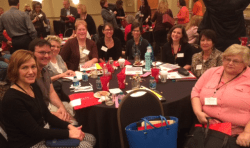
ACLCP Fall 2015 Conference organizers decided to change things up by using a lightning talks format for its 50th Anniversary and Member Showcase, featuring Access, Collaboration, Learning, Community, and Preservation held on Friday, October 23, 2105 at the Red Lion Hotel in Harrisburg.
Following the introductory remarks by current Executive Committee Chair Robin Wagner, and announcements made by Beth Evitts, Vice-Chair/Chair Elect, the energy flowed with ten 10-minute presentations given by librarians from nine member institutions: Bucknell, Elizabethtown, Juniata, HACC, the PA College of Technology, Lebanon Valley, Gettysburg, Albright, and Dickinson. A recurring theme that “struck” me during the talks was our libraries’ embrace and use of popular culture as a way to leverage, enhance, and generate enthusiam for our services. This motif complemented the larger conference theme of “Access, Collaboration, Learning, Community, and Preservation” nicely. Here’s a quick run-down of the morning:
- Stick it to the Wall: ACRL Framework Poster Collaboration by Nancy Frazier, Jill Hallam-Miller, and Benjamin Hoover of Bucknell University. Summarized how three Bucknell librarians with different areas of expertise worked together to develop student-centered versions of the ACRL Information Literacy Framework’s threshold concepts in question format and then created posters that could be shared with other institutions under a Creative Commons License and further customized.
- 1, 2, 3 Count with Me: Using iPads and LibAnalytics to Collect Space Data by Sylvia Morra and Sarah Penniman from Elizabethtown College. Explained ongoing project that involves having student workers use iPads and LibAnalytics to track usage of 29 different spaces within the library with the goal of gaining insight into how to re-purpose their instruction classroom, the McCormick Research Lab.
- Using iAuthor to Write an eBook by Corrine Syster, Jennifer Hummel, and Elise Jackson from Harrisburg Area Community College. Described an Apple grant-funded effort to develop an interactive iBook titled Libraries & Research: Getting Started (which introduces students to academic libraries and research, with an international audience in mind) and shared numerous lessons they learned during the process.
- Batgirl Unbound, or How a College Library Started a Comic Con by Tracey Amey from the PA College of Technology. Explained the origin of the Wildcat Comic Con, a more academic, learning-focused Comic Con, which was launched in 2012 and continues to expand, and recommended how to host one at your library.
- Geek and Greet at Bishop Library by Sara Green and Maureen Bentz of Lebanon Valley College. Reviewed their spin-off event “Geek and Greet” (based on “Geek the Library”) as a way of bringing in new library users and promoting lifelong learning. During the event, each library staff member (and even some non-library staff) got to “geek” a subject with a display, talks, special activities, etc.
- What’s New in Preservation at Musselman Library by Carolyn Sautter and Mary Wootton of Gettysburg College. Presented on involving their Special Collections student workers in both preservation of physical materials as well as editing MARC records, for a binding description project dealing with books having specialized bindings.
- Bigfoot in the Library: Engaging Elementary School Students in an Academic Library by Heidi Ziemer from Albright College. Described Albright Library’s adaptation of an event/activity written about by Knott & Stabo (2013) in which elementary school students were brought into a college library to investigate and evaluate information on Bigfoot and how this was an effective and appreciated community-building activity between Albright College and Reading Public Schools.
- Marketing Solutions for E-Content shared by Samantha Bise, Jessica Howard, Samantha McCulloch, and Maureen O’Brien Dermott from Dickinson College. Detailed their plan of identifying specific e-resources to promote as well as their marketing campaign which involved branded digital signs strategically placed in the library plus other strategies for building awareness and use.
- LGBTQ & You: Connecting Collections with the Campus Community by Mallory Jallas and Amy Ward of Gettysburg College. Described effort to build stronger relationship with the Allies Club on campus that came about as a result of ideas generated by a graduating student worker to promote and build the library’s LGBTQ collection; the project coming to fruition as a result of the engagement of multiple librarians, the Library Director, the Dean, other offices on campus, etc.
The morning went by in a “flash” and conference participants headed to lunch, where member libraries introduced their first-time ACLCP attendees and announced staff changes. Special Interest Group meetings followed, their agendas determined by their respective chairs. I attended the Reference & Instruction SIG meeting, which did not have a preset agenda, so the conversation flowed around what different campuses were doing in information literacy instruction, assessment, chat reference services, and more.
At the close of the SIG meetings, conference attendees funneled back to the main meeting room where a three-tiered, elaborately decorated 50th Anniversary Cake was being cut and distributed. It was a sweet and dramatic end to a worthwhile day of sharing and connecting. (And the hyper-pigmented, electric blue icing on some of the cake slices resulted in a few unexpectedly humorous farewells for the day.)
At my school, we provide our students with 3 different delivery methods: traditional day classes, evening classes, and online classes. At the library, we are lucky to have both the ability and the invitation from faculty to deliver instruction to all 3 types of classes. When I was preparing to write this post, I remembered the recent survey regarding faculty and librarian views on their interactions with each other (http://lj.libraryjournal.com/2015/09/academic-libraries/closing-gap-librarian-faculty-views-research/). While some of our faculty, as at many institutions, might not communicate with us as well as we would prefer–when it comes to information literacy instruction, we have several with whom we’ve been able to work closely in developing both one-shot and multiple-session instruction opportunities.
I have had the enjoyable task of working with one of our online-only faculty to bring business-related research instruction to his classes. This professor, who I’ll call Dr G., believes very strongly in the importance of the library and its resources for student success, so we have been doing hour-long (approximately) sessions that cover reminders about citation and plagiarism with more in-depth coverage of our main business database and other related sources (depending on the course focus). What makes these sessions even more valuable is that, because we have access to teleconferencing software, we are able to offer these sessions live. I set up and run the meeting room, which allows us to start with a PowerPoint presentation but also switch back and forth to screen-sharing so I can demonstrate databases and other online resources. The Chat feature enables the students who attend the live session to not only respond to our questions but also use the opportunity to ask questions of their own. Since the professor and I lead the session together, they ask questions about their course content and about using library and other information resources.
Since these are online classes, we understand that not everyone is able to attend the live session as scheduled. The software allows us to record the meeting in all its details, so the students can see and hear everything that happened. Dr. G. has a great way of making sure that most (if not all) of the students actually watch the session who did not attend: he asks 5 questions spaced throughout the session, providing the answers at the same time. These are not course-related questions, though–they’re somewhat silly, personal questions about him that students are not able to guess or find by Googling. (Example: what was his first non-elementary-school role in a theater production?)
The turnouts for these sessions are, of course, less than we would prefer, but there is no way we could schedule the sessions when all the students would be available. We just had our 3 sessions for this quarter, and 1 session had no students attend. Dr. G. and I still ran through the session, recording it, since all the students are required to watch it (although it went a little more quickly with no student questions). The third session this quarter had the best turnout I remember–9 of the 25 were there from the beginning, with a 10th student logging in late.
For the students that do manage to attend, we have always had positive feedback about the relevance of the sessions. I know there have been several students who have taken more than one class with this professor–and have still come to subsequent live sessions rather than simply watch the recording. (Sure, they may feel obligated to attend if possible, but we like to hope they appreciate the additional time with us and the resources and the chance to ask questions. It probably doesn’t hurt that Dr. G. started as a musical theatre major so he is rather entertaining.)
In addition to the normal “thank you” and “this was helpful/useful” comments, almost every session a student remarks that “I wish I had gotten this information earlier.” I consider that my challenge to continue to reach out to the other faculty members who teach online classes–but who do not utilize the librarian services…yet.
*Part of the title for this post is a modification of what Dr. G. has started to say in the sessions…bringing the library into their living rooms
“Students are not to shovel sugar into their cups”
For the past several years, the Special Collections department at the McNairy Library and Learning Forum has been digitizing the faculty meeting minutes of the Pennsylvania State Normal School of the Second District (the earlist manifestation of the Millersville University of Pennsylvania).
The project encompasses the faculty minutes from 1871 to the 1950s.
Recently, the first volume was published online in the Keystone Library Network digital collection: http://digital.klnpa.org/cdm/compoundobject/collection/mvsminutes/id/295/rec/1. [When you navigate to that site, please note that the collection provides a transcription for each page. To access the transcription, the user can either click on the “Text” tab or choose the “View Image & Text” button.]
Covering the years from 1871 to 1878, the minutes provide a snapshot of the concerns and issues related to an early co-educational school. Recurring topics include individualized reports on student progress, regulations, absences, health, the deportment of students, table manners, and the interaction between the sexes (which is strictly regulated).
Below you will find extracts from the minutes of 1871-78. I chose the following passages in order to illustrate not only the mores and concerns of the faculty at that time but also to illustrate the expressive language employed by the participants.
Jan. 10, 1873
Mr. Book sent out of the building for dancing in his room.
Apr. 17, 1873
See that pupils when explaining a prob. on the board assume a graceful posture and that the pointer be held in the hand next the board.
Apr. 27, 1873
Quite a lengthy discussion was entered into on the subject of pronunciation. It was agreed that the German pupils should be corrected.
Jan. 16, 1874
[Suggestion for teachers] To avoid giving too much matter outside of the text-book; the teacher should crystallize his thoughts, put them upon the board, and require their pupils to copy them.
Feb. 26, 1874
Mr. Read expelled for the reason that he accompanied Miss Mattie Barkley to Lancaster after being told not to.
November 27, 1874
It was agreed that the fol. Dining room regulations should be announced:
1. Sections. These shall consist of eight persons except at the head of the table where the no. shall be 9. Pies shall be dis. among the no. 6.
2. Carving. The meat shall be cut in thin slices and across the grain.
3. Passing Things. Each mem of a div. shall be helped to meat before anything else is passed to them. Ladies helped first. When any dish is asked for it shall be passed directly by the person most convenient to it.
4. Bread. When the crusts of bread have not been taken off before bringing it to table, the person passing it shall remove them to the side of the bread on the plate.
Feb. 26, 1875
No spitting on the floor to be allowed.
Apr. 12, 1875
No whispering by teachers or pupils from the time the first signal bell rings until all the pupils are out of the dining room.
Apr. 22, 1875
The chair suggested that the teachers assist him in creating a sentiment against defacing the prop. of the school.
June 3, 1875
[T]eachers having charge of halls should make it a point to visit all their pupils who may need their cheering presence.
June 10, 1875
The pres further remarked that he had ascertained that Misses M. Ball and Updike and Messrs Hayemen and Lark had been having secret meetings at various hours during the day and evening.
Pun[ishment]. The two gentlemen and Miss Updike expelled and Miss Ball on account of her confession recommended to leave school not to return again.
October 28, 1875
The green grocers not permitted to leave the yard after tea without permission.
Feb. 4, 1876
New Regulations. Students are not to shovel sugar into their cups nor use more than 4 teaspoonfuls. Molasses mugs to be kept in saucers when not in use.
Mar. 17, 1876
Miss Hartman stated that some days ago she found Mr. Kauffman and Miss Brice locked in Mrs. Clark’s room…The secretary read a pledge signed by Mr. Kauffman and Miss Brice which was, to effect that if they again violated any of the important regulations of the institution they would be expelled…After some remarks by several mems of the faculty Mr. Westlake moved that Mr. Kauffman and Miss Brice be expelled. The motion was seconded put and unanimously carried…
June 21, 1877
A letter from Mrs. Becca Kaffman [aka, Miss Brice, having since married Mr. Kauffman] was read by the pres. She states that she is trying for a position in the West and…she also asks the pres. to write her a recommendation in which he is not to speak of her repeated and grave violations of the regulations of the institution. The pres. said he would assist her as much as he could without making any sacrifices of principles.
Apr. 27, 1876
No jumping to be done in the front yard.
September 21, 1876
That [the teachers] should take occasion now and then to speak words of kindness and encouragement to the soldiers orphans under our charge and thus make them feel happy and contented.
December 7, 1876
The chair suggested that when the teachers are absent from their classes that they leave them in charge of some competent person…Pupils should clean the boards by moving the erasers downwards.
Jan. 4, 1877
Orphan girls are not to have any more stationary unless they pay cash for it.
Mar. 21, 1877
Students not to get up until 4 o’clock AM.
No jumping in the front yard.
Apr. 26, 1877
Mr. Behimer remarked that some of the students play croquette in Locust Groves. They must discontinue.
May 17, 1877
No carrying of water during study hours.
May 31, 1877
Some of the gentlemen at the lower tables take the ice off of the butter and put it in their water.
October 18, 187[7]
Holiday to gather chestnuts to be restricted to the senior class. Ladies not to go out after tea without special permission. Clock to be turned back ten minutes so as to be with railroad time.
By now we’ve all heard some notion of 508 compliance, accessibility in education or universal design as a key focus for growth or strategic planning—as the percentage of students with disabilities matriculating for college/university study is outpacing non-disabled growth since 2012. Add to that the ubiquity of technology-enabled distance education across the non-profit/for-profit spectrum and the wide advertising net cast to attract non-traditional learners, and you are faced with a sizeable and increasing population for whom accessibility will be critical to success. If you are reading this, then your chosen career path brings you to the frontline of this need and casts you in the role of guide and advocate.
To that end, and to add to the solutions spoken to by organizations such as Educause, U.S. Department of Education’s Office for Civil Rights, Thinkcollege, AHEAD, LearningAlly, or Closing-the-Gap (to highlight a very few), I thought I would share a few helpful resources and best practices from my own experience. While you may not be able to remodel the building to meet universal design tenants or refurbish your entire technology array, there are attainable resources for areas you can affect:
- MS Office Accessibility Suite – Probably a familiar solution, this collection of basic Assistive Technology tools (screen-to-text narrator, monitor zoom level, speech-to-text recognition agent, and on-screen keyboard) affords you a host of tools which will cover the large portion of what your special needs students will require. The best part…you already have it installed on any non-Mac at your disposal. Check the Accessories>>Accessibility or Ease of Access Center located from any Windows system’s Start menu.
NOTE: This is a BASIC collection of tools—much better alternatives exist in each category. For those with a budget I would recommend visiting freedomScientific.com and www.kurzweiledu.com to explore some of the more polished commercially available options. - Assistive Technology Lending Centers – Most states have a centrally located, nationally funded program where Assistive Technologies are able to be loaned for free to non-profit organizations and residents—the way you would check out a book. I know that I have gone to PATL many times in the past for my Pennsylvania area patrons. Find your local and FREE AT lending center by using RESNA’s State Program list.
- Techmatrix.org – This site, funded through the National Center for Technology Innovation (NCTI), offers students and educators a chance to research and compare a growing library of available Assistive Technologies. This site allows you to evaluate and spend wisely.
- Understood.org – A big part of your role in this situation is as an advocate. This site will help you, the student and their parent/caregiver navigate the tricky world of funding, universal design considerations, AT evaluation and more. Few sites do a better job of reducing the noise and helping you get results.
Finally, and this one gets a paragraph instead of a bullet as it is more important than any listed above, Your Institution’s Office of Special Needs. It goes without saying that the best resource you have available to you are the peers and professionals in your own organization whose education and training is centered on best-serving this growing student population. Yet I have found that there is infrequently a dialogue between those who shape these programs and those of us in information services who are readily working to make them work. In addition, half of the battle in properly serving this population stems from creating an atmosphere where special needs students feel understood and supported without being made to feel additionally “special”. This means that care should be taken when deciding where to locate specialized technologies…do we fill a PC at the edge of the lab with all of the tools—relegating the user to separation—or are we making sure that they are having the same enabled and fulfilling experience as other students? Similarly, how we personally work with these students is critical toward supporting their sense of experimentation with the tools we present. We should be sure our confidence with the resources at hand, physical posture, language choice and overall demeanor is one not influenced by whether a student is in a chair with legs or with wheels. Your institution’s special needs office is full of professionals who can help YOU best support this student population.
The need to serve this population is growing, and with a little bit of exploration and inspiration we can make a significant difference as service providers who shape the conceptualization and delivery of these critical resources.
CRD Luncheon Recap – Maria Accardi’s “The Souls of Our Students, the Souls of Ourselves: Resisting Burnout through Radical Self-Care”
Maria Accardi’s “The Souls of Our Students, the Souls of Ourselves:
Resisting Burnout through Radical Self-Care”
Slides available at http://bit.ly/1RybIuu
Text of Accardi’s speech available at http://bit.ly/1X3sZj8
Recap by Melissa Correll, Instructional Services Librarian, Lycoming College, Williamsport, PA
On Tuesday, October 6, 2015, Maria Accardi, Coordinator of Instruction and Reference at Indiana University Southeast, gave the keynote address at the College & Research Division luncheon during the Pennsylvania Library Association’s Annual Conference. Her presentation, “The Souls of Our Students, the Souls of Ourselves: Resisting Burnout through Radical Self-Care,” addressed an issue that affects many librarians: burnout.
Often, librarians don’t want to talk about burnout. We may be ashamed to admit we have feelings of frustration and fatigue. Accustomed to accommodating faculty and students alike, we may have lost our ability to recognize our feelings along the way. We may even be afraid that any harboring kind of negative feelings might mean that we are bad librarians. These feelings are real, however, and Accardi is working to bring burnout, and its prevention and remedies, into the light.
While Maria Accardi was planning library instruction for a First-Year Seminar, the faculty member with whom she was trying to collaborate wrote to her in an email, “I don’t think of this as teaching this class for me – I consider it providing a service for the FYS students.” The professor signed her name, writing Ph.D. after it, and Accardi felt slighted, as if the faculty member were ‘putting her in her place.’ While this is certainly not the way the majority of teaching faculty treat reference and instruction librarians, it is probably safe to claim that we have all experienced a similar slighting. Being treated like a service provider, rather than an educator, can lead to feelings of burnout. Accardi experienced this firsthand.
When she began to feel exhausted in her career and to question her decision to enter librarianship, Maria Accardi used her sabbatical to do something very librarianish: she started to research burnout. She found that workers in social and human services, fields which demand a lot of emotional labor or have a highly affective component, suffer burnout often. Affect is central to librarians’ work. Reference and instruction librarians, for example, must always be approachable. We must use open body language, make initial eye contact, and set the tone for the reference interaction. Essentially, we have to be “on” at all times, which can be emotionally taxing. Yet, these emotional skills are not part of the library school curriculum, and, in fact, are rarely acknowledged.
Take this emotional drain, add the intellectually intensive work of the profession, and stir in all the extra demands of academic life (like committee work, faculty meetings, and the demands of tenure and promotion), and you have a recipe for burnout. If these factors combine in a demoralizing institutional climate, in which librarians’ work is not valued, or faculty do not see librarians as equal partners in the educational mission, burnout is even more likely. The institutional climate is what triggered Accardi’s experience with burnout; she was “tired of explaining what we do, why we do it, and why it matters.”
Librarians often feel frustrated by the continual need to demonstrate that we are doing our jobs well, and deserve to keep them. So how can we combat these feelings of burnout? Accardi recommended taking a holistic view, reminding ourselves that we are whole people, and that our identities do not necessarily hinge on our careers. This is where the radical self-care comes in.
The word “radical” comes from the Latin “radix,” meaning “root;” radical self-care means taking care of our roots. To illustrate the concept, Accardi drew a metaphor comparing librarianship to her garden, which was planted too compactly, stunting the growth of some of the plants. Something similar to this failure to flourish happens to librarians when we take on too much; if we do not allow ourselves the time and space we need to develop personally, we wither. Accardi reminded us that it is okay, even necessary, to say “no” sometimes so that we can care for ourselves.
Extending the metaphor, Accardi noted that the quality of the soil is important to the health of the plants. Librarians want to know that they are valued contributors to the garden of teaching and learning. In her research, Accardi found that a positive institutional climate can be the most influential factor in reducing burnout. Institutions can cultivate a positive climate by recognizing employees’ full humanity, and making policies that support work/life balance. Participatory management styles can also help employees feel empowered. Accardi suggested that institutions show their dedication to their public-facing librarians with strong, visible financial and political support.
Individual strategies may also help librarians to cope with burnout. Knowing our limitations, and saying “no” to responsibilities that are not productive or are a time-drain is a start. Taking restorative downtime to focus on a favorite hobby can also help. Librarians can also use their teaching philosophy as a form of self-care; Accardi suggested that seeing the student as a whole person, and teaching to that whole person, is a way to reaffirm the librarian’s humanity. Additionally, she recommended that we view ourselves as active educational collaborators rather than service providers.
If we forget to take care of ourselves, we run the risk of burning out our passion for the profession; we can’t care for our students if we can’t care for ourselves. It is important to recognize and acknowledge feelings of burnout so that we can take steps to remedy the problems.


 Adam Balcziunas
 Alex K.
 Alexandrea Glenn
 Andrea Pritt
 aprilnkelley
 Ashley Purvis
 Bethann Rea
 blj13
blj13 Brendan Johnson
 Amanda Boyer
 Bret Stiffler
 Bonnie Powers
 Christopher Lemery
 clarewithers
 clblibrarian
 Kelly Clever
 Charlotte M. Johnson
 colemanluzerne
 CRD of PaLA
 crdvirtualjournalclub
 cre5314
 csgarth
 Erin B.
 danajkerrigancv
 denisewetzel1
 Darren G. Poley
 elm43
elm43 Heather Burychka
 James D'Annibale
 Annie Jansen
 Jill Hallam-Miller
 jennifercribbs
 Jenn Monnin
 Jen Hasse
 Jessica Showalter
 johnmeier1
 Julie Durci
 Kelly Safin
 Kim Karim
 Kristen Seikaly
 Kayla Van Osten
 Cecelia Lasley
 librarianjsmith
 Linda Neyer
 mabogino1
 Matthew McNelis
 Meg Massey
 Maggie Savidakis-Dunn
 Rebecca
 miskatoniclibrarian
 Maureen Bentz
 Michele G. Anfuso
 Nicole Miyashiro
 paulmcmonigle
 Rob Sieczkiewicz
 ronlmccoll
 Sam Bardarik
 shannahollich
 smartin592
 Ula Lechtenberg