CRD 2015: A recap
In 2015, the CRD maintained a strong presence in the academic library community and provided numerous professional development and networking opportunities for PA librarians. In case you missed out, here is a brief summary of the CRD’s involvement in 2015:
PaLRaP – The CRD’s open access journal, Pennsylvania Libraries Research and Practice (PaLRaP) had two issues published, one in spring and one in fall. All issues of the journal can be viewed on the Archives page of palrap.org.
Connect & Communicate – The CRD’s free webinar series, Connect & Communicate, hosted six virtual sessions covering a variety of topics including library security, the ACRL framework for information literacy, interactive technology tools, and using elevator speeches and PA Forward for academic libraries.
LSTA funds – The CRD used LSTA funds to support several programs including regional meetings, PaLA chapter workshops, and PA Forward initiatives. For more information, visit the LSTA page.
CRD Spring Workshop – The annual CRD Spring Workshop entitled, “The Times They Are A-Changin’…Again: Exploring the New Roles of Libraries in Higher Education,” was held on May 29, 2015 at Milllersville University. Speakers included Melissa Bowles-Terry (University of Nevada Las Vegas), Nancy Kranich and Megan Lotts (Rutgers University), and a panel of PA librarians. Approximately 70 people attended. See the blog recap for a full summary or view the Past Events page to view the original workshop flyer.
PALS Sponsorship – The CRD sponsored two early-career librarians, Melissa Correll (Lycoming) and Elizabeth Kavanaugh (Misericordia) to attend the PA Academy of Leadership Studies (PALS) workshop held annually in June. Melissa and Elizabeth were also welcomed as members-at-large to the 2016 CRD Board.
PaLA Annual Conference and CRD luncheon – At the PaLA Annual Conference, the CRD hosted its annual luncheon with Maria Accardi (Indiana University Southeast) as the featured keynote speaker. Maria spoke about library instruction burnout, which is the focus of her own personal blog, librarianburnout.com. For a summary of her presentation, visit our blog recap or see Accardi’s own blog post at bit.ly/1X3sZj8. In addition, the CRD sponsored ten regular conference sessions.
CRD blog contributors – In 2015, the CRD formed a new blog team of PA academic librarians with a variety of backgrounds and interests (view the full list of contributors on the About page). Our bloggers play a large role in keeping the PaLA community up-to-date on current trends in technology, instruction, management, and outreach in academic libraries. The CRD will be looking for several new bloggers in 2016, so if you’re interested in contributing, stay tuned at crdpala.org for announcements!
Division membership – As of 2016, there are 238 registered members of the CRD, thirty-eight of which are new personal regular members.
For more information on all of the CRD’s initiatives, visit the Get Involved page and subscribe to crdpala.org for all of the latest news and commentary from the PA academic library community. We look forward to meeting new members and providing even more opportunities for involvement in 2016!
Connect & Communicate Event: Tech Tools for Interaction

Join CRD’s Connect & Communicate Series for a Presentation by Liz Johns, Johns Hopkins University
“Tech Tools for Interaction:
Get your Students to take an Active Role in the Classroom”
Wednesday, December 9, 2015, 2:00-3:00PM Eastern
Join us for a one-hour interactive online session to chat about interactivity in the classroom. The discussion is based on the ACRL Instruction Section, Instructional Technologies Committee’s latest Tips and Trends article, “Interactive Options in Online Learning,” written by Liz Johns. Although the article discusses the tools with an eye towards an online classroom, many of the tools can be adapted for use in face-to-face classrooms as well. Attendees will have the opportunity to experience first-hand some of the tools discussed in the article, and share techniques they have effectively utilized to stimulate engagement in their own face-to-face and online learning environments. “Interactive Options in Online Learning” is freely available at bit.ly/tipsandtrendsfa15
Liz Johns is a teaching and research librarian at Johns Hopkins University in Baltimore, MD. Liz works with undergraduate and graduate students both face-to-face and online settings, synchronously and asynchronously. Liz focuses her research and practice in developing innovative uses of technology in the classroom and online to support student research and learning.
NOTE: Liz presented an online discussion, “Interactive Options in Online Learning,” for ACRL’s Instruction Section on November 17th. If you attended that session, this one will be very similar.
Register at the following link: http://goo.gl/forms/ZUoJdWYPfz
Upon submitting your registration, you will receive an email confirmation that includes details about connecting to the conference. This is the only notification you will receive. If you do not receive the confirmation email, please contact Jill Hallam-Miller at jbhm001@bucknell.edu
For this program, you will need speakers or headphones to hear the presenter. Participants are encouraged to ask questions via the chatbox; moderators will monitor the chatbox and facilitate question and response at the end of the presentation.
You can test your connection ahead of time at http://centralpenn.adobeconnect.com/common/help/en/support/meeting_test.htm
If you would like to be emailed directly about other upcoming Connect & Communicate Series events, provide us with your name and email address here: http://goo.gl/4urXl
Please continue to share your ideas for programming topics, speakers, or formats with us! If you or someone you know is doing something great in Pennsylvania’s academic libraries, tell us about it!
The Connect & Communicate Series of online programming offered by the PaLA College & Research Division aims to help foster a community of academic librarians in Pennsylvania. Please contact Jill Hallam-Miller at jbhm001@bucknell.edu or at 570-577-2055 with questions.
Librarian’s Boon or Bust? The Distance Education Conundrum
The explosion of distance education programs popping up across the traditional and for-profit education sectors has effectively pushed the reset button on how institutions are thinking about everything from curricular design to new enrollment parameters. With enrollments dropping steadily for the past few years, and statistical analysis showing a further decline looming for the future (as evidenced by demographic population data), engaging and retaining a non-traditional student population is becoming an increasingly important focus to secure the future of many institutions. But with all of the revamped ad campaigns and millions of dollars being spent on web-based educational technologies, it seems to me that efforts to ensure the academic support structures that will ultimately drive success for these students is NOT receiving the same rejuvenated approach.
Online education is a FANTASTIC opportunity for many who had thought that college level education was beyond their grasp. The flexibility of e-Learning platforms and the increasing stability of streamed and embedded media means that instructors are able to paint new vistas for these students to explore. But how do we reconcile this flexibility against the often firm margins we as librarians are asked to work within. The simple fact is that online learners don’t keep Banker’s hours…but somehow, most of us still do. So how are we to continue to play the critical guiding role for these students…many of which are completely without the competencies and academic agilities that we have previously ascribed to traditional students? The good news is that if we are able to carve a viable and replicable niche for our services within the distance learning modules, the critical role we play as a student’s tangible and accessible go-to in an otherwise digital landscape will cement the foundations of our career path and give us even more control over how information literacy and information service offerings are woven into the fabric of education.
Here are my meager suggestions toward bridging this cognitive chasm and ensuring the boon, not the bust:
- Orientation is your jam! – The first introduction many students have to the library is during tours or orientation. In many institutions, including those on my resume, the librarians were given a small portion of the program to talk about library services and offerings. While it is tempting (or even mandated) that this sort of presentation focus on how great and helpful the library services can be-in the abstract, my approach was to use this time with students to avoid this boiler-plate/elevator speech and instead think of the session as a chance to market the librarians, not the library. Use this introductory period, when they are still forming opinions about what is or is not valuable to them, to market yourself. Focus less on a guided tour of the library website and more on how the people—not the databases—are the real ally to a new student. 15 minutes devoted to demonstrating that you are as approachable as you are knowledgeable will pay off as the term progresses.
- Rage against the one-off Information Literacy session – Even in traditional classroom settings, a single Info Lit session early in the term is typically little more than an extended preview of things to come—the content of which, even with the best presenter, finds only some purchase with the students. We all know that the real Information Literacy sessions are those which happen in the lab, on the fly as a paper deadline looms. Speak to your faculty and offer a multi-session approach to Information Literacy which matches pace with the demands of the course. Having your input and evidence-based guidance as a more regular facet of a course will ease the non-traditional student mind by making clear the path to assistance—often times at hours when faculty may not be available.
- Buy Donuts for the Curricular Design Team – …or muffins…chocolates are also nice…do all that you can, through whatever channels appropriate, to garner attention to the fact that including you and your fellow librarians in course planning…even down to the way library services are positioned in the course shell…is one of the best ways to promote success for all students. You are in the trenches term after term, helping students work through assignments which have become familiar by rote, and as such are uniquely positioned to comment on how the presentation of resources can positively influence their outcomes.
- Librarian 2.0 – As our institutions and the students they serve are increasingly embracing the social and interactive Web 2.0 approach to education, we must keep pace. Non-traditional students come with non-traditional hours, and as such, so must our resource base. Many states offer virtual reference services from the state library, as do many institutions, but for those of us without such an umbrella there are a host of options for assisting that Sunday evening student query. Services such as Google+ or GoTo Meeting have a very low overhead cost and provide an accessible and dynamic platform from which to perform reference interviews through video conferencing, offer numerous tools for group exploration and highlighting of resources, provide printable logs of chats, and allow you to record the sessions in a number of formats—enabling you to start your own dynamic knowledge base which can be embedded into any given course shell. Further, starting your own blog/microblog or podcast can also serve to underscore your ability to match the evolving information services needs encountered by distance learners in a way that a Databases page off of the library website can never achieve.
As this is simply the informed opinion of one librarian, your own experience may differ—and if so I sincerely hope you will take a moment to share a note on this thread. Not only will your thoughts help paint a fuller picture, but if your experience contradicts my own I welcome the hope it will bring for all of us.
Fall issue of #PaLRaP now available online
The Fall 2015 issue of Pennsylvania Libraries: Research & Practice (PaLRaP) is now online at palrap.org. We invite you to review the Table of Contents below; then visit our web site to review articles and items of interest.
Pennsylvania Libraries: Research & Practice Vol 3, No 2 (2015)
http://palrap.org/ojs/index.php/palrap/issue/view/6
Table of Contents
——–
Editorial
——–
- Editors’ Note (89-91)
Anne Behler, Tom Reinsfelder
Interview
——–
- In the PaLRaP Spotlight: Courtney Young (92-93)
Stephanie Campbell
Practice
——–
- Access to Library Resources for Clinical/Adjunct Faculty: A License-Driven Model (94-101)
David Brennan
- Out of the Pickle: Promoting Food Science and STEM in Public Libraries (102-114)
Dawn States
- Recycling C.R.A.P.: Reframing a Popular Research Mnemonic for Library Instruction (115-121)
Robert E. LeBlanc, Barbara Quintiliano
- Connecting RDA and RDF: Linked Data for a Wide World of Connected Possibilities (122-135)
Ashleigh Faith, Michelle Chrzanowski
- Searching for an Academic Librarian Job: Techniques to Maximize Success (136-143)
Angela R. Davis
- Information Literacy in the Changing Landscape of Distance Learning: The Collaborative Design of a Flexible, Digital, Asynchronous Course (144-155)
Betsy Reichart, Christina Elvidge
- Displaying a Poster, Unifying a Campus: Undergraduate Research Day at Penn State Wilkes-Barre (156-168)
Jennie Levine Knies, Megan MacGregor
News
——–
- Noteworthy: News Briefs from PA Libraries (169-182)
Bryan James McGeary, Stephanie Campbell
Pennsylvania Libraries: Research & Practice http://www.palrap.org
Thanks for the continuing interest in our work — Tom Reinsfelder & Anne Behler, Co-Editors
==
If you would like to comment on articles and/or receive individual email announcements for new issues, please register as a user at www.palrap.org.
PaLRaP is an open access, peer reviewed publication sharing information about the research and practices at or of interest to Pennsylvania’s academic libraries. PaLRap is run by a volunteer staff of CRD members, each with two year terms in various journal management positions, and it is published by the University Library System (ULS), University of Pittsburgh, through its E-Journal Publishing Program.
Published biannually: March and October
Editors: Anne Behler, Penn State University; Tom Reinsfelder, Penn State University
Peer reviewers: Members of the Pennsylvania library community
#palrap
Vikings, Lions and Jeeps, 3D printing update
I have already rambled on here once about 3D printing in libraries. Since our first semester of living with 3D printing is almost over, I thought I’d report on some of our observations here at Penn State Wilkes-Barre.
We placed our Micro3D printer in a prominent location, and it immediately became the most talked-about piece of equipment in the library. It’s very cute, and blue, and little, and quiet. Since September, I would say we are averaging about 3 prints per week for students, and the rest of the time the library staff prints objects of use (pen holders are popular with us. I have yet to find a good design for keeping my cords untangled in my purse, however). Students have requested knick-knacks such as key chains using a Jeep logo, the Nittany Lion mascot and other animals, and props for class projects, like this Viking Longboat (more on that later).
Our system is simple. Students email us a design file and specify a color. We print it. We have had successes and failures. When we fail, we will discuss with the student and either try to find an alternate design, or, if we are so inclined, see if we can identify the flaws. In truth, a lot of the designs available for download on Thingiverse are not the most stable or well thought out. But we have been impressed with our Micro3D printer, which seems to have no problem running 8-10 hours every day.
The Micro3D does have its limitations. Early on, students wanted to print cases for their phones and the bed of the Micro3D is not large enough to accommodate most modern smart phone cases. I optimistically stated back in July that I wanted to try to build my own 3D printer. Well, time ran out on that over the summer, and an Engineering instructor took pity on us and loaned us a DIY printer that they built over the summer, the SeeMeCNC Rostock Max, v. 2.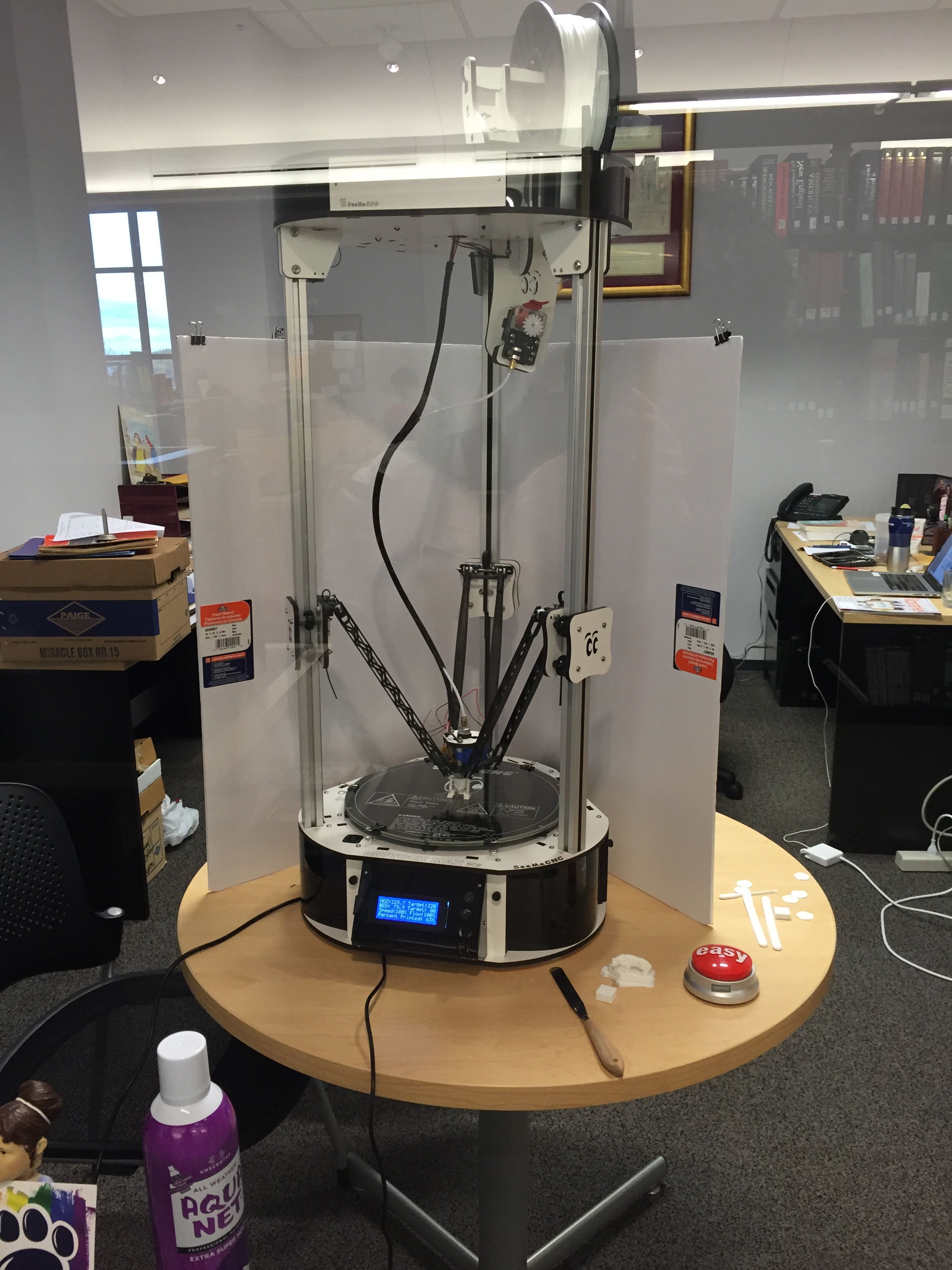
The Rostock Max is more imposing than the Micro3D, and also a great conversation starter. It is louder, and, as a result, sits on a table in front of a large window in my office. It definitely encourages students to peek their heads in and talk to me. One student provided me with detailed instructions to build a plexiglass shroud to surround the printer (I currently use poster board to try to block drafts from my vents and skylight, which I have found can have negative affects on my printing attempts).
This is not a plug and play machine. The instruction manual is 373 pages and includes numerous links to how-to videos. Lucky for me, the instructions on how to use the machine do not start until page 245 (the manual is hilarious. SeeMeCNC seems to have a good sense of humor). Our Engineering mentor encouraged me to try to download the required software (called “Matter Control”) and calibrate the machine on my own. I did not do too badly, but it is a tedious job, and requires regular monitoring. The main thing is to ensure that the extruder (i.e. the nozzle from which the plastic dispenses) is the correct height from the glass (it must be close enough that a piece of paper can move, under it, but not easily). Then it is necessary to check the height of the nozzle at three additional points on the glass. If any of those points are too high or too low, then actual screws need to be tightened or loosened with a regular Phillips-head screwdriver. Then you have to run the whole calibration test over again. It takes about 87 tries before everything is perfect, and there is a fascinating YouTube video, if you want more detail. Occasionally, the calibration just goes out of whack on its own. I blame it on the same ghosts who set off our security gates at random times when the library is empty.
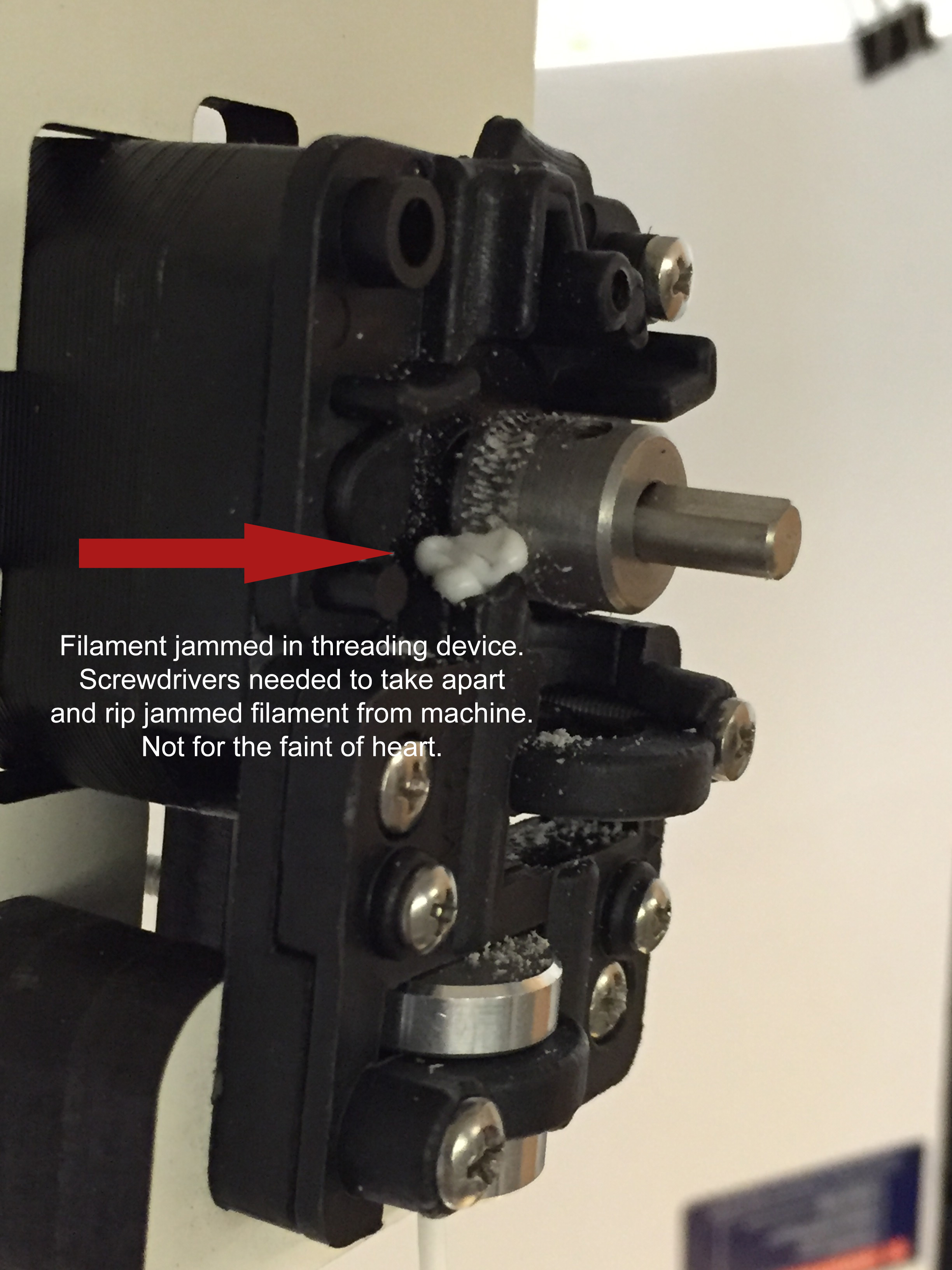 My first print, a square box, turned out well. But after that, no plastic would come out of the nozzle. Turns out, it can get jammed in there. The printer is also highly configurable. The standard plastic for 3D printers is 1.75mm in diameter. However, hard-core 3D printer users recommend measuring the plastic at five different points with calipers, and then averaging the measurement and adjusting the printing software accordingly. I am not going to do this. Ever.
I then managed to print a fancy box, designed by my colleague, to be used in a display. However, she needed four, and after the first one, we had multiple disasters that involved the design slipping on the glass and creating spaghetti-like abstract art. This was despite my liberal application of AquaNet hairspray to the glass print bed to prevent sliding. SeeMeCNC recommends a coating of Elmer’s glue, but my Engineering mentor swears by the AquaNet.
The poster-board semi-shroud around the printer seems to have solved some problems. Just like my late-great-aunt, this printer is sensitive to drafts. Before each print, the bed has to heat to 80C, and the nozzle to 220-228C. My Engineering mentor suspected that the initial plastic jam was due to hot plastic sitting too long in the nozzle, so there are apparently settings to force the printer to heat the bed first, and then the nozzle, so that as soon as the nozzle is hot, it starts to print and doesn’t sit, waiting. Remember the Viking Longboat mentioned above? A student needs that for a display case for a class project. The design is too large for the Micro3D. I successfully printed the mast, the oars, and the shields, but have not managed to print any other components yet. After three attempts, I postponed the sail until I could receive some more expert help, as the plastic kept bubbling up on the surface of the printer bed and ultimately turning into a gooey mess.
We have only been printing with ABS plastic (we have been using PLA on the Micro3D printer). PLA is supposed to be more forgiving, but in order to use the PLA, we needed to install a fan on the printer, and that only happened last week. I suspect that some of our problems could be solved by increasing the density or quality of our prints, and by printing with extensive support material. The Micro3D printer makes this simple – their software allows a user to check off boxes to include supports, and to specify density of the print from a pull-down menu. The Rostock’s Matter Control software is much more crazy complex.
I don’t know that I had a research question going into this project. I know I wanted to explore whether or not new technologies like this would engage students and interest students from all disciplines. It seems that the answer to that is yes. I also wanted to experiment with different and more complex printers. For my own professional development, using the more advanced Rostock printer has been eye-opening and valuable. I’ve learned about different plastics, and also which designs tend to work with and without supports. But I wouldn’t recommend that any library buy a DIY printer kit, build one, and attempt to incorporate it into their service model. It requires too much care, calibration, and patience.
Due to the popularity of the service, however, I will likely start to explore larger plug and play printers in order to accommodate larger designs, and try to learn more of the 3D modeling software.


 Adam Balcziunas
 Alex K.
 Alexandrea Glenn
 Andrea Pritt
 aprilnkelley
 Ashley Purvis
 Bethann Rea
 blj13
blj13 Brendan Johnson
 Amanda Boyer
 Bret Stiffler
 Bonnie Powers
 Christopher Lemery
 clarewithers
 clblibrarian
 Kelly Clever
 Charlotte M. Johnson
 colemanluzerne
 CRD of PaLA
 crdvirtualjournalclub
 cre5314
 csgarth
 Erin B.
 danajkerrigancv
 denisewetzel1
 Darren G. Poley
 elm43
elm43 Heather Burychka
 James D'Annibale
 Annie Jansen
 Jill Hallam-Miller
 jennifercribbs
 Jenn Monnin
 Jen Hasse
 Jessica Showalter
 johnmeier1
 Julie Durci
 Kelly Safin
 Kim Karim
 Kristen Seikaly
 Kayla Van Osten
 Cecelia Lasley
 librarianjsmith
 Linda Neyer
 mabogino1
 Matthew McNelis
 Meg Massey
 Maggie Savidakis-Dunn
 Rebecca
 miskatoniclibrarian
 Maureen Bentz
 Michele G. Anfuso
 Nicole Miyashiro
 paulmcmonigle
 Rob Sieczkiewicz
 ronlmccoll
 Sam Bardarik
 shannahollich
 smartin592
 Ula Lechtenberg