Marshall Breeding Talk at Lehigh University
Marshall Breeding Talk at Lehigh University
Marshall Breeding is coming to Lehigh to lead an engaging conversation about technology in libraries on Thursday, February 9, 2012 at 4:10 p.m. in the Scheler Family Humanities Forum (Linderman Library 200). Sponsored by Friends of the Lehigh Libraries. For more information, please visit Lehigh University Libraries’ Website about the event.
This event is free and open to the public.
Map to Linderman Library at Lehigh University: http://g.co/maps/uvpqd
Universal Design for Instruction in the Library
Librarians have a great deal of information to “Keep up” with and the wide world outside the discipline sometimes receives less attention despite interesting ideas with great confluence in the wonderful work librarians already do. Universal Design is one of those great ideas.
First, some notes on terminology. “Universal Design” was a movement started by Ron Mace, an architect, to recognize the real users of buildings instead of making them for that most mythical and mysterious of all races: regular people. Some folks use wheelchairs or are clumsy or have trouble reading fancy lettering. Further, designing with these real world users in mind creates a better experience for everyone. Interest in applying this idea to education grew with the success of this movement, not least the Americans with Disabilities Act.
What this idea is called in the education field, depends on who one asks. Variously, “Universal Design for Learning” (UDL, geared toward K-12), Universal Design for Instruction (UDI, geared toward higher education), Universal Design for Higher Education (UDHE) inter alia are used to describe the specific bodies of research and enumerated guiding principles stemmig from the same fundamental idea (designing for the real range of humanity makes a better education for all).
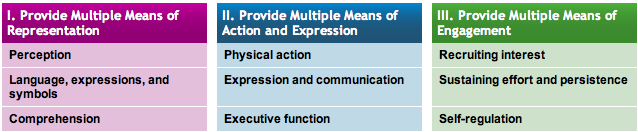
The image at the top lists the 3 Principles of Universal Design for Learning, which I personally advocate. I think these three statements capture perfectly the essence of the idea and are easy to remember. The 9 Principles of UDI are more specific and narrowly defined.
Librarians already know that different people learning differently. The UDL Principles (those pictured at the top) conflate with librarianship in the classroom, at the reference desk and in working with faculty. One of the key tenets of UDL is multiple means of engagement and one of the top ways of accomplishing this is student choice which gives a sense of ownership. In research, this can mean mentioning outlines and mind mapping as a way of taking notes. In teaching, it can mean giving students a choice between a paper, a mashup video or an online presentation, which more and more libraries are supporting. Another way to use the UDL Principles could be a kinesthetic activity for teaching website evaluation.
This is the very short list of uses. If anyone has used UDL/I Principles in their library, give the example in the comments.
For more information:
Happy New Year!
As we begin a new year, I’d like to thank the members of the 2011 Board for facilitating my job as Chair, especially Linda Neyer for stepping up when needed. It was a very busy and productive year.
On March 1, we launched this Blog/Website, It’s Academic <crdpala.org>, to which Board members have been posting regularly on topics of interest to academic librarians and our readership is growing.
For 2010-2011, CRD received a $22,000 Library Services and Technology Act (LSTA) grant in support of professional development opportunities for academic librarians in PA from the State Library, which supported the following:
1. CRD sessions at the 2010 PaLA Conference.
2. The CRD Annual Spring Workshop, “Higher Ed Assessment: How do libraries measure up?” held on Tuesday, May 17, 2011 featured Megan Oakleaf, author of the recent ACRL publication: The Value of Academic Libraries: A Comprehensive Research Review and Report.
3. Programs and workshops offered by 7 PaLA units as well as the ARCL-Delaware Valley Chapter’s fall program; the PA Information Literacy Learning Community’s first-ever face to face meeting; the Tri-State College Library Cooperative’s annual program; “Copyright, Education, and You,” a program at Muhlenberg College by Duke University Attorney and Librarian Kevin Smith; and a program featuring John D. Shank speaking about the capability of digital learning materials at Kutztown University.
CRD sponsored two academic librarians to attend the 2011 PaLA Academy of Leadership Studies–Stephanie Riley, Reference Librarian and Assistant Professor at the Gabriele Library, Immaculata College and Tara Wink, Temporary Special Collections Librarian at the F.H. Green Library, West Chester University. In collaboration with CRD, several of the academic librarians who attended PALS developed a survey to ascertain how CRD can increase its value. We are looking for input from both members and non-members of PaLA so I encourage you to please take the time to complete the survey when it is distributed later this month.
Stay tuned for another exciting year in 2012!
“Why Johnny Can’t Search”
In November Wired.com featured an article discussing the problems that students have searching for information online. To librarians, this is not much of a revalation, but this article is noteworthy because it did not appear in an publishing source primarily focused on education or librarianship.
The article discusses a study which proves that students are not searching critically or “assessing information sources on their own merit.” Instead “they’re putting too much trust in the machine.” Librarians are also particularly mentioned in the article as champions of information searching: “Librarians are our national leaders in this fight; they’re the main ones trying to teach search skills to kids today.”
This looks like another good article to circulate among faculty or post online to encourage the university to appreciate all that librarians have to offer!!!! Lets use the publicity we are given and market ourselves as the one group of people who can help solve this problem, a concern which more and more people, people located outside of the library or the world of education, are becomming aware about.
Media assignments and copyright in the library
 Copyright issues are a frequent concern with media assignments — for the librarian & professor — but not, perhaps, the student. In my informal observation, students will go to Google images directly after hearing an informational literacy session on copyright. Librarians have taken a few different approaches to dealing with these issues: information about copyright or the research process, a “scared straight” listing of the dire consequences of plagiarism and providing alternatives. Posit: providing alternatives is the best option. Here is why:
In “Facilitating Students’ Intellectual Growth in Information Literacy Teaching,” Gabrielle Wong urges librarians to be mindful of the students’ level of intellectual development. The article references the seminal work by Kurfiss in enumerating four stages of intellectual development:
Level 1: Dualism, knowledge as facts. Students believe that knowledge is a collection of discrete facts; therefore learning is simply a matter of acquiring information delivered by professors, who are viewed as the authority of right answers.
Level 2: Multiplicity, knowledge as opinion. Students realize that conflicting opinions, theories, and points of view are inevitable features of knowledge. Without understanding the reasons behind the different perspectives, they attribute them to personal opinions, all of which they treat as equal.
Level 3: Relativism, knowledge as reason. Students recognize that not all opinions are equal; points of view should be backed up by good logic and evidence. They learn the importance of evaluating an issue by weighing multiple factors.
Level 4: Commitment in relativism, knowledge as commitment. Individuals take a position and make commitments of what they choose to do or believe. They are committed to nurturing ideas and developing themselves intellectually.
Students starting out at college (those normally the most widely reached by IL programs) are in the first 2 levels. Librarians know if one asks 3 copyright experts one can expect 3 interpretations of the fair use defense. Copyright is a very complex issue and the final “knowledge as commitment” decisions on copyright at an institution is an interplay of risk and reward analysis, interpretation of the law, knowledge of case law, risk adversity, and institutional culture.
In deciding whether to use a copyrighted image in a YouTube video, for example, as student may consider the following:
- If I get sued for infringement is a fair use argument a viable strategy for defending my actions? Which begs the question…
- Is it worth it for me to go to court over this assignment considering the cost and likelihood of success? All of which is obviated by…
- Do I have the knowledge of DMCA take down procedures to understand that it is a “guilty until proven innocent” system whereby the owners have the right to demand take down until I prove a fair use exception in a process that will likely extend far beyond the due date of my assignment?
Further complicating the decision is “fair use guidelines” or “checklists,” which differ depending on the source and are not enshrined in law, but instead derived from case law.
This all speaks against the usefulness of giving students who recognize facts or equally valid opinions as the foundations of knowledge: they simply do not possess the intellectual development to make sense and decide copyright use-cases for themselves.
The “scared straight” option, on the other hand, runs contrary to the students’ experiential knowledge and perceptual inclinations. The data on plagiarism are a notoriously difficult set to pin down, but studies show that some students plagiarize on a regular basis and consequences are not always forthcoming. The numbers range widely as do the methodologies and a quick search in ERIC will highlight the controversies and difficulties. Considering all this, however, it is fair to say that some significant percentage of students have ambivalent perceptions about plagiarism and copyright violations online.
In sum, present materials licensed for educations as an “alternative” option without making much mention of copyright laws, rights, issues, or cases. Framing Creative Commons to students as, “Wow, the artists want you to use this to do creative projects and all they ask for is a little credit” works to change the student’s perception more than enumerating the academic policies on plagiarism or trying in 50 minutes or less to wade into the morass of copyright law before students are ready.
Kurfiss, Joanna G. Critical Thinking: Theory, Research, Practices, and Possibilities. ASHE-ERIC Higher Education Report No. 2, (Washington, D.C.: The George Washington University, Graduate School of Education and Human Development, 1988)
Wong, G. W. (2010). Facilitating Students’ Intellectual Growth in Information Literacy Teaching. Reference & User Services Quarterly, 50(2), 114-118.


 Adam Balcziunas
 Alex K.
 Alexandrea Glenn
 Andrea Pritt
 aprilnkelley
 Ashley Purvis
 Bethann Rea
 blj13
blj13 Brendan Johnson
 Amanda Boyer
 Bret Stiffler
 Bonnie Powers
 Christopher Lemery
 clarewithers
 clblibrarian
 Kelly Clever
 Charlotte M. Johnson
 colemanluzerne
 CRD of PaLA
 crdvirtualjournalclub
 cre5314
 csgarth
 Erin B.
 danajkerrigancv
 denisewetzel1
 Darren G. Poley
 elm43
elm43 Heather Burychka
 James D'Annibale
 Annie Jansen
 Jill Hallam-Miller
 jennifercribbs
 Jenn Monnin
 Jen Hasse
 Jessica Showalter
 johnmeier1
 Julie Durci
 Kelly Safin
 Kim Karim
 Kristen Seikaly
 Kayla Van Osten
 Cecelia Lasley
 librarianjsmith
 Linda Neyer
 mabogino1
 Matthew McNelis
 Meg Massey
 Maggie Savidakis-Dunn
 Rebecca
 miskatoniclibrarian
 Maureen Bentz
 Michele G. Anfuso
 Nicole Miyashiro
 paulmcmonigle
 Rob Sieczkiewicz
 ronlmccoll
 Sam Bardarik
 shannahollich
 smartin592
 Ula Lechtenberg