CRD Chair releases book
The CRD Board is proud to announce that our current Chair, Christina Steffy, has just released her first book, Librarians & Stereotypes: So, Now What? which introduces a critical perspective on the history, current knowledge, and impact of stereotypes in librarianship.
Official press release:

Christina displays Librarians & Stereotypes: So, Now What?
CRD Chair Releases Book
Christina J. Steffy releases Librarians & Stereotypes: So, Now What?
Leesport, PA – Christina J. Steffy, chair of PaLA’s College & Research Division (CRD) released her first book, Librarians & Stereotypes: So, Now What?
While other books have been written on the topic of librarians and stereotypes, most stop at explaining what stereotypes exist; most also examine stereotypes solely through the lens of librarianship. Steffy’s book uses that prior body of a knowledge as a starting point to answer the question, “So, now what do we do with this information?”
Librarians & Stereotypes: So, Now What? examines librarianship through communication, gender, psychology, anthropology, and cultural studies theories to begin to get to the root of why certain librarian stereotypes exist today and whether or not it’s possible to change some of these stereotypes. It also looks at what stereotypes librarians think exist about the field today, how librarians present themselves and whether or not this is changing (and consequently helping or hurting, the profession), and what public perceptions exist about librarianship as opposed to just what the media tells us about librarianship. An overview of stereotypes presented in the literature is provided, however the point of this book is to go beyond simply rehashing what stereotypes are there and to look at how we can use knowledge of the current stereotypes and knowledge from other disciplines to change some of these stereotypes. The book also looks at the possible impossibility of changing certain stereotypes, and possible repercussions our actions, or lack thereof, with regard to stereotypes may have on the future of the profession. Finally, tips are offered to help librarians begin to combat stereotypes.
The book is available on Amazon and Barnes and Noble’s websites.
In addition to writing this book, Steffy is the current CRD chair. She has been a CRD member since 2012 and has held various board positions. She was also a member of the editorial team for CRD’s peer reviewed, open access journal Pennsylvania Libraries: Research & Practice (PaLRaP).
Steffy is the manager of library support services at Pennsylvania College of Health Sciences, Lancaster, PA. She is also a freelance writer. Steffy graduated from Rutgers, the State University of New Jersey, with a Master of Library and Information Science in 2011. She also earned a B.A. English/Professional Writing in 2009 and a B.A. Speech Communications in 2006 from Kutztown University of Pennsylvania.
For more information about Steffy and her book, you can contact her directly at cjsteffy@gmail.com or email david@cravepress.com.
Inspiration:
Christina’s inspiration for the book stems from her academic interests as well as her own experiences in librarianship. “Once I became a librarian, I was really confronted with how stereotypes damage our image,” says Steffy. “Stereotypes make people think libraries don’t need funding because they are a dying business that only works with print. The idea that stereotypes could be that damaging was shocking,” she adds. Christina’s curiosity about stereotypes eventually led to more intensive research; however, she knew that she had to go beyond the simple concept of librarian stereotypes. That had already been done. “There wasn’t much out there that did anything with the information about stereotypes,” she says. Instead, Christina used her interests in communication, women’s history, and language to take the conversation one step further, exploring issues such as why stereotypes exist, whether or not we can (or should) change them, and their impact on librarians and the profession. “I started researching and thinking about this [topic], and I realized this would pull together everything in my academic and professional background,” she explains.
Librarians & Stereotypes: So, Now What? can be found on Amazon or Barnes & Noble’s website.
ISBN: 978-0-9852599-6-9
Price: $19.95
Lost in the Weeds
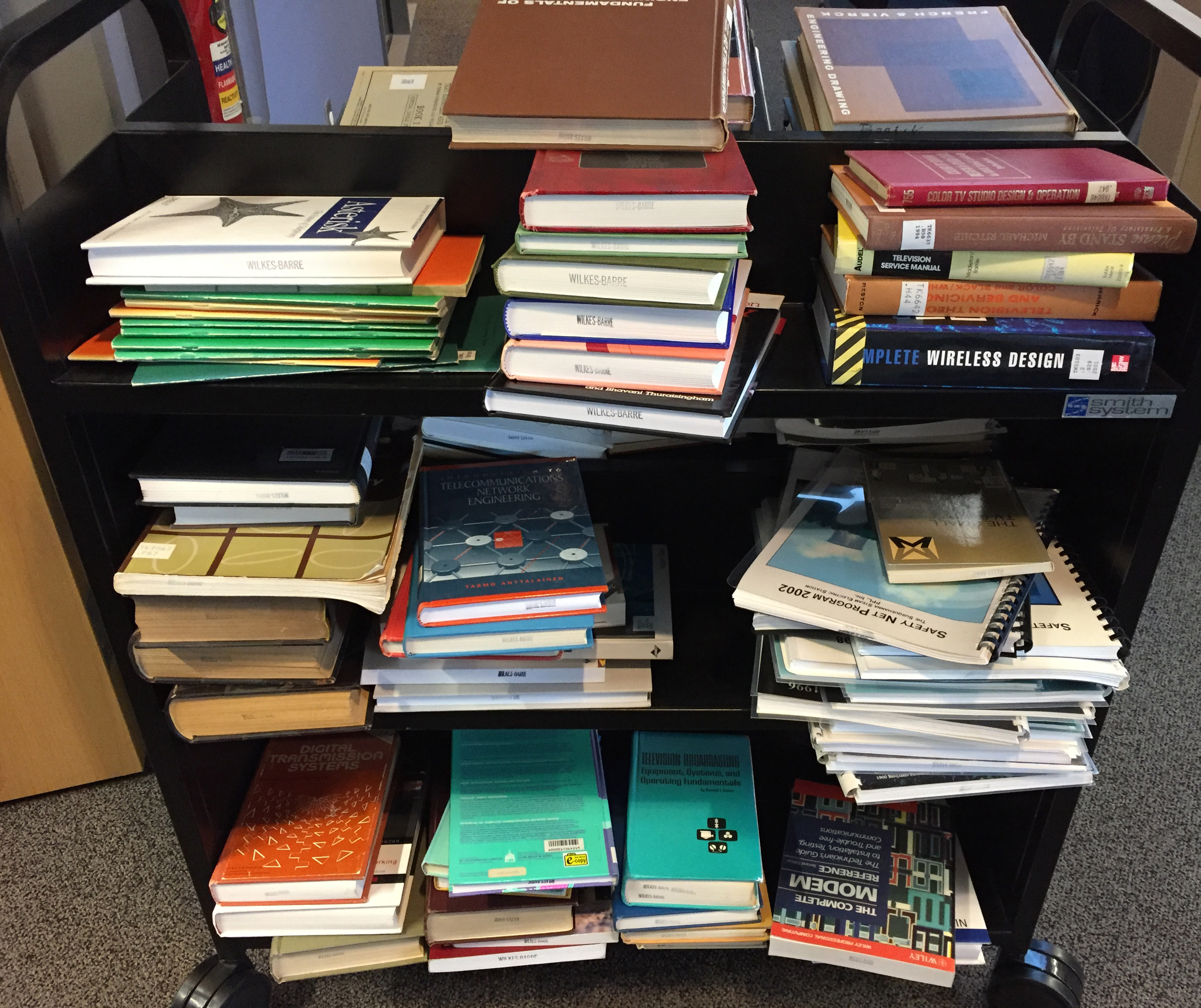
Books selected for appraisal by a faculty member
My library’s on-site collection is approximately 30,000 volumes. Spread out across one large floor, our ranges do not look like a large library. However, as we constantly remind our students, we are but one small part of the 5-million-volume Penn State University Libraries system. We can have most books in their hands in 48 hours, and that seems to be good enough for most of our community.
From what others have told me, past librarians have periodically weeded portions of the collection, but low staffing levels and other priorities meant that this did not happen very often. A goal I set for myself in 2016 was to weed 10% of the collection. Why 10%? I did do some background reading, and kept coming across the 5%/year number. Since this has not been happening in my collection, I thought 10% might make me feel more caught up. (My favorite piece of weeding literature has been this 2008 manual created by Jeanette Larson for the Texas State Library and Archives Commission: CREW: A Weeding Manual for Libraries). I also have some intentions to remove some shelving this summer, and need to make sure that everything will fit and have room to grow.
Most people are surprised to hear that throwing things away was perhaps a motivating factor in me becoming a librarian. My first library job as an undergraduate involved assisting the state documents librarian appraise an aging and extensive document collection and there was a certain thrill to me in generating new, empty shelf space for current publications. In my years as an archivist, I loved the sense of accomplishment I felt when selecting the best three copies of a publication in a box and recycling the rest.
I’m oversimplifying of course. There are a lot of nuances involved in the decision to keep or discard a book in a library collection and much has been written on the topic. A large percentage of our collection is related to engineering, science, and technology, fields about which I know very little. Engaging the faculty in helping with the process enabled me to understand that Biology lab workbooks from 1967 might no longer be useful. However, engaging the faculty has only gotten me so far – they have tended to become wrapped up in their section of the library, and rather than selecting out-of-date texts for me to evaluate, they start reading everything in their path. This method has only helped me weed about 1% of the collection, approximately 300 books.
So I turned to data analysis. Penn State Libraries are fortunate to have “The Annex” – offsite shelving where books are stored to relieve congestion in the library stacks. These books are circulating, but often they are books that receive very low usage. Our library has about 3600 volumes that also have at least one copy in our Annex. This means that likely another librarian has already determined that these volumes are worth preserving, but may not be as relevant or get the usage they once did. I took this list and narrowed it to books that had not been checked out in the past fifteen years, and found that almost all of them (approximately 3,400) fit this description. So now we are embarking on a much more systematic approach, pulling the books with Annex copies, and quickly appraising them off of our shelves.
I still occasionally stroll through the stacks and try to identify books to weed. There are books that are just clearly outdated, usually in the areas of self-help, career advice, or software and Internet “how-to” books. This has also helped me understand what types of books we need to plan to refresh on a regular basis with more current versions. We have books that support no majors or course of study on our campus – we had a whole shelf of German literature (in German) that I removed (plenty of other copies in the system and I do not know when German was last offered as a language option on this campus).
But despite my love of creating shelf space, there are times when I have to chant “not an archive not an archive” to myself. When my emotions start to hamper my decisions, I know that I have weeded enough for the day. My brain fills with visions of The Day After Tomorrow (you know, that movie with Dennis Quaid where the next ice age suddenly starts). Jake Gyllenhaal and his friends are stranded in the New York Public Library and must burn the books to stay alive. What if I end up stuck in the library one day and the next ice age begins? Will we have enough books to fuel the fire? Or what if a solar flare destroys all of our electronic capabilities and we must revert to older technologies? Will I be sorry that I shipped the Television Service Manual from 1984 to the Annex? Or the Closed Circuit Television Handbook from 1969? My grandfather repaired televisions for a living – would he have been horrified to hear that I was throwing away tools of his trade? Would the Chemistry of Winemaking be a useful book to have on hand? Micros and Modems: Telecommunicating with Personal Computers? (1983). It is easy to convince myself that these will never be useful again, although I am not sure how I will feel when I get to the agricultural sections of the library.
Oddly, I found that I was not nostalgic or sentimental when weeding the library science section – our profession is growing so rapidly that in many cases, books published even ten years ago feel outdated. It’s true that in my personal collection in my office, I still occasionally refer to some classic texts from the 1980s and 1990s, but Building Better Web Sites: A How to Do It Manual for Libraries from 2003 is not one of them. Begone! WorldCat informs me that there are still over 350 libraries in the country that hold you on their shelves. You had excellent intentions and I am sure you were useful to people in your time. But it is time for a new generation of web how-to manuals to take your place.
Warning: Graphic Information Literacy
Over the past several years as a librarian, I have attempted to depict information literacy ideas in visual formats. For example, when I was the Dean of Library Services at Le Cordon Blue in Pittsburgh, PA, I used mixing bowls to identify the different areas students could find information. The largest bowl was for Google and/or the internet at large and the smallest bowl was a representation of the library catalog. Because I am a visual learner, I prefer to view concepts graphically; however, I ironically, am not a huge fan of graphic novels.
This semester I have the honor of teaching a two credit online library course. I searched for many hours looking for an awesome text that would essentially be a surrogate to the concepts that I would lecture in a face-to-face classroom. After stumbling upon a recently published text, Information Now, A Graphic Guide to Student Research, I found my answer. Not only is the entire text in graphic novel format, it thoroughly covers all of the major information literacy concepts that I would want to teach in the online course. The text eloquently displays concepts such as controlled vocabulary using everyday examples and images. For example, the authors use the idea and graphics of seat versus chair for defining subject headings and goes further into the explanation of boarder and narrower terms using this example. One image identifies Google with a spider web and touches on the idea of website ranking system via a popularity contest of prom King and Queen. Overarching ideas covered in the text include steps to finding and using the right information; how information is organized and found; understanding the hunt for information (library catalogs); journals/databases; searching the open web; evaluating sources and using information ethically. Overall, the text is a quick read, entirely engaging, and will have you laughing out loud. When was the last time you could say this about information literacy concepts? I just wish the authors would create power point presentations of some images to use in one shot information literacy sessions. The text is also at an awesome price point of less than $20. If you get a chance to pick up a copy, let me know your thoughts.
The Pennsylvania Library Association (PaLA) is seeking a dynamic Executive Director with strong organizational and interpersonal skills who can work openly and effectively with diverse groups of people, and who is comfortable working with complex policy processes and political dynamics. Successful candidates will demonstrate excellent communication skills, and effectiveness in advocating for organizational programs with government policy-makers.
Additionally, applicants must be able to present a history of skill in fiscal management and budgetary practice. Individuals should have a forward-looking mindset, direct experience in developing strategic initiatives, and experience in delivering on programmatic goals. We are seeking a person of honesty and integrity, who instills trust and can create an organizational climate that engages people, motivates them to do their best, and inspires leadership among association members.
The Executive Director is responsible for the implementation of the Association’s strategic initiatives, the administration and oversight of budgeting, planning, evaluation, management, and executing the Association programs as directed by the Board of Directors in accordance with the Bylaws and policies established by the Association.
For additional information, please consult the PaLA website for a position description and additional details on qualifications and the application process.
The deadline for applications is January 25, 2016.
Call for submissions–#PaLRaP 2016 spring issue
Pennsylvania Libraries: Research & Practice (PaLRaP) is accepting submissions for research, practice, feature and commentary articles and for news items for the Spring 2016 issue (vol. 4, no. 1).
Research, practice, feature, and commentary manuscripts are welcomed at any time; however, for full consideration for the spring issue, please submit your manuscripts by February 26, 2016.
News item submissions are also welcome at any time, too. For full consideration for the spring issue, however, please submit your news items here by March 18, 2016.
See the submission guidelines and section policies at palrap.org for more information.
PaLRaP is a peer reviewed, online, open access publication of the Pennsylvania Library Association’s College & Research Division. This journal provides an opportunity for librarians in Pennsylvania to share their knowledge and experience with practicing librarians across the Commonwealth and beyond. It includes articles from all areas of librarianship. Contributions from all types of libraries and library personnel in the Commonwealth are welcome.
If you would like to comment on articles and/or receive individual email announcements for new issues, please register as a user at www.palrap.org.
PaLRaP is an open access, peer reviewed publication sharing information about the research and practices at or of interest to Pennsylvania’s academic libraries. PaLRaP is run by a volunteer staff of CRD members, each with two year terms in various journal management positions, and it is published by the University Library System (ULS), University of Pittsburgh, through its E-Journal Publishing Program.
Published biannually: March and October
Editors: Anne Behler, Penn State University; Tom Reinsfelder, Penn State University
Peer reviewers: Members of the Pennsylvania library community


 Adam Balcziunas
 Alex K.
 Alexandrea Glenn
 Andrea Pritt
 aprilnkelley
 Ashley Purvis
 Bethann Rea
 blj13
blj13 Brendan Johnson
 Amanda Boyer
 Bret Stiffler
 Bonnie Powers
 Christopher Lemery
 clarewithers
 clblibrarian
 Kelly Clever
 Charlotte M. Johnson
 colemanluzerne
 CRD of PaLA
 crdvirtualjournalclub
 cre5314
 csgarth
 Erin B.
 danajkerrigancv
 denisewetzel1
 Darren G. Poley
 elm43
elm43 Heather Burychka
 James D'Annibale
 Annie Jansen
 Jill Hallam-Miller
 jennifercribbs
 Jenn Monnin
 Jen Hasse
 Jessica Showalter
 johnmeier1
 Julie Durci
 Kelly Safin
 Kim Karim
 Kristen Seikaly
 Kayla Van Osten
 Cecelia Lasley
 librarianjsmith
 Linda Neyer
 mabogino1
 Matthew McNelis
 Meg Massey
 Maggie Savidakis-Dunn
 Rebecca
 miskatoniclibrarian
 Maureen Bentz
 Michele G. Anfuso
 Nicole Miyashiro
 paulmcmonigle
 Rob Sieczkiewicz
 ronlmccoll
 Sam Bardarik
 shannahollich
 smartin592
 Ula Lechtenberg