Registration for Fall ACRL DVC Program is Open!
Join the Delaware Chapter of ACRL as they present their fall program on October 25th at Cedar Crest College. You can register for the program here, and information on the event is below!
Beyond Diversity Speak: Practicing Cultural Humility in your Library
October 25 @ 9:00 am – 3:30 pm
$40
This year’s program will be focused on incorporating cultural humility into equity, diversity, and inclusion professional development in academic libraries.
Sara Ahmed (2012) describes diversity initiatives as frequently being “happy talk” that institutions write into their strategic plans and mission statements to manage their image but then do not integrate into everyday practice. While some libraries make a concerted effort to provide diversity or cultural competency training opportunities, often the attention is superficial and/or uninformed. Nicole Cooke (2016) stresses the importance of cultural humility in serving diverse populations.
Cultural humility is a cousin to cultural competency, but while cultural competency means learning about other cultures, cultural humility means continuously working to uncover how we and the institutions in which we engage are complicit in underserving some and overserving others and making ourselves accountable for rectifying the disparity. To do this, librarians and libraries need tools to help them reflect on themselves and their institutions, facilitate difficult discussions, and imagine new possibilities.
Lorin Jackson, the Research and Instruction Resident Librarian from Swarthmore College and co-founder of WOC+Lib, an online community dedicated to amplifying the voices of librarians of color, will run an interactive workshop in the afternoon on cultural humility that promises to be fun, enlightening, and practical.
9:00am Coffee and Snacks
9:30am Programming Begins
10:00-11:30am Presenters
11:30am-12:30pm Lunch
12:30-12:45pm Business Meeting
12:45-2:45pm Cultural Humility Workshop
2:45-3:15pm Roundtable Discussions/Next Actions
3:15-3:30pm Closing Remarks
In correlation with this event, the organization is seeking to support the library studies of an individual that is focused on helping to create a more equitable society. A $1000 scholarship will be awarded to a student enrolled in an ALA-accredited program to help offset the cost of educational expenses. To apply, please submit your resume and a 250-500 word essay describing your interest in cultural humility in librarianship. Eligible applicants must reside in, work, or attend school in the chapter’s service area.
Deadline: Monday, October 14, 2019.
Please send submission to dvcmentoring@gmail.com.
What’s New in APA Style—Inside the Seventh Edition of the Publication Manual of the American Psychological Association
As information services librarians, we are often responsible for instructing our students on how to cite using (usually) either APA or MLA formatting. APA remains fresh in my memory from graduate school as recently as two and a half years ago, so I am curious as to the changes which the seventh edition of the publication manual of the American Psychological Association will bring to the proverbial instruction table. Fortunately, a webinar being held on October 24th by the Association of College & Research Libraries (ACRL) will help in unveiling the seventh edition and the newest nips, tucks, and tweaks of APA formatting. More details from the ACRL below:
Date and Time: Thursday, October 24, 2019 1:00 pm
Central Daylight Time (Chicago, GMT-05:00)
Duration: 1 hour
Description:
The release of the seventh edition of the Publication Manual of the American Psychological Association ushers in a new era of APA Style. In this session, members of the APA Style team will discuss the seventh edition of the Publication Manual, highlighting key updates in each of the manual’s 12 chapters. The panelists will provide insights into the rationale behind many of the changes and advice for navigating the transition to the seventh edition style. They will also address how students, faculty, and librarians can incorporate APA Style into the classroom and promote the teaching and mastery of the skills of effective scholarly communication.
Used worldwide by students and professionals in psychology, nursing, education, business, engineering, and many other fields, APA Style provides essential guidance for making writing more precise, concise, and inclusive. As the official source for APA Style, the Publication Manual guides writers through all aspects of the scholarly writing process. It is an indispensable tool for all authors to achieve excellence in writing and make an impact with their work. The seventh edition of APA’s bestselling publication reflects advancements in ethical standards, research reporting, use of electronic sources, and accessibility over the past 10 years. It has been expanded to include expert recommendations for writing without bias, student-specific resources, and updated guidance on best practices in scholarly writing, research, citing, and publishing. It also features more than 100 new sample references and more than 40 new sample tables and figures.
Speaker(s):
Hayley S. Kamin, Chelsea L. Lee, and Timothy L. McAdoo
Hayley S. Kamin, Chelsea L. Lee, and Timothy L. McAdoo are Content Development Managers with the APA Style team of the American Psychological Association. They are members of the team responsible for writing and updating the seventh edition of the Publication Manual of the American Psychological Association. Together, the three of them have fielded more than 30,000 questions, written hundreds of blog posts, and spoken to countless people about APA Style. They are passionate about APA Style and excited to pass on their knowledge of effective scholarly communication; citations and references; and ethical, inclusive, and accessible writing.
Sponsored by:
Marketing the Academic and Research Library
Some of you may have seen the viral Twitter post below. This got me thinking about the nature of scholarly publishing and the role the academic and research library plays in access to these materials.

Before I begin, I want to say I mean no disrespect to Dr. Witteman here. Dr. Witteman is clearly trying to be helpful, and promoting what she believes to be ethical access to materials. However, Dr. Witteman is incorrect here on several fronts.
First of all, as many of you are well aware, the authors are not always allowed to send their papers to students for free. This depends on publishing agreements and contracts with publishers, and many publishers write into their contracts that the publisher retains the rights to all intellectual property contained within the article. In these circumstances, authors are not allowed to send copies of their research papers for free – this would be a violation of copyright law.
Secondly, it is not the role of the author of a research paper to provide access to those materials. This is the role of the library! Many authors are extremely busy people who cannot field dozens (or hundreds) of requests for their research paper. This is where the library and a trained librarian comes in, where we can help students search for materials, find related materials, and even get access to materials we do not own through interlibrary loan and other resource sharing agreements.
It seems so obvious to me that everyone knows academic and research libraries can provide access to scholarly articles. After all, isn’t this the whole point of a library in general, to provide free access to information?
However, I see this as a challenge and an opportunity for libraries. Clearly librarians – myself included – need to do a better job of marketing library services. In today’s environment, many students are growing up all the way through their schooling, through the K-12 grades, without a school librarian. Many students never receive the kind of information literacy instruction they need in school, and then they enter the world of college and university unequipped and unprepared to conduct the kind of research they are expected to conduct.
It is our job to reach these students with this message. The days where we could assume a basic understanding of writing, research, and information literacy when a student enters college are gone. It is more important than ever, especially in a world where the complexity of information is increasing exponentially, to reach students with a basic message of what their library does, what their librarians can do to help them, and how to go about accessing information.
Something as simple as a once-per-semester announcement of library services, or a flyer or poster explaining basic library services, can do wonders to spread the message to students of what the library can do for them. I am a big fan of the ALA’s Libraries Transform campaign as a toolkit to get libraries started in marketing to their stakeholders. I am also a big believer in the “one-shot” instruction session not just as an information literacy tool, but as a library marketing tool. It is incredibly helpful for students to see the face of their librarians, to get to know their names and recognize them, so that later when they are in need of help they may think to ask a librarian.
Perhaps you can share some marketing strategies that you have found to be high-impact and helpful for your students and your community! I admit I am not an expert on marketing, but I do believe this is a great opportunity for us all to learn from one another – to not “reinvent the wheel” and to borrow what works.
How do we ensure all of our students know what the library and their librarians can do to help them? I look forward to hearing your thoughts!
C&CS Recording available of “If Not Us, Who? Privacy Literacy Instruction in Academic Libraries”
Thank you to everyone who participated in today’s session, “If Not Us, Who? Privacy Literacy Instruction in Academic Libraries” with Alex Chisholm and Sarah Hartman-Caverly.
Link to video is below:
As always, huge thanks to our presenters, Sarah and Alex, for their really interesting work. Thank you to Ronalee Ciocco for moderating and Sara Pike for closed captioning. And thank you to PaLA for continuing to support the C&CS.
Professional Development Opportunity – Virtual Conference on November 7th
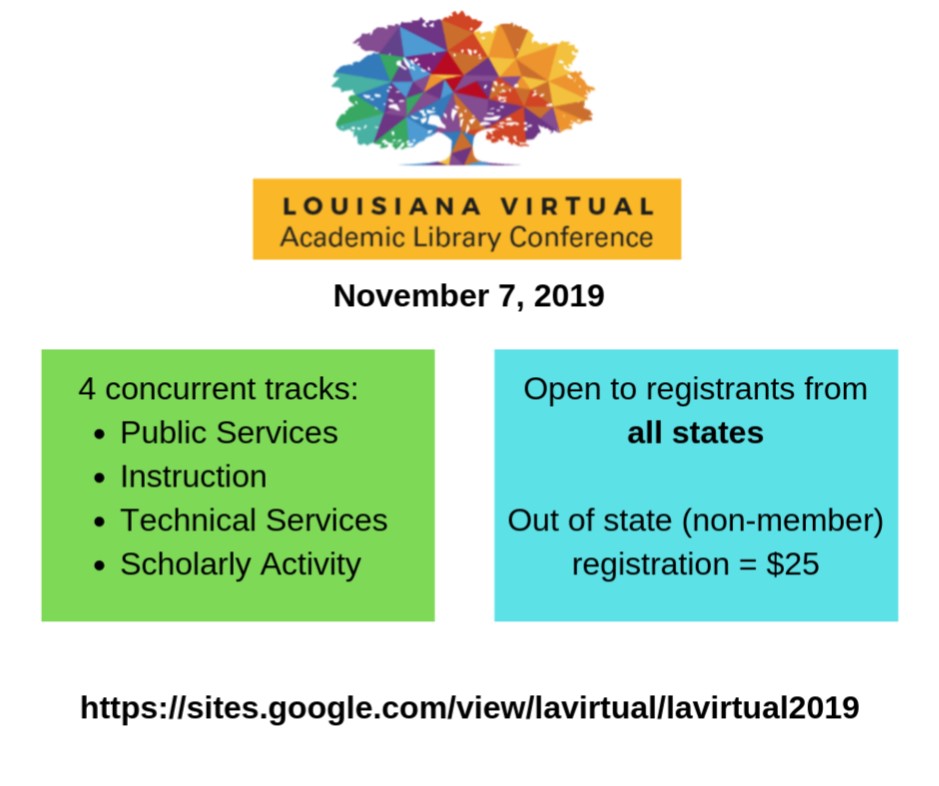
The Louisiana Library Association’s Academic Section and Louisiana chapter of the ACRL are thrilled to share the details for their upcoming 2nd annual Louisiana Virtual Academic Conference 2019. Join us on November 7, 2019 from your computer via Zoom.
The Louisiana Virtual Academic Conference was established to provide additional presentation and professional learning opportunities for academic and other librarians in Louisiana and beyond for little to no cost. This year there are four concurrent sessions: public services, instruction, technical services, and scholarly activity.
As members of PaLA, your registration fee is just $25 and will grant you access to the conference on November 7, as well as the recordings made available afterwards.
Learn more about the LA Virtual Academic Conference here: https://sites.google.com/view/lavirtual/lavirtual2019
Register here: https://sites.google.com/view/lavirtual/registration


 Adam Balcziunas
 Alex K.
 Alexandrea Glenn
 Andrea Pritt
 aprilnkelley
 Ashley Purvis
 Bethann Rea
 blj13
blj13 Brendan Johnson
 Amanda Boyer
 Bret Stiffler
 Bonnie Powers
 Christopher Lemery
 clarewithers
 clblibrarian
 Kelly Clever
 Charlotte M. Johnson
 colemanluzerne
 CRD of PaLA
 crdvirtualjournalclub
 cre5314
 csgarth
 Erin B.
 danajkerrigancv
 denisewetzel1
 Darren G. Poley
 elm43
elm43 James D'Annibale
 Annie Jansen
 Jill Hallam-Miller
 jennifercribbs
 Jenn Monnin
 Jen Hasse
 Jessica Showalter
 johnmeier1
 Kelly Safin
 Kim Karim
 Kristen Seikaly
 Kayla Van Osten
 Cecelia Lasley
 librarianjsmith
 Linda Neyer
 mabogino1
 Matthew McNelis
 Meg Massey
 Maggie Savidakis-Dunn
 Rebecca
 miskatoniclibrarian
 Maureen Bentz
 Michele G. Anfuso
 Nicole Miyashiro
 paulmcmonigle
 Rob Sieczkiewicz
 ronlmccoll
 Sam Bardarik
 shannahollich
 smartin592
 Ula Lechtenberg
 It's Academic