Textbooks, Supplemental Resources, and OER

Librarians trying to encourage the adoption of Open Educational Resources (OER) on their campuses face several challenges, but none more so than faculty reliance on the various supplemental resources that publishers create and attach to their textbooks. These resources could be pre-made tests, PowerPoint slides, or video content, for example. Combined these materials create a sort of “lock in” that can make faculty reluctant to leave those textbooks. Of course, these resources also create increased costs to students, who end up paying for them in the end. When approaching faculty about adopting OER librarians may find themselves facing faculty reluctant to adopt resources without these supplemental resources. Which is problematic because most OER do not offer those kinds of supplemental material.
However, this is changing somewhat. Openstax, an OER collection from Rice University, does offer supplemental resources for their textbooks when faculty adopt them. PowerPoint slides, test questions, and course cartridges that integrate into the Canvas LMS are available for their textbooks. These are the kinds of items that faculty have come to rely on. Demonstrating that they are available for some OER may hep get faculty on board for OER adoption.
If you’ve run into this problem I highly recommend you look at the instructor resources area attached to each textbook on Openstax. You can’t see the instructor resources until you’ve been verified to be an instructor interested in using the text. This is to prevent students from accessing the questions provided. But you can see the types of material available. It might be just the thing to get faculty on board to try an OER textbook in their class.
Here is a link to all the texts available from Openstax – https://openstax.org/subjects
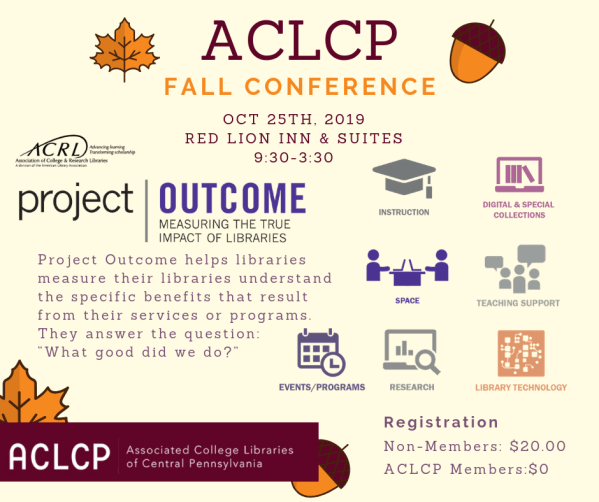
ACRL will present Project Outcome at the ACLP Fall Conference on October 25th at the Red Lion in Harrisburg.
Registration is free for ACLCP (Associated College Libraries of Central Pennsylvania) members and $20 for non-members.
Learn more about Project Outcome here: https://acrl.projectoutcome.org/
Register for the ACLCP Fall Workshop here: Register
Survey Invitation for CRD Luncheon – Cultural Intelligence in PA Libraries
We hope to see everyone next month in Erie for the Pennsylvania Library Association Annual Conference. Our CRD luncheon speaker, Dr. Michele Villagran, will present on Cultural Intelligence in Libraries, and she hopes to include some data from our membership to inform her work.
I hope that you will take a few moments to respond to her survey by September 20, available here: https://sjsu.qualtrics.com/jfe/form/SV_czLDKKwSAwK8tMx
You do not need to be a PaLA member, CRD member, or conference attendee to complete the survey. Anyone who works in a Pennsylvania Library is eligible.
Bullies on the Playground: Confronting Horizontal Hostility

Photo Credit: G. Adam Poley (CC BY 4.0)
It’s that “back-to-school” season again. Will there be bullies on the playground? In higher ed it is hoped that the worries of high school harassment are left behind as the young adults on our campuses form the habits of college students. Unfortunately, the ubiquitousness of handheld communication carries with it the baggage of cyber-bullying. Some faculty members at Villanova University noted recently that people seem to grow down and not up when it comes to online activities. “Just read the comments section of anything online.” This is particularly disturbing when educational practices that involve electronic media continue to accelerate without any end in sight.
As librarians we used to worry about creeps in the stacks or vandals defacing the books. Now that the life of students is imbued with online media and incessant status checks using a “smartphone,” educators need to be sensitive to the impact of horizontal hostility. The term was coined by thinkers in the feminist movement and the concept has been researched extensively concerning nurses in the workplace, but what about our library users? Especially if they are students.
Overt physical hazing on campuses may be less, although unfortunately still not entirely unheard of, but the initiation of young people into a new learning environment is not only disorienting, but also distressing if their fellow members of the community are critical to the point of abusive. If libraries are loci for democratizing access to knowledge, a crossroads for academic disciplines and a commons for interdisciplinary dialog, librarians need to educate patrons about the insidious and very real possibility of some in the learning community using the anonymity of online media to excoriate each other. The problem of jurisdiction is real, however the library can be a resource for stemming the behavior and fostering civil discourse, if we bring it into the forefront.
Kelsey Merkley gave a passionate talk about “Horizontal Hostility” in the Open community at the Creative Commons 2019 Global Summit earlier this summer. Maybe librarians should even consider programming around shining a light on horizontal hostility in the workplace as well as within the student body?
You can check out all the keynotes from CC’s 2019 Global Summit via their Website: creativecommons.org/2019/08/27/now-you-can-watch-the-keynotes-from-ccs-2019-global-summit/
The CRD Virtual Journal Club is back!
Join the College and Research Division’s Virtual Journal Club fall series! This series we will focus on students’ transition from high school to college. All members of PaLA are welcomed.
In our online meetings, participants engage in discussion or critical appraisal of professional literature covering a broad range of topics in our field. You can learn more about how our series have benefited our participants in our recent Pennsylvania Libraries: Research & Practice article.
The CRD virtual journal club fall series will meet September 24, October 22, and November 19 from 2:00-3:00 pm. Those interested in participating can sign up at https://forms.gle/UxZhxfP2XsFM9KQv7.
Prior to the September meeting, registered participants will receive an email containing a link to article we will be discussing, a list of discussion questions/prompts, and the online Zoom meeting invitation.
If you have any questions or suggestions for the planning committee, please feel free to contact us at CRDVirtualJournalClub@gmail.com.


 Adam Balcziunas
 Alex K.
 Alexandrea Glenn
 Andrea Pritt
 aprilnkelley
 Ashley Purvis
 Bethann Rea
 blj13
blj13 Brendan Johnson
 Amanda Boyer
 Bret Stiffler
 Bonnie Powers
 Christopher Lemery
 clarewithers
 clblibrarian
 Kelly Clever
 Charlotte M. Johnson
 colemanluzerne
 CRD of PaLA
 crdvirtualjournalclub
 cre5314
 csgarth
 Erin B.
 danajkerrigancv
 denisewetzel1
 Darren G. Poley
 elm43
elm43 James D'Annibale
 Annie Jansen
 Jill Hallam-Miller
 jennifercribbs
 Jenn Monnin
 Jen Hasse
 Jessica Showalter
 johnmeier1
 Kelly Safin
 Kim Karim
 Kristen Seikaly
 Kayla Van Osten
 Cecelia Lasley
 librarianjsmith
 Linda Neyer
 mabogino1
 Matthew McNelis
 Meg Massey
 Maggie Savidakis-Dunn
 Rebecca
 miskatoniclibrarian
 Maureen Bentz
 Michele G. Anfuso
 Nicole Miyashiro
 paulmcmonigle
 Rob Sieczkiewicz
 ronlmccoll
 Sam Bardarik
 shannahollich
 smartin592
 Ula Lechtenberg
 It's Academic