The latest issue of Pennsylvania Libraries: Research & Practice is now available at palrap.org
Articles include:
- In the PaLRaP Spotlight: Tanya Fischer, MEd, MSLIS (she/her)
- Customizing Summon for a Specific User Population: A Health Sciences Library’s Experience
- Noteworthy: News Briefs from PA Libraries
Bryan McGeary & Danielle Skaggs, Co-Editors
===========================================================================
Pennsylvania Libraries: Research & Practice (PaLRaP) is a peer-reviewed, open access journal, sponsored by the College and Research Division of the Pennsylvania Library Association. PaLRaP provides an opportunity for librarians in Pennsylvania to share their knowledge and experience with practicing librarians across Pennsylvania and beyond. The journal includes articles from all areas of librarianship, and from all types of libraries within Pennsylvania.
LMS and Library Database Integration
One constant in libraries is the fewer barriers you place between users and some resource the more users will take advantage of that resource. That’s why libraries use technologies like ip authentication, single sign on, and responsive websites to make our collections more convenient for our patrons.
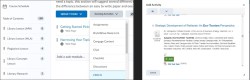
Another tool that’s available to libraries is using LTI integrations to make library databases available within a learning management system. LTI stands for Learning Tools Interoperability. LTI is an open standard that allows different pieces of software to communicate with a learning management system. The LTI standard is supported by all major LMS: Blackboard, D2L, Canvas, and many others. Using an LTI to integrate library databases into an LMS enables faculty to search those databases and quickly link to their resources within their online courses. For example, my Library has a subscription to Films on Demand, an online video streaming database, our integration of this database enables faculty to seamlessly embed videos into their online courses. Of course, there are other ways to do this, but for faculty uncomfortable using things like embed code, the LTI is a much better option. Since an LMS is already password protected, anything embedded using an LTI requires no login from students.
With online classes so common today the LMS has become “the college” as far as many students are concerned. The LMS is the digital campus through which students interact with everything that the university offers. As such, it’s a good idea for libraries to see that their services are as present in the LMS as possible. That could be a link to the library website or the ability for faculty to access library resources directly inside their course pages.
Most major database providers will have excellent documentation on how to setup an integration between their products and common learning management systems. The process can be easily completed in a few days in most cases. I highly recommend libraries explore this option.
Affordable Learning PA Summit 2022 Call For Proposals
The Affordable Learning PA Steering Committee invites you to submit a proposal for the fourth annual Affordable Learning Summit. The Affordable Learning Summit is an opportunity for librarians, faculty, and others to collaborate on building a network dedicated to making higher education in Pennsylvania more accessible and affordable.
The theme for this year’s Summit is Infrastructure for Affordability. Opportunities include panels, individual presentations, virtual posters, pre-recorded lightning talks, roundtables/networking (breakout rooms with moderators), or other format suitable for a fully virtual conference environment.
The Steering Committee welcomes proposals on aspects of open and affordable education activities across these themes:
| Theme | Suggested Topics |
| Building Networks | Communities of Practice Faculty Partnerships Engaging Students OER Advocacy Organizations Campus Connections: bookstore, student success offices, learning technology |
| Constructing OER | Publishing and Creating OER Copyright Digital Repositories Authoring Tools ILS Integration |
| Blueprints for Assessment | Financial Learning Satisfaction Learning Outcomes Programmatic Accessibility |
| Pedagogy Frameworks | Open Pedagogy Interactive Course Materials Renewable Assignments |
| Miscellaneous Building Materials | Zero Cost Materials Designing OER for accessibility |
This year’s ALPA Summit will be held virtually from August 9th-August 10th. The deadline for submissions is Thursday June 30th. Notifications for accepted proposals will be delivered by July 15. The date, time, and format of proposed presentations will be confirmed through conversation with the presenters during the week of July 25th.
Please click here to submit your proposal.
If you have additional questions about submitting your proposal, or about the ALPA Summit in general, please contact alpa-summit@palci.org
(Link not working? Find the proposal submission form here: https://forms.gle/bP8WNRpn8QtDNaEJ7)
Recordings of the two most recent Connect & Communicate sessions are available on our YouTube channel. Thank you to everyone who joined us live, and special thanks to our presenters.
In April, Allyson Wind of East Stroudsburg University presented “Promoting Inclusion in the Academic Library with a CILLS Program Internship.”
In May, Ashoo Kumar, Sandy Morgart, Eric Novotny, and Dan Peters from Penn State University Libraries presented “Microfilm Enters the Digital Age: A Big Evolution for a Microformat.”
Bucknell University invites librarians and their colleagues to submit a proposal to present at this year’s digital scholarship conference. Please see the call for proposals below.
Converging Paths: Digital Scholarship, Social Justice, and Intersecting Communities
Digital scholarship has often been rooted in the academy, although many of our projects seek to uncover community histories, lives, and events. In this year’s Bucknell University Digital Scholarship Conference (October 18-20, 2022; the event will be fully virtual), we seek to address the question: What are the paths through which digital scholarship intersects with communities and social justice?
The questions we pose to participants as jumping off points for proposals include, but are not limited to:
- How does digital scholarship help us challenge dominant narratives and ideologies?
- Whose voices can be elevated, uncovered, and reclaimed through digital scholarship?
- How do we bridge the gap and promote engagement between the academy and community through digital scholarship?
- What does it mean to collaborate on and produce digital scholarship projects with communities beyond our own, and what ethical responsibilities do we share?
- How can we learn from and build on our experiences to sustain digital scholarship projects?
#BUDSC22 is committed to expanding the definition of digital scholarship to be more inclusive across diverse communities, both inside and outside of academia. The conference will bring together a broad community of practitioners — faculty, researchers, students, librarians, educational technologists, administrators, and others — collaborating on digital scholarship through research, teaching, and community engagement.
Submissions may take the form of interactive presentations, project demonstrations, digital posters (pre-recorded), panel presentations, work-in-progress sessions, workshops, or other creative formats.
We look forward to building on the success of our past conferences, in which we came together to discuss challenges, share working models, reflect on projects, and inspire new avenues for actively including students in scholarly pursuits. Want to learn more? Check out video highlights from our past conferences or search our archived sessions.
Submission Link: https://tinyurl.com/BUDSC22Proposal
Submission Deadline: July 15, 2022
Notification By: August 15, 2022
Conference Website: https://budsc.scholar.bucknell.edu/
Questions? Please contact the BUDSC planning committee at: budsc@bucknell.edu


 Adam Balcziunas
 Alex K.
 Alexandrea Glenn
 Andrea Pritt
 aprilnkelley
 Ashley Purvis
 Bethann Rea
 blj13
blj13 Brendan Johnson
 Amanda Boyer
 Bret Stiffler
 Bonnie Powers
 Christopher Lemery
 clarewithers
 clblibrarian
 Kelly Clever
 Charlotte M. Johnson
 colemanluzerne
 CRD of PaLA
 crdvirtualjournalclub
 cre5314
 csgarth
 Erin B.
 danajkerrigancv
 denisewetzel1
 Darren G. Poley
 elm43
elm43 Heather Burychka
 James D'Annibale
 Annie Jansen
 Jill Hallam-Miller
 jennifercribbs
 Jenn Monnin
 Jen Hasse
 Jessica Showalter
 johnmeier1
 Julie Durci
 Kelly Safin
 Kim Karim
 Kristen Seikaly
 Kayla Van Osten
 Cecelia Lasley
 librarianjsmith
 Linda Neyer
 mabogino1
 Matthew McNelis
 Meg Massey
 Maggie Savidakis-Dunn
 Rebecca
 miskatoniclibrarian
 Maureen Bentz
 Michele G. Anfuso
 Nicole Miyashiro
 paulmcmonigle
 Rob Sieczkiewicz
 ronlmccoll
 Sam Bardarik
 shannahollich
 smartin592
 Ula Lechtenberg