Using MLA professional competencies to help support scholarly activity of clinical staff
One of the most intriguing tasks that I have as a clinical and reference librarian at hospital library in which I work, is the work of supporting the scholarly activities of our clinical staff.
As I have learned this support comes in many different roles such as providing poster creation and design help for our nurse residency groups or conducting and maintaining author publication lists for our clinical and resident staff or simply answering reference questions in support of publication.
The goal of supporting these scholarly activities within the clinical setting is to ensure that the library is supporting the evidenced based medicine practice that ensures the best quality of care for our patients. I am proud to be a part of the team but wanted to make sure that I was supporting the team the best way that I could, so I turned to the Medical Library Association’s Professional Competencies (https://www.mlanet.org/page/test-competencies ) to ensure that I was on the right track.
I realized that I was meeting the competence of Health information professionalism by seeking out assistance through the collaborative work of the MLA communities(https://www.mlanet.org/page/special-interest-groups-landing-page) and their listserv emails list serves and by utilizing the competency itself to guide my work.
The competencies of supporting evidenced based practice and research, instruction and instructional design as well as the competency for leadership and management were helpful in providing guidance for managing the marketing to the various clinical groups and the implementation of the processes used to provide training to the nursing residency groups and in the fine tuning of the existing author publication reporting procedure.
Utilizing the Medical Library Association’s Professional Competencies assisted me and strengthened by abilities to support the information needs and provide the right information services to support the scholarly activity of my clinical staff.
Summer 2022 CRD Virtual Journal Club
Greetings!
Welcome to the Summer 2022 series of the Virtual Journal Club, sponsored by the College & Research Division of the Pennsylvania Library Association! The theme for this series will be faculty perceptions of information literacy.
We will meet on the third Thursday of the month from 2:00-3:00 pm. Meeting dates are June 16, July 21, and August 18. For our first meeting, we will discuss:
Huddleston, B., Bond, J. D., Chenoweth, L. L., & Hull, T. L. (2020). Faculty perspectives on undergraduate research skills: Nine core skills for research success. Reference & User Services Quarterly, 59(2), 118-130.
We will use the following Zoom link and passcode for each meeting in the series:
https://kings.zoom.us/j/93660828235?pwd=MmxaNUszSEZEUTFOcWk0Y3RBUTZnZz09
Meeting ID: 936 6082 8235
Passcode: 635767
Please reach out if you have any questions!
Have a great day,
Melissa, Alex, and Rebecca
Food Insecurity
Right now, many of us are wincing each time our gas tank is creeping towards ‘E,’ and we’re noticing our grocery bills are getting higher. The pandemic is still putting us through our paces, but we are not the only ones feeling the strain on our wallet. This year many of our colleges and universities returned to full-time, in-person instruction. With the return to campus, there were some notable changes amongst our students.
At Susquehanna University, where I work as the First-Year Experience Librarian, my colleagues and I were noticing that the café in our library was busier than normal. In fact, it would have a line out the door from open until close. The café manager shared that they were averaging one thousand meal swipes a week –at the school’s smallest eatery. Like many places, our Dining Services Office was struggling to find enough staff. Students were also still wary of COVID, and they preferred the grab-and-go options of the library café and other campus eateries over the large open and maskless space that was the main dining hall. Students were sometimes waiting two hours for food after submitting an order. Some were putting in lunch orders at breakfast or skipping the lines (and dinner) altogether to make it to class on time. Bottom line? Our students were hungry.
In my role I work closely with Student Life, and I was expressing to one of my colleagues my concerns over student food insecurity. She told me that there were two pantries on campus (one in our chapel and one at the Hillel House), but she lamented that the need was growing beyond what those pantries could provide. Considering the library is located on the opposite side of campus from the chapel, I and my colleague, Tracy Powell, proposed we started a third pantry in the library.
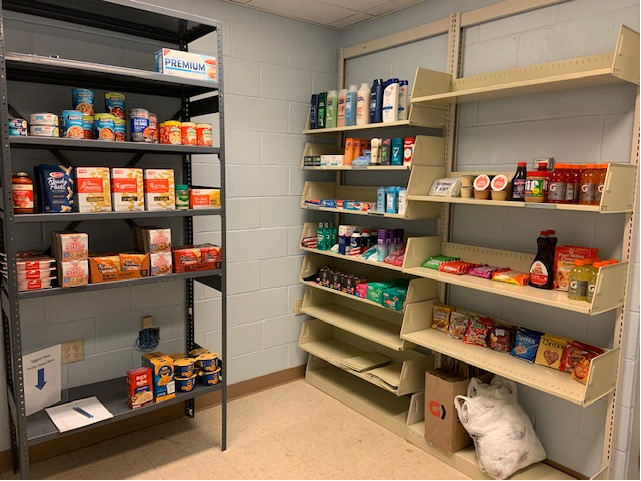
All SU pantries are funded by our Student Care Fund, which is a fund alumni specifically donate to in order to provide students with emergency supplies. Our pantry, like the others on campus, is stocked with lots of thought. Not all students have can openers, some students want to avoid the sodium levels that come with ramen noodles, some pre-packaged items still require fresh ingredients, etc. We try to find cans with tabs or ready-made pasta, and our chapel pantry has a refrigerator with milk, eggs, butter, etc. Our library pantry is also stocked with personal hygiene items. We have everything from soap and shampoo to feminine products, contact solution, acne scrub, and hairbrushes. In order to truly meet the students’ needs, we also have a notepad where students can write down items they’d like to see in our pantry. Many of the suggestions are for more organic items, fresh produce, and so on.
Over the summer, when the campus eateries are closed, students hit the pantries even harder. Those of us who host the pantries are considering making each location have its own specialty. For example, the chapel is the only pantry with a refrigerator for fresh products. The library seems to be turning into the hotspot for personal hygiene items. And, finally, the Hillel House seems to be getting more requests than the others for organic and vegan items. Times are changing and so are our students’ needs. Before we think about how best to teach them information literacy, maybe we should stop and wonder if they ate yet today. How can we nurture the student as a whole person in addition to supporting them in their research needs? What resources exist on our campuses that we can tap into, or where are there gaps in meeting our students’ unique and dynamic needs?
Scaling back on LibGuides

I have a love-hate relationship with LibGuides. So much so I presented about them at LOEX 2022 just a couple of weeks ago. In that presentation, my mentor and I expressed our frustrations and hopes for LibGuides in what we consider to be their optimal use. We started off by soliciting the audience’s grievances, and, boy, did they deliver.

It seems like everyone has a beef with making LibGuides. If they are so onerous to make…to keep up to date…to get students to use…Why do we continue to make them? Would anything make them better? I have so much to say on this topic, especially after conducting a literature review in preparation for our presentation, but, for now, I will reflect on the aspect that sticks with me the most: centering the learner.
Take a moment to think about how you decide to make a LibGuide. I suspect we fall into these categories:
- Subject LibGuides for liaison subjects/departments
- Course Guides at faculty request or our own volition.
- General guides about a topic of our choosing, whether subject or current event related.
These approaches do not inherently center the learner. They center the information and, honestly, us. We choose what materials to include in the guides based on subject expertise or familiarity with collections. Faculty let us know what they want to see in the guides sometimes with little room for feedback from us. Or we choose to make a guide based on a topic we find interesting or important. Where are our users in these approaches?
Centering the learner means understanding how our students look for and engage with information. Librarians’ mental models differ from our students’. We have a complete understanding of the research process and present information in a way that reflects that. We create guides that have a certain flow, that have an order that is logical to us: here are the books that might be useful, here are the databases. Students are focused on the product of research. They want access to the information that will get them there which means they are not reading through our guides like a book.
Our students are also search dominant thanks in part to Google. When they see a search box, they will use it both to “assert independence” from the navigation and as an “escape hatch” when they can’t seem to find what they need. They are not browsing our lists of resources on LibGuides just because. It is unsustainable for us to continue to make guides that we *think* might be useful but then never update them. And then hand them over to other librarians when we leave an institution.
To me it seems like the best approach to making LibGuides is to make them for specific courses and to embed them into the learning management system (LMS), like Canvas or Blackboard. When we go into that class for an instruction session, either teach directly from the guide or make explicit to students that the guide was made specifically for them. They are more likely to use the guide when it is already embedded into the LMS environment that they are in all the time.
This approach will result in fewer guides, which sounds really great to me. The guides we do make, however, will be more meaningful and useful to our students. I’m willing to try it out.
Register for Summer CRD Journal Club!
The summer series of Journal Club will meet on the third Thursday of the month from 2:00-3:00 pm. We will meet on June 16, July 21, and August 18. Please use this link to register and let us us know any topics you are interested in reading about this summer. We look forward discussing the latest scholarly literature with you!


 Adam Balcziunas
 Alex K.
 Alexandrea Glenn
 Andrea Pritt
 aprilnkelley
 Ashley Purvis
 Bethann Rea
 blj13
blj13 Brendan Johnson
 Amanda Boyer
 Bret Stiffler
 Bonnie Powers
 Christopher Lemery
 clarewithers
 clblibrarian
 Kelly Clever
 Charlotte M. Johnson
 colemanluzerne
 CRD of PaLA
 crdvirtualjournalclub
 cre5314
 csgarth
 Erin B.
 danajkerrigancv
 denisewetzel1
 Darren G. Poley
 elm43
elm43 Heather Burychka
 James D'Annibale
 Annie Jansen
 Jill Hallam-Miller
 jennifercribbs
 Jenn Monnin
 Jen Hasse
 Jessica Showalter
 johnmeier1
 Julie Durci
 Kelly Safin
 Kim Karim
 Kristen Seikaly
 Kayla Van Osten
 Cecelia Lasley
 librarianjsmith
 Linda Neyer
 mabogino1
 Matthew McNelis
 Meg Massey
 Maggie Savidakis-Dunn
 Rebecca
 miskatoniclibrarian
 Maureen Bentz
 Michele G. Anfuso
 Nicole Miyashiro
 paulmcmonigle
 Rob Sieczkiewicz
 ronlmccoll
 Sam Bardarik
 shannahollich
 smartin592
 Ula Lechtenberg