Garrison Keillor: Closing Speaker
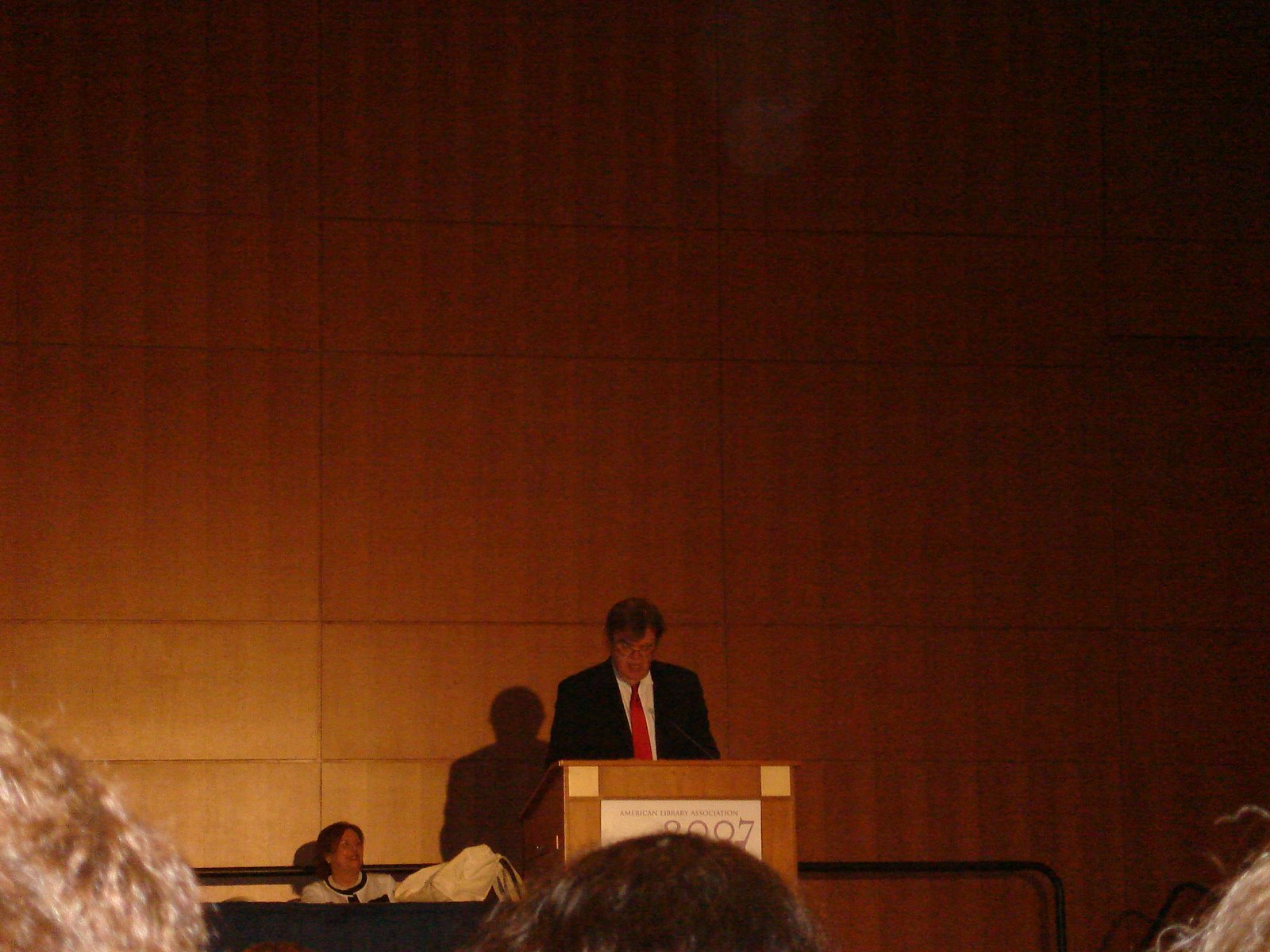
Garrison Keillor was the speaker at the closing session. He talked about libraries and librarians for about 45 minutes and was delivered with his usual dry sense of humor. (cf. his article on libraries in Salon which touches on some of what he said to us.) This session was taped for broadcast on C-Span and the auditorium was packed. I was fortunate to be able to attend the Awards Ceremony and the Inaugural Banquet later that evening in support of Charles Kratz, the Dean of the Library at the University of Scranton, who is joining the ALA Executive Board. I saw Barbara Cole from Commonwealth Libraries and Debbie Malone, Library Director at DeSales University and Co-Chair of PaLA’s Legislative Information Committee.
Once Upon a Furl in a Podcast Long Ago
This morning I attended “Once Upon a Furl in a Podcast Long Ago: Using New Technologies to Support Library Instruction.” This was a panel of four librarians: Joan Lippincott gave an overview of emerging technologies and library instruction; Kathy Burnett is teaching future librarians at Florida State Unviersity how to use technology tools in the classroom; Kathryn Shaughnessy is using the tools with Social Justice students who are in Third World countries; and Heather Tompkins shared lots of tips about using the social web tools.
Poster Session – This afternoon was devoted to my poster session, “You Asked, We Responded: Redesigning an Academic Library’s Web Site Based on User Input.” Several people who are thinking about redesigning their Web sites asked quite a few questions. When I get back to the library, I’ll add a picture.
Although I never did manage to hook up with Barbara Burd, I did see several more librarians from Pennsylvania, including Christie Roysdon and Evelyn Minick. There are two Internet cafes here at the conference and there is a kiosk at the hotel that also has some computers with Internet access which have made my ability to blog while I’m here possible.
Harnessing the Hive
I went to an interesting program this morning, “Harnessing the Hive: Social Networks and Libraries,” sponsored by MARS. There were 3 speakers. Matthew Bejune talked about his Wiki research. He said that libraries are using Wikis mainly for collaborating with other libraries or with library staff, but few are using Wikis to collaborate with their users. This is where he focused his research. He created LibraryWikis as a companion to his upcoming article in the September 2007 issue of Information Technology and Libraries. Matt was followed by Meredith Farks, aka Queen of Wikis, who maintains Library Success: A Best Practices Wiki and who is the Distance Learning Librarian at Norwich University in Norwich, VT, spoke about “Knowledge Management.” She demonstrated several ways that libraries are using Wikis. Her presentation can be found at http://meredithfarkas.wetpaint.com/. The final speaker was Tim Spalding, creator of LibraryThing, an online service to help people catalog their books. He describe LibraryThing as social cataloging. Libraries are starting to incorporate LibraryThing into their online catalogs. Currently only one library, the Danbury Library in CT is using this, but Tim said that within the next month more will be added. For more info about how your library can incorporate social cataloging, go to http://www.librarything.com/forlibraries/. On the negative side, I overheard some people chatting as I was waiting in line in the rest room the they were unhappy with Tim’s criticism of Library of Congress Subject Headings.
Conference Afternoon Programs
I went to two interesting programs this afternoon. The first, sponsored by ACRL, was on gaming. James Paul Gee, a professor at the University of Wisconsin, explained the many ways that video games incorporate good learning principles. Some of these principles include the following: 1) they lower the consequences of failure; 2) they encourage players to think about systems and relationships, not just isolated events, facts, and skills; 2) learning is embodied and affective (emotional). He encouraged librarians to not just read a story to children, but to play a video game with them. George Needham, Vice-President Member Services at OCLC, then spoke about what librarians can learn from gamers. He suggested that we should rethink how we deliver services. IM and text messaging are ways that we can hit people where they are, when they really need it.
The second program was sponsored by LITA. It was a panel discussion with the librarians from the “Google Five” libraries and Adam Smith, Product Developer from Google. They gave an update on the status of this project. There were some problems like unbarcoded books, brittle paper, and binding; but, the librarians all seemed to feel that these were minor and that the benefits far outweighed the problems. Dale Flecker, from Harvard University, suggested that because of the project text mining would become a new research field.
ACRL 101
I was able to spend about an hour visiting the exhibits this morning. While I was there I met some other PA librarians, Lynn Moses from Commonwealth Libraries, Merrill Stein from Villanova, and Joe Fennewald from Penn State Hazleton. I didn’t find the booth with the Wheel of Acronyms yet, but I’ll keep looking!
ACRL 101 – This was a great program! Very well organized. Pam Snelson, ACRL President gave a welcome and invited us to get to know a little bit about our neighbors. Then she gave an overview of how ACRL is organized (more acronyms!) Mary Jane Petrowski, ACRL Associate Director, told us how we can get involved in the Association and she broke this down by how much (or how little) time we could spend being engaged. We also heard from Jo Ann Carr who told us where we could find a home in ACRL, and if one doesn’t exist, then they would build one for us! Louise Sherby, ACRL Representative to the 2007&2008 ALA Conference Program Coordinating Team explained how that committee organized the programs. She also gave us some tips on finding things in the Program Guide. And Julia Gelfand, Past Chair, ACRL Science & Technology Section gave us some tips on navigating the Exhibit Hall. The ‘official’ program being over, we were free to speak with representatives from many of the Sections. ACRL is creating a New Member Wiki and the surveyed us for things that we thought might be helpful to include. On our way out we participated in a Jelly Bean Assessment. We voted on whether or not we found the program “useful” by depositing jelly beans in jars. When I left, the “useful” jar was filling up fast and the “not useful” jar was empty.


 Adam Balcziunas
 Alex K.
 Alexandrea Glenn
 Andrea Pritt
 aprilnkelley
 Ashley Purvis
 Bethann Rea
 blj13
blj13 Brendan Johnson
 Amanda Boyer
 Bret Stiffler
 Bonnie Powers
 Christopher Lemery
 clarewithers
 clblibrarian
 Kelly Clever
 Charlotte M. Johnson
 colemanluzerne
 CRD of PaLA
 crdvirtualjournalclub
 cre5314
 csgarth
 Erin B.
 danajkerrigancv
 denisewetzel1
 Darren G. Poley
 elm43
elm43 Heather Burychka
 James D'Annibale
 Annie Jansen
 Jill Hallam-Miller
 jennifercribbs
 Jenn Monnin
 Jen Hasse
 Jessica Showalter
 johnmeier1
 Julie Durci
 Kelly Safin
 Kim Karim
 Kristen Seikaly
 Kayla Van Osten
 Cecelia Lasley
 librarianjsmith
 Linda Neyer
 mabogino1
 Matthew McNelis
 Meg Massey
 Maggie Savidakis-Dunn
 Rebecca
 miskatoniclibrarian
 Maureen Bentz
 Michele G. Anfuso
 Nicole Miyashiro
 paulmcmonigle
 Rob Sieczkiewicz
 ronlmccoll
 Sam Bardarik
 shannahollich
 smartin592
 Ula Lechtenberg