Where Angels Fear to Tread: Devising a Lean and Mean Reference Collection
Gumberg Library, Reference Dept., Duquesne University, Pittsburgh, PA
Allison Brungard & Sandra Collins
What to do about the print reference collection? Considerable maintenance, not much usage. How they went about it, what was involved. Not how we done it good, but ‘don’t do what I did.’ Criteria: Currency, significance, and relevance.
Sandy spoke first. Budgetary considerations were a large part of it. Reference is prime real estate; library wanted an information commons. Collection had not been weeded for a time. Has been a reorientation to how to do reference; standard reference works like Sheehey and Katz are simply not being used, even by reference librarians. Are the materials timely? Do we even know what’s there, if it’s outside of our subject specialty?
Another question they asked was whether more of the reference collection should circulate. Probably, since librarians aren’t really using much of the collection. Avoid like the plague Internet guides — out of date once they’re published. Bibliographies in the Zs should be in the subject areas. Obsolete formats — why get phone books, CIA Fact Book, when available online.
How did they do this? First began by updating Reference Collection Development Policy to reflect new priorities. Collection has outgrown the space, and they needed to deselect (not ‘weed’). Does the item deserve to be in Reference? If not, then where does it belong? Needed to create a consensus among reference librarians and went to liaison librarians (bibliographers). Took about 4 months to this point.
Wanted to keep process relatively simple, a few basic questions/priorities. Don’t tell me what was done in past; does it belong in this collection? The process for weeding Reference was a pilot for weeding the entire collection.
How was the weeding actually done? Allison spoke to this. They wanted a lasting record of how the process was done. They started with 9400 records (not individual titles), imported 6800 records into an Access db of all Reference titles. Assigned different librarians different LC call number ranges. Had to be able to share the db to work on it; on a shared server.
Only decisions that could be made about a title:
1) Keep in Reference
2) Move to stacks
3) Withdraw completely
Had to allow for some flexibility; set a terminal date for decision making. In hindsight, should have had a field for over sized; did hold them up a bit.
Positives (‘Blessings’):
-taking ownership of a large, multi-departmental project
-increased confidence that you can go over to the shelves and pull something that would be worthwhile
-did provide a blueprint for weeding rest of collection
Negatives (‘Curses’)
-too many stakeholders means that the project can get bogged down
-some who feel slighted by project can create discord; internal politics
-some will want more or different choices than those offered by the project parameters; some people can’t make a decision (notes field was kept purposely small)
Had to take into consideration the human element; had to work with folks to help them make decisions. Had to get them to focus on whether or not the book belonged in the collection; not questioning relative worth of book, just its relevance to the Ref collection.
Project is still ongoing. Continue to add new books to database. Updating the collection now involves pricing print vs. electronic. If electronic, then becomes an Electronic Resources Committee decision. Bought the Gale Philosophy, Religion, and Literature Center, but is still librarian-directed.
Recommendations:
-Communicate expectations; have participants try out the process and report back by a specified deadline
-Get organizational buy-in
-Clarify decision-making authority; who has responsibility
-Set solid deadlines but have a back-up plan
-Limit the number of decision makers
One year later…
-Kept 35% of Reference books; withdrew 10% of materials, rest (55%) went to general collection
-Have more room for tables
-Most books not yet moved; backlog in tech services
-First electronic purchases on the horizon: Narrowed choices to Gale & Oxford collections
Q & A
Was usage tracked? No, hadn’t done that. Would have been helpful. Did ask, “Have you ever had a question about that?” as criteria. One library made tick marks on inside of cover when used book for a transaction. One library tracks usage in library instruction. Is this really use if users aren’t using.
-LN
The Challenge of Open Access for University Presses
The Challenge of Open Access for University Presses (Tuesday, 2:45 to 4:00)
Sandy Thatcher, Director, Pennsylvania State University Press
University presses were founded in the late 19th century to help alleviate a problem of market failure, namely, insufficient demand in the commercial marketplace to sustain a publishing operation on the basis of sales alone. Now, in the face of another type of market failure –insufficient funds to sustain library subscriptions to STM journals — calls have come forth to change the economic model of publishing from sales-based to grants-based, offering the fruits of knowledge for free to all users with an Internet connection. This session will examine both the challenges and opportunities that the variants of ‘open access’ present to university presses, as they seek to fulfill their traditional mission of disseminating knowledge, far and wide, while remaining sustainable as businesses.
(Thanks to Christie Roysdon for the reminder!)
Soaring to New Heights!
Soaring to New Heights!
Here’s a link to the full Conference Program.
In addition to the CRD workshops posted by Bonnie yesterday, here’s a few more that will be of definite interest to PA academic librarians:
SUNDAY, OCTOBER 14
2 – 3:15 pm – Academic Librarianship by Design: The Blended Librarians’ Perspective on Enhancing Library Instruction
John D. Shank, Instructional Design Librarians, Penn State, Berks Campus
Sponsor: Library Instruction Round Table
MONDAY, OCTOBER 15
9 – 10:15 am – Low-Cost Techniques for Creating an Interactive Web Site
John Houser, Senior Technology Consultant, PALINET
Sponsor: Electronic Resources Round Table
TUESDAY, OCTOBER 16
9 – 10:15 AM – The Impact of the Internet on Politics
Lee Rainie, Project Director, PEW Internet & American Life Project
There have been many predictions about the impact of the Internet on
politics. Is the Internet the lever for direct democracy? Or is it a wedge
for political polarization? Either conclusion may prove too simple. To
understand how technology might reshape politics, consider what has
been learned from the initial decade of online campaigning, and how
various fears and hopes have fared.
Sponsor: College & Research Division
Annual Conference: Soaring to New Heights

Students as Library Advocates: Friends of the Academic Library
Presenters: Amy L. Deuink & Marianne Seiler
Moderator: Bonnie W. Oldham
Beyond Browsing: Online Tools You Can Use
Moderator: Bonnie W. Oldham
Where Angels Fear to Tread: Devising a Lean and Mean Reference Collection
Presenters: Allison Brungard, Sandra Collins, and M. Diana Sasso
Moderator: Christine Roysdon
MONDAY 10/15/200
Launching a Redesign of Your Library’s Web Site? What Do Users Want?
Presenters: Bonnie W. Oldham & Tina Hertel
Moderator: Barbara Burd
MONDAY 10/15/200
Presenter: Lee Rainie
Moderator: Vickie Kline
MONDAY 10/15/200
Presenter: Alexia Hudson
Moderator: Vickie Kline
TUESDAY 10/16/2007
The Impact of the Internet on Politics
Presenter: Lee Rainie
Moderator: Vickie Kline
TUESDAY 10/16/2007
Understanding the Problem Before You Solve It: Effective Resource-Based Assignments
Presenter: Terrence Mech
Moderator: Mark Podvia
TUESDAY 10/16/2007
Gone Fishin’:
Using the Fish! Philosophy to Shore Up Employee Morale and Improve Customer Service
Presenter: Sandra Janicki & Ed Zimmerman
Moderator: Tina Hertel
WEDNESDAY 10/17/2007
DMCA, TEACH and Copyright in Higher Education
Presenter: Becky Albitz
Moderator: Christine Roysdon
WEDNESDAY 10/17/2007
Blogging, Wikis, RSS and More in the Classroom
Presenters: Clara Hudson & Megan O’Malley
Moderator: Tina Hertel
Final thoughts
Final Thoughts
Attending my first ALA Conference was a great experience. Before the conference, I was a bit overwhelmed, but once I got there I found that it was just like any other conference I had attended, but on a much larger scale. I was fortunate to be able to attend with three of my colleagues who are veteran conference goers–Margaret Craft, Bonnie Strohl, and Narda Tafuri. I woud definitely attend again.
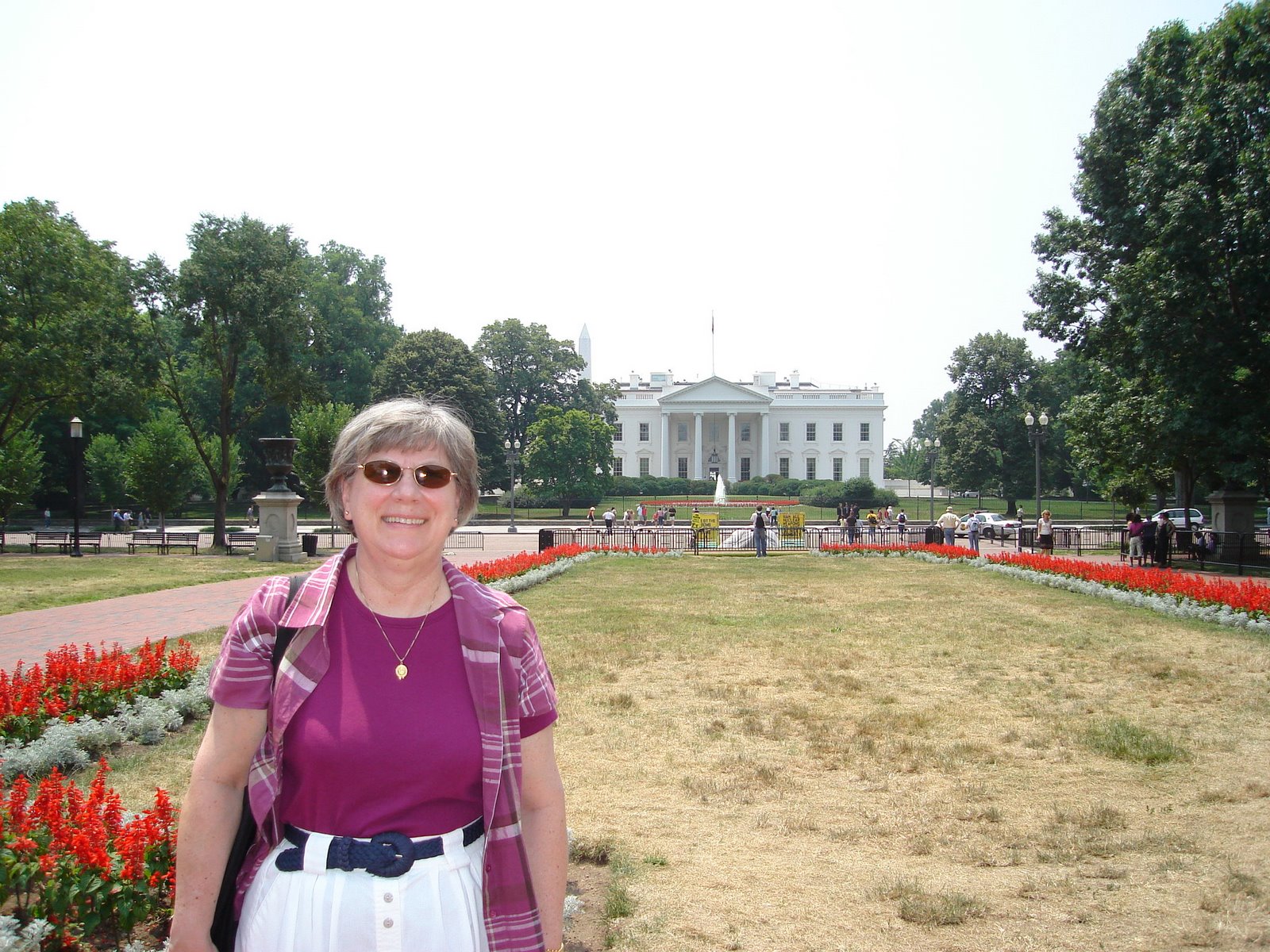 While in Washington, DC, I was able to spend some time visiting with my daughter and son-in-law, Lynn and Donald, and I was able to do a little sight-seeing. Lynn and I toured the National Building Museum where there is currently a wonderful David Macaulay exhibit. This building is where all of the U.S. Presidents have held their Inaugural Balls since 1885. Here is a photo of me with the White House in the background.


 Adam Balcziunas
 Alex K.
 Alexandrea Glenn
 Andrea Pritt
 aprilnkelley
 Ashley Purvis
 Bethann Rea
 blj13
blj13 Brendan Johnson
 Amanda Boyer
 Bret Stiffler
 Bonnie Powers
 Christopher Lemery
 clarewithers
 clblibrarian
 Kelly Clever
 Charlotte M. Johnson
 colemanluzerne
 CRD of PaLA
 crdvirtualjournalclub
 cre5314
 csgarth
 Erin B.
 danajkerrigancv
 denisewetzel1
 Darren G. Poley
 elm43
elm43 Heather Burychka
 James D'Annibale
 Annie Jansen
 Jill Hallam-Miller
 jennifercribbs
 Jenn Monnin
 Jen Hasse
 Jessica Showalter
 johnmeier1
 Julie Durci
 Kelly Safin
 Kim Karim
 Kristen Seikaly
 Kayla Van Osten
 Cecelia Lasley
 librarianjsmith
 Linda Neyer
 mabogino1
 Matthew McNelis
 Meg Massey
 Maggie Savidakis-Dunn
 Rebecca
 miskatoniclibrarian
 Maureen Bentz
 Michele G. Anfuso
 Nicole Miyashiro
 paulmcmonigle
 Rob Sieczkiewicz
 ronlmccoll
 Sam Bardarik
 shannahollich
 smartin592
 Ula Lechtenberg