Let’s Ban all Print Books on College Campuses
Marc Prensky, who coined the term “digital native,” an idea which has been used to label may of our current and future college students as naturally technologically savvy, wrote an inflammatory opinion article that was posted on the Chronicle of Higher Education’s website this past Sunday, Nov. 13th. In this article Prensky advocates for the immediate ban of all print books on college campuses.
“Let me be clear,” he says, “that I’m not advocating that we get rid of the good and valuable ideas, thoughts, or words in books—only that we transfer them to (and have students absorb them through) another form” which would be “transformational, in very positive ways, for education.” Some of these transformations which Prensky cites in his article are the ability of e-readers to collect commentary from professors and other sources, and to link their readers to multiple other texts.
However, perhaps more interesting than the article itself, are some of the comments people have made in response to this article, which total 60 at this point in time. Some of the comments speculate upon the nature of the piece and wonder if it is intended to be a satire or if Prensky is actually serious in making this argument. Other comments point out flaws in this so called “plan,” such as the current cost of e-readers and the fact that the copyright still constrains a lot of what society can do with electronic texts. Still others argue that e-readers and e-books would do nothing to help students learn to think more deeply and critically. There are event comments which are directly related to concerns of librarians, such as the question of who owns all this digital information. And then there is the final comment that I will leave you with,“Someone’s drunk a whole lot of industrial strength industry Kool-Aid”
I will leave it to you to decide….
What is Piazza?
Piazza is not just a beautiful gathering place in Italy; it’s a free interactive Q&A space on the Web for undergraduate students and instructors. Professors from academic institutions like UC Berkeley, MIT, Harvard, and Stanford use Piazza to collaborate, instruct, and connect with their students. The founder and CEO of Piazza, Pooja Sankar, received her graduate degree in Computer Science from the University of Maryland, College Park and has worked in high tech environs such as Oacle, Kosmix, and Facebook. Her most recent endeavor brings together a community of undergraduate students and their instructors. Students receive assistance with their assignments by asking questions, working with each other, and querying their professor. Follow-up discussions about in-class topics may occur as well.
If you are an academic librarian who teaches credit classes, this could be a great resource for you.
Check it out at http://www.piazza.com
Impressions of EDUCAUSE 2011

flickr: educausestaff http://goo.gl/Ajb1L CC-by-nd-nc
With EDUCAUSE in Philadelphia this year, I had the rare opportunity to glimpse the hot issues in higher education from an different prespective: IT. According to the website (educause.edu)…
EDUCAUSE is a nonprofit association whose mission is to advance higher education by promoting the intelligent use of information technology.
The attendees ranged from web developers and instructional technologists to CIOs and VPs of Technology. (And, yes, some librarians!) EDUCAUSE is a large conference with more than 20 sessions running concurrently in each 50 minute slot. There is not as much hands-on as one might expect; it was mostly amazing people reporting on amazing projects and state of the art talks. I found the experience to be very enlightening.
The first session I attended was “Developer’s View of Web Accessibility: Pitfalls, Gotchas, and Solutions” with a panel of Robert Crisler (Director, Internet and Interactive Media,
University of Nebraska – Lincoln), Sue Cullen (Program Manager – Universal Design Center
California State University, Northridge), John Foliot (Manager, Stanford Online Accessibility Program
Stanford University), Terrill Thompson, moderator, (Technology Accessibility Specialist,
University of Washington), and Christian Vinten-Johansen (Info Technology Mgr.,
The Pennsylvania State University). The panelists spoke about very different experiences and different approaches to the issue of access on the web. Some advocated having at least 1 developer in a web shop using a screen reader, while others felt that web developers should not be required to use a reader. One panelist pointed out that a page can be perfectly compliant and still totally unusable. Some of most memorable information concerned managing relationships between lawyers and web developers. One panelist admonished folks not to go down the path of ticking off Section 508 of the ADA requirements or you have already lost.
The next session was a riveting presentation on “The Remixed University” from Hal Abelson, Computer Science and Engineering, at MIT. With MIT’s OpenCourseWare project now 10 years old, the open education movement is coming of age with both positive and negative consequences. Students all over the world now have free access to courses from the best minds in their field – that’s the positive. The publishers, however, who have made a great deal of from the scholarly publishing crisis are now actively fighting back against openness and are starting to “open-wash” or feign openness in a traditional model. The other side of the discussion was faculty research and path from the DSpace vision to the current institutional repository (IR) model. The speaker was a strong advocate for libraries and believes that IR should be the domain of libraries.
Open Educational Resource Commons
Open Courseware Consortium
DuraSpace
In the afternoon, Anya Kamenetz, Senior Writer, at Fast Company Magazine give a talk on “DIY U: Edupunks and the Future of Higher Education” that looked at new emerging models of education. This included the recent efforts of 2 Stanford professors to open up an Artificial Intelligence class to the world (which turned out to be over 160,000 people). She mentioned the possibility of a completely distributed system of educational badges whereby a student learns something in their own time and their own pace and upon demonstrating that knowledge to a badge issuer (museum, library, etc) gets a “credit” (the badge). These badges would be collectable online for viewing by potential employers or educational institutions.
Attending “GameZombie TV: Using Game Media Production to Construct a Project-Based Learning Environment” I was not completely sure what to expect. Once I learned what the project really involved, it was amazing. The idea of GameZombie TV is to make a public internet TV show as part of a core class for the Media Arts & Game Development major. It involves video production, audio production, graphic design, journalism, production management, theatre skills and pieces of other disciplines. The students learn true-to-life skills because the award-winning site IS real and really “out there” on the web. It gives students a sense of ownership and accomplishment.
GameZombie TV
The last session was “Wikipedia and Academia, Friends at Last: Curricular Initiatives in Higher Education” featuring a panel of Richard Knipel, Regional Campus Ambassador,
Wikipedia Education Initiative, Cristian Opazo, Sr. Academic Computing Consultant and Adjunct Faculty, at Vassar College and Christopher Smart, Associate Professor of Chemistry at Vassar College. The panelists discussed examples of editing Wikipedia as a graded assignment. This was interesting as a librarian because Professor Christopher Smart started from a place of skepticism about Wikipedia and was galvanized by student outrage at questioning Wikipedia to explore it further. His students learned a great deal about concise writing for a general audience and took personal ownership of their output. The Wikipedia Educational Initiative now has hundreds of projects of this type all over the world.
List of Educational Wikipedia Projects (Vassar’s project isn’t currently listed)
I would highly recommend taking the chance to go to EDUCAUSE in the future if you have it. More than just technical how-tos, EDCAUSE features leading minds in education with new minted ideas. It is not just relevant to techie librarians, but ALL librarians.
“Stay Hungry. Stay Foolish.”
With the passing of Steve Jobs, I, like many others, have been thinking about his life, work, and legacy. In his 2005 Stanford University Commencement Speech, Jobs urged the graduates to “Stay Hungry. Stay Foolish.” He had read the phrase on the back of a catalog many years before and the saying had stuck because it particularly resonated with him.
You may wonder what all of this has to do with academic librarianship. How does Steve Jobs, considered by many to be a visionary genius, a presenter/marketer par excellence, a noted driven perfectionist — how could he relate to what we do as librarians? I think that the connections and lessons-to-be-learned are readily apparent by reading and pondering some of his notable quotes. The quotes below and many more can be found at <http://blogs.wsj.com/digits/2011/08/24/steve-jobss-best-quotes/>.
When you’re a carpenter making a beautiful chest of drawers, you’re not going to use a piece of plywood on the back, even though it faces the wall and nobody will ever see it. You’ll know it’s there, so you’re going to use a beautiful piece of wood on the back. For you to sleep well at night, the aesthetic, the quality, has to be carried all the way through.” [Playboy, Feb. 1, 1985]
[Strive for excellence in everything you do or attempt to do.]
“Being the richest man in the cemetery doesn’t matter to me … Going to bed at night saying we’ve done something wonderful… that’s what matters to me.” [The Wall Street Journal, May 25, 1993]
[Take pride in what you do.]
“You can’t connect the dots looking forward; you can only connect them looking backwards. So you have to trust that the dots will somehow connect in your future. You have to trust in something — your gut, destiny, life, karma, whatever. This approach has never let me down, and it has made all the difference in my life.” [Stanford commencement speech, June 2005]
[Imagination is key.]
“When I was 17, I read a quote that went something like: “If you live each day as if it was your last, someday you’ll most certainly be right.” It made an impression on me, and since then, for the past 33 years, I have looked in the mirror every morning and asked myself: “If today were the last day of my life, would I want to do what I am about to do today?” And whenever the answer has been “No” for too many days in a row, I know I need to change something.“Remembering that I’ll be dead soon is the most important tool I’ve ever encountered to help me make the big choices in life. Because almost everything — all external expectations, all pride, all fear of embarrassment or failure — these things just fall away in the face of death, leaving only what is truly important. Remembering that you are going to die is the best way I know to avoid the trap of thinking you have something to lose. You are already naked. There is no reason not to follow your heart.” [Stanford commencement speech, June 2005]
[In other words, “Stay Hungry. Stay Foolish.”]
PaLA 2011 – CRD Sessions
While the 2011 PaLA Conference is still fresh in everyone’s mind, I wanted to share some photos that I took of some of the presenters.

Larissa Gordon
Larissa Gordon had the honor (or was it the horror?) of presenting the first CRD session at the conference. She talked about how the librarians at Arcadia University are collaborating with the Program Coordinators for the First Year Seminars and English 101 to establish Information Literacy goals and Student Learning Assessments for both of these courses. Larissa’s PPT slides: Assessment as a Collaborative Activity
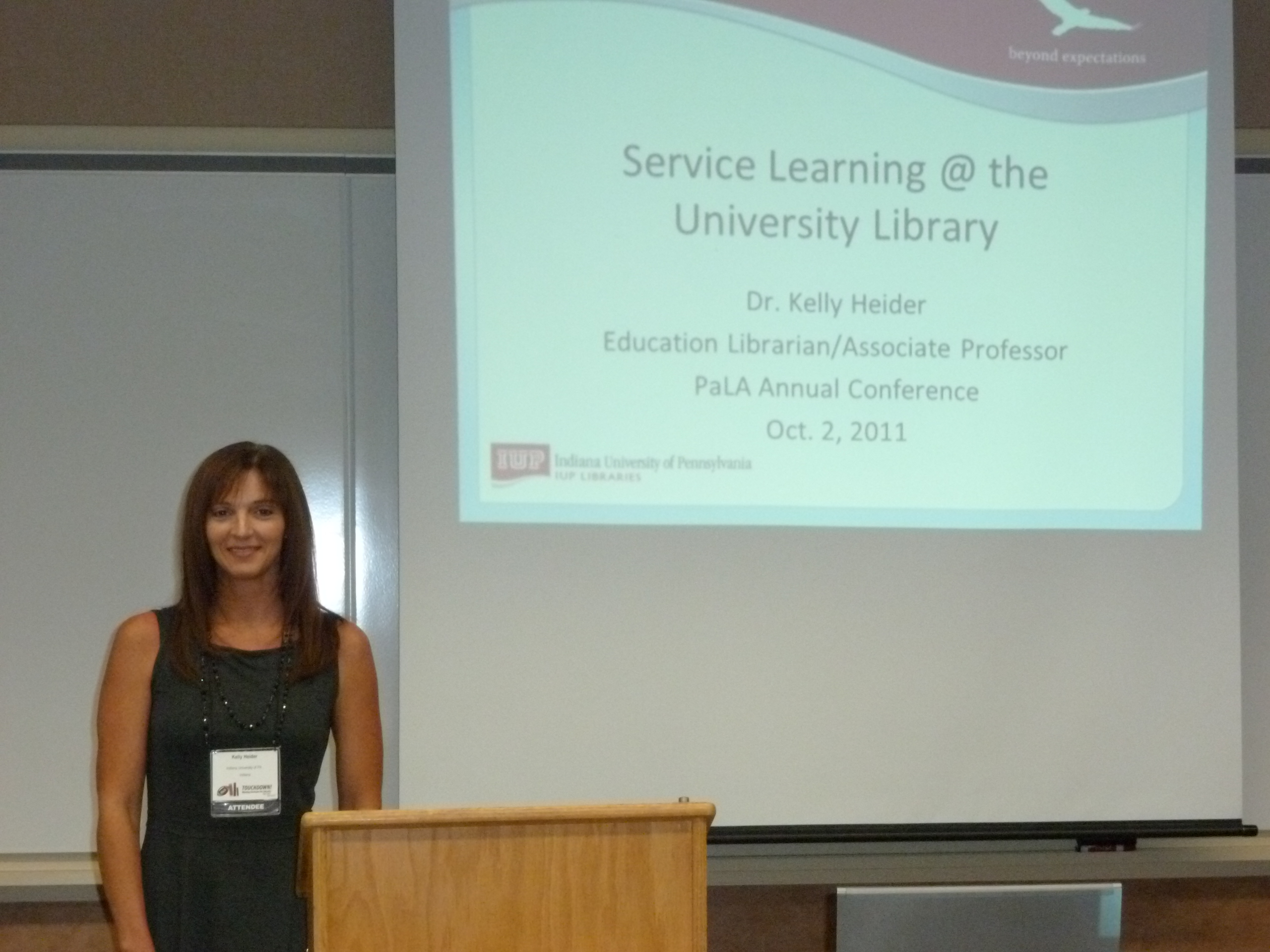
Dr. Kelly Heider
Dr. Kelly Heider, the Education Librarian at Indiana University of Pennsylvania, spoke about Service Learning and more specifically about a Service Learning opportunity that the IUP library offers to education majors, Wild about Books. The best part about this session was that attendees were given the opportunity to brainstorm about how they could develop their own Service Learning Programs.

Kristen Yarmey-Matthew Ciszek-Tara Fay
A Safe Space on Campus was the topic of the presentation given by Kristen Yarmey, Digital Services Librarian, and Tara Fay, Faculty Specialist, The University of Scranton; and Matthew Ciszek, Head Librarian, Penn State Shenango. A copy of their slides can be found on Slide Share: http://www.slideshare.net/kristenyt
Unfortunately, attendance at Sunday’s sessions was less than expected. I guess that a lot of people have good intentions and indicate that they will attend, but then get a later start than they intended or become involved in some other aspect of the conference.
Monday featured two CRD sessions at each time slot so apologies to the presenters in the three sessions that I missed.
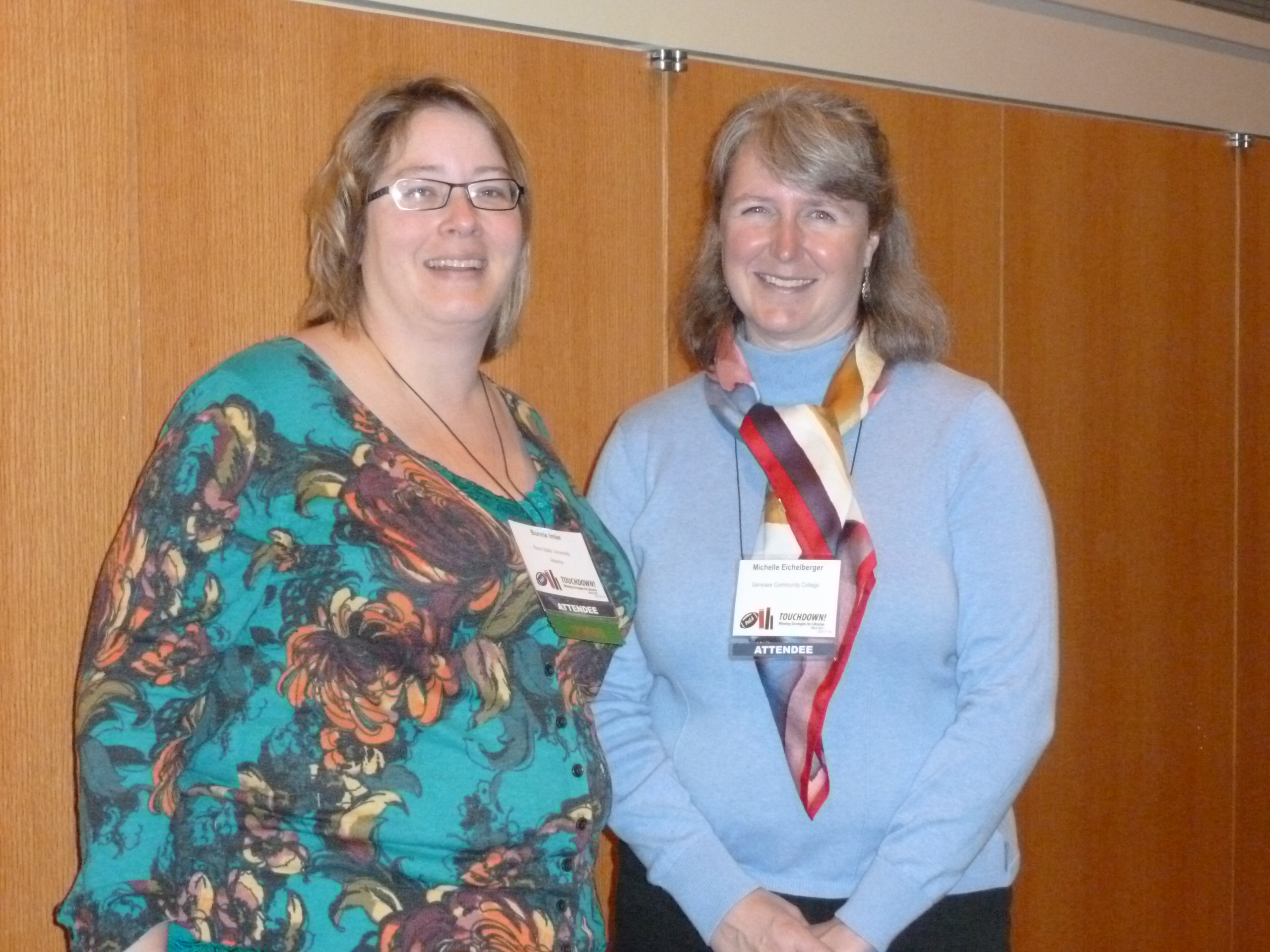
Bonnie Imler-Michelle Eichelberger
Bonnie Immler, Information Technology Librarian, Penn State Altoona, and Michelle Eichelberger, Systems and Electronic Services Librarian, Genessee Community College, presented the results of their research that used video screen capture with undergraduate students. Here are their PowerPoint slides: UndergradResearchBehavior.
Also in this time slot was A Librarian’s Guide to Near Field Communication presented by Sheli McHugh and Kristen Yarmey. A copy of their slides can be found on Slide Share: http://www.slideshare.net/kristenyt
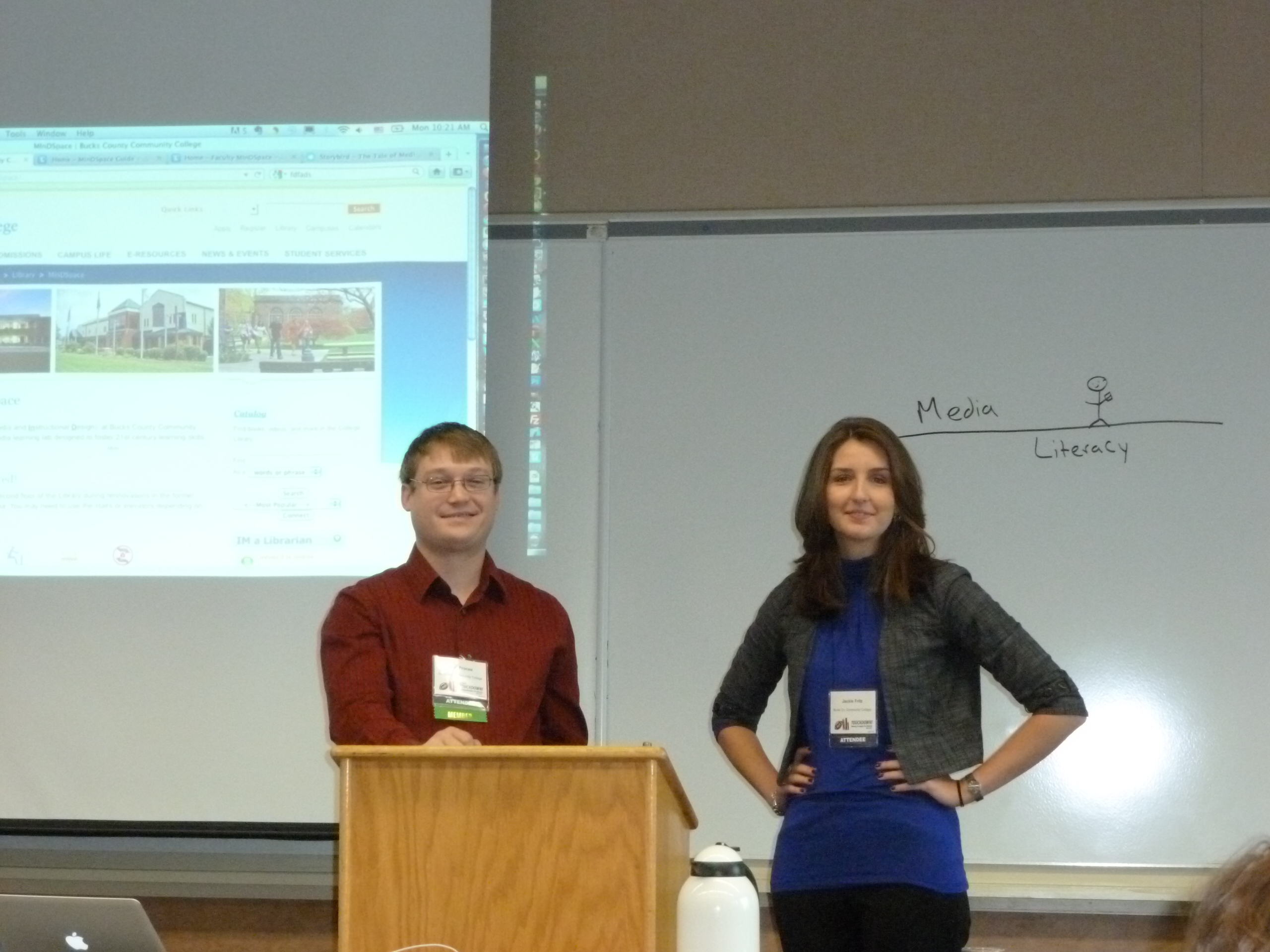
Paul Process-Jacqueline Fritz
Walking the Information Media Tightrope, presented by Paul Proces, New Media Librarian, and Jacqueline Fritz, Faculty Liaison, Learning Technologies, focused on the media literacy program at Bucks County Community College. To learn more, visit the Media and Instructional Design Space (MInDSpace) on the college’s Web site.
Russell Hall, Reference Librarian at Penn State Erie, shared the results of his survey of Academic library managers in his session titled, Nature, Nurture and the Pennsylvania Academic Library.
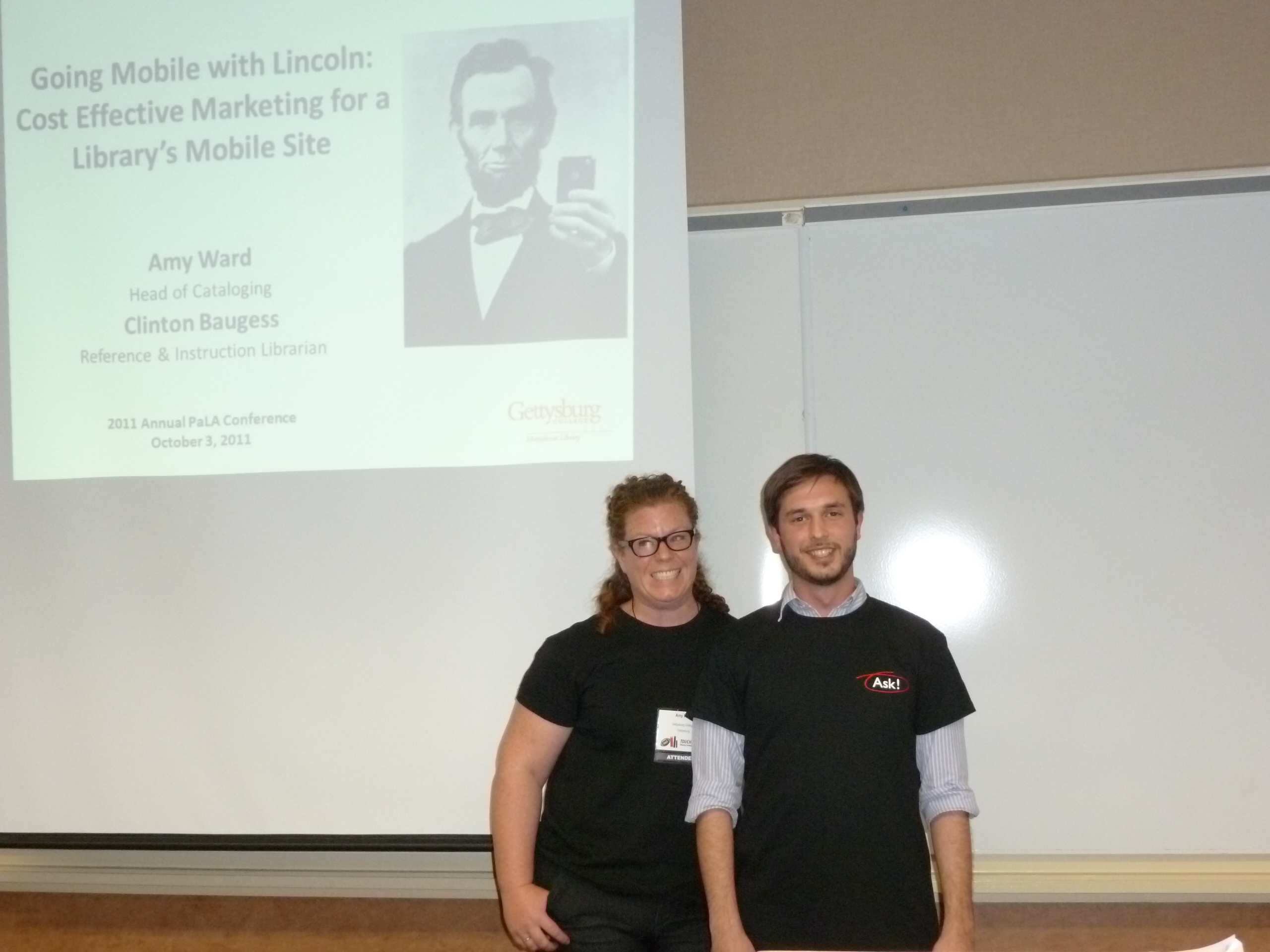
Amy Ward-Clinton Baugess
In their session, Going Mobile with Lincoln, Amy Ward, Cataloging Librarian, and Clinton Baugess, Reference & Instruction Librarian, shared how the Musselman Library at Gettysburg College created a marketing campaign to promote accessing the library’s website through mobile devices. After their presentation, they provided attendees with an opportunity to identify who their target audience would be and how they would create their own marketing campaign.
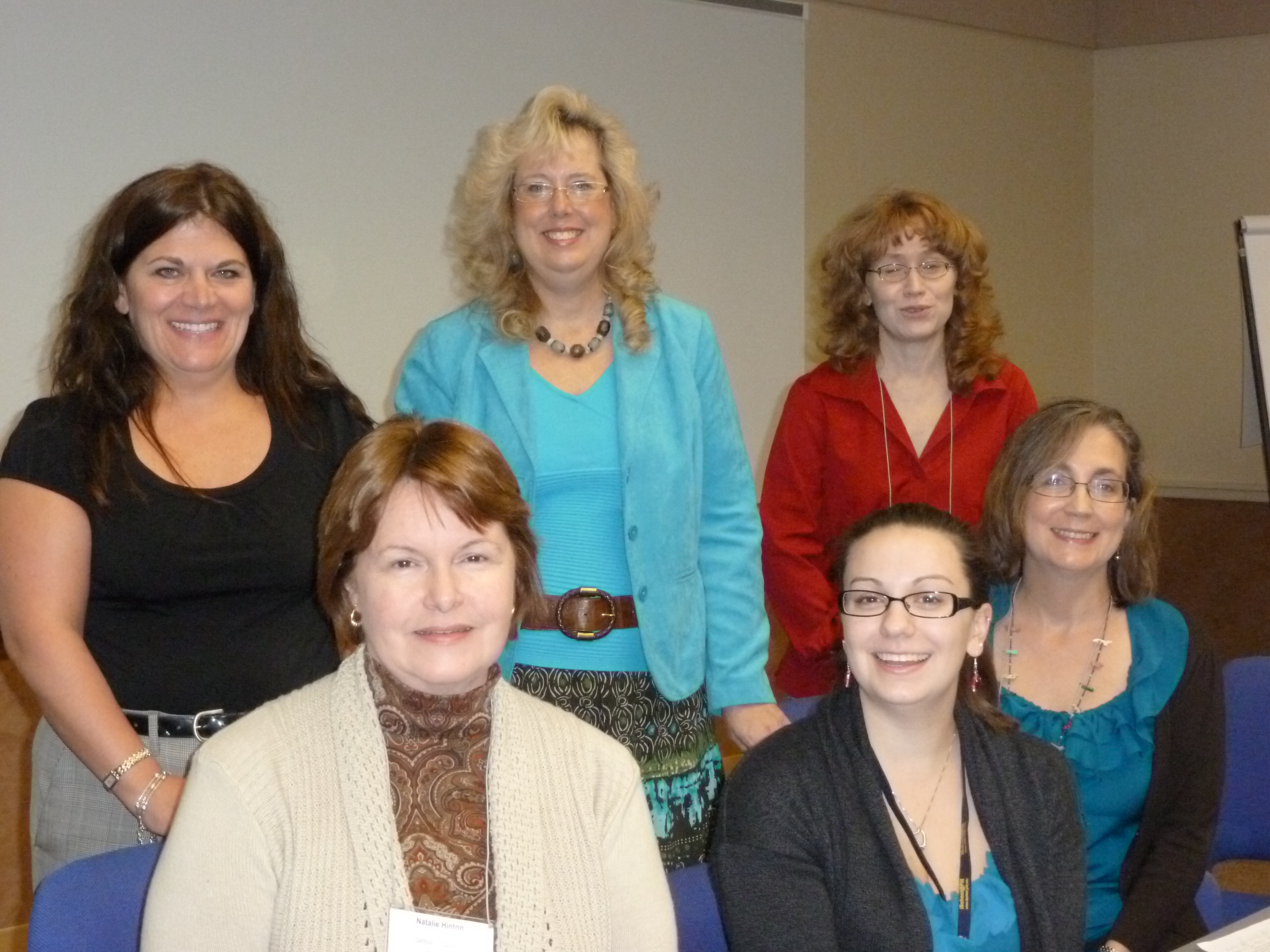
Gaining Insight Presenters
Librarians Ronalee Ciocco, Natalie Hinton, and Kaitlyn Lynons from Gettysburg College, and Theresa McDevitt, Michele Corcoran, and Beth Farabaugh from Indiana University of Pennsylvania shared ways that they used to successfully gain insight about their patrons’ viewpoints, including surveys, focus groups, usability testing, and floor plan drawing.
In the session, Demonstrating the Value of Academic Libraries, Rachel McMullin, Humanities and Information Literacy Librarian at the Green Library shared how West Chester University is collaborating with academic departments to assess information literacy using rubrics. For more information, go to her Information Literacy Research Guide. Melissa Gold, Science Librarian at Millersville University explained how she created a curriculum for the Ganser Library using the process of curriculum mapping. Here are her PowerPoint slides: Curriculum Mapping. Colleges and Universities have recently begun to utilize online Assessment Management software. Scott anderson, Information Systems Librarian, explained how the Ganser Library Millersville University is using WeaveOnline and Dick Swain, Director of Library Services, showed how West Chester University is using TracDat and LibPAS.
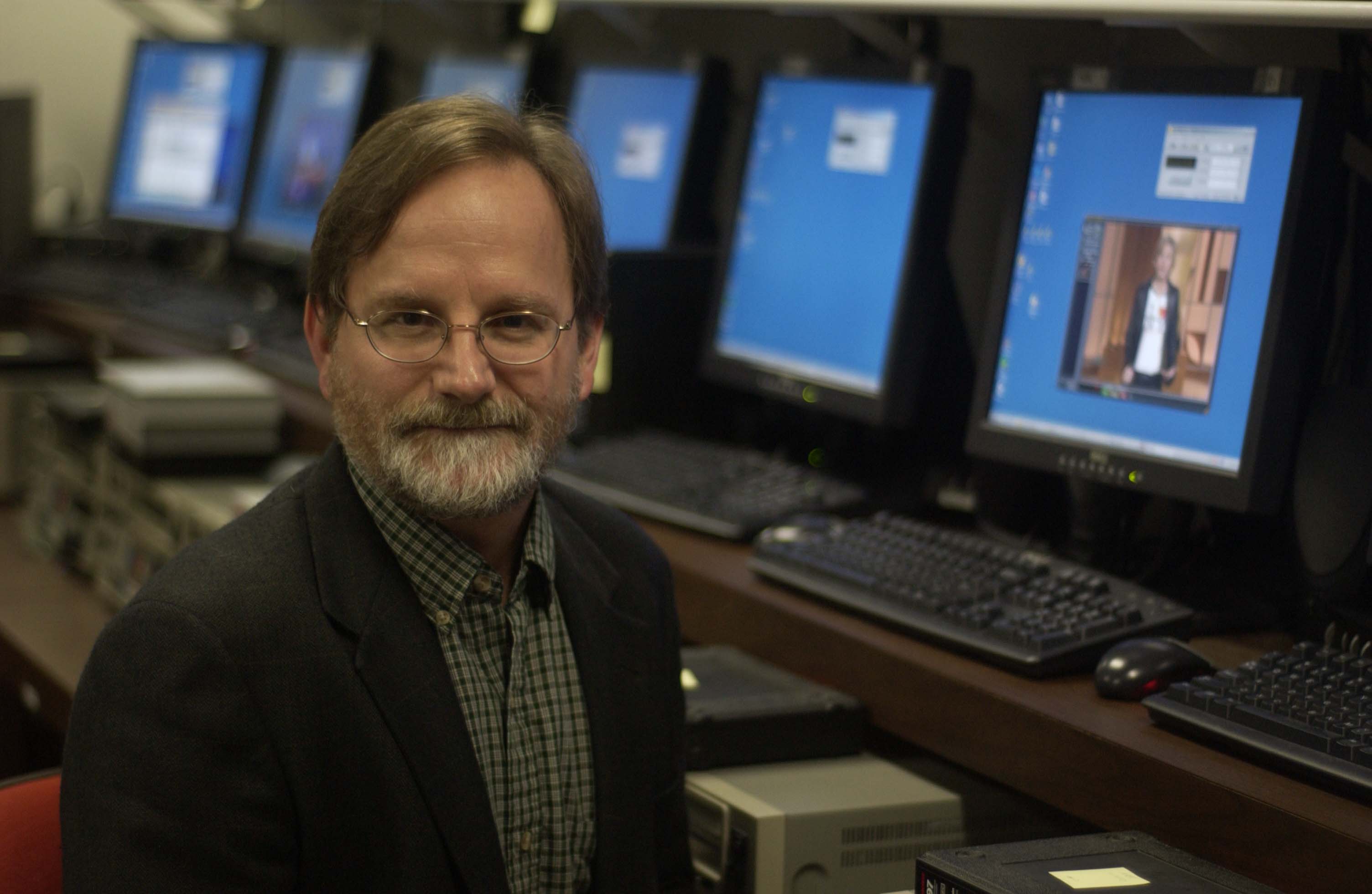
Marshall Breeding
One of the highlights of the PaLA Conference each year is the College & Research Division Luncheon and this year was no exception. I had the honor of meeting and introducing Marshall Breeding, Director for Innovation Technologies and Research at the Vanderbilt University Libraries. His presentation titled, Beyond the ILS: Introduction and Future Directions, described the emerging products and services for library automation that aim to address the new realities that include increased emphasis on delivering access to electronic resources and digital collections.
Wednesday morning featured Donna Mazziotti, Public Services Librarian, and Teresa Gretano, English Professor, from The University of Scranton in a session titled, Rethinking Information Literacy. Based on the research that they gleaned from a course that they co-taught on Rhetoric and Social Media, their presentation made a case for an updated definition of Information Literacy that takes into consideration the effects of social media practices on students’ information seeking behavior.
Darla Bressler and Kathryn Yelinek, Reference Librarians at Bloomsburg University, presented Shush No More: Accommodating Noise in Today’s Library. There session featured time for attendees to discuss what has/hasn’t worked for other libraries. Here is a link to their PowerPoint slides: Shush No Moreand to their Sush No More Handout.


 Adam Balcziunas
 Alex K.
 Alexandrea Glenn
 Andrea Pritt
 aprilnkelley
 Ashley Purvis
 Bethann Rea
 blj13
blj13 Brendan Johnson
 Amanda Boyer
 Bret Stiffler
 Bonnie Powers
 Christopher Lemery
 clarewithers
 clblibrarian
 Kelly Clever
 Charlotte M. Johnson
 colemanluzerne
 CRD of PaLA
 crdvirtualjournalclub
 cre5314
 csgarth
 Erin B.
 danajkerrigancv
 denisewetzel1
 Darren G. Poley
 elm43
elm43 James D'Annibale
 Annie Jansen
 Jill Hallam-Miller
 jennifercribbs
 Jenn Monnin
 Jen Hasse
 Jessica Showalter
 johnmeier1
 Kelly Safin
 Kim Karim
 Kristen Seikaly
 Kayla Van Osten
 Cecelia Lasley
 librarianjsmith
 Linda Neyer
 mabogino1
 Matthew McNelis
 Meg Massey
 Maggie Savidakis-Dunn
 Rebecca
 miskatoniclibrarian
 Maureen Bentz
 Michele G. Anfuso
 Nicole Miyashiro
 paulmcmonigle
 Rob Sieczkiewicz
 ronlmccoll
 Sam Bardarik
 shannahollich
 smartin592
 Ula Lechtenberg
 It's Academic