Happy New Year!
As we begin a new year, I’d like to thank the members of the 2011 Board for facilitating my job as Chair, especially Linda Neyer for stepping up when needed. It was a very busy and productive year.
On March 1, we launched this Blog/Website, It’s Academic <crdpala.org>, to which Board members have been posting regularly on topics of interest to academic librarians and our readership is growing.
For 2010-2011, CRD received a $22,000 Library Services and Technology Act (LSTA) grant in support of professional development opportunities for academic librarians in PA from the State Library, which supported the following:
1. CRD sessions at the 2010 PaLA Conference.
2. The CRD Annual Spring Workshop, “Higher Ed Assessment: How do libraries measure up?” held on Tuesday, May 17, 2011 featured Megan Oakleaf, author of the recent ACRL publication: The Value of Academic Libraries: A Comprehensive Research Review and Report.
3. Programs and workshops offered by 7 PaLA units as well as the ARCL-Delaware Valley Chapter’s fall program; the PA Information Literacy Learning Community’s first-ever face to face meeting; the Tri-State College Library Cooperative’s annual program; “Copyright, Education, and You,” a program at Muhlenberg College by Duke University Attorney and Librarian Kevin Smith; and a program featuring John D. Shank speaking about the capability of digital learning materials at Kutztown University.
CRD sponsored two academic librarians to attend the 2011 PaLA Academy of Leadership Studies–Stephanie Riley, Reference Librarian and Assistant Professor at the Gabriele Library, Immaculata College and Tara Wink, Temporary Special Collections Librarian at the F.H. Green Library, West Chester University. In collaboration with CRD, several of the academic librarians who attended PALS developed a survey to ascertain how CRD can increase its value. We are looking for input from both members and non-members of PaLA so I encourage you to please take the time to complete the survey when it is distributed later this month.
Stay tuned for another exciting year in 2012!
“Why Johnny Can’t Search”
In November Wired.com featured an article discussing the problems that students have searching for information online. To librarians, this is not much of a revalation, but this article is noteworthy because it did not appear in an publishing source primarily focused on education or librarianship.
The article discusses a study which proves that students are not searching critically or “assessing information sources on their own merit.” Instead “they’re putting too much trust in the machine.” Librarians are also particularly mentioned in the article as champions of information searching: “Librarians are our national leaders in this fight; they’re the main ones trying to teach search skills to kids today.”
This looks like another good article to circulate among faculty or post online to encourage the university to appreciate all that librarians have to offer!!!! Lets use the publicity we are given and market ourselves as the one group of people who can help solve this problem, a concern which more and more people, people located outside of the library or the world of education, are becomming aware about.
Media assignments and copyright in the library
 Copyright issues are a frequent concern with media assignments — for the librarian & professor — but not, perhaps, the student. In my informal observation, students will go to Google images directly after hearing an informational literacy session on copyright. Librarians have taken a few different approaches to dealing with these issues: information about copyright or the research process, a “scared straight” listing of the dire consequences of plagiarism and providing alternatives. Posit: providing alternatives is the best option. Here is why:
In “Facilitating Students’ Intellectual Growth in Information Literacy Teaching,” Gabrielle Wong urges librarians to be mindful of the students’ level of intellectual development. The article references the seminal work by Kurfiss in enumerating four stages of intellectual development:
Level 1: Dualism, knowledge as facts. Students believe that knowledge is a collection of discrete facts; therefore learning is simply a matter of acquiring information delivered by professors, who are viewed as the authority of right answers.
Level 2: Multiplicity, knowledge as opinion. Students realize that conflicting opinions, theories, and points of view are inevitable features of knowledge. Without understanding the reasons behind the different perspectives, they attribute them to personal opinions, all of which they treat as equal.
Level 3: Relativism, knowledge as reason. Students recognize that not all opinions are equal; points of view should be backed up by good logic and evidence. They learn the importance of evaluating an issue by weighing multiple factors.
Level 4: Commitment in relativism, knowledge as commitment. Individuals take a position and make commitments of what they choose to do or believe. They are committed to nurturing ideas and developing themselves intellectually.
Students starting out at college (those normally the most widely reached by IL programs) are in the first 2 levels. Librarians know if one asks 3 copyright experts one can expect 3 interpretations of the fair use defense. Copyright is a very complex issue and the final “knowledge as commitment” decisions on copyright at an institution is an interplay of risk and reward analysis, interpretation of the law, knowledge of case law, risk adversity, and institutional culture.
In deciding whether to use a copyrighted image in a YouTube video, for example, as student may consider the following:
- If I get sued for infringement is a fair use argument a viable strategy for defending my actions? Which begs the question…
- Is it worth it for me to go to court over this assignment considering the cost and likelihood of success? All of which is obviated by…
- Do I have the knowledge of DMCA take down procedures to understand that it is a “guilty until proven innocent” system whereby the owners have the right to demand take down until I prove a fair use exception in a process that will likely extend far beyond the due date of my assignment?
Further complicating the decision is “fair use guidelines” or “checklists,” which differ depending on the source and are not enshrined in law, but instead derived from case law.
This all speaks against the usefulness of giving students who recognize facts or equally valid opinions as the foundations of knowledge: they simply do not possess the intellectual development to make sense and decide copyright use-cases for themselves.
The “scared straight” option, on the other hand, runs contrary to the students’ experiential knowledge and perceptual inclinations. The data on plagiarism are a notoriously difficult set to pin down, but studies show that some students plagiarize on a regular basis and consequences are not always forthcoming. The numbers range widely as do the methodologies and a quick search in ERIC will highlight the controversies and difficulties. Considering all this, however, it is fair to say that some significant percentage of students have ambivalent perceptions about plagiarism and copyright violations online.
In sum, present materials licensed for educations as an “alternative” option without making much mention of copyright laws, rights, issues, or cases. Framing Creative Commons to students as, “Wow, the artists want you to use this to do creative projects and all they ask for is a little credit” works to change the student’s perception more than enumerating the academic policies on plagiarism or trying in 50 minutes or less to wade into the morass of copyright law before students are ready.
Kurfiss, Joanna G. Critical Thinking: Theory, Research, Practices, and Possibilities. ASHE-ERIC Higher Education Report No. 2, (Washington, D.C.: The George Washington University, Graduate School of Education and Human Development, 1988)
Wong, G. W. (2010). Facilitating Students’ Intellectual Growth in Information Literacy Teaching. Reference & User Services Quarterly, 50(2), 114-118.
Call for Volunteers
 Happy Monday-after-Thanksgiving! I hope you’re feeling rested and refreshed. If you’re like me, you spent part of your holiday playing professional catch-up, reading articles, blog posts, books, what-have-you, and mentally mapping out a research project or two. For someone who enjoys librarianship, this isn’t work; it’s a labor of love. However, I admit to moments of wanting to chuck the whole thing and live “off the grid.” I think most of us feel at times the work we do is not valued by others, and I am no exception. Support from others is needed to stay positive and engaged, and at these moments my husband is my best friend and therapist. (Thank you, dear!)
An administrator on my campus recently told me in conversation that, in his opinion, faculty are very good at what they do but not very good at explaining how it contributes to the University’s mission. Faculty (and librarians are faculty on my campus) are often so involved, he said, in their own disciplines/silos that they do not see the bigger picture. I’m sure this has always been true in higher ed, but now it seems we must see the bigger picture and think of terms not only of contributing to our institutions’ missions but also of building the perception that we contribute to them.
How to do this? To begin, we can follow Megan Oakleaf’s advice in her recent editorial for College & Research Libraries, “Do the Right (Write) Thing”:
Librarians might begin their value research by asking themselves the questions, “What part of my job makes the biggest difference in the lives of students, faculty, or administrators at my institution? In what ways does my work impact their ability to meet their goals, outcomes, or missions?” Once librarians articulate library value in these terms, they might also ask themselves, “Do I have evidence of my impact? How might I gather that evidence in an ethical and purposeful way? Who might I share that evidence with?”
Once we’ve thought that through, we need to collect our evidence, write it up, and present it to our decision-makers to support our requests for resources, staff, and so on. Oakleaf again:
To institutional decision makers, small-scale, local studies can be just as convincing, and sometimes even more compelling, than large-scale studies involving other institutions… Even the major disadvantage of local studies, the perception or reality of “self-serving” results, can be counteracted by following ethical, responsible research practices and by clearly stating all study limitations.
Finally, we need to share our “small-scale, local studies” to support and learn from each other. There are many ways to do this in our growing professional literature. For example, the blog In the Library with the Lead Pipe publishes peer-reviewed blog posts that are indexed in LISTA. Another growing area is that of open access journals. A quick perusal of the Directory of Open Access Journals (DOAJ) reveals over 120 open access library and information science journals, including the following:
code{4}lib
Collaborative Librarianship
Communications in Information Literacy
D-Lib Magazine
Evidence Based Library and Information Practice
Interdisciplinary Journal of E-Learning and Learning Objects (IJELLO)
Issues in Informing Science and Information Technology (IISIT)
Issues in Science & Technology Librarianship: A Quarterly Publication of the Science & Technology Section, Association of College & Research Libraries
Journal of Information Literacy
Journal of Library Innovation
Journal of the Medical Library Association
Kansas Library Association College & University Libraries Section Proceedings
Library and Information Research
Library Issues
North Carolina Libraries
Virginia Libraries
Whatever the format, these publications/blogs do a wonderful job of supporting the profession and continuing the conversation among librarians about how to demonstrate our value as a profession. The CRD Board would like to join this conversation. At its last meeting the CRD Board officially approved the concept of a CRD-sponsored, online, peer-reviewed (or peer-invited), open access journal for PA librarians. The Board agreed to form an ad hoc committee to explore the concept and develop a plan. The intent is the journal will publish articles on “small-scale, local” research being done by Pennsylvania librarians (academic, public, school, or special) and possibly contain short videos of individuals giving presentations or demos, similar to JoVE (Journal of Visualized Experiments). At this point, we have no limits in mind (OK, some limits — there are not unlimited funds : ).
As incoming CRD Chair, I will form an ad hoc committee to explore how to proceed, considering things like scope, audience, frequency, platform, costs, indexing, etc. I am seeking at least 6 volunteers, PaLA members, who have an interest in and/or expertise with writing, using social media, publishing, or designing. If you are interested in volunteering, please send me a brief email at lsn5383 (at) gmail (dot) com detailing your interest and background by December 17th. I anticipate the committee will start up at the end of January, meeting primarily online using Skype. If you have any questions or comments, you can either post them here or contact me by email. Thanks!
Library Journal/ Temple University: #futurelib11


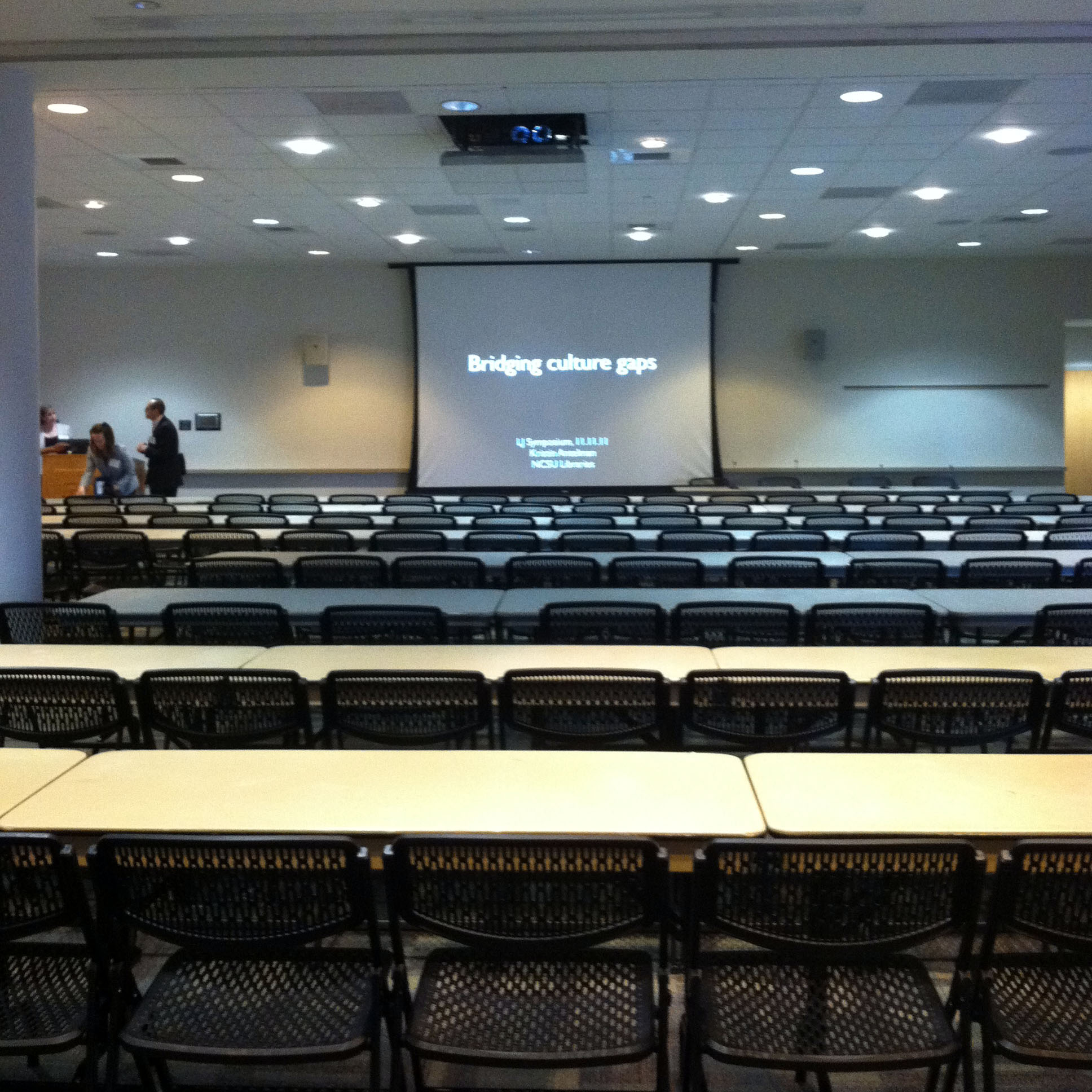
Last Friday I participated in a panel discussion during the LJ/Temple Academic Library Symposium in Philadelphia. I really enjoyed the smaller, more intimate setting of this one day conference. The organizers did a great job of inviting a wide variety of front lines, new, and more experienced librarians and administrators to reflect on some really tough issues within the field.
I took some notes during Kristin Antelman’s keynote address on bridging culture gaps. Antelman is the Associate Director for the Digital Library at North Carolina State University and I found her talk to be inspiring and a good framework for the rest of the event:
- Gap: Everybody vs IT – communication style, constrained resources, decision making process
- Gap: Everybody vs administration
- What preconceptions do we bring? Agendas & past experience. Organizational myths with meaning attached
- Where is the real power/influence within the organization? Doesn’t necessarily align with positional power
- Information & trust = keys to bridging the gaps
- Scary gap: Library as a symbol – there is a common understanding of the purpose of libraries but also stereotypes relating to librarians as “guides” through information overload. We “can’t build on sand”
- Scary gap: Library as brand – google “library” = books
- Organizational culture – competing values framework by Cameron & Quinn, adhocracy (new term for me)
- New leaders want to move from hierarchy to autocracy, that’s the biggest gap
- Organizational life is not static, could be cyclical
- Do we have a strong or weak organizational culture?
- Assess gaps and set goals. Be in perpetual beta, ask forgiveness, choose “either/or” not “both/and”
- Can there be a shared vision if there is not a shared understanding?
- Some projects never leave the gate because people want assurance up front that it will be a success (how do we change this expectation?)
- Consensus model is unwieldy, inclusiveness hinders progress
- People who aren’t contributing – how do we deal with this?
- Affinity group or team based approach instead of committees – opt into a project
To read recaps/reviews by other presenters and attendees, check out the following blog posts
- Academic Library Summit: Bridging the Gaps, by Courtney Young, Head Librarian and Associate Professor of Women’s Studies at Penn State Greater Allegheny Campus
- Getting Past Misunderstanding, by Andy Burkhardt, Emerging Technologies Librarian at Champlain College
- the future of academic libraries, by Shannon Marie Robinson, Access Services Librarian at the Philadelphia University of the Arts
or search for the Twitter hashtag #futurelib11.
What are your thoughts on bridging the different gaps we have within academic libraries? What gaps are we missing in these conversations – beyond generational, IT, diversity, experience, leadership, administration, change-agents/resistors, status, cultural, etc?
_________________________________________
Erin Dorney is the Outreach Librarian at Millersville University of Pennsylvania and outgoing Treasurer of the PaLA College & Research Division. She can be found on Twitter at libscenester and blogging at www.libraryscenester.wordpress.com.


 Adam Balcziunas
 Alex K.
 Alexandrea Glenn
 Andrea Pritt
 aprilnkelley
 Ashley Purvis
 Bethann Rea
 blj13
blj13 Brendan Johnson
 Amanda Boyer
 Bret Stiffler
 Bonnie Powers
 Christopher Lemery
 clarewithers
 clblibrarian
 Kelly Clever
 Charlotte M. Johnson
 colemanluzerne
 CRD of PaLA
 crdvirtualjournalclub
 cre5314
 csgarth
 Erin B.
 danajkerrigancv
 denisewetzel1
 Darren G. Poley
 elm43
elm43 James D'Annibale
 Annie Jansen
 Jill Hallam-Miller
 jennifercribbs
 Jenn Monnin
 Jen Hasse
 Jessica Showalter
 johnmeier1
 Kelly Safin
 Kim Karim
 Kristen Seikaly
 Kayla Van Osten
 Cecelia Lasley
 librarianjsmith
 Linda Neyer
 mabogino1
 Matthew McNelis
 Meg Massey
 Maggie Savidakis-Dunn
 Rebecca
 miskatoniclibrarian
 Maureen Bentz
 Michele G. Anfuso
 Nicole Miyashiro
 paulmcmonigle
 Rob Sieczkiewicz
 ronlmccoll
 Sam Bardarik
 shannahollich
 smartin592
 Ula Lechtenberg
 It's Academic