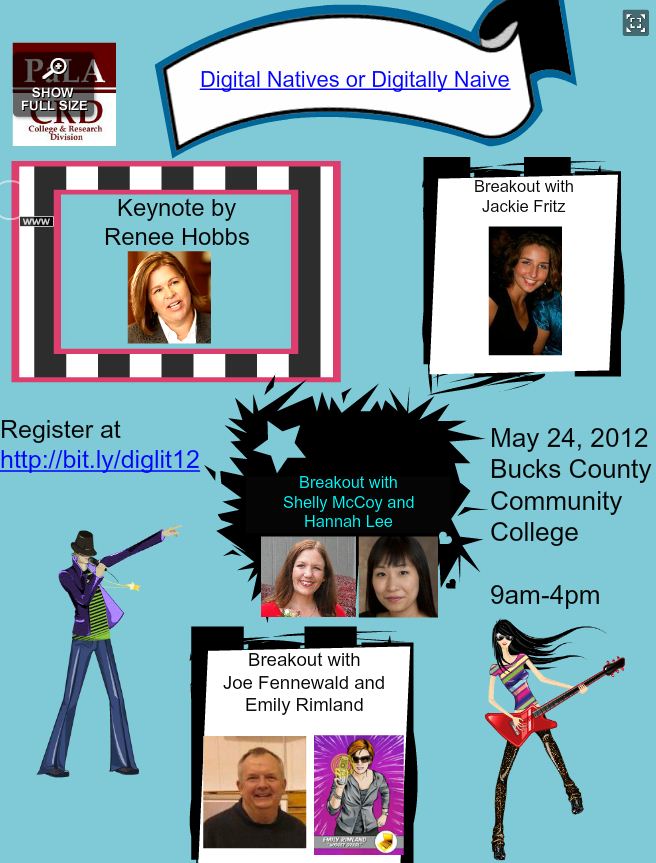
Register at http://bit.ly/diglit12 by May 18th. See our Upcoming Events page for more information about the program at Bucks County Community College.
“This project is made possible by a grant from the U.S. Institute of Museum and Library Services as administered by the Pennsylvania Department of Education and the Commonwealth of Pennsylvania, Tom Corbett, Governor, through the College and Research Division (https://crdpala.org/) of PaLA. Show your appreciation by becoming a member of PaLA! And if you are a member – thank you!”
CRD Board Candidates for 2013
Following are the PaLA-CRD members running for the CRD Board for 2013.
VICE-CHAIR/CHAIR ELECT:
Valerie Ann Lynn, Head Librarian, Penn State Hazleton
Serving as a member of the CRD Board for the last several years has been a pleasure and has allowed me to participate in a number of activities including evaluating course proposals for the annual PaLA meeting and writing blog posts. As a member of the Connect & Communicate sub-committee of the CRD Board I recognize the importance of offering relevant timely programming. I am very interested in service and leadership and have experience as a member of the Medical Library Association Continuing Education Committee and Liaison to the National Program Committee 2012. In my current position as Head Librarian at the Penn State Hazleton campus I am pursuing the development of a Knowledge Commons. I have an MLS from the University of Pittsburgh and an MSIT from Bloomsburg University. It would be an honor to serve as the CRD Vice-Chair/Chair Elect.
SECRETARY:
Jennifer V. Luksa, Head of Collection Resource Management, Bevevino Library, Misericordia University
I am the Head of Collection Resources Management at Misericordia University, where I have been employed for more than 18 years. I received my bachelor’s degree in American studies from Penn State University and my master’s degree in library and information science from Drexel University. I am also a 2009 graduate of the Pennsylvania Academy for Leadership Studies (PALS). I have served on the PaLA Scholarship Committee and the Nominating Committee for the Northeast Chapter of PaLA. Currently, I am serving as the Membership Liaison for the CRD Board, and I am involved with the planning committee for 2012 PALS. As an academic librarian, I see the importance of being involved with PaLA, and I appreciate the opportunity that I have to serve on the CRD Board. CRD provides academic librarians from across the state the opportunity to collaborate on issues and challenges that face our libraries today. If elected secretary, it would be an honor to continue serving PaLA and CRD.
James Maccaferri, Ph.D., Associate Professor, Department of Library Science, Clarion University of Pennsylvania
I have been a member of PaLA since 1998, and have served as treasurer (2002-2003), Technical Services Roundtable chair (2003-2004), and Preservation Roundtable chair (2004-2005). I am also active in the ACRL Western Pennsylvania/West Virginia Chapter, currently serving on the nominations committee. I believe that CRD makes an extremely positive contribution to continuing education opportunities for academic librarians and would like to be part of that process. My MLS and PhD (Modern Middle East History) are both from UCLA, and I have been on the library science faculty of Clarion University of Pennsylvania since 1991, where I teach in the areas of cataloging and classification, preservation, and technical services. I have also taught at UCLA and at San Jose State.
Allyson Valentine, Adjunct Reference & Instruction Librarian, HACC Lancaster, Brossman Library
I am an adjunct Reference and Instruction Librarian at HACC Lancaster and I also teach Information Literacy courses at York College. I received my MLS in 2009 from Clarion University and I have my BA in English. I am a 2010 PALS graduate and I have been on the PALS planning committee for the last two years. Currently, I am the Academic Chair for the South Central Chapter of PaLA. I would love the opportunity to further be involved in PaLA and serve the CRD as Secretary.
CRD Workshop ’12 Schedule and Registration
There’s still plenty of time to register for the Spring Workshop, “Digital Natives or Digitally Naive”.
Tentative schedule:
9:00 am – 9:45 am – Registration and Breakfast
10:00 am – 10:15 am – Introduction and Housekeeping
10:15 am – 11:15 am –
Keynote: So You Want to Get Started with Digital & Media Literacy? Considering the Why, Wherefore and How
Renee Hobbs, Professor and Founding Director
Harrington School of Communication and Media, University of Rhode Island
11:15 am – 11:30 am – Break
11:30 am – 12:30 pm – Discussion: The Four Dimensions of Digital Literacy
12:30 pm – 1:15 pm – Lunch
1:15 pm – 1:30 pm – Brief CRD Business Meeting
1:30 pm – 2:30 pm – Concurrent Breakout Sessions:
Collaborating to Revitalize Student Learning
Jackie Fritz, Faculty Liaison for Learning Technologies, Bucks County Community College
The Knowledge Commons at Penn State
Joe Fennewald, Head of the Tombros and McWhirter Knowledge Commons & Emily Rimland,
Information Literacy Librarian and Learning Technologies Coordinator, Penn State University Libraries
Multimedia Literacy: A Plan to Get Started
Shelly McCoy, Head Student Multimedia Design Center& Hannah Lee, Assistant Librarian, University of Delaware
2:30 pm – Tour of campus
Stay tuned for more information as it becomes available. Please direct all questions to Paul Proces (pproces@gmail.com). Register at http://bit.ly/diglit12.
iPad 3 Winner!
First, a thank you to everyone who responded to the CRD survey. We had over 270 people take the survey. Your input is very valuable to the CRD Board, and we will be looking at your responses in the coming months.
The CRD Board would like to congratulate Paige Andrew, Penn State Libraries, winner of the iPad3. Paige was one of the lucky survey participants who entered his name to win the new iPad. According to Paige, “I am thrilled and very thankful to have won it.”
Again, thank you to everyone who participated in the survey!
Info literacy is (or is not) equal to info technology
People on our campus are currently discussing information literacy and what it means to our curriculum. What sparked this discussion? None other than implementation of our new general education program. Faculty are in the midst of reviewing course proposals for their support of the University’s ten newly selected General Education Student Learning Outcomes (SLOs). The second SLO, labeled ‘Information Literacy,’ states that students will be able to “Find, evaluate, and ethically use information using appropriate technology.”
Right now, the discussion of information literacy centers on how broadly or narrowly this goal should be defined, and on the role technology plays in information literacy. Some faculty equate this goal with ‘information technology,’ stating emphatically the goal is all about teaching students how to effectively use technology. Interestingly enough, the faculty espousing this view are from the colleges of education and business. I have heard it said this goal is primarily about learning how to use technology, because technology is mentioned in the goal. I, and others, have responded that the goal clearly is about finding, evaluating, and using information using the appropriate technology, which may or may not be electronic. Most often it will be, but students should be able to judge when it is not appropriate. Is it appropriate to spend 3 hours using a library computer to search the Internet for an authoritative source listing a drug interaction, when a print or electronic book readily at hand contains the needed information? You be the judge.
OK, I admit I’m a little cranky on this topic, but I find no support for the idea that technology will solve all our problems. In fact, it often seems to create new problems that were unforeseen. To paraphrase Shane, from Jack Schaefer’s novel of the same name, technology is a tool, only as good as the people using it. I am not a Luddite by any means — I do not want to go back to the days of card catalogs, thank you very much — but I disagree with the assumption that using technology is, in and of itself, always a desirable act. Yes, technology is ubiquitous and we do have to learn to use it, but boy oh boy, I think we can benefit from being more critical of how we use it.
OK, so I’d like to hear what you think. Do you distinguish between information literacy and information technology literacy? How do you define technology? How do faculty on your campus define information literacy? Information technology literacy? What do you make of PA Forward’s definition of information literacy:
Information Literacy – Libraries can help all Pennsylvanians learn how to use online resources and current technology to improve their education, to enhance their job skills, and to participate fully in a digital society.
Do you agree with this definition? It seems to agree more with those on my campus who equate info lit with info technology. What do you think?


 Adam Balcziunas
 Alex K.
 Alexandrea Glenn
 Andrea Pritt
 aprilnkelley
 Ashley Purvis
 Bethann Rea
 blj13
blj13 Brendan Johnson
 Amanda Boyer
 Bret Stiffler
 Bonnie Powers
 Christopher Lemery
 clarewithers
 clblibrarian
 Kelly Clever
 Charlotte M. Johnson
 colemanluzerne
 CRD of PaLA
 crdvirtualjournalclub
 cre5314
 csgarth
 Erin B.
 danajkerrigancv
 denisewetzel1
 Darren G. Poley
 elm43
elm43 Heather Burychka
 James D'Annibale
 Annie Jansen
 Jill Hallam-Miller
 jennifercribbs
 Jenn Monnin
 Jen Hasse
 Jessica Showalter
 johnmeier1
 Julie Durci
 Kelly Safin
 Kim Karim
 Kristen Seikaly
 Kayla Van Osten
 Cecelia Lasley
 librarianjsmith
 Linda Neyer
 mabogino1
 Matthew McNelis
 Meg Massey
 Maggie Savidakis-Dunn
 Rebecca
 miskatoniclibrarian
 Maureen Bentz
 Michele G. Anfuso
 Nicole Miyashiro
 paulmcmonigle
 Rob Sieczkiewicz
 ronlmccoll
 Sam Bardarik
 shannahollich
 smartin592
 Ula Lechtenberg