Five ingredients for successful collaboration: embedded librarian helps instructor launch food history course
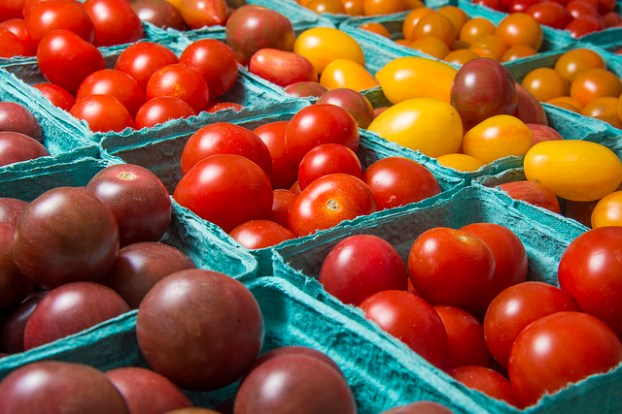
Image from USDA
Food history is a hot topic for researchers in many fields right now. When Penn State Altoona lecturer Julie Rockwell decided to launch a new history course focused on food, she enlisted the help of Lori Lysiak, a librarian at Penn State Altoona.* Together, the two women developed a fun and engaging course, “HIST 111: American Food System: History, Technology, and Culture.” Their successful collaboration models five strategies for librarians who team up with faculty.
Over 40 undergraduate students from a range of majors took the course. Assignments included weekly blog posts, two investigative essays, a research paper, a group project in which students made regional cookbooks, and a final reflection paper. Rockwell says, “Our primary goal was to get students to understand where their food comes from, and how it gets to the table. Whatever your discipline is, you can connect it to food. We had nursing students write about nutrition, engineering students write about farm equipment, computer science students write about how farmers are using software for planting and harvesting. There’s something for everyone.” Ultimately, Rockwell explains, “The history of food is the history of people, too.”
As they developed the course, Lysiak and Rockwell practiced these five strategies:
1. Build on an existing relationship.
As the Penn State Altoona Library liaison to the history department, Lysiak had worked with Rockwell before to deliver information literacy workshops for her HIST 020 and HIST 021 survey courses. So, when Rockwell began to construct her new HIST 111 course, she contacted Lysiak early in the process. Lysiak and Rockwell began planning for the fall 2017 course in late spring. Rockwell provided Lysiak with a list of books, journals, and DVDs that she was considering for the course. Lysiak searched each title to determine which materials were already available to students, and she placed purchase requests for those not owned by the library. Lysiak and Rockwell also worked with library staff to place items on course reserve for students.
2. Bring your personal strengths to the table.
Before teaching at Penn State Altoona, Rockwell had worked at a farm and as a chef at several restaurants ranging from farm-to-table to French-style cuisine in Oregon for 14 years. She also taught culinary courses at a community college. This background, plus her M.A. in theatre history, prepared her to teach HIST 111.
In addition to her M.L.I.S., Lysiak has a M.A. in history and previously taught U.S. history courses in traditional, online, and hybrid environments for a community college in Texas. For HIST 111, she reframed some of her previous research on historical representations of Native Americans to teach the students about product image recognition and the psychology of branding.
3. Create an online workspace together.
Rockwell used the course management system Canvas to develop her course, and she included a Library Resources tab that linked to a custom-built LibGuide built by Lysiak. In class and in her syllabus, Rockwell let students know that Lysiak was available for online chats as well as in-person reference consultations at the library.
4. Adapt and evolve.
Rockwell plans to offer an adapted version next fall, with Lysiak’s help. Lysiak plans to increase her role in future semesters. She says, “There’s a range of levels of embedded librarianship. In this case, we decided to start light and grow from there.”
Students, too, developed as the class unfolded. Rockwell describes, “A big moment in class that really sealed the deal was when we watched Food, Inc., a documentary on the treatment of animals at factory farms as well as how large corporations have taken over the food chain in the United States. It was a tipping point–you could hear a pin drop. I saw their minds clicking. Some were horrified.” For their final blog post, she challenged them to write 10-point manifestos listing future goals. Many wrote that they planned to start visiting farmer’s markets, to learn to cook, to vote on sustainability issues. One student even changed her minor to Global Food Systems after taking the course.
5. Have fun!
Rockwell balanced tough issues such as food insecurity and food and labor justice with an innovative, engaging teaching approach. The course included several food tastings, including a taste of one of Coca-Cola’s oldest competitors, Moxie. She invited an array of guest speakers to enliven the course, including several local chefs and farmers, the curator of the Pasto Agricultural Museum, the agricultural ombudsman from the Blair County Conversation District, and staff from Penn State Extension.
Lysiak says, “We were thrilled with this course. The topic was intriguing and fun, and Julie’s blended approach mixed humanities and social sciences, hands-on workshops, multimedia, and much more. Very well done.”
Rockwell adds, “I couldn’t have done it without Lori. I don’t know it all, and I can’t do it all. It was an invaluable addition to the class to have a library buddy who understands students.”
*HIST 111: American Food System had been offered at several other Penn State campuses, but it had never been taught at the Altoona campus.
What is Your Library Doing for Endangered Data Week?
February 26 – March 2 is Endangered Data Week with the aim of “raising awareness of threats to publicly available data; exploring the power dynamics of data creation, sharing, and retention; and teaching ways to make endangered data more accessible and secure.”
These lofty goals may seem overwhelming for many academic libraries. Don’t let that stop you from taking action on your campus. You might not be in a position to undertake a huge effort, but there are probably steps we can take to raise awareness. Start with the known concerns of your faculty and students, pair those with your library’s strengths, and go from there.
At Bucknell, we are focusing on the census for Endangered Data Week. We will be hosting a panel discussion about how faculty use census data in their teaching and research. Since we are a Federal Depository Library, we will be creating a book display to highlight the value of the historical census volumes in our collection. There is also a group of faculty and staff reading and discussing The American Census: A Social History written by Margo Anderson, a Bucknell alum.
Over to you. What might your Library do to raise awareness of endangered data?
Learn more about Endangered Data Week at endangereddataweek.org
Larissa Gordon, instruction and scholarly communications outreach librarian at Arcadia University, has been selected as the new Co-Editor of Pennsylvania Libraries: Research & Practice, the scholarly open access journal of the Pennsylvania Library Association. Gordon will be taking the place of Anne Behler who has served as co-editor for the past 3 years. Larissa Gordon holds master’s degrees in library and information science as well as education, and is currently pursuing a master’s degree in English. She has a strong record of professional publications and presentations and previously served as chair of the College and Research Division of the PA Library Association. Gordon has also served as a news editor and peer reviewer for Pennsylvania Libraries: Research & Practice.
Pennsylvania Libraries: Research & Practice is peer-reviewed by members of the Pennsylvania library community and is freely available online. Articles may be read online at palrap.org. The journal provides an opportunity for librarians in Pennsylvania to share their knowledge and experience with practicing librarians across the Commonwealth and beyond. Pennsylvania Libraries: Research & Practice is published by the University Library System (ULS), University of Pittsburgh, through its E-Journal Publishing Program.
Pennsylvania Libraries: Research & Practice – Call for Submissions
Pennsylvania Libraries: Research & Practice (PaLRaP.org) is accepting submissions for research, practice, feature and commentary articles as well as news items for the Spring 2018 issue (vol. 6, no. 1).
Research, practice, feature, and commentary manuscripts are welcomed at any time; however, for full consideration for the spring issue, please submit your manuscripts by February 28, 2018.
News item submissions are also welcome at any time. For full consideration for the spring issue, however, please submit your news items here by April 13, 2018.
See the submission guidelines and section policies at palrap.org for more information.
Pennsylvania Libraries: Research & Practice is the peer reviewed, online, open access publication of the Pennsylvania Library Association, and is managed by the College & Research Division. This journal provides an opportunity for librarians in Pennsylvania to share their knowledge and experience with practicing librarians across the Commonwealth and beyond. It includes articles from all areas of librarianship. Contributions from all types of libraries and library personnel in the Commonwealth are welcome.
==
PaLRap is published by the University Library System (ULS), University of Pittsburgh, through its E-Journal Publishing Program.
Published biannually: April and October
Co-Editors: Larissa Gordon, Arcadia University; Tom Reinsfelder, Penn State University
Due to the continuous changing environment, diverse collection development has become an essential part of academic libraries. Library materials should promote awareness on diverse social issues and not exclude material that seems offensive. A diverse collection should also reflect all perspectives and ideas and include controversial material such as political content, economic theory, religious beliefs, social philosophies, sexual content and expression, and other potentially debated topics.
Collections such as these enhance cultural knowledge within society that provide a welcoming learning environment. It is uncomfortable for a patron to enter a library and find there is limited or no resources available to them regarding their ethnicity. If libraries are going to represent themselves as providing academic services to students then they should recognize academic needs amidst multicultural groups.
Libraries must have a clear view of what diversity means to the library’s collection whether it is economics, political, religious, minority, social, or sexual issues before beginning a collection assessment. Diversity in the collections also helps to broaden student’s awareness of the world!


 Adam Balcziunas
 Alex K.
 Alexandrea Glenn
 Andrea Pritt
 aprilnkelley
 Ashley Purvis
 Bethann Rea
 blj13
blj13 Brendan Johnson
 Amanda Boyer
 Bret Stiffler
 Bonnie Powers
 Christopher Lemery
 clarewithers
 clblibrarian
 Kelly Clever
 Charlotte M. Johnson
 colemanluzerne
 CRD of PaLA
 crdvirtualjournalclub
 cre5314
 csgarth
 Erin B.
 danajkerrigancv
 denisewetzel1
 Darren G. Poley
 elm43
elm43 James D'Annibale
 Annie Jansen
 Jill Hallam-Miller
 jennifercribbs
 Jenn Monnin
 Jen Hasse
 Jessica Showalter
 johnmeier1
 Kelly Safin
 Kim Karim
 Kristen Seikaly
 Kayla Van Osten
 Cecelia Lasley
 librarianjsmith
 Linda Neyer
 mabogino1
 Matthew McNelis
 Meg Massey
 Maggie Savidakis-Dunn
 Rebecca
 miskatoniclibrarian
 Maureen Bentz
 Michele G. Anfuso
 Nicole Miyashiro
 paulmcmonigle
 Rob Sieczkiewicz
 ronlmccoll
 Sam Bardarik
 shannahollich
 smartin592
 Ula Lechtenberg
 It's Academic