Save the Date: Assessment in Action
The College & Research Division will host the ACRL Roadshow
ASSESSMENT IN ACTION
Demonstrating and Communicating Library Contributions
to Student Learning and Success.
Friday, August 17th, 2018
Arcadia University
Glenside, Pa
In this day-long workshop on strategic and sustainable assessment, participants will identify institutional priorities and campus partners, design an assessment project grounded in action research, and prepare a plan for communicating the project results.
SAVE THE DATE
MORE DETAILS SOON!
Caregiver Support
I am a little late posting this month because of changes in my own life and it occurred to me that this might be a topic for the blog. Although support of caregivers might seem to be more in the realm of public libraries, so many families are affected by loved ones with dementia that students, faculty, and staff at our institutions might welcome information that we can provide.
When dementia strikes, it is not always gradual. A functional human being can rapidly become completely dependent on others and most of us are not prepared. Also, many caregiver support groups are designed for those who do not work and so they are scheduled during the day. Academic libraries would be doing a great service to offer lunchtime or evening sessions with speakers and resources for those who are struggling to balance care with full-time work or students who are coping with dementia in their families. We can also assist with searches for reliable medical information and clinical trials.
Here are some helpful resources.
Lewy Body Dementia Association
Although dementia is not always a disease the elderly, you may also want to partner with your local Area Agency on Aging.
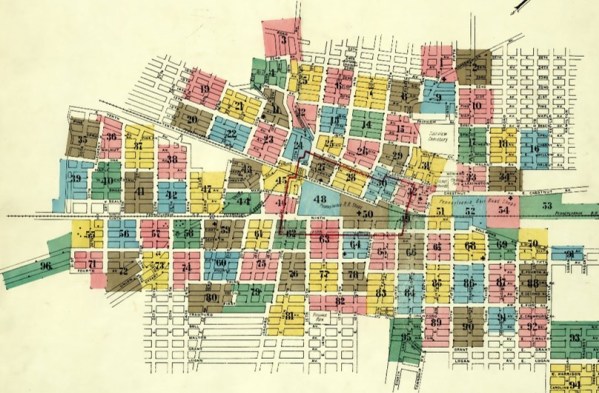
Sanborn Fire Insurance Maps provide oodles of information for the personal archivist. Recently I tracked down information about my current home, my family history, and my city’s history using Penn State Libraries’ digitized Sanborn maps of Pennsylvania. My interest was personal, but the same methods could be applied to research historical figures or sites. Here’s how I used the maps.
Accessing the maps
Penn State Maps Library offers free online access to Pennsylvania Sanborn maps up to 1923 (later issues will be forthcoming in 2019 as copyright runs out and they become public domain). Sanborn mapmakers began creating the maps in 1867 for insurance purposes. The maps are very beautiful—they were hand drawn, printed lithographically, and hand colored with bright yellow, pink, blue, and green ink.
The Penn State Sanborn Maps collection covers over 500 cities and towns across the state. To view the maps, click on the city name from the alphabetical list and choose the year you want to see. Many of the city maps have multiple sheets that zoom in on different parts of the city, so you may need to browse until you find the exact location you are seeking. You can also download or print the maps.
In addition, Penn State has shared the maps with the Digital Public Library of America, so you can also access the maps there.
 Your home’s history
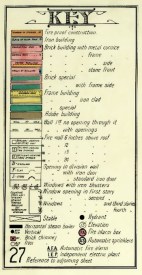
If you live in Pennsylvania and your home was built before 1923, you may be able to find it on a Sanborn map. Using the Sanborn key, you can see information about your home’s construction materials, building use, property boundaries, number of stories, water facilities, windows and doors, etc. at the time the map was created.
I tracked down my house, which was built in 1909, and printed and matted the map for display. Visitors often ask about the map, and we usually end up trying to look up their houses, too!
Your family’s history
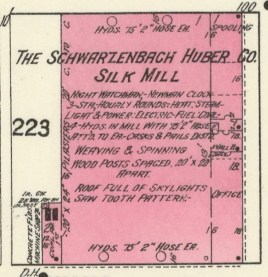 Using the maps in conjunction with genealogical records is a way to flesh out your family’s history. You can find the street addresses for family homes, workplaces, schools, churches, and so on. Then you can try to locate that neighborhood in the Sanborn maps collection to add to your personal archive.
For example, I looked up the silk mill where my maternal great-grandparents met. The family legend is that my great-grandmother was working at a sewing machine when my great-grandfather walked past with a skein of silk. Some of the silk got caught in her earring, and the rest is history.
Your city’s history
Several projects compare present-day maps with historical images to track a city’s development over time, for example this one of New York City and this one of Washington, D.C. Using Sanborn maps, you could do something similar with your town. When I studied a Sanborn map of my community, I found to my surprise that my neighborhood used to be an independent city of its own before being incorporated into a neighboring city in the late nineteenth century as the railroad industry grew.
What if you’re looking for a map outside PA?
Consult the Penn State Maps library manager Heather Ross’s library guide for more on Sanborn maps from other states and even select locations outside the United States.
Jessica Showalter is an Information Resources and Services Support Specialist at Penn State Altoona’s Eiche Library. Say hello on Twitter @libraryjms
- With Our Powers Combined: Teaming Up with the Writing Center to Improve Information Literacy Practice
- Promoting Evidence-Based Practice and Information Literacy through an Undergraduate Nursing Journal Club
- An Interview with Chris Ritter, Head Librarian of the Antique Automobile Club of America (AACA)
- Marketing a Library Science Program: Personalization with Purpose
- Collaboration at the Center: Librarian, Faculty, and Students Partner to Revive Their Curriculum Lab
- Using a Workflow to Reduce Database Costs without Affecting Collection Needs
- News Briefs from PA Libraries
On Teaching Information as Obligation
Dispositions outlined under the ACRL Framework suggest several ways students should gather, analyze, synthesize, create, and ultimately disseminate information. Too often these performative practices are limited by the language and parameters of the framework to purely academic contexts, however. While following the new framework, librarians typically guide students to interact with information as students only, thus limiting discussion of their eventual responsibilities as professionals, academic or otherwise. Outside departments of journalism, or those disciplines incorporating pedagogical coursework, students rarely learn how to curate information once they pivot toward a professional setting.
One field librarians overlook in this sense is healthcare. While medical and allied health departments often include communication coursework aimed specifically at preparing students to speak and interact with patients in their care, librarians are given little explicit direction in the framework for supplementing this instruction.
We are told learners who recognize that information has value should “see themselves as contributors to the information marketplace rather than only consumers of it” and “are inclined to examine their own information privilege.”[1] These respectable outcomes, however, tell us little about the ways newly-minted nurses, physical and occupational therapists, or athletic trainers, can transfer information and impart at least a fundamental level of information literacy to their patients. I fear we are doing too little to acknowledge, let alone instructionally address, the fact that these students will soon transition from seeking, vetting, and consuming information for themselves to serving a public eager to do the same for themselves.
We know that patients, caregivers, and others routinely seek supplemental healthcare information during times of sickness or injury. We also know that an abundance of misinformation is easy to find and often even impossible to avoid. As authorities in their field, healthcare professionals should feel comfortable providing valid information to patients. They should also recognize that patients are more and more likely to seek second opinions, alternative treatments, and all the knowledge they can possibly obtain.
It seems to me that librarians may provide a significant service by teaching healthcare students (and those in other disciplines as well) that they have an obligation to pass on to others both knowledge and the basic skills to discern, access, and acquire it. There is no frame entitled “Information as Obligation,” but in reality it will come with the job for many of the students we teach. Are we currently doing enough to prepare them for it?
[1] ACRL Framework for Information Literacy for Higher Education, 2015, http://www.ala.org/acrl/standards/ilframework


 Adam Balcziunas
 Alex K.
 Alexandrea Glenn
 Andrea Pritt
 aprilnkelley
 Ashley Purvis
 Bethann Rea
 blj13
 Brendan Johnson
 Amanda Boyer
 Bret Stiffler
 Bonnie Powers
 Christopher Lemery
 clarewithers
 clblibrarian
 Kelly Clever
 Charlotte M. Johnson
 colemanluzerne
 CRD of PaLA
 crdvirtualjournalclub
 cre5314
 csgarth
 Erin B.
 danajkerrigancv
 denisewetzel1
 Darren G. Poley
 elm43
 Heather Burychka
 James D'Annibale
 Annie Jansen
 Jill Hallam-Miller
 jennifercribbs
 Jenn Monnin
 Jen Hasse
 Jessica Showalter
 johnmeier1
 Julie Durci
 Kelly Safin
 Kim Karim
 Kristen Seikaly
 Kayla Van Osten
 Cecelia Lasley
 librarianjsmith
 Linda Neyer
 mabogino1
 Matthew McNelis
 Meg Massey
 Maggie Savidakis-Dunn
 Rebecca
 miskatoniclibrarian
 Maureen Bentz
 Michele G. Anfuso
 Nicole Miyashiro
 paulmcmonigle
 Rob Sieczkiewicz
 ronlmccoll
 Sam Bardarik
 shannahollich
 smartin592
 Ula Lechtenberg