C&CS Presents: What Does PA Forward and the Star Library Program Have To Do With Academic Libraries?
What Does PA Forward and the Star Library Program Have To Do With Academic Libraries?
Presented by Amy Snyder, Christina Steffy, and Joann Eichenlaub
February 21, 2019 at 2pm
Click here to register for the Zoom link
Academic librarians, are you interested in participating in the PA Forward Star Library program but don’t know how it will work for you? Or, are you working your way through the program and want to learn more about how you can support the literacies and earn your stars? Join librarians from Pennsylvania College of Technology (Penn College) and Pennsylvania College of Health Sciences (PCHS) to learn how they became gold star libraries. Penn College’s Madigan Library and the Learning Commons at PCHS are the first two academic libraries in the Commonwealth of Pennsylvania to earn the PA Forward Gold Star status. They are eager to share their experiences, challenges and opportunities as they achieved the Gold.


Joann Eichenlaub achieved her MSLS from Drexel University. She is the Assistant Director of the Madigan Library at Pennsylvania College of Technology located in Williamsport, PA. She is current Chair of PA Forward’s Star Library and Training Committee and also serves as a Director At Large on the Board of the Pennsylvania Library Association.
Christina J. Steffy is the Director of the Learning Commons and Library at Pennsylvania College of Health Sciences in Lancaster, Pa. She is also a PaLA mentor and a peer-reviewer for the journal Pennsylvania Libraries: Research & Practice. Christina has been very active in PaLA programs, and spent 6 years on the CRD board. She earned her Master of Library and Information Science from Rutgers University and is currently working on a Master of Arts in Professional and Digital Media Writing at East Stroudsburg University.
Amy Snyder is the Education Librarian at Pennsylvania College of Health Sciences. She earned her Master of Science in Library Science from Clarion University. She is a current member of the College and Research Division’s Connect & Communicate Series Planning Committee.
As a reminder, Zoom session will be made available with closed captioning when possible. Zoom link will be sent to registrants approximately 48 hours before the session.
How to Survive a Large Conference
I spent much of last week at ALA’s Midwinter conference in Seattle, and my mind is still swimming from all the work, the committee meetings, the programs, the social events, the great things I learned and experienced, and the terrible times, too.
ALA is huge, and getting involved in both the organization itself and its conferences (two each year!) can be daunting. But once you begin to dip your toe in the water, it can be hard to stop yourself from diving in completely. For example, much of my conference time was taken up with committee work, since I serve as a member of:
- ALA Washington Office Committee on Legislation, Telecommunications Subcommittee
- ALCTS CaMMS Research and Publications Committee
- Graphic Novels and Comics Round Table Metadata and Cataloging Committee
And have also just begun service on the Gay, Lesbian, Bisexual, and Transgender Round Table’s Rainbow Book List Committee. On top of all that, I’m running for a spot this spring as an ALA Councilor-at-Large, because I believe that governance matters and that decisions are made by those who show up.
So with that said, here is my advice for how to survive an ALA (or PaLA, or any such similar) conference:
- Drink lots of water. Bring snacks. This is general life advice, really.
- Make time for downtime. Have lunch with friends (or friendly strangers!). Wander the exhibit hall. Take a nap if you need one.
- Be flexible. Sometimes it makes more sense to skip a program and have a great conversation with some colleagues.
- Be a good colleague. Remember that even though you’re not in your office and you’re having fun, you’re at a work event. This means, among other things, treating people professionally and respectfully.
- Examine your biases. You are about to be thrown into an unfamiliar environment with a large number of people you have never met before. Be a good ally. Call out microaggressions when you see them. Make sure your BIPOC colleagues are being afforded the same courtesy and respect as you. (Learn from the mistakes made at this ALA Midwinter.)
- Always use the microphone. Always ask others to use the microphone. Yes, even in a smaller room. Yes, even during the Q&A. It’s an accessibility issue, and an important one.
The PaLA 2019 Conference isn’t until October, but consider submitting a proposal to present – the call for presenters is open until March 15. And you don’t have to wait until the end of the year to practice these conference tips – ER&L in March and ACRL in April are particularly relevant for those of us in academic libraries.
What conference tips and advice do you have?
Make Room For DH: The Results of an Investigation
Duke University Libraries have published a report on their investigation into the surprisingly still immature space for Digital Humanities publishing, A Framework for Library Support of Expansive Digital Publishing.
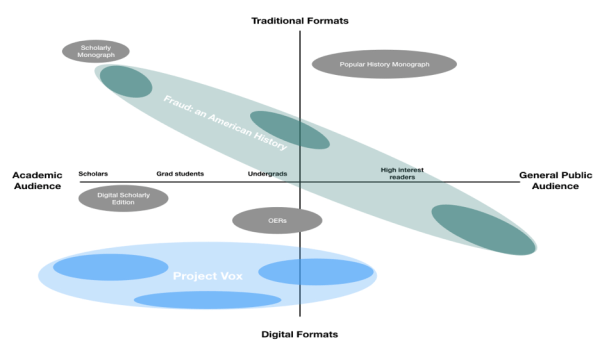
Diagram from the Introduction of “A Framework for Library Support of Expansive Digital Publishing”
showing how 2 Duke publications relate to their publishing environment.
The report advocates adopting an “expansive digital publishing” model and proposes “a cohesive framework of support.” What do they mean by expansive digital publishing? “Online publications that challenge current systems and expectations of publishing, primarily because they push against and beyond the limits we typically use to successfully manage publications.” Why should we care? “Libraries have the capacity to drive positive change in several dimensions of digital publishing, including infrastructure, resource allocation, assessment, and long-term sustainability.” In fact, the report makes the case that it is already in the veins of library’s at colleges and universities. “Situating expansive digital publishing programs within scholarly environments provides the best way to ensure that they are guided by scholarly and academic values.”
It’s well written, not very long, realistic in it tone but exceptionally substantive and comprehensive, so it is highly recommended reading for any librarian interested in scholarly communication and library publishing as well as the future of DH.
Here is a Table of Contents for the Report:
Introduction
1. Planning for Expansive Digital Publications
2. Allocating Resources
3. Making Expansive Digital Publications Discoverable
4. Evaluating and Understanding Impact
5. Preserving and Sustaining Expansive Digital Publications
Conclusion
Ten ideas for library outreach to student organizations
Photo by Daria Shevtsova from Pexels
One way to boost outreach and engagement efforts at your library is to connect with student organizations. Traditionally librarians have been liaisons to academic departments; we can adapt those same strategies to being a library liaison to student organizations as well.
The potential benefits of outreach to student organizations might include increasing attendance at library events, connecting with students outside the classroom setting, creating opportunities for student-led programming, and building new collaborations with staff in the Student Life office at your campus.
Here’s a list of 10 strategies I’ll be experimenting with this year to reach out to student organizations:
- Connect with student organizations at the Student Involvement Fair.
- Meet regularly with your campus Director of Student Life to stay in the loop.
- Attend events sponsored by student organizations.
- Promote student organizations’ events with social media and physical signage at your library.
- Serve as a guest speaker at one of their club meetings.
- Offer library programming in the Residence Halls.
- Get a library portal on Connect, OrgSync, or whichever online platform is used by the Student Life office at your campus.
- Invite student organizations to co-host programming at the library.
- Serve as faculty advisor for your campus’s Library Student Advisory Board–or, if your campus doesn’t have one, encourage students to start one.
- Offer satellite reference service in the HUB or Student Union building during semester crunch times.
Please share your ideas for outreach to student organizations in the comments. Thanks!
Jessica Showalter is the Student Engagement & Outreach Librarian at Penn State Altoona’s Eiche Library. Say hello on Twitter @libraryjms
Science Information Literacy and First Year Students
In May 2018, I was hired as the new Science, Technology, Engineering, and Mathematics (STEM) Librarian at the Penn State Harrisburg Library. I have always had a love of and a passion for science, which led me to a bachelor’s degree in biology years ago. I have been working in libraries for close to ten years and while I enjoy working with students in all disciplines, I have a particular, nostalgic affinity for undergraduate science students. I remember those classes, those assignments, and those expensive textbooks. It is a familiar world and one that I truly enjoyed. In my new role as the STEM Librarian on campus, I am always looking for opportunities to share my love of science with undergraduate students.
Recently our campus’s quantitative skills coordinator approached me with an idea that led to a general discussion about science literacy, diversity in STEM fields, and our shared love of science. As we were chatting, we decided to create a first year seminar presentation geared toward science majors on our campus. I am interested in science literacy and science information literacy and she is interested in studying tactics and resources for undergraduate students. It seemed like the perfect collaboration for us and over the past few weeks, we have been brainstorming our presentation together.
Admittedly, I have a few lofty questions that I consider when I work with undergraduate science students. What are their feelings about science? Do they understand science in a general sense? Do they trust science? How does this trust (or distrust) manifest in their personal lives? In their educational careers? I recognize that this first year seminar session will not be sufficient to answer all of the questions I have. However, it is a good place to start for now.
Our plan is to begin the session by discussing junk science vs. legitimate science, how to locate relevant and trustworthy information, then allowing the discussion to chart the rest of the course. With a few planned stops relating to the ACRL Framework along the way. We are also designing a science related activity in which the students will gather in groups to complete the exercise. Our current idea is to present a problem and ask the students how to work through it utilizing the library resources at their disposal. For example, let us say that the students were given the OK to create a community garden on the roof of their dorm building. What plant(s) will they choose and will they grow in Central Pennsylvania? Do they have access to electricity or a water supply on the roof? If no, how will they design a system to ensure the garden is properly maintained?
Our hope is that this activity will appeal to all of the student participants. Perhaps the student is a biology major with an interest in botany. Maybe the engineering students in the session figure out a novel way to transport water onto the roof. The math student uses her geometry skills to create the optimum greenhouse layout for the roof size. We will be asking the groups to share their findings and ideas with the rest of the class and I am looking forward to hearing all of the responses. This session may not go as planned but sharing my interest in science literacy with even a few students will be meaningful for me. A brief assessment questionnaire will be given to the participants at the end of the session. I am keeping my fingers crossed that the responses will assist me in making this one of many first year seminars geared toward STEM related library resources. Additionally, I hope it will open the gates to future discussions surrounding science information literacy on our campus.


 Adam Balcziunas
 Alex K.
 Alexandrea Glenn
 Andrea Pritt
 aprilnkelley
 Ashley Purvis
 Bethann Rea
 blj13
blj13 Brendan Johnson
 Amanda Boyer
 Bret Stiffler
 Bonnie Powers
 Christopher Lemery
 clarewithers
 clblibrarian
 Kelly Clever
 Charlotte M. Johnson
 colemanluzerne
 CRD of PaLA
 crdvirtualjournalclub
 cre5314
 csgarth
 Erin B.
 danajkerrigancv
 denisewetzel1
 Darren G. Poley
 elm43
elm43 James D'Annibale
 Annie Jansen
 Jill Hallam-Miller
 jennifercribbs
 Jenn Monnin
 Jen Hasse
 Jessica Showalter
 johnmeier1
 Kelly Safin
 Kim Karim
 Kristen Seikaly
 Kayla Van Osten
 Cecelia Lasley
 librarianjsmith
 Linda Neyer
 mabogino1
 Matthew McNelis
 Meg Massey
 Maggie Savidakis-Dunn
 Rebecca
 miskatoniclibrarian
 Maureen Bentz
 Michele G. Anfuso
 Nicole Miyashiro
 paulmcmonigle
 Rob Sieczkiewicz
 ronlmccoll
 Sam Bardarik
 shannahollich
 smartin592
 Ula Lechtenberg
 It's Academic