C&CS Session “What Does PA Forward and the Star Library Program Have To Do With Academic Libraries?” now available
Great turn out for yesterday’s session, “What Does PA Forward and the Star Library Program Have To Do With Academic Libraries?”. The session has been recorded and is available at the following link:
Closed captioning should be available within a few hours of uploading. We thank our session presenters, Christina Steffy, Amy Snyder and Joann Eichenlaub for their excellent insight into the Star Library Program and how we can go about creating sessions and advocating with the PA Forward program.
Experiencing imposter syndrome when working with upper-class students?

One of the areas we are focusing on for assessment during this academic year involves upper-level classes/students. The English department is one of my liaison areas and I’m meeting with that department’s Capstone class three times this semester. Today was the second time the class would be coming to the library. Through discussions with the professor, we had decided that what the students might benefit from most, at this stage in their research, was a one-on-one reference desk appointment with a librarian. I was able to recruit two of my colleagues to help and so we each met with three or four students for about 20 minutes at a time.
As I prepared to meet with these students, I found myself wondering if I was going to be able to understand their topics enough to help them. It’s been over ten years since I’ve taken an English class and even then, I hadn’t read most of the texts these students were using. What if I couldn’t offer the students anything valuable? Would a bad interaction with this class deter their professor from wanting to work with the library again? It feels like there can be an expectation that librarians are walking encyclopedias, able to answer questions on any topic without hesitation. Having met with this class once before and hearing what they intended their research topics to be, I felt like a big imposter. How was I supposed to help someone who already knew more than me?
I was worried that students wouldn’t take me seriously if I admitted that I didn’t know what they were talking about. However, in almost every interaction, I found myself admitting to students up front: “I am not familiar with this text” or “I’ve never heard of genre theory”. This gave students a chance to explain these topics to me and in some cases I think providing an explanation to me helped them clarify their understanding of it. One of my colleagues said she too had this experience and felt that by us admitting we didn’t know something; the students were more comfortable admitting they didn’t know how to search in certain databases or weren’t familiar with the library website.
I found that I really enjoyed these interactions, perhaps more than my normal ref desk interactions, because they turned out to be a conversation between equals: they “experts” on their topic and I an “expert” on how to find information using library resources. They had already tried many of the more basic search strategies and based on that work I found it easier to come up with suggestions for how they could take their searches to the next level: suggesting databases they might not have known about, helping them track down citations, or even assisting with E-Z Borrow and ILL requests.
I met with four students, and each one of them walked away with at least a few new sources that they could explore further. I also think that they walked away with a deeper appreciation of how talking with a librarian could help them during their research. After class I talked with my colleagues and they both indicated that they thought some of the students they met with would be seeking them out for further assistance as their projects progressed. Which I think is great news for the students and for us.
For now, the imposter has been banished and I’m feeling good about my ability to assist all of our student patrons, even the 400-level capstone researchers. Do you have many opportunities to interact with your upper-level students? How do you feel about trying to represent yourself as someone who can help in your liaison areas, even if you aren’t an expert in those subjects?
Your Bookish Guide to the Oscars
The Oscars air on Sunday, and Oscar season always makes me want to put up a display — it’s easy to highlight classic award-winning films and this year’s contenders. In the face of constant threats of campus closures due to bad weather, students may want to grab up a few movies to pass the time.
But in addition to the films, I’m always interested in the Best Adapted Screenplay category, which is often the book’s time to shine at film’s “big night.” While many will always claim that the film is never better than the book (I will argue that Jaws makes a much better film), films can take a different perspective on the source material and even introduce audiences to a book that can become a new favorite.
This year’s Best Adapted Screenplay category features a range of films adapted from novels and memoirs (and A Star Is Born, versions 1-3). Let’s take a dive into the “adapted from literature” nominees!
BlacKkKlansman, screenplay by Spike Lee, Charlie Wachtel, David Rabinowitz and Kevin Willmott
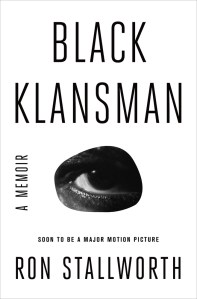
Adapted from Black Klansman: A Memoir by Ron Stallworth.
In 1978, Ron Stallworth is the first and only black police officer in Colorado Springs, Colorado. He sees a classified ad in the newspaper for the local chapter of the Ku Klux Klan with an address to write to for more information. Mr. Stallworth wrote a note expressing his interest in joining — but forgot to sign his undercover name, and instead signs his real name. He soon receives a phone call asking if he would like to join the KKK.
Working with a white colleague who posed as Ron, Mr. Stallworth and the police department were able to infiltrate the Klan in Colorado Springs and prevent a great deal of their activities and potential violence; he even spoke regularly on the phone to KKK Grand Wizard David Duke about Klan operations, who had no idea he was speaking to a black man.
Can You Ever Forgive Me?, screenplay by Nicole Holofcener and Jeff Whitty
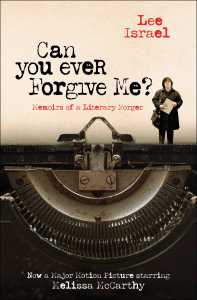 Adapted from Can You Ever Forgive Me?: Memoirs of a Literary Forger by Lee Israel
Author Lee Israel had a successful career writing biographies of the notable, the rich, and the famous. But her success dried up and by 1990, she was broke and in need of a lifeline. She turned to forgery — typing up 300 fake letters in the names of literary superstars and selling them to collectors before she was caught.
If Beale Street Could Talk, screenplay by Barry Jenkins

Adapted from If Beale Street Could Talk by James Baldwin
Tish and Lonny, a young black couple, fall in love, have a child, and intend to marry. But Lonny is falsely accused of a crime and is jailed.
Tish and her family work to find a lawyer and prove Lonny’s innocence as they consider their relationship and their place in the world.
The Ballad of Buster Scruggs, Screenplay by Joel and Ethan Coen
Adapted from All Gold Canyon by Jack London and The Girl Who Got Rattled by Stewart Edward White
The Coen brothers adapted two chapters of their Western-anthology film from stories by London and White which were originally published in The Century Magazine in 1904 and 1901, respectively. All Gold Canyon, tells the story of a gold miner’s life in the American West, complete with both astounding beauty and violence. The Girl Who Got Rattled recounts a trip West by a woman and her fiance, and the guides who help them survive.
See who wins on Sunday!
Emily Mross is the Business Librarian and Library Outreach Coordinator at Penn State Harrisburg Library.
“How do critical educators approach student learning outcomes assessment?” with Carolyn Caffrey Gardner and Rebecca Halpern (a C&CS session)
Connect and Communicate Series
presents:
“How do critical educators approach
student learning outcomes assessment?”
presented by
Carolyn Caffrey Gardner and Rebecca Halpern
Friday, March 1, 2019
2pm EST (11 am PST)
Register for the Zoom link here
Assessment: Necessary evil? Is assessment the solution to prove libraries’ value? A tool of institutional oppression? In this webinar, two information literacy program coordinators attempt to answer the question: How do we as critical educators approach student learning outcomes assessment in our daily practice? Assessment is an institutional reality for most of us, though we might be in tension with some of our institutions’ approaches and top-down mandates. We will provide background on critical pedagogy’s relationships to assessment and the neoliberalization of higher education. From there we will shift to how we can push back against compliance and embrace ownership of understanding how students learn. Rebecca will describe an approach to building a culture of critical assessment at a liberal arts college, Carolyn will take us through a learning outcomes assessment project where librarians scored student work at a public comprehensive university, and ultimately both will reflect on the assessment process from a critical perspective. We will spend time in the webinar discussing how do we challenge our own expectations for information literacy instruction and student expectations of librarians while remaining critical practitioners? How do we also, somehow meet the mandates of the institution?


Carolyn Caffrey Gardner is the information literacy coordinator at California State University, Dominguez Hills. After completing her MLS from Indiana University Bloomington, Gardner worked as an instruction librarian at University of Wisconsin–Superior and then University of Southern California, where she focused on the intersections of first-year writing programs and information literacy instruction. Her research interests include critical pedagogy and assessment, peer-to-peer scholarly resource sharing through social media, and information literacy collaborations in higher education.
Rebecca Halpern is the Undergraduate Engagement Team Leader at The Claremont Colleges Library, where she oversees the first year information literacy instruction program. Rebecca completed her MLIS from the University of Texas at Austin, and then moved on to instruction and reference librarian roles at Antioch University Los Angeles and University of Southern California. Since moving into supervisory positions, her research interests include antiracist library management, critical pedagogy and assessment, and ethnographic research methods.
Can’t make the session? No worries! As always, session will be recorded and made available in closed captioning when available. After recording, registrants will be given links to the session and to an evaluation form.
If you would like to host a C&CS session, please contact Erin Burns or any member of the C&CS team. The team graciously thanks PaLA and the CRD and members for supporting us and these important professional development opportunities.
Information about our team, a session proposal form, and past and future sessions can be found on the CRD blog site here: https://crdpala.org/connect-communicate/
Using a Short Story Dispenser for Citation Workshops
Penn State Brandywine Vairo Library received a fun new toy this semester. A few weeks ago, a large box arrived at the library with a Short Story Dispenser. For those who are unfamiliar with Short Story Dispensers, it’s a product by Short Édition created “for the public to enjoy a serendipitous literary experience, free of charge.”
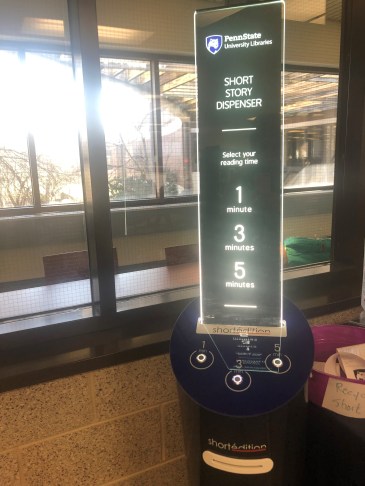
The machine sits right inside the entry to Brandywine’s library, and generated a lot of interest since its arrival. There are no specific instructions, just buttons to press. A would-be reader picks a button for a 1-minute, 3-minute, or 5-minute read, and out comes a long receipt paper with a title, author, and a quick read on it.
The dispensers are at Brandywine because of the urging of one of our faculty members, who is using student work as submissions for the machine. We at Vairo Library are happy to host it, and have been using it as a tool for citation workshops while we have it. Students in a history class, working in pairs, grabbed a popular magazine and a story story from the dispenser, then worked together to create both a notation and a bibliographic entry in Chicago style. Because the stories in the dispenser are all types of content we were also able to discuss the differences in primary and secondary sources using the dispenser. For anyone who teaches Information Literacy sessions, these are not new lessons, but using the Short Story Dispenser to generate content was a fun way to engage students with these topics in a new way.
Though the dispenser has been useful in class and is namely here for pedagogical support, my favorite part is the students who print a story, read it, and come over to tell me whether they liked it better than the last one they read. That kind of reading engagement is always welcome!


 Adam Balcziunas
 Alex K.
 Alexandrea Glenn
 Andrea Pritt
 aprilnkelley
 Ashley Purvis
 Bethann Rea
 blj13
blj13 Brendan Johnson
 Amanda Boyer
 Bret Stiffler
 Bonnie Powers
 Christopher Lemery
 clarewithers
 clblibrarian
 Kelly Clever
 Charlotte M. Johnson
 colemanluzerne
 CRD of PaLA
 crdvirtualjournalclub
 cre5314
 csgarth
 Erin B.
 danajkerrigancv
 denisewetzel1
 Darren G. Poley
 elm43
elm43 James D'Annibale
 Annie Jansen
 Jill Hallam-Miller
 jennifercribbs
 Jenn Monnin
 Jen Hasse
 Jessica Showalter
 johnmeier1
 Kelly Safin
 Kim Karim
 Kristen Seikaly
 Kayla Van Osten
 Cecelia Lasley
 librarianjsmith
 Linda Neyer
 mabogino1
 Matthew McNelis
 Meg Massey
 Maggie Savidakis-Dunn
 Rebecca
 miskatoniclibrarian
 Maureen Bentz
 Michele G. Anfuso
 Nicole Miyashiro
 paulmcmonigle
 Rob Sieczkiewicz
 ronlmccoll
 Sam Bardarik
 shannahollich
 smartin592
 Ula Lechtenberg
 It's Academic