Instructing my First Information Literacy Classes
I only recently started my job as the part-time interlibrary loan and information services librarian with Lehigh Carbon Community College’s Rothrock Library back in October 2018. From my very first day on the job, I was handling interlibrary loans through OCLC WorldShare®, connecting with libraries all across the country in search of articles and books. After a few weeks, I was comfortable enough to staff the reference desk and to provide assistance for students and faculty. I was assured that at some point come the spring semester, I would be conducting my first (ever!) information literacy courses for ENG 105, which is our Research and Composition English course. I was actually pretty nervous about it, being that I really do not have a faculty background. I had been a substitute teacher back in the day for elementary school children, so standing up in front of a classroom really did not intimate me. But you can fool children if need be (sometimes); adults listen, catch on, judge, and know when you are a total moron. (Maybe I am underestimating elementary school-aged children and overestimating adults.) I just wanted to make sure I knew what I was talking about and how to be comfortable operating all this fancy technology with which I was not really familiar. I am not ashamed to admit that I can be old-school and tend to shun most social media platforms, save Instagram. Even those huge smart boards in the classrooms which can operate with the simple touch of my finger are absolutely amazing and intimidating to me; I feel – and probably, look and act – like Charlie Bucket winning the last Golden Ticket to visit Willy Wonka’s Chocolate Factory when I am operating one of those bad boys!
My first instruction in front of a class was supposed to happen this past Friday at one of our satellite campuses and was for our ENG 106 course, which is Introduction to Literature. Having been asked to do this well ahead of time really put me at ease. I knew I would have the time and resources to prepare my instructional lesson plan. I knew I could be prepared.
But the best-laid plans of mice and men often go awry. Two weeks prior to this scheduled instructional session – and first thing on a Monday morning, no less – one of my fellow librarians approached me with an emergency. He had two ENG 106 courses, back-to-back, which he would not be able to instruct, and he wanted to know if I could step in and cover for him.
I probably blanched completely white like one of those cartoon characters out of sheer panic. I only had an hour to prepare. I was not dressed my best. The students would notice my sparse eyebrows and my messy, unruly hair. (Its choice, not mine.) I quickly reviewed my notes which another one of my fellow librarians had provided me. I would be showing the students how to navigate Encore to search our library holdings in addition to some of our databases, in particular, Literature Online and Literature Resource Center. I had very little time to review the short stories which the students were working on, but they seemed like classic works from well-known authors, including Ernest Hemingway’s “Hills Like White Elephants,” Nathaniel Hawthorne’s “The Birthmark,” William Faulkner’s “A Rose for Emily,” and Catherine Perkins Gilman’s “The Yellow Wallpaper.”
The instructor was present for both of these classes, so at least she was able to prompt the students to think about their assignment, a short research paper dissecting various themes and symbolism within the stories. My first task was to show them how to look up materials in our library through Encore and of course, as luck would have it, our platform was down at that particular hour. I could retrieve results but when I clicked on a title for a description and summary, I got all that Java talk and errors. No doubt this would happen to me during my very first information literacy instruction! But the instruction must go on, so I delved into the database descriptions for Literature Online and Literature Resource Center. Fortunately, these databases were cooperating with me and I was able to retrieve results for demonstration. I am hoping that I was able to give a thorough understanding of how to conduct research, including on how to cite it properly, and I walked around to each student to ask if he or she needed any assistance.
Even with having displayed my contact information, not one of the students from those two classes approached me afterward to follow up with questions about their research. I see the instructor on a regular basis and she asks me if any of her students have been in touch with me, and sadly, I have to tell her no. To reiterate what Daniel De Kok’s article earlier this week entitled “Those Who Can” for this blog addressed, how do we get the students to ask for our help? What will it take? I cannot imagine that there would be no follow-up questions. It is rather disappointing and discouraging, but I take away from it that once I get more comfortable with conducting information literacy courses, I will eventually familiarize myself with the material and my enthusiasm for the subject will show, especially if it is Introduction to Literature.
For what was supposed to be my first information literacy course this past Friday, I took the time to prepare by reading a few of the short stories which the professor had included on his syllabus. Fortunately, most of them were the same as the previous two classes, being that they are both Introduction to Literature courses taught by two different professors. I was able to re-read a childhood favorite of mine – Edgar Allan Poe’s “The Cask of Amontillado,” which really got me pumped for the class. I felt much more confident and engaged in teaching this course at the satellite campus since I was more familiar with the databases. Now I know I can handle more information literacy courses as they come my way; I have gotten over the initial hump of awkwardness and shyness. I would like to know – what was your first information literacy instruction like?
Those who can…
My name is Daniel De Kok, and I’m the Reference and Special Collections Assistant at the Langston Hughes Memorial Library, Lincoln University. Lincoln is the nation’s oldest degree-granting HBCU, founded in 1854, and our alumni include Thurgood Marshall, New Jersey Lieutenant Governor Sheila Oliver, and the past presidents of several African countries. We’re a stone’s throw from US-1 on the southwestern end of Chester County, about 10 miles north of the Maryland/Pennsylvania border. I’m telling you all this because at the last conference I attended, it seemed no one knew who or where we were.
I’ve been doing a lot of thinking about patron service lately. Like you, I have had customer service experiences in my daily life that range from wonderful to wretched, and could talk about them at length. As library professionals, we take pride in the service we offer patrons, and we take great care to be thorough and precise in offering information. I would go so far as to say that all working in the library and information science field are called upon to teach. We may not have a formal classroom, but surely we have an opportunity to teach every time we remind a patron of an unpopular policy, take a struggling student through the process with citing an article in the proper style, or show someone how to access a database one more time. When we are presented with a patron with a willingness to learn, we have an obligation to teach them, and it’s a great feeling when you know you’ve helped a student untie a knotty problem.
But there can be a downside. I have noticed in many people an unwillingness to ask for help, accept instruction, or to discipline themselves sufficiently to follow a plan of action (My current students notwithstanding—who I find polite, well-spoken, and eager to learn). How often have we heard, after an exhaustive reference interview, the patron exhale a resigned sigh and “Oh, I’ll just Google it”, as though the information we help them gather is dubious at best. Whether it’s a barbecue cookbook or instructions for assembling a desk, people seem bound and determined to follow the lead of Home Improvement’s Tim Taylor, who was heard to say “real men don’t need instructions”.
There is something to be said for self-reliance—“Figuring it out yourself”—but everyone needs an independent, objective guiding hand at some point. The elementary school that our children attended had a mantra that many of the teachers used, “Ask three before me”–in other words, find three other sources of information (classmates, web or printed sources, etc.) before you ask the teacher. How do we as library professionals change patron’s hearts and minds and create a culture of trust, integrity and mutual learning? How do we get them to ask us?
I don’t claim to have all the answers. Perhaps we must accept that patron stubbornness is part of human nature and it will always be with us. Meanwhile, all we can do is our best. I’m hoping that this blog will in part assist me in becoming a better library professional. Onward.
“Que Sera Sera”: Surviving Spring Semester?
It is often said that March comes in like a lion and goes out like a lamb. After over twelve years in higher education, I’ve come to realize that the spring semester as a whole is very much a lion in contrast with the latter part of the fall semester.
While the fall semester frequently gets off to a slow start with new students and faculty, by the time midterms have wrapped, there’s only a small break for Thanksgiving before final exams. The spring semester, however, seems to always be a whole different kind of animal. We start back in late January, after a lengthy holiday semester break, just in time to have the month of February sprinkled with snow delays and closures, to be continued often through March as well. Throw in flu season, spring break, and by the time everyone has regained a sense of normalcy, it’s time for Easter break (especially for those of us at institutions with a religious component) before we ever hit the home stretch of final exams and graduation.
Does anyone else sense this disconnect with the spring semester as a whole? How do you combat it? How do you overcome and create a sense of “normalcy” for yourself, staff, faculty, and more importantly, the students? How do you stay motivated?
Ask any cadet on our campus and they can tell you exactly how many academic days are left on the calendar before graduation! Do we embrace their countdown, and have one posted in the library? Turn it into an advent calendar of sorts?
Do we take everything one day, and one event at a time? Simply clicking off items as if they’re grocery items on a shopping list can leave us feeling empty, unsatisfied, or simply wondering what we’ve forgotten.
Is there a magic formula? Or is it simply a matter of “que sera sera” (whatever will be will be)?
I’ve always been one to say that the Beatles are wiser than Idina Menzel, and to “let it be” rather than “let it go”. The best we can do is guide our students through to the finish line and graduation, perhaps providing quick brain-breaks along the way.
We’re already planning our extended hours coverage for final exams, even though we haven’t yet celebrated National Library Week, and we’ve teamed up with Campus Activities for “stress busters” during finals as well.
So – ask me how many days til the therapy pets arrive, and I can tell you it’s 43 calendar days! Ask me what’s on the agenda for the next week, and I honestly don’t know!
Leveraging Command of Creative Commons Licenses
Copyright is a scary word for a lot of folks. Many people aren’t sure what all it entails, how it matters for their own product, or what the consequences of not adhering to copyright regulations are. As a faculty librarian, I’m often asked questions about copyright, and while I sometimes have to send them to librarians who have specialized in copyright, most questions I receive can be answered with a short lesson in Creative Common Licenses. By leveraging command of what Creative Commons is and how it can be used in student work, librarians can gain entrance into more courses for both copyright and other information literacy skill instruction sessions.
A lot of faculty at my institution have heard of Creative Common licenses, but aren’t really sure what they are or how they work. However, more and more faculty are encouraged to have their students create products that involve some type of digital media. Whether it’s podcasts, portfolios, or digital narratives, students are increasingly engaged in the digital arts. While they may use their own content, sometimes students are wont to “borrow” content they find online. Often that content is copyrighted. A quick lesson in how to find and use free licensed content is a valuable tool for an academic librarian to offer to faculty and students, and a good way to promote librarian help and instruction in classes that may not normally ask for it.
Over the past year, I’ve been approached about doing more information literacy sessions that involve a short piece on copyright. At first I started talking about Creative Commons licenses for just a few moments during those sessions, but soon after faculty began to approach me directly with questions about Creative Commons. I found a lot of useful resources made by my Penn State Media Commons colleagues, but also created some of my own content to share with students. While a lot of resources dive into how to find Creative Commons or other free licensed material, understanding why Creative Commons and copyright exist is a starting place I’ve had more luck with. I’ve found that students are especially appreciative of the knowledge that what they create is theirs; they own it, and they can promote it how they want. While we mainly talk about class projects, I always bring up the importance of following copyright on any creative content our students are producing, whether its a personal interest or an academic assignment, and stress that their creations are also copyrighted. This then ties back into the idea of giving credit to whomever has created the original work or written the article, and also lets me tie in lessons on proper citation and why it matters but that citing something does not automatically mean you’re following copyright regulations, too. Faculty have been happy to have a brief lesson on copyright that they don’t need to plan, and I’m happy to get more class time with courses I have not worked with previously.
For quick resources on fair use, copyright, and Creative Commons licenses, check these links:
- CreativeCommons.org “Licensing Considerations” https://creativecommons.org/share-your-work/licensing-considerations/
- Stanford University Libraries “Welcome to the Public Domain” https://fairuse.stanford.edu/overview/public-domain/welcome/
- Teaching Copyright “Copyright FAQ” https://www.teachingcopyright.org/handout/copyright-faq.html
- Penn State University Copyright Portal “What Constitutes Fair Use?” http://copyright.psu.edu/copyright-basics/fair-use/
- Penn State University Copyright Portal “Using Creative Commons Licenses” http://copyright.psu.edu/copyright-basics/creative-commons/
Literary art is powerful. As an editor & writer for the Pennsylvania (PA) Center for the Book at Penn State University Libraries who supports programs such as the PA Letters About Literature Writing Contest—in which an oft bullied 5th grade winner in 2018 realized, “I can be brave, and change the way people view me… I can change the way I think of myself,” after reading Erin Entrada Kelly’s Hello, Universe, for example—I’ve seen the transformative power of literature firsthand.
So when PA Center for the Book Assistant Director, Ellysa Stern Cahoy and Senior Director of Community Relations at Juniper Village Senior Living at Brookline, Katie Kensinger approached me for ideas on how to link Juniper residents with the local community through poetry, I jumped at the opportunity.
With similar poetry-centered community efforts already at work in the area—such as Being Heard, a writing program taught in low-income nursing homes that grew into the Ridgelines Language Arts nonprofit founded by Abby Minor, and the Free-Range Poetry of Hannah Inglesby, who writes on-the-spot poems for people in public places (both skilled, Poems from Life poets)—I knew I wanted to offer a new approach.
Katie was passionate about developing a project that would celebrate the uniqueness of each of her participating resident’s lives, with the goal of sharing their stories, not just with family and friends who would delight in learning something new and, perhaps, unexpected about their loved ones, but also with the general public to build community connections.
As a form, poetry lends itself to mining personal experience and emotional depth and to reflecting on life, both internally and externally, making it ideal for community projects. Being Heard guides participants in writing their own poetry and Hannah’s Free-Range poems are written in the moment, for example. In considering Katie’s hopes for her residents, I suggested an approach that pairs poets and residents one-on-one for personal discussions that then inspire the poet’s creation of a poem that celebrates the resident’s life.
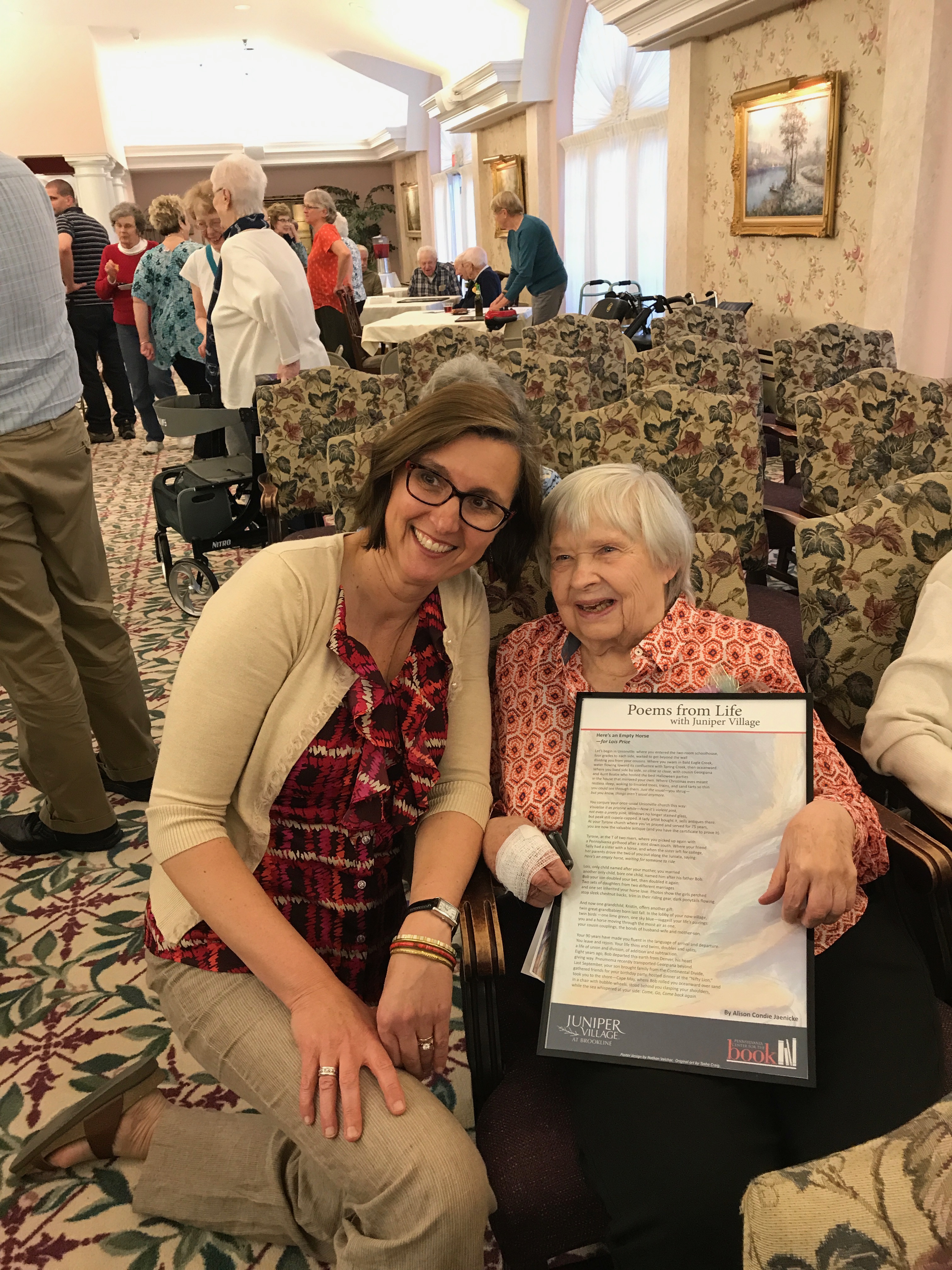
2017 Poems from Life event.
In line with Juniper’s mission of “nurturing the spirit of life,” the project was named Poems from Life with Juniper Village. Now in its third consecutive year, Poems from Life yields shared stories and new friendships that foster community ties. Two of this year’s 18 participants: Joe Bueter and Dick Backastow, discovered common ground in their childhood experiences with Boy Scouts, referenced in Joe’s poem for Dick— to be unveiled Tuesday, April 9.
Poems from Life culminates in a celebratory event hosted by Juniper where poets reveal their work to residents in a reading, accompanied by poetry posters and chapbooks, among family, friends, and community members.
Steven Herb, Emeritus Director of the Pennsylvania Center for the Book, says:
“I was moved at each poem, which perfectly married literature with story, and in this case, the story of some very interesting older people. We all do live unique lives and the poetry shared those ultimately transcendent experiences beyond the walls of their rooms or houses or memories. I was quite moved, as was the entire audience.”
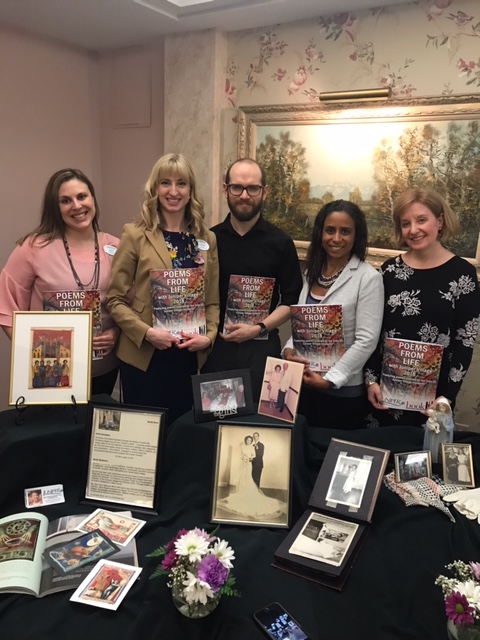
The 2019 Poems from Life with Juniper Village event will be held at 6:30pm on Tuesday, April 9, and is free and open to the public—join us!
Event Details:
Poems from Life with Juniper Village – Celebration & Reading (Free)
Drinks & Appetizers
6:30pm Tue, Apr 9
Willows Dining Hall
Juniper Village Senior Living at Brookline
1950 Cliffside Drive
State College, PA 16801
Facebook Invite
The Pennsylvania Center for the Book—sponsored by Barbara I. Dewey, dean of University Libraries and Scholarly Communications, and Penn State State University Libraries—is an affiliate of the Center for the Book at the Library of Congress. It encourages Pennsylvania’s citizens and residents to study, honor, celebrate and promote books, reading, libraries and literacy.
For more information about the Pennsylvania Center for the Book’s Poems from Life with Juniper Village project, please email Nicole Miyashiro at nmm16@psu.edu, or visit https://pabook.libraries.psu.edu/poems-life, where videos from its previous years’ celebratory readings can also be found.


 Adam Balcziunas
 Alex K.
 Alexandrea Glenn
 Andrea Pritt
 aprilnkelley
 Ashley Purvis
 Bethann Rea
 blj13
blj13 Brendan Johnson
 Amanda Boyer
 Bret Stiffler
 Bonnie Powers
 Christopher Lemery
 clarewithers
 clblibrarian
 Kelly Clever
 Charlotte M. Johnson
 colemanluzerne
 CRD of PaLA
 crdvirtualjournalclub
 cre5314
 csgarth
 Erin B.
 danajkerrigancv
 denisewetzel1
 Darren G. Poley
 elm43
elm43 James D'Annibale
 Annie Jansen
 Jill Hallam-Miller
 jennifercribbs
 Jenn Monnin
 Jen Hasse
 Jessica Showalter
 johnmeier1
 Kelly Safin
 Kim Karim
 Kristen Seikaly
 Kayla Van Osten
 Cecelia Lasley
 librarianjsmith
 Linda Neyer
 mabogino1
 Matthew McNelis
 Meg Massey
 Maggie Savidakis-Dunn
 Rebecca
 miskatoniclibrarian
 Maureen Bentz
 Michele G. Anfuso
 Nicole Miyashiro
 paulmcmonigle
 Rob Sieczkiewicz
 ronlmccoll
 Sam Bardarik
 shannahollich
 smartin592
 Ula Lechtenberg
 It's Academic