The summit is taking place on Monday, July 15 at the Conference Center at Central Penn.
Please see full details, including session descriptions and location details, by clicking here.
The 2019 Pennsylvania Library Association’s PA Forward Information Literacy Summit is focused on connecting people with resources and opportunities. This year’s summit is looking at information literacy and how it intersects with basic, civic and social, health and financial literacy, helping individuals navigate various information channels and understanding the role all libraries have in the discovery and application of credible information.
When: Monday, July 15, 2019, 8:30 AM – 5:00 PM
| Where: |
The Conference Center at Central Penn College 600 College Hill Rd Summerdale, Pennsylvania 17093 United States |
| Contact: | Brandi Hunter-Davenport brandi@palibraries.org 717-766-7663 |
Leveraging #EdTech for Library Instruction
As librarians we all wear many hats, and one of my unofficial hats at our small campus is with instructional design and education technologies due to my experience as an online faculty member, and mentor to new online students and faculty, as well as my reputation for being a “tech nerd” and early adopter.
I had the opportunity today to attend ADVIS’s (Association of Delaware Valley Independent Schools) Innovation Workshop today with our Academy Dean (grades 7-12) and Systems Administrator so that we can begin brainstorming about how to better leverage free (and low cost) educational technologies on our campus for the next academic year.
The workshop was set up as “speed sessions” or lightning talks held in two rounds with 10-12 concurrent sessions each repeated 4 times in the round, allowing participants to choose 4 sessions from each round, attending 8 sessions total in under 2 hours! My head is still spinning with ideas that can be borrowed, tweaked, new technologies to try, and some frameworks and guidelines to explore.
My top 3 #EdTech highlights from the day that can be easily used in our college/university classrooms and libraries include:
- PearDeck (The Essential Plan is free, and paid versions are available). Pear Deck is built to work with Google Slides, and helps incorporate assessment into presentations/discussions (and captures data). So, for those of us teaching one-shot information literacy sessions, this could be an easy way to embed assessment with our instruction.
- TedED. Allows users to create or use existing lessons to engage students in TedTalks style lectures! (Still in pilot phase if anyone is interested…)
- Educreations. Designed to engage users with video. Most of the examples mentioned in today’s sessions were for math students demonstrating how they solve a problem. I immediately envisioned that missing link in librarian’s studies of user-experience with web design, LibGuides, and database usage, where we can see how students approach a research task!
Where do you get your Ed Tech ideas? How do you engage faculty to experiment with new technologies in the classroom?
I like to follow:
Let’s get creative and have our students use their beloved technology to learn!
Student organizations as curators in the library

This month our library collaborated with a student organization, the Penn State Altoona Environmentalist Coalition, to curate a “Take a Hike” display as a celebration of Earth Day and National Parks Week. Here I share why and how we did it for librarians eager to try a similar project.
Part of my mission in my role as Student Engagement & Outreach Librarian is making more room for students to be active partners in the library. I aim to show students how our library is not just a space to study or a room full of books, but also a place for them to share their research with a broader audience, express their creativity, and build their resumes outside the classroom setting.
I’m inspired by the book, Students Lead the Library: The Importance of Student Contributions to the Academic Library, edited by Sara Arnold-Garza and Carissa Tomlinson. This book has so many great ideas for librarians seeking to incorporate opportunities for student leadership development, student engagement, experiential learning, and more. In particular, the sections “Students as Curators” and “Student Groups as Library Leaders” offered some helpful models for our student-organization-curated exhibit.
Working with a student organization has some built-in advantages. Members are already super interested in a specific topic and motivated to advocate for it outside the classroom. Plus, they can share the work as a group rather than one individual doing all the work.
So, how did we collaborate?
- Reach out. I went to the Student Involvement Fair at the beginning of the semester, asked about each club and what they do, introduced myself and my role, handed out business cards, and brainstormed on the fly about ways our library could support their specific needs, address their challenges, and work together on projects. For groups that expressed interest (including the Environmentalist Coalition), I followed up with emails about a week later.
- Be flexible. I had already started planning an April display when the Environmentalist Coalition approached me in mid-March. So, I happily threw out my plans and worked with them instead! Also, when the students later asked if they could bring in original artwork for the display, I enthusiastically went with their suggestion instead of sticking with our first idea for a green paper backdrop.
- Be clear. The students had never made a display before, so I gave them a quick tour of the space and then gave them a clear checklist of things they could supply: a bibliography of 20 suggested books, a list of 5 suggested websites for the iPad kiosk, all delivered by a deadline. Plus, I gave them a clear break down of what my responsibilities would be (e. g. get approval from library director, resource acquisition, coordinate with office of strategic communications, installation).
- Be a fan! I promoted their hard work with posters, social media posts, a news release, and announcements in the Student Newsletter and the Faculty/Staff Newsletter. I also emailed the group about 2 weeks after installation with positive feedback their display had gotten, and at the end of the month, I recapped their success, suggested how they might describe their work on professional documents, and offered to be a reference if needed.
- Plan ahead. To wrap up, I made contact with their incoming officers to let them know that I’d be happy to work with them next year if they were interested.

- A collage of photos of the library display.
Jessica Showalter is the Student Engagement & Outreach Librarian at Penn State Altoona’s Eiche Library. Say hello on Twitter @libraryjms
C&CS Presents
Policies, Platforms and Promotion: Social Media for Every Library
with
Emily Mross, Josefine Smith and June Houghtaling
May 9th, 2019 at 11am
Register here for the Zoom link
Libraries of all types and sizes can develop meaningful engagement with their patrons through social media. Join the 2018 Pennsylvania Library Association’s Academy of Leadership Studies (PALS) Social Media Project Team to learn how to get started with or improve your library’s presence on social media through the development of a social media policy, selecting the right platforms for your audience, and resources to help you create interesting content. This webinar will address both academic and public library contexts, and the social media considerations unique to each environment. We will also introduce new best practices documents and templates for libraries created by the team over the past year as a service project for The Pennsylvania Library Association and its members.
This project is made possible, in part, by a grant from the Institute of Museum and Library Services as administered by the Pennsylvania Department of Education through the Office of Commonwealth Libraries, and the Commonwealth of Pennsylvania, Tom Wolf, Governor.
Presenters:
-

- Emily Mross
-

- Josefine Smith
-
- June Houghtaling
Emily Mross is the Business Librarian and Library Outreach Coordinator at Penn State Harrisburg Library in Middletown, PA. Emily holds an MLIS from the University of Pittsburgh, and M. Ed. in Instructional Technology from East Stroudsburg University.
Josefine Smith is the Instruction & Assessment Librarian at Shippensburg University in Shippensburg, PA. Josefine holds an MLIS degree from the University of Pittsburgh and a Master’s in American Studies from Penn State Harrisburg.
June Houghtaling is the District Consultant for North Central Library District, based out of the James V Brown Library in Williamsport, PA. June holds an MSLS from Clarion University.
Other Team Members:
Tegan Conner-Cole is a Youth Services Librarian for the Cheltenham Township Library System in Montgomery County. Tegan holds an MLIS from the University of Pittsburgh.
Liz Kluesner is a Librarian at the Lackawanna County Children’s Library in Scranton, PA and an Adjunct Reference and Archives Librarian at Wilkes University in Wilkes-Barre, PA. Liz holds an MLS from Clarion University.
John Siegel was previously Head Librarian at Penn State DuBois. He now serves as Coordinator of Information Literacy at the University of South Carolina Upstate in Spartanburg, SC. John holds an MLS from the University of Maryland and an M. Ed. in Adult and Professional Learning from the University of Arkansas at Little Rock.
What Ever Happened To Blexting?
As much as it may sound like one, blexting is not a teen fad of the recent past. It is the concept of co-mingling a crowdsourced solution for the documenting of urban blight with the power of social media and ease of texting. The source of the idea can be traced back to a decade ago when Jerry Paffendorf, Mary Lorene Carter, and Larry Sheridan co-founded Loveland Technologies. Loveland Technologies worked with Data Driven Detroit and others on the Motor City Mapping project.
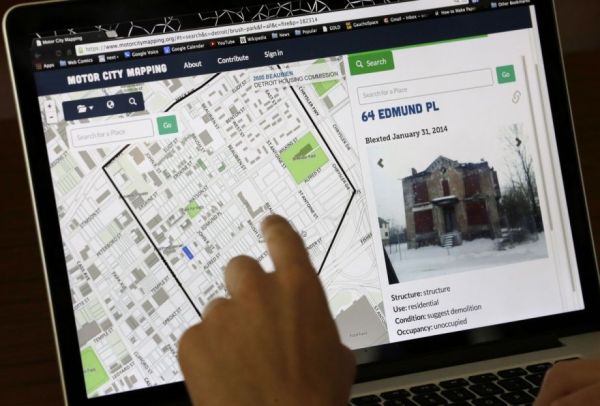
“Detroit residents can now use a ‘blexting’ app — short for blight texting — to send photos
about derelict properties to a mapping database in Detroit. (AP Photo/Carlos Osorio)”
https://nextcity.org/daily/entry/detroit-blight-blexting-houses-motor-city-mapping
The Blexting App from Loveland was a key tool that allowed a small army of everyday people in 2014 to collect data about changes such as deterioration of or improvements to the almost 400,000 properties in the city of Detroit, MI. One result, the surveying was completed in less than 2 months. Another was it empowered local government agencies to act in an informed manner. Based on the effort Detroit was awarded nearly 50 million dollars by the federal government for blight reduction.
Last year The City of Detroit unveiled it’s Open Data Portal for providing updated public record information. Perhaps the most important outcome of the inception of blexting, it provided proof of concept to a noble idea. Empower citizen-driven collection of big data to solve real problems using the tech devices that just about everyone carries around with them all the time.
Earlier this year, Loveland Technologies released its nationwide land parcel data mining site landgrid.com, that anyone can “surf,” and coming soon the Motor City Mapping survey will be updated. However, the real promise of blexting becoming a tech trend revolution in the gathering of important data about communities has yet to really blossom. Let’s hope it does.
“Detroit Getting $50 Million to Fight Blight.” Detroit News, 16 Dec. 2014, https://www.detroitnews.com/story/news/local/michigan/2014/12/16/michigan-detroit-blight-funding/20479333/
Lewan, Amanda. “Why Blexting Is The Next Tech Term To Know.” Michipreneur, 24 Feb. 2014, http://www.michipreneur.com/why-blexting-is-the-next-tech-term-to-know/
“Motor City Mapping.” Data-Smart City Solutions, Ash Center for Democratic Governance and Innovation, https://datasmart.ash.harvard.edu/solutions/motor-city-mapping
Muller, David. “‘Blexting’ (Blight+texting) App Enlists Community to Help Detroit Fight Blight.” Mlive.Com, 15 July 2014, https://www.mlive.com/news/detroit/2014/07/grant_money_available_as_commu.html
“Press Release: Loveland Technologies Releases Landgrid.Com for Nationwide Land Parcel Data.” LOVELAND, https://makeloveland.com/blog/press-release-loveland-technologies-relea


 Adam Balcziunas
 Alex K.
 Alexandrea Glenn
 Andrea Pritt
 aprilnkelley
 Ashley Purvis
 Bethann Rea
 blj13
blj13 Brendan Johnson
 Amanda Boyer
 Bret Stiffler
 Bonnie Powers
 Christopher Lemery
 clarewithers
 clblibrarian
 Kelly Clever
 Charlotte M. Johnson
 colemanluzerne
 CRD of PaLA
 crdvirtualjournalclub
 cre5314
 csgarth
 Erin B.
 danajkerrigancv
 denisewetzel1
 Darren G. Poley
 elm43
elm43 James D'Annibale
 Annie Jansen
 Jill Hallam-Miller
 jennifercribbs
 Jenn Monnin
 Jen Hasse
 Jessica Showalter
 johnmeier1
 Kelly Safin
 Kim Karim
 Kristen Seikaly
 Kayla Van Osten
 Cecelia Lasley
 librarianjsmith
 Linda Neyer
 mabogino1
 Matthew McNelis
 Meg Massey
 Maggie Savidakis-Dunn
 Rebecca
 miskatoniclibrarian
 Maureen Bentz
 Michele G. Anfuso
 Nicole Miyashiro
 paulmcmonigle
 Rob Sieczkiewicz
 ronlmccoll
 Sam Bardarik
 shannahollich
 smartin592
 Ula Lechtenberg
 It's Academic