Give Me a Break! No, Seriously!
Taking shorter breaks throughout your day is good for your health! Aim for 5-15 minutes a day away from your desk each day. It allows your body to move out of a stationary position which is rough on your body, especially your back and neck.
Ideas for your shorter breaks:
- Meditate
- Take a walk
- Office yoga
- Get some much needed water to stay hydrated
- Deliver a package to another office
The most important break of the day is your lunch break! Make your lunch break a priority in your day as you would a meeting. A car cannot run on empty, why should you?
Ideas for your lunch breaks:
- Place your lunch breaks on your calendar for the remainder of the year
- Set a reminder on your task-list on your phone! You’ll need to check off your lunch break each day.
- Plan to have lunch with a co-worker or colleague
- Have lunch away from your desk in order to not be tempted into working
- After eating, take a walk if you find you have time remaining prior to getting back to work
Remember, you are not a workhorse! Take breaks as frequently as needed to restore yourself for the work ahead. Don’t think about it, just do it.
Enjoy your breaks!
Running the Outreach Marathon

One of my titles is Outreach Coordinator, and this week, I am definitely feeling it. Classes begin on Monday and I’ve just finished my sixth outreach event of the week — move in day for the new freshmen.
Outreach can definitely be a lot of work, but to me, it’s worth it to make a connection, especially with those new to campus, who may feel lost or confused. The personal touch we provide can make a huge difference to someone trying to navigate a completely new — and often pretty complicated — environment. Here are some tips for making an impact while saving your sanity.
Preparation
Take some time at the end of each semester and right after each orientation period to update your materials and take stock of what you have on hand. Update PowerPoints, handouts, and order new materials if needed. Create a checklist of regular orientation events and set calendar reminders to reach out to coordinators about their events and any due dates for materials. Add those to your calendar too.
Delegate
Even though I’m often the face of outreach at my library, I can’t and shouldn’t do it all. Outreach to specific programs in another colleague’s liaison area should be their domain. Create a shared document where everyone can record their outreach events. It’s easier to manage outreach when many people contribute, and your colleagues can improve connections with their constituents. At the end of the year, that shared document can help you generate an outreach report, and keep track of all the events you may not be aware of. It’s also helpful if there is turnover — you can help new employees keep track of the events they should take responsibility for.
Usability
Make sure any handouts you share are USABLE for the audience that will receive them. While it may be tempting to create one resource for simplicity, different audiences have very different needs. The most important things about the library for a part-time adjunct professor will be very different than the most important things about the library for a full-time undergraduate student who lives on campus. Think about your audience when you create each document and limit the information to what will be essential for them to know right away.
Rest
If you have to work extra or extended hours to cover outreach events, try to work with your supervisor for flextime to get a break! Outreach can be very taxing, and to best serve your campus, you need time to relax and recharge.
Happy new semester!
Are you planning to attend the Pennsylvania Library Association Annual Conference in Erie, PA, October 13-16? CRD members are eligible to apply for a conference scholarship to help defray the cost of attendance.
The final amount of the scholarships will depend on the number of successful applications, and recipients are responsible for conference-related costs beyond the amount of the scholarship. Only current CRD members will be considered, and recipients may be called upon to serve the CRD in the near future. You do not need to attend the full conference, but must register for at least one day.
Applications will be accepted until 11:59 pm on Tuesday, September 3.
Questions? Contact Emily Mross.
Figuring Out the ‘What For’ of Digital Scholarship Centers
The success of any new enterprise in a library often depends on decisive and nimble planning. But if you begin by asking the question ‘Why’ you will get either rather bland reasons such as competition or a thoroughly subjective rationale that is simply responding to a current but all too specific need. You don’t want to chuck away the opportunity to articulate a vision by simply chalking it up to broad relevance or fall victim to creating a president too hastily. Either can be disastrous.
When it comes to a cause célèbre like Digital Scholarship the agenda is often shaped solely by identifying what a library is already prepared to support, for instance: Text and data mining, Geospatial analysis, or Data visualization.
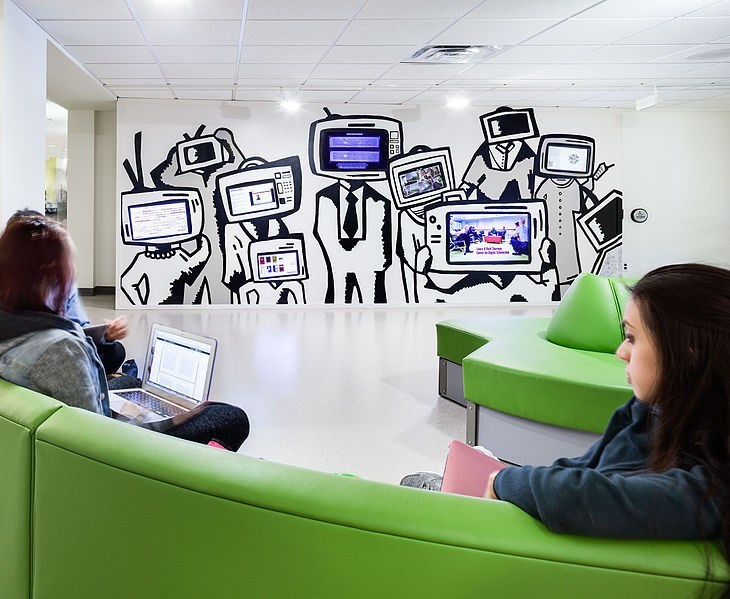
Media Wall outside The Lewis & Ruth Sherman Centre for Digital Scholarship in Mills Memorial Library at McMaster University
The ‘What’ may very well be driven by only investigating the scholarly community of practice the library serves and evaluating resources, but perhaps “a more socially directed mode” of generous thinking, that “might enable us to make possible a greater public commitment in our work which in turn might inspire a greater public commitment to our work,” is what’s called for (Cf. The Munro Lecture: “Generous Thinking” with Kathleen Fitzpatrick).
An important preliminary will be to provide a common understanding of Digital Scholarship. It would help to decide on a coherent definition of Digital Scholarship, like the one from CU Boulder University Libraries, Center for Research Data & Digital Scholarship: “Digital Scholarship extends traditional methods of research by leveraging new technologies and digital data to advance research and enhance pedagogy. While it is most commonly associated with Digital Humanities, Computational Social Science, and Data Science, Digital Scholarship is applicable to all disciplines, and it often relies on interdisciplinary collaborations.”
Mission statements that live in a drawer and are infrequently consulted in assessing day-to-day decisions cannot be a force. That it is why it is necessary to determine the values which will be at the forefront of every conversation in answer to ‘What For?’ A good example of this are the Core Tenets of Boston College Libraries Digital Scholarship Group:
- We aim to build experience and community
- We are experimental
- We are open
- We teach, support, and collaborate
Some keys to generous thinking which Kathleen Fitzpatrick describes in her Munro Lecture that may also help are to maintain a tension between “critical audacity” and “critical humility,” and when working as a group “assume positive intent” and “own negative effects.” Thus, a spirit of generosity will enrich even further the thinking around the questions to be asked.
For descriptions of Digital Scholarship programs check out the ARL’s Digital Scholarship Profiles. You be the judge. Are they asking What For?
Join us August 28th at 12pm EST
for
“The times, they are a’changing”: The Library Legacies Oral History Project
presented by Jackie Esposito
Register for the Zoom Link (online, free): here
Library Legacies, a Penn State University Libraries oral history project, was conducted to ensure that the Libraries long-distinguished University history is captured and made accessible. By interviewing 150 present and former University Libraries administrators, faculty, and staff, this project attempted to place the rich work and experiences of these individuals in the context of the immense changes in the Library industry over the past 60 years. Their memories can infuse and negotiate the meanings of the past, amplify how their actions inform the present, and establish a path forward into a strategic future. The earliest interviewee began her Library career in 1958, the most current in 2018. This presentation will discuss trends, skill set development, strategic impacts, human resource issues and effects of technology across the Library as an industry.
Jackie Esposito is the Special Projects Librarian/Archivist at Penn State University. Jackie has been actively engaged in the management and preservation of University archival and library collections for over thirty years. She began serving Penn State in the fall of 1986 as a Project Archivist and was promoted through the ranks to her current position as Full Librarian. She currently is overseeing an extensive oral history project for the University Libraries entitled Library Legacies and assisting with reference/instruction at Penn State DuBois. She is the author of numerous articles on archives management, higher education legislation and records issues as well as co-author of The Nittany Lion: An Illustrated Tale.
This session will be presented via Zoom. You will receive a login link approximately 48 hours before the session begins. We will try to provide closed captioning to the best of our abilities during the session, and will have a moderator for questions.
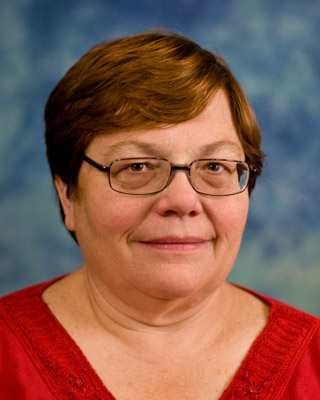
Jackie Esposito


 Adam Balcziunas
 Alex K.
 Alexandrea Glenn
 Andrea Pritt
 aprilnkelley
 Ashley Purvis
 Bethann Rea
 blj13
blj13 Brendan Johnson
 Amanda Boyer
 Bret Stiffler
 Bonnie Powers
 Christopher Lemery
 clarewithers
 clblibrarian
 Kelly Clever
 Charlotte M. Johnson
 colemanluzerne
 CRD of PaLA
 crdvirtualjournalclub
 cre5314
 csgarth
 Erin B.
 danajkerrigancv
 denisewetzel1
 Darren G. Poley
 elm43
elm43 James D'Annibale
 Annie Jansen
 Jill Hallam-Miller
 jennifercribbs
 Jenn Monnin
 Jen Hasse
 Jessica Showalter
 johnmeier1
 Kelly Safin
 Kim Karim
 Kristen Seikaly
 Kayla Van Osten
 Cecelia Lasley
 librarianjsmith
 Linda Neyer
 mabogino1
 Matthew McNelis
 Meg Massey
 Maggie Savidakis-Dunn
 Rebecca
 miskatoniclibrarian
 Maureen Bentz
 Michele G. Anfuso
 Nicole Miyashiro
 paulmcmonigle
 Rob Sieczkiewicz
 ronlmccoll
 Sam Bardarik
 shannahollich
 smartin592
 Ula Lechtenberg
 It's Academic