PaLA Leadership Orientation
Earlier this month, I had the pleasure of attending the Pennsylvania Library Association’s Leadership Orientation at the decorative and warmly inviting Wyndham Gettysburg on December 9th and 10th. The invitation to attend came courtesy of Christi Buker, the executive director for the Pennsylvania Library Association, as I am an incoming Vice-Chair for the association’s Technical Services Round Table. This was my first time attending anything PaLA related, so I was very excited to finally meet up with fellow librarians throughout the state. Gettysburg is only a two-and-a-half-hour drive for me from the Lehigh Valley and the orientation was a two-day event.
I had already been in touch with other members of the Technical Services Round Table prior to the orientation, including outgoing Chair Paige Andrew of Penn State University Park, incoming Chair Anitra Gates of Erie County Public Library (six hours away!), and Secretary/Treasurer Katie Greenleaf Martin, District Consultant for Altoona District. Prior to the various meetings and break-out sessions, we broke off into three groups to go out into the city for dinner. Here, I was able to talk more with my comrades in the Technical Services Round Table, as well as be introduced to several other librarians who joined us for dinner. I had the pleasure of meeting Emily Mross for the first time. She is a business librarian for Penn State Harrisburg and often writes articles for the Pennsylvania Library Association’s quarterly bulletin. It was a wonderful experience to finally connect with people whose articles I have been reading for nearly two years or with whom I have been exchanging emails over the last several months as I begin the transition to Vice-Chair.
After dinner, we regrouped at the Wyndham for our official welcome from Christi Buker and were also introduced to the first Vice-President and President-Elect, Michele Legate, as well as Rob Lesher, the newly appointed PA Forward™ Program Manager. Michele had us engage in an ice-breaker with whom we were sitting at our tables to rank fifteen items we would utilize in the event of being stranded in the middle of the Atlantic Ocean. All I can say is that while I got the first item correct according to the Coast Guard (a shaving mirror, which can be used to signal for help), I would not survive being lost at sea! Afterward, we highlighted the achievements and challenges of 2019 with unit reports from the various divisions, chapters, and round tables, as well as board reports and directors at large, dispensing what they had learned by serving this year. The evening capped off with a fabulous dessert reception. I can honestly say that the Wyndham Gettysburg really fed us well! It being a Monday night, however, and with the Eagles playing Monday night football (against the Giants, which I sadly must say was no contest), I retired early to my room to get ready for the next day’s busy schedule of events.
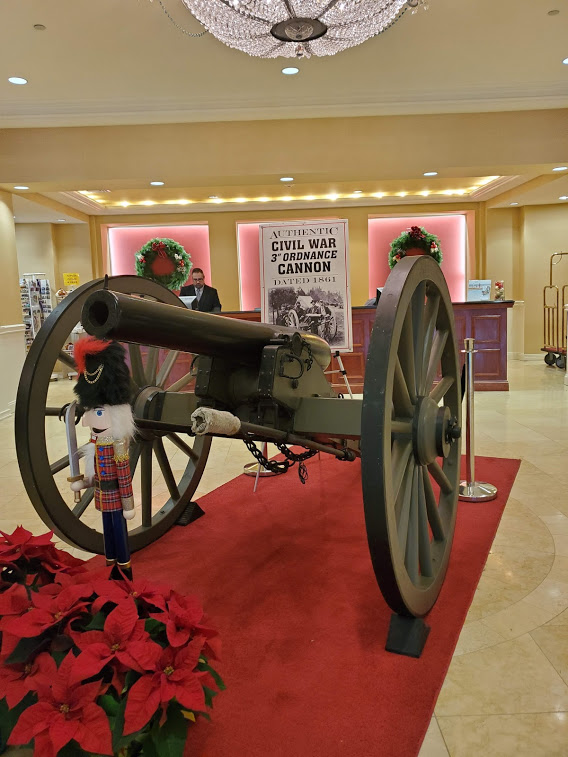
An authentic Civil War 3rd Ordnance cannon sits in the lobby of the Wyndham Gettysburg.
We started our second day with regrouping in one of the hotel’s ballrooms to discuss our mission for 2020. Christi Buker really stressed the importance of membership to the Pennsylvania Library Association and how opportunities need to be provided for members to engage, learn, and volunteer. Buker encouraged us to promote the PaLA to those who are not members and to be persuasive in getting them to join. We touched upon organizing workshops and events where speakers would be presenting, and how to coordinate dates, locations, vendors, audio/visual set-ups, food, evaluations, marketing, registration fees and policies, and on-site considerations. (I give a huge shout-out and applause for those who coordinate such events!) Another session delved deeper into the Pennsylvania Library Association’s website, with Buker encouraging us to either add or update our profile pictures. Buker and I had never met before (although we have talked on the telephone), but she recognized me immediately in the lobby the evening before because of my profile picture, and she thanked me for that. During the presentation the following day, she called me out for having an up-to-date profile picture!
In addition to keeping our profiles updated, Buker also explained to us how to send out group and individual messages so we can keep connected with our fellow members, as well as other features. I have come away with a better understanding of our association’s website and feel more confident utilizing it. It will be a valuable tool as I step into the role of Vice-Chair for the Technical Services Round Table, especially since face-to-face encounters with the incoming Chair might prove difficult given the distance. We wrapped up the orientation with break-out sessions among the various board and committee chairs, divisions, chapters, and round tables, where we got to discuss what unique circumstances and challenges we face as we move into the third decade of the twenty-first century. (Already???)
Overall, I was deeply pleased with my trek to the Leadership Orientation, and I give my heartfelt gratitude to Christi Buker, Michele Legate, and the other hardworking members of the Pennsylvania Library Association who made this orientation possible. An appreciative thanks goes to the Wyndham Gettysburg for hosting us in its splendid hotel, and to the nearby restaurants who accommodated us. I strongly encourage you to actively recruit your fellow librarians who are not yet members of the PaLA to join, and for those who are already members, please have them consider opportunities to involve themselves with this fabulous association. As with anything we do in life, it is all about a leap of faith. I am not sure what the next two years will bring for me as I serve on the Technical Services Round Table, but my hope is that I will continue to grow in my knowledge and capabilities as a librarian to better serve in my profession. I cannot do this isolated; I need the assistance and wisdom of my fellow librarians as I navigate this still new and largely unfamiliar landscape. This is what the Pennsylvania Library Association provides. Through the association, I am able to feel a sense of family as I connect with other librarians across the state; it brings us together when we otherwise would not normally have the opportunity to engage in person. Thank you, PaLA! Here is wishing all of you a joyous holiday season with your loved ones and continued peace and prosperity in the New Year!
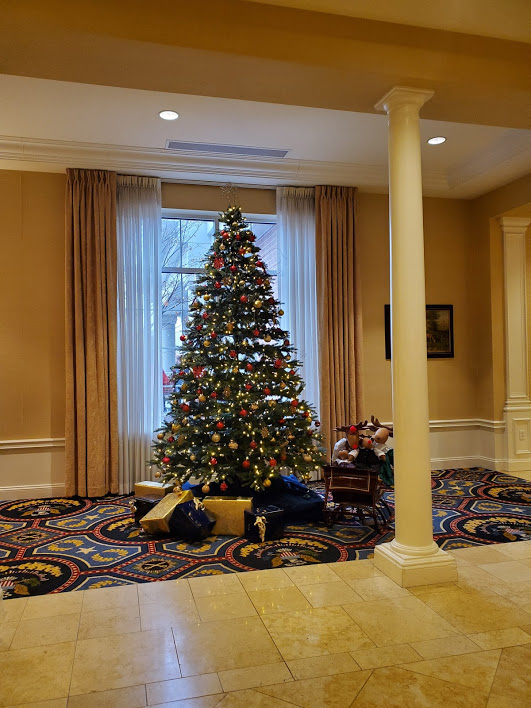
The beautifully decorated lobby of the Wyndham Gettysburg is incredibly inviting for this time of year!
Happy Holidays!
’Twas the day before winter holiday break, and all through the library, not a student was to be found. Paper and project deadlines have passed, and exams have been sat. The faculty have seemingly long since retreated to their home offices to grade (wait, wasn’t that just last week?). The librarians paused to take a deep breath and reflect on the fall semester that had just passed. Time to service the printers and copiers, fill the staplers, empty the hole punchers, and restock the pens and pencils that were “borrowed” (but are hardly ever returned). Then to check the book drops and shelve.
It feels odd to take down Christmas decorations before Christmas has even come, and then we remember why we had the student workers string the lights around the banisters… Maybe they can stay until January.
A few more reports to run, out of office assistants to be set up, and then break can begin. Well, after we check out our own reading list books!
Happy Holidays!
Colleagues
It’s the end of the year so I thought I’d share some food for thought. Has anyone else read Kevin Seeber’s blog post titled Colleagues? You can find it here, https://kevinseeber.com/blog/.
In the post he reflects on the way that the current model of interaction between librarians and faculty, one-shot instruction sessions, can cause a lot of anxiety and stress for the librarian. As he states in his blog post, many faculty are wonderful to work with but it can be frustrating at times.
I can’t say that I’ve had overtly bad experiences with any faculty that I’ve worked with but I think all of us, can sympathize with the well-meaning faculty member who pipes up mid-session and asks you to demo a database or answer a question about something that you hadn’t planned to cover. It’s stressful to try and pivot to cover that material adequately and then get back on track with your planned instruction. Would faculty so casually interrupt other guest lecturers in their class?
I really like Kevin’s question, “Is this how colleagues treat each other?” as a way to reflect on faculty/librarian relationships. What are ways that we can move away from the service model to a true colleague? I’m open to suggestions!!
Bloggers Wanted!
Have you ever read the posts on It’s Academic and thought to yourself, “I could totally write blogs for CRD, and they would be awesome!” then we want you! We are looking for anyone interested in contributing to It’s Academic throughout the 2020 calendar year. We welcome new and experienced bloggers, as well as those who want to contribute frequently or those who would rather only post once or twice a year.
What we’re looking for:
People to author blog posts (of any length or format) on any topic relevant to college and research libraries (bonus points if it’s specific to Pennsylvania). We’ll put together a posting schedule (for the 2020 calendar year) that will let you know what weeks you’re responsible for posting to the blog. On your scheduled week, we’d like to have at least one new blog post by you go live (but you’re absolutely allowed to post more than once in the week if you want to).
Interested?
Send a short email to Matt McNelis at matthewmc1@pcom.edu. Please include how frequently you would like to contribute to the blog (once a month, twice a semester, etc.) and any scheduling issues you foresee so we know when is/isn’t a good time to put you on the calendar. If you have any questions, include them in your email.
How to Build a Better Collection: Practical Tips on Incorporating Diversity, Equity and Inclusion into Collection Development Workflows
Detail image from Scientific American 1, no. 2 (Sept. 4, 1845): p. 1. Courtesy of Wikimedia Commons.
Librarians at Villanova University’s library have begun to talk about what it means to have diversity as a core value when it comes to collection development. The DEI focus up to now has been on raising awareness through programming and displays, diversify staffing, and increasing cultural competencies among our current staff. A recent conversation with a colleague revolved around weighing the LC classification system versus the LC subject headings as a means of doing DEI gap analysis. It was agreed both are flawed methods, because they can be a skewed metric for many reasons and are inherently representative of the dominant political culture. The Change the Subject documentary was still fresh in our minds. How then do we get started?
The findings of Ciszek and Young (2010) still seem to apply: “Libraries wishing to assess a collection for diversity should have a clear definition of diversity in place before assessment. Many collection assessment methods useful for determining the diversity of a collection are not applicable for large libraries. Additional tools may need to be developed to facilitate this type of assessment in the future, especially at large libraries.” The main practical piece of advice is to have a controlled vocabulary for talking about what exactly DEI means for your library.
Two very insightful points made by Anne Doherty in a 2019 Choice360 webinar, Creating an Inclusive Collection: Selecting and Evaluating Diverse Resources, were, “scarcity of time and resources” and “turning outward to expand inclusivity.” The former is mentioned whenever the idea of bringing DEI into focus concerning collection building, but as she says this is a “challenge which I think could be a bullet point on any library presentation about library workflows.” However instead of letting this challenge inhibit the process she states recognizing this “at the start can help you as you define how you want to move forward.” The latter idea is one she credits as coming from the Libraries Transforming Communities initiative which allows libraries to improve their community engagement. (See the simple Turn Outward assessment.) Doherty goes on to say Turing Outward is a phrase and terminology “predominantly seen in public libraries” but to turn outward can be an inspirational consideration for every library when it comes to DEI and collection development.
Cruz (2019) makes several suggestions “for building and maintaining a diverse collection.” Beginning with establishing a committee charged with evaluation and modification of the collection for diversity. Actively identify smaller publishers and discover niche sources for DEI-related materials. Gather feedback from the patrons of the library. Get professional help assessing “the collection for diversity criteria.” Develop a ‘diversity selection criterion’ to be sure what’s collected includes divergent points of view. Use a ‘diversity acquisition code’ to evaluate what monies have been spent on DEI acquisitions and to make the case if a larger budget is required to ensure “ideas from non-dominant sources” are represented and “diverse items” are collected. Cruz goes on to elaborate the central role distinctive collections can and should have in diversifying the library’s holdings overall, which seems a wise approach but not one that works well for every library.
However, in response to the ALA’s recently revised interpretation of the Library Bill of Rights related to diversity in collection development and the library’s own strategic objective to “diversify the collection,” librarians at the Sherwood Public Library did several things on a shoestring budget that all libraries can consider doing:
- Created separate fund for DEI collection building and sought grant funding
- Prioritized filling gaps in “Own Voices titles,” i.e., books “authored by those who share a diverse, minority, or marginalized trait with their protagonist”
- Monitored new media sources, such as e-journals, blogs, podcasts, and independent book publisher’s websites, for book reviews and award announcements related to “marginalized authors”
- Selected books based on analysis of curated lists which highlight “a broad range of voices, perspectives, and authors representing ethnic diversity, all genders and sexualities, and all abilities.”
- Acquired hard-to-get books from a wide range of smaller publishers at an international book fair
- Expanded world languages represented in the collection based on data about the community the library serves
- Adjusted deselection criteria for DEI books, to allow them more time to circulate
References
Ciszek, Matthew P., and Courtney L. Young. “Diversity Collection Assessment in Large Academic Libraries.” Collection Building 29, no. 4 (October 12, 2010): 154–61.
Creating an Inclusive Collection: Selecting and Evaluating Diverse Resources. ACRL-Choice webinar. Recorded May 21, 2019. https://choice360.org/librarianship/webinars/creating-an-inclusive-collection
Cruz, Alice M. “Intentional Integration of Diversity Ideals in Academic Libraries: A Literature Review.” The Journal of Academic Librarianship 45, no. 3 (May 2019): 220–27.
“Diverse Collections: An Interpretation of the Library Bill of Rights.” American Library Association. Adopted July 14, 1982, by the ALA Council; amended January 10, 1990; July 2, 2008; July 1, 2014 under previous name “Diversity in Collection Development”; and June 25, 2019. http://www.ala.org/advocacy/intfreedom/librarybill/interpretations/diversecollections
Garcia, Crystal, and Adrienne Calkins. “Figuring Out Where to Start, and How: One Library’s DEI Strategies.” OLA Quarterly 25, no. 2 (October 28, 2019). https://commons.pacificu.edu/cgi/viewcontent.cgi?article=1988&context=olaq


 It's Academic