Call for Proposals: Pennsylvania Library Association College and Research Division Spring Workshop
Workshop Theme: Pennsylvania Academic Libraries: Powering Progress with Essential Literacies
Workshop Description:
Academic libraries are known as champions of information literacy. Though information literacy is vital to the critical thinking development of college students, it is not the only literacy needed to be successful. Additionally, many libraries are interpreting information literacy beyond its traditional definition to increase their scope and services to their campus communities. On Tuesday, May 19 at Penn State Harrisburg in Middletown, PA, the College and Research Division of the Pennsylvania Library Association will explore how we engage with many literacies in an academic library context.
To facilitate this exploration, we are seeking innovative and interactive proposals for one-hour breakout sessions that showcase scholarship in or academic library efforts to engage their campus communities in the five essential literacies that empower our students to become critical thinkers and engaged citizens as identified by the PA Forward Star Library Program (http://paforwardstarlibraries.org/):
- Information Literacy
- Health Literacy
- Civic and Social Literacy
- Financial Literacy
- Basic Literacy
You do not need to be a Star Library in order to submit a proposal. Proposals should broadly fit the theme of at least one literacy category, and may relate to instruction, programming, collection development, or any other area your library supports through literacy efforts.
Proposal Requirements:
Proposals must include a title, an abstract of no more than 250 words, the literacy/literacies addressed, a brief plan for audience engagement, and 2-3 learning objectives. Please refrain from including identifiable information in your abstract and other materials to help ensure a blind evaluation. PaLA CRD members will be given preference in session evaluation and selection.
Submissions are due by March 16. Workshop registration will be available soon at palibraries.org.
Submit your proposal here: https://pennstate.qualtrics.com/jfe/form/SV_3eER4RjN2FcdJNb
Questions? Contact us at CRDPALA@gmail.com
This project is made possible by a grant from the Institute of Museum and Library Services as administered by the Pennsylvania Department of Education through the Office of Commonwealth Libraries, and the Commonwealth of Pennsylvania, Tom Wolf, Governor.
Support is also provided by the College and Research Division of the Pennsylvania Library Association, https://crdpala.org/
Learning to Teach
I have a confession to make…I’m an instruction librarian who never learned how to instruct. Learning to teach information literacy skills was not part of my schooling. There was no Teaching 101 in library school for me, no Educational Theory 405. I didn’t learn the ins-and-outs of different ways our brain learns new ideas or how to best keep college students engaged.
Because of this, I usually walk away from a teaching session asking myself “did the students listen to me? Did they pay any attention? Did they learn anything at all?” I’m a librarian. I’ve had the training and the experience to know how important information literacy skills are and want nothing more than to share that knowledge and understanding with the students. So how do I as an untrained teacher develop engaging lessons about, admittedly, not the most exciting topics?
This is something I have been thinking about ever since I started observing my colleagues teach and then as I began to teach myself. My initial thought was “how can I make info lit interactive so I talk less and the students do more?”
After reading Amy Boykin and Allison Willson-Metzger’s article “A Murder in the Library” I got inspired. A Murder Mystery seemed like the perfect idea to get students engaged, especially with the rising popularity of escape rooms and the like. Reading this article led me to discover Carleton College’s Annual Library Mystery Event where they created an interactive Murder Mystery complete with clues where students learned about library resources and services. This seemed perfect to me and a great way to get incoming freshmen familiar with the library during their orientation. Using this as a base, I created my own “Mystery at the Library: the Quest for the Holy Grail” where a history professor went missing on his search for the Holy Grail. The freshmen students had to retrace their steps to find the missing professor and Holy Grail, all the while learning in a hands-on way about our resources and services. The event was successful, but I thought how can I take this fun activity and bring it into the classroom?

I read a lot of articles and listened to presentations on different ways this could be possible with my ultimate end-goal being an engaging lesson from which students will learn and have fun. I turned towards Canvas, my institution’s learning management system, to develop a digital scavenger hunt.developed what I hope (key word: Hope) will be an engaging way to get students to a) learn the importance of information literacy skills and b) have fun. This digital scavenger hunt I created asks students questions about printing money, databases, InterLibrary Loan, and more. After each question the students are given a clue to a cypher. Once they answer every question, gather the clues, and put them in the correct order, the cypher reveals a call number to a book revealing that the missing professor and the Holy Grail are located in the stacks near the book.
Currently, graduate and undergraduate students who work in the library are testing the digital scavenger hunt. So far I have received great feedback, though with the overall feeling that I made it too difficult. Whether or not this is due to my own design skills or the questions being too difficult, I’m unsure. If the questions are too hard, I like to believe if the students had an info lit class prior to taking it, they would be able to get through it more easily. This of course leads to a bigger discussion on what and how we are as librarians teaching students and how we can make this better. I will continue to edit the questions and rethink how to make the Quest a great companion to a lecture in my information literacy classes. I’m determined to speak less, have the students do more, and create enthusiasm around library instruction.
I certainly don’t have all the answers, and don’t know yet if this digital scavenger hunt will have a positive effect on student learning outcomes. Until I become the superhero teacher I wish to become, I do know I will continue to learn through my own research and experience to find what works and doesn’t in the classroom, and will always seek to make learning fun.
What Are You Reading?: Organizing Inter-Campus Book Displays
Books displays are hard. Even with an investment in fancy shelves or display cases, getting students, faculty, and staff to pause and pick up books from a display table as they’re on their way to class or tutoring is a challenge. Though we switch out displays weekly and link the content or theme of each table to something going on in the larger campus community or in the world, browsing of these displays rarely happens.
Conversely, if we think about how books are displayed in bookstores, we see a lot more engagement. People pick books up and read the back covers or inside of the jacket. Granted, they are there because it’s a bookstore and they want to browse or purchase a book, but something about that particular table and that particular book has caught their eye. What can libraries do differently to get this type of reaction from our displays?
If you’re like me, one of the places you check out when first walking into any bookstore is the staff recommendations shelf. There is always something surprising on the shelf; always a title I’ve never heard of and want to pick up and take a closer look at. I also know from working in a bookstore that staff really enjoy coming up with suggestions and sharing their favorite titles with patrons. We took this idea and ran with it on our campus, and we’ve gotten some good results!
One of our librarians contacted different units on campus (admissions, athletics, student affairs, etc.) and asked them to submit the titles of their favorite books. Once enough titles were received from individuals in each department, we gathered multiple copies of each title, sometimes in different formats, and put them on a display with digital signage making clear which department on campus recommended these titles. Once on display, an email was sent to that department inviting them to come and see their display. Individuals also get a bit of library swag when they come over, as a thank you for participating.
This may seem like a simple idea, but it’s gotten engagement from members of the departments who submit their titles, other faculty and staff who are interested in what their colleagues are reading, and even a few students who pick up the books on display. I also think it’s also helpful that there are multiple copies of each title on the table. Just like the last piece of cake, no one wants to take the single copy of a book on display. I’m sure there is some psychological theory that explains why that is, but in the meantime, I’ll just be happy that our display tables are getting more traction!
Open and FAIR go Together Like a Horse and Carriage
The State of Open Data Report has been produced 2016-2019 by Digital Science and Figshare. What’s different about 2019? The number of respondents, which remained relatively the same for the first three years, quadrupled to over 8000 world-wide according to Briony Fane, “What is the State of Open Data in 2019?” in The State of Open Data Report 2019 (Digital Science, October 24, 2019), 8-12.
Fane goes on to say, the value of a citation to a dataset was rated highly or more highly than was a citation to a standard research paper. What makes this attitude interesting is that while a third of respondents published their first peer-reviewed article in the 2010s nearly half already have tenure and over a third are professors. So, the idea that researchers who have already passed over the coveted professional thresholds care only about traditional forms of scholarship is not a truism. But this may be the case because researchers who are established in their careers are less concerned about getting scooped by sharing their data and are more interested in collaborating with other scholars.
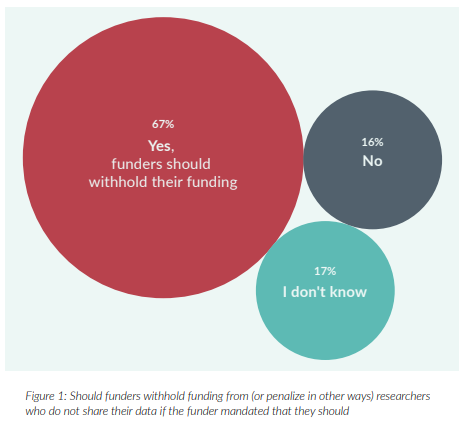
It may seem logical that over a third of respondents have concerns about misuse of data. However, the second most frequent concern was uncertainty about copyright and licensing. It is encouraging though that the percentage of respondents who don’t know what license covered their data when it was made openly available has dropped significantly since the first report four years ago.
The sad reality these reports reveal is that most researchers still don’t know what FAIR principles are when it comes to open data. But on the positive, a majority “of respondents who had never used open data in their research would be willing to do so” (Fane 11).
Some other “Big Takeaways” identified by Briony Fane, a Data Analyst with Digital Science:
- “full citation (61%), co-authorship (42%), consideration in job reviews (45%) and financial reward (38%) all ranked highly as important mechanisms for researchers as credit for sharing their data openly”
- “65% of respondents reported that they curated their data for sharing either privately or publicly”
- “79% of 2019 respondents were supportive overall of a national mandate for making primary research openly available.”
There have been tremors in the research publishing community since an open letter with now over 60 signatories was sent late last year to petition for a White House Executive Order to require open access for publicly funded research. Based on The State of Open Data Report 2019, an important step a librarian can take is to educate researchers about the FAIR principles and ensure research data is Findable, Accessible, Interoperable, and Reusable.
Call for Presenters – Share Your Ideas, Knowledge, & Experience at the Pennsylvania Library Association 2020 Conference!
The 2020 Pennsylvania Library Association Conference, Mountains of Possibilities! will take place October 18 – 21, 2020 at Kalahari Resorts & Conventions in the Poconos.
The 2020 Conference Program Committee is currently accepting proposals for sessions to take place during the conference, to include more than sixty educational sessions on topics of interest for the library community. Suggested topics
If you are an expert on a topic that you feel will be of interest to this group, we invite you to submit a session proposal!
The deadline for submissions is noon (EST) on Monday, March 16.
For more information on the conference, and the submission link and requirements, CLICK HERE, and by all means plan to join us at Kalahari! You won’t want to miss it!


 Adam Balcziunas
 Alex K.
 Alexandrea Glenn
 Andrea Pritt
 aprilnkelley
 Ashley Purvis
 Bethann Rea
 blj13
blj13 Brendan Johnson
 Amanda Boyer
 Bret Stiffler
 Bonnie Powers
 Christopher Lemery
 clarewithers
 clblibrarian
 Kelly Clever
 Charlotte M. Johnson
 colemanluzerne
 CRD of PaLA
 crdvirtualjournalclub
 cre5314
 csgarth
 Erin B.
 danajkerrigancv
 denisewetzel1
 Darren G. Poley
 elm43
elm43 James D'Annibale
 Annie Jansen
 Jill Hallam-Miller
 jennifercribbs
 Jenn Monnin
 Jen Hasse
 Jessica Showalter
 johnmeier1
 Kelly Safin
 Kim Karim
 Kristen Seikaly
 Kayla Van Osten
 Cecelia Lasley
 librarianjsmith
 Linda Neyer
 mabogino1
 Matthew McNelis
 Meg Massey
 Maggie Savidakis-Dunn
 Rebecca
 miskatoniclibrarian
 Maureen Bentz
 Michele G. Anfuso
 Nicole Miyashiro
 paulmcmonigle
 Rob Sieczkiewicz
 ronlmccoll
 Sam Bardarik
 shannahollich
 smartin592
 Ula Lechtenberg
 It's Academic