Resources for Keeping Patrons in the Know About COVID-19
COVID-19 is an infection caused by a novel coronavirus that leads to a respiratory illness which can spread from person to person. COVID-19 continues to spread globally. This post is a guide to academic resources on the topic, and also general information to help our communities be well-informed.

Map of confirmed cases in the state of Pennsylvania by counties as of 26 March 2020.
COVID-2019 DATA, MAPPING AND TRACKING RESOURCES
- Centers for Disease Control and Prevention (CDC) global map
- Healthmap.org Novel Coronavirus (COVID-19) global map with animation spread
- Johns Hopkins University – Global Cases by the Center for Systems of Science and Engineering (CSSE) global map
- nCoV2019.live global tracking
- New York Times United States map tracker (NYT login required)
- Coronavirus (COVID-19) cases from the Pennsylvania Department of Health
- World Health Organization health emergency dashboard
OPEN CURATED SCHOLARLY RESOURCES
- The American Society for Microbiology (ASM) – Novel Coronavirus (COVID-19) Resources
- The BMJ – Coronavirus (covid-19): Latest news and resources
- Clarivate Analytics – Coronavirus Resources
- EBSCO – COVID-19 Portal
- Elsevier – Coronavirus Information Center
- Journal of the American Medical Association (JAMA Network) – Coronavirus Resource Center
- The Lancet – Coronavirus Resource Centre
- LitCovid – curated literature for access to research articles in PubMed
- Nature – SARS-CoV-2 Coronavirus Collection
- Semantic Scholar – COVID-19 Open Research Dataset (CORD-19)
- UpToDate – Coronavirus Open Access Information
- Wolters Kluwer – COVID-19 Tools & Resources for Clinicians
STATE, NATIONAL & INTERNATIONAL RESOURCES
Commonwealth of Pennsylvania
- Health.pa.gov Coronavirus PA COVID-19 Updates (including testing, statistics, and more)
- PA Hotline 1-877-PA-HEALTH (1-877-724-3258)
Centers for Disease Control and Prevention (CDC)
- About Coronavirus Disease 2019 (COVID-19)
- Daily Situation Summary
- Testing in the United States
- Protecting Yourself
- Frequently asked questions
National Institutes of Health (NIH)
National Library of Medicine (NLM)
- Coronavirus Disease 2019 (COVID-19)
- GenBank sequence data at the severe acute respiratory syndrome coronavirus 2 (SARS-CoV-2) data hub.
- LitCovid – curated scholarly research articles in PubMed
- NLM Technical Bulletin – New MeSH Supplementary Concept Record for the 2019 Novel Coronavirus
Environmental Protection Agency (EPA)
- List N: Disinfectants for use against Use Against SARS-CoV-2
- Frequently Asked Questions about List N: Disinfectants for Use Against SARS-CoV-2
U.S. Food & Drug Administration
World Health Organization
European Union
Government of Canada
Content adapted from CORONAVIRUS (COVID-19) RESOURCE GUIDE by Sarah Hughes, Nursing, Biology, and Health Sciences Librarian, Villanova University
Homeschool with A Baker’s Dozen Booklist and Activities
In these stay-at-home days of the coronavirus pandemic, A Baker’s Dozen booklist is a valuable online resource for teachers and guardians of preschoolers who are in search of educational materials and have books available via e-libraries, YouTube read-along posts, etc.
A Baker’s Dozen: The Best Children’s Books for Family Literacy highlights 13 fiction/nonfiction picture books selected by the Pennsylvania (PA) Center for the Book at Penn State University Libraries each year. Those chosen must be published in the previous year and go through a rigorous selection process to ensure text and illustrations within support the interests and developmental milestones of children ages three-to-six (with many titles suitable independent-reads for those seven and eight-years-old).
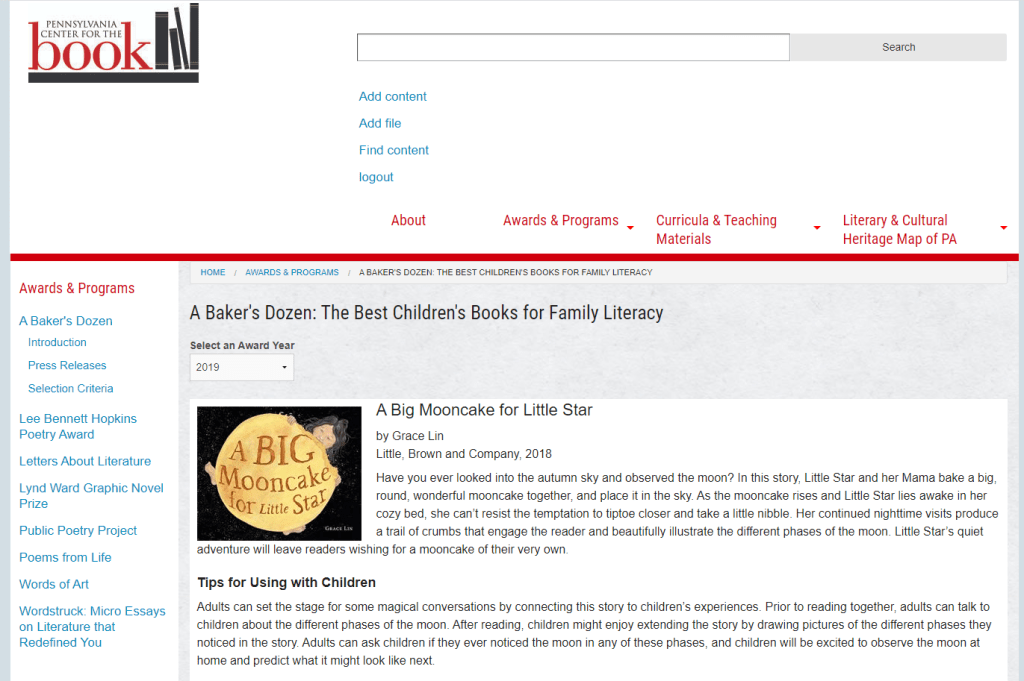
The website houses booklists by year from 2004 to 2019, with 2020 forthcoming, that are annotated with summaries, tips, and activities. Families, caregivers, and educators can discuss the concept of remembering with kids by referring to thought bubbles on the pages of Teddy’s Favorite Toy, for example – a book by Christian Trimmer, illustrated by Madeline Valentine (Atheneum) from the 2019 Baker’s Dozen.
Or while exploring the 2014 Baker’s Dozen book Hank Finds an Egg by Rebecca Dudley (Peter Pauper Press), “…adults can ask children what they would do if they found an egg like Hank did. How would they take care of the egg? Adults can allow children to touch and hold a hard-boiled egg. What words would children use to describe the egg? What would happen if the egg was not handled gently?”
Tips and annotations provide instructions on emphasizing words and phrases to further age-appropriate core learning concepts, as well as hands-on activities. Books that rise to the top of the selection jury’s picks have readable fonts, natural and repetitive phrasing, amply and evenly spaced formatting, illustrations that extend text concepts, a diversity of appealing topics for families, and/or a smooth cadence for reading aloud.

So while huddled inside, try A Baker’s Dozen to warm and enrich the space for young ones with more than just sweet treats from the oven! Be sure to revisit A Baker’s Dozen online in the coming months for the latest 2020 titles!
A Baker’s Dozen is administered by PA Center for the Book Director, Karla M. Schmit, with team members Caroline Wermuth, James McCready, and a dedicated jury of experts on children’s literature.
The PA Center for the Book—sponsored by Barbara I. Dewey, dean of University Libraries and Scholarly Communications, and Penn State State University Libraries—is an affiliate of the Center for the Book at the Library of Congress. It encourages PA’s citizens and residents to study, honor, celebrate and promote books, reading, libraries and literacy.
For more information, visit the PA Center for the Book website or contact Caroline Wermuth (cvw1@psu.edu), outreach coordinator.
C&CS Presents: Setting the Stage for Civic-Minded Education: Collaborative Approaches to Instruction, April 16th at 12pm EST
C&CS Presents:
Setting the Stage for Civic-Minded Education: Collaborative Approaches to Instruction
with Jen Bonnet and Lily Herakova
April 16th at 12pm EST
Register here for the Zoom login information (free!)
For the past four years, Lily Herakova and Jen Bonnet have been collaborating to shape and assess an information literacy curriculum for a large enrollment Public Speaking course. This presentation focuses on what we have learned about the relationships among students’ self-efficacies and skills in information literacy, public speaking, and civic-mindedness. We will share the results of several studies, and invite participants to engage with the practical applications we have developed.
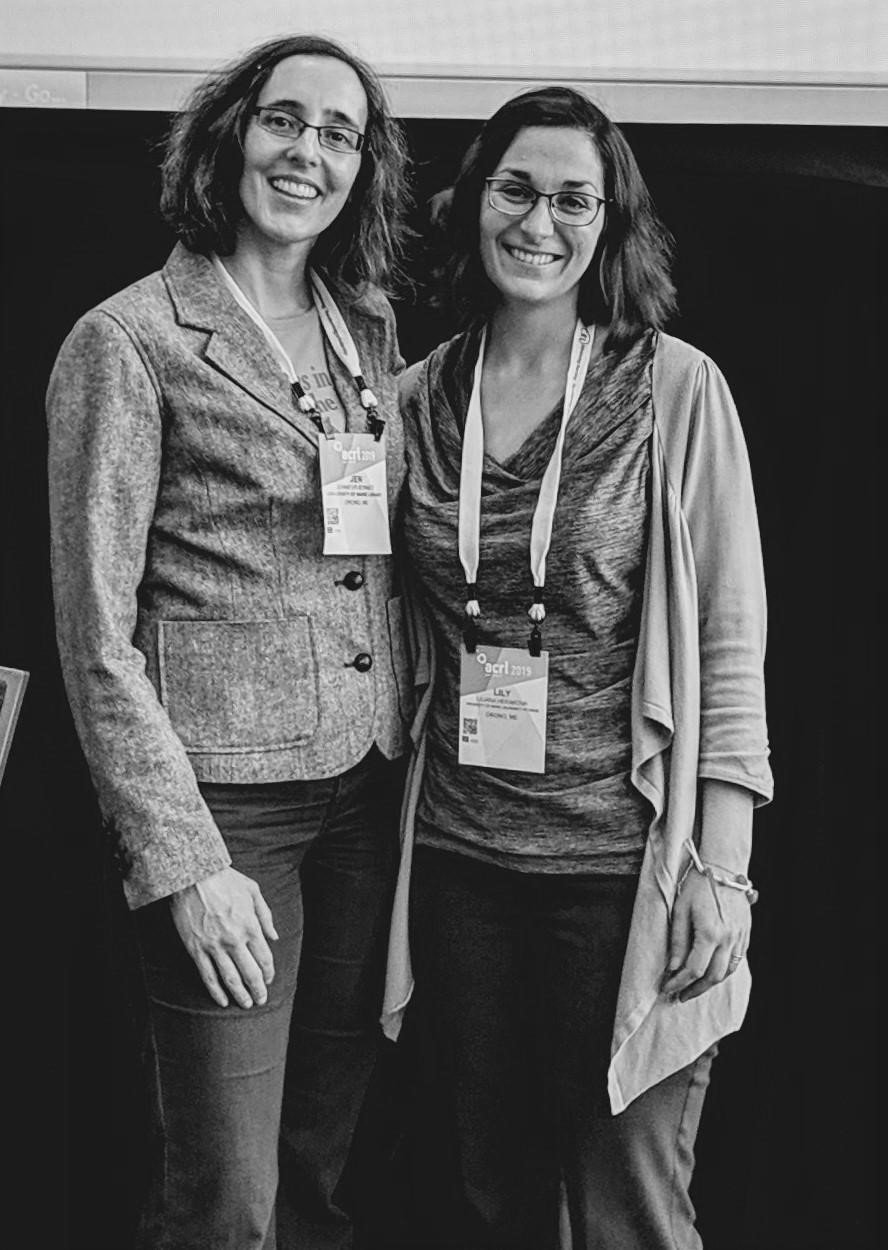
Black and white photo of Jen Bonnet and Lily Herakova
Jen Bonnet is a foster parent, educator, baker (although she has miles to go before she’s as skilled as Lily), and outdoor enthusiast. As a Social Sciences and Humanities librarian at the University of Maine, she engages in a wide range of outreach, instruction, consultation, and research. She has published with Lily Herakova in the Association of College and Research Libraries 2019 conference proceedings, Basic Communication Course Annual, and Journal of Academic Librarianship.
Lily Herakova is a mother, teacher, immigrant, baker, writer, and community organizer. She is an Assistant Professor and Graduate Teaching Coordinator in the Department of Communication and Journalism at the University of Maine. Her work focuses on communication’s potential to bring about equitable, just, and inclusive worlds/communities, especially in educational and health-related contexts. She has published and presented nationally and internationally in the areas of communication pedagogy and mentoring, performance, social justice, and health communication.
Librarian’ing From Home
Today marks the first day of online instruction for my college. I had thought we would get hit with a high volume of chat reference questions today as students begin to get information from their faculty about what resources they will need moving forward. However, this rush on librarian assistance has not materialized. Perhaps it is too soon for the students to even think about accessing resources when they are still wrapping their heads around all the ways their courses are changing? Has anyone else noticed an increase or decrease in student or faculty questions?
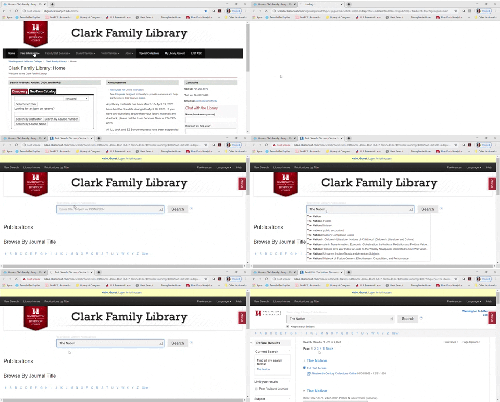
The students aren’t the only ones trying to wrap their minds around this new reality. I’m trying to figure out what is the best way to do my job from home. Video tutorials for our website and databases has always been one of those projects that we have never seemed to have time for and now they’ve really moved up the list of important tasks. I attempted to teach myself how to make a gif on Friday. My first attempt – showing students how to search for a specific publication – was not what I would call a success but not a total failure either. Anyone have good tips for creating these types of videos?
The other thing I’m thinking about is how to offer library instruction remotely. My first experience is coming tomorrow afternoon. I created a LibGuide with resources that will be useful for their assignment which has been shared out to them via Sakia, our LMS. I’m scheduled to be available within their Sakai chat room tomorrow for the duration of their class period so that students can ask me questions. However, I know from my face to face instruction that students rarely ask questions so I’m trying to think of conversation starters I can use to get them to engage. My fingers are crossed that my sparkling personality can come through via a chat room! 😉
I look forward to hearing from other libraries what you all are doing to cope with the COVID-19 situation.
Coping with Crisis
Things have changed rapidly for Pennsylvania libraries over the last week. Public libraries, schools and many non-essential businesses have closed. Universities and colleges have moved classes online for a few weeks or for the rest of the semester. Instructors are working to modify their lesson plans for an online environment. Libraries are shifting to provide more virtual assistance to users. Students are also struggling – unable to return to campus, missing the connections they’ve made with their friends, their professors and their community at large.
In this new normal, we’re all struggling to figure out how to best support our users and each other. Here’s a few pieces of advice for facing times of crisis:
Give each other (and yourself) some grace
In times like this, it’s more important than ever that we show kindness, understanding and grace to our coworkers and ourselves. These are trying times. Let’s support each other and lift each other up. Give yourself a break too – you need it.
Be flexible
If the news is any indication, things are changing rapidly. It’s important to be flexible and willing to change practices quickly to make things work for our users and for our colleagues.
Practice self-care and make healthy choices
Now more than ever, it’s incredibly important that we take care of ourselves. Running on empty isn’t good for anyone. Working from home? Make sure to take breaks and keep the blood flowing with some movement. Get some sleep, unplug when you need to, and yes, wash those hands!
Find ways to stay connected
This situation has already caused many to feel isolated. Find ways to reach out to your friends and colleagues. Instructors are using Zoom or Skype to connect with students. Artists like Coldplay and John Legend shared live broadcasts on their social media accounts with hashtag #TogetherAtHome. With modern technology, we can still find ways to connect with each other!
Laugh a little
In these trying times, it’s important to have a sense of humor. We all could use a little levity. Instructors and students are having fun changing their Zoom backgrounds. Share a fun video or photo you stumble on with a colleague.
Take care and stay healthy, everyone. We’ll get through this!


 Adam Balcziunas
 Alex K.
 Alexandrea Glenn
 Andrea Pritt
 aprilnkelley
 Ashley Purvis
 Bethann Rea
 blj13
blj13 Brendan Johnson
 Amanda Boyer
 Bret Stiffler
 Bonnie Powers
 Christopher Lemery
 clarewithers
 clblibrarian
 Kelly Clever
 Charlotte M. Johnson
 colemanluzerne
 CRD of PaLA
 crdvirtualjournalclub
 cre5314
 csgarth
 Erin B.
 danajkerrigancv
 denisewetzel1
 Darren G. Poley
 elm43
elm43 James D'Annibale
 Annie Jansen
 Jill Hallam-Miller
 jennifercribbs
 Jenn Monnin
 Jen Hasse
 Jessica Showalter
 johnmeier1
 Kelly Safin
 Kim Karim
 Kristen Seikaly
 Kayla Van Osten
 Cecelia Lasley
 librarianjsmith
 Linda Neyer
 mabogino1
 Matthew McNelis
 Meg Massey
 Maggie Savidakis-Dunn
 Rebecca
 miskatoniclibrarian
 Maureen Bentz
 Michele G. Anfuso
 Nicole Miyashiro
 paulmcmonigle
 Rob Sieczkiewicz
 ronlmccoll
 Sam Bardarik
 shannahollich
 smartin592
 Ula Lechtenberg
 It's Academic