Love Among the Ruins: Potential Post-Pandemic IT Scenarios for Higher Ed

Some say the global COVID-19 pandemic has irrevocably changed the IT landscape for colleges and universities. The latest EDUCAUSE Information Technology Issues Project “Top IT Issues, 2021: Emerging from the Pandemic” by Susan Grajek, Vice President, Communities and Research, for EDUCAUSE and the 2020–2021 EDUCAUSE IT Issues Panel outlines three post-pandemic IT scenarios for Higher Ed.
Institutions will either restore, evolve, or transform. That is, some “will be focused on figuring out what to do to get back to where [they] were before the pandemic,” while others will evolve by being “focused on adapting to the new normal.” Those which are nimble enough and can afford to “will be focused on redefining [the] institution and taking an active role in creating the innovative future of higher education.” Members of the 2020–2021 EDUCAUSE IT Issues Panel also identify Collaboration and Partnership as key to managing IT in 2021.
The different scenarios were determined by presenting nineteen potential 2021 IT Issues and having them evaluated by members in EDUCAUSE’s annual IT Issues survey. The priorities for each potential future are explored in depth by the report. The outcome is summarized well in this short video: “The EDUCAUSE 2021 Top IT Issues.”
Considering the library’s central role in the academic enterprise, librarians ought to contribute to any discussion on the technological commitment, capability, and future of the institution they serve.
“EDUCAUSE is a nonprofit association whose mission is to advance higher education through the use of information technology.”
What Have We Learned in 2020? Or: How I Learned to Stop Worrying and Love (ok… mildly accept) the “New Normal”
Raise your hand if you have ever felt personally victimized by the year 2020. If anything, I just wish that we could all get along (and physically get together to forget about COVID-19) like we used to in middle school (or prior to 2020). I wish that I could bake a cake (or go out to eat one in a diner) made out of rainbows and smiles and we’d always be happy. And COVID-free. But alas, if we need to share our feelings and have learned anything from the upside-down year that has been 2020, it is we must rise above feeling victimized to this “new normal” and be flexible to the impending changes in librarianship and information literacy instruction – provided we’re not kept here past four o’clock.
Who could have imagined that last year at this time, we were assisting students in-person with wrapping up their fall semester examinations, or providing instruction for a winter session course? We were face-to-face, within six feet of one another, rubbing our noses should we have had the sniffles or masking an unwanted cough in our sleeves without a second thought (or face covering). We laid our hands repetitively on countertop surfaces, keyboards, mice, and door handles that had most likely not been sanitized in ages. Our students studied diligently in our libraries, sprawled out at our tables with their snacks and beverages. Catching a contagious and potentially deadly virus was most likely the last thing on anyone’s mind.
And yet here we are, twelve months later. Our formatting for instruction and communication has changed to a completely remote environment. Zoom meetings have become the way to conduct information literacy sessions and to provide support for our students. Our dining room tables have been transformed into our workstations. (I am personally comfortable in my living room on the second floor of my parents’ house.) Who could have predicted that we’d be homebound for two and a half months? (My county, Lehigh, was one of the last counties in Pennsylvania to move out of the red phase.) Who could have foreseen wearing masks when out and about and limiting our social contact with one another? While you were wrapping your holiday presents last year at this time, did you ever think that something like this would happen on such a global scale? Could you fathom that how you worked as a librarian could change literally overnight?
I am an eternal optimist, a silver lining to every cloud kind of person. I believe that there are a lot of positive attributes which we can take from this crazy, unpredictable year. One of the most positive attributes to this pandemic is the rise and convenience of remote work. To be honest, I for one, have often been left exhausted from my short (but extremely chaotic) commute to my community college, so having the option to walk across the hallway from my bedroom to my living room to start my workday has been a blessing. Creating a Zen-like environment – complete with candles, calming chill music courtesy of Sirius XM, and at this time of year, the serene presence of my beautiful Christmas tree – has increased my productivity and eased my nerves while grading assignments and offering reference chat services to our students. While I do miss my co-workers, I do not miss the idol chattering or office politics, which has especially been heightened given this year’s presidential election. My co-workers and dean are never more than an email or a Zoom meeting away, and there is a convenience to that.
Naturally, there are some inconveniences to working remotely. Since I work on interlibrary loans, I do need to be in the office several days a week to handle requests for physical items. Everyone understands that shipping items at this time, given the pandemic and now especially with the holidays, is just plain crazy and no one expects a book or DVD to show up the very next day. We have all had to exercise more patience when it comes to physical requests. And I believe we can all agree that practicing patience has been detrimental during this pandemic; patience with staying inside our homes, patience with having to continuously wear face coverings, patience with waiting for a vaccine, and patience with our students as they navigate a whole new digital landscape – something which many never signed up for in the first place. And that has been another drawback: by default, we are social creatures. We were not meant to communicate solely through our screens and smart phones. We crave touch and face-to-face contact. We need to feed off of each other’s facial expressions (or at least the upper half of our facial expressions these days) and body language, both of which have not benefitted from the decree of social distancing. No doubt, this has been difficult on our students who need our support and who greatly benefit from having a librarian in physically proximity. Fortunately, screen-sharing has been a tremendous blessing during this time, as students can feel as though the librarian is really right there with them.
Another benefit which has arisen from the bowels of turmoil that has marked this year has been an increase in social justice awareness. Between the racial tension plaguing our country and the great digital divide which has prevented many citizens from jumping onto the remote bandwagon, this year has heightened the plight of underrepresented peoples. My hope is that this has resonated with our librarians in increasing the awareness of social and racial injustices. Over the course of the year, there have been numerous webinars concerning racism and political unrest within the world but especially within the United States. Librarians across the globe were quick to respond by holding remote workshops on racism and by increasing awareness through virtual and physical displays of literature and media either created by or concerning underrepresented populations.
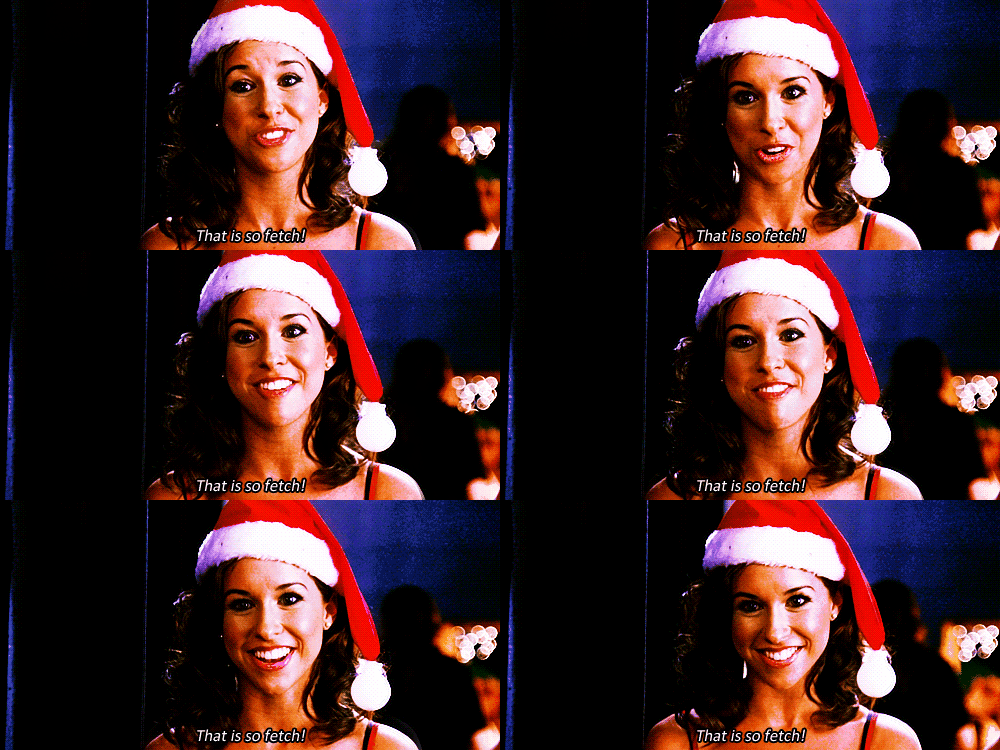
While I am an eternal optimist, I do not believe that at the stroke of midnight come January 1, 2021, all of this will disappear and suddenly everything will go back to the way it used to be before COVID-19. There will be most likely be more shutdowns, a second or third or fourth wave of the pandemic bearing down upon us, more racial injustices, and more people who cannot access all that the digital world has to offer. It will take more than just the changing of a year to bring about health, prosperity, and reconciliation. Librarians are going to remain at the forefront of this rebuilding and reshaping, as being flexible and adapting to a constantly changing world is one of our strong points in our profession. We will remain the voices of reason, the champions of truth and accessibility for all, for centuries to come. And that is “fetch” that is definitely going to happen!
New Issue – Pennsylvania Libraries: Research & Practice (Fall 2020)
The latest issue of Pennsylvania Libraries: Research & Practice is now available at palrap.org
Articles include:
- In the PaLRaP Spotlight: Justin Hill
- Lessons Learned in Leaving the Library and Coming Back Again
- Promoting Open Educational Resources: A Beginner’s Playbook
- Flip It and Break It: Using Flipped Lessons and Breakouts to Energize Learning
- littleBits: Not Just for the Kids
- 21st Century Innovations: Librarians, Trend-Watching, and the Warning Signs of Fads
- Noteworthy: News Briefs from PA Libraries
Bryan McGeary & Danielle Skaggs, Co-Editors
=======================================================================
Pennsylvania Libraries: Research & Practice (PaLRaP) is a peer-reviewed, open access journal, sponsored by the College and Research Division of the Pennsylvania Library Association. PaLRaP provides an opportunity for librarians in Pennsylvania to share their knowledge and experience with practicing librarians across Pennsylvania and beyond. The journal includes articles from all areas of librarianship, and from all types of libraries within Pennsylvania.
What worked? What Didn’t?
As we find ourselves at the end of a whirlwind semester filled with changes to how we offer library services, I find myself reflecting on what worked well for me and what did not. I’m really thinking about my instruction sessions this fall because I felt like some of them when really well but then others were not great, from my point of view. Our library decided that we would only offer online information literacy instruction this year and we had not delivered content online prior to this fall. I decided that for me that would mean my default was synchronous Zoom sessions in the hopes that they would closely resemble an in-person instruction session.
This approach worked well for upper-level students and students with very clear research assignments. They knew I had information that would make their lives easier and they were very willing to unmute their mic and have a virtual conversation with me.
This approach did not work as well for my “do your normal library thing”, first-year student, sessions. These students don’t always have a true research assignment and so what I end up doing is focusing more on source identification and evaluation. The activities I did in the classroom didn’t translate that well to the breakout room format and I think students had less tolerance for something they couldn’t immediately connect to what they needed to do to be successful in their class.
After a few session that were just OK, I talked with one of the English professors and we decided that in addition to the synchronous Zoom session that I should also meet with each of her students one-on-one to discuss an assignment later in the semester. I found this interaction to be so much more rewarding than the class session. I realized that meeting with these students to talk directly with them about their approach to an assignment was replicating the part of the in-person first-year sessions that I like best, which is walking around the room and talking with each student individually as they explored their topic.
I think in the spring as I get instruction requests, I will be less likely to suggest a synchronous Zoom with each class and explore more of the asynchronous interactions. I want to create a tutorial that is focused on general tips for using EDS, our discovery tool. I think it will be good to have that to share out via our LMS and then perhaps meet with me one-on-one for more focused guidance on their topic.
It seems like we’re still going to be dealing with hybrid learning at best through the Spring semester so I would love to hear from others about what worked for them and what didn’t.
CRD Virtual Journal Club Meet & Connect
While we did not hold our typical series of meetings during the fall semester this year, the Virtual Journal Club will host a meeting on Thursday, December 17th, from 11:00 am to noon.
This meeting will provide an opportunity to discuss the challenges and successes of this extraordinary semester, as well as a forum to share ideas for the Journal Club moving forward. We hope to host a series of meetings in the spring 2021 semester to return to discussing journal articles once again.
Please join us if you can! Sign up to receive an email including the Zoom link. We look forward to connecting with you.


 Adam Balcziunas
 Alex K.
 Alexandrea Glenn
 Andrea Pritt
 aprilnkelley
 Ashley Purvis
 Bethann Rea
 blj13
blj13 Brendan Johnson
 Amanda Boyer
 Bret Stiffler
 Bonnie Powers
 Christopher Lemery
 clarewithers
 clblibrarian
 Kelly Clever
 Charlotte M. Johnson
 colemanluzerne
 CRD of PaLA
 crdvirtualjournalclub
 cre5314
 csgarth
 Erin B.
 danajkerrigancv
 denisewetzel1
 Darren G. Poley
 elm43
elm43 James D'Annibale
 Annie Jansen
 Jill Hallam-Miller
 jennifercribbs
 Jenn Monnin
 Jen Hasse
 Jessica Showalter
 johnmeier1
 Kelly Safin
 Kim Karim
 Kristen Seikaly
 Kayla Van Osten
 Cecelia Lasley
 librarianjsmith
 Linda Neyer
 mabogino1
 Matthew McNelis
 Meg Massey
 Maggie Savidakis-Dunn
 Rebecca
 miskatoniclibrarian
 Maureen Bentz
 Michele G. Anfuso
 Nicole Miyashiro
 paulmcmonigle
 Rob Sieczkiewicz
 ronlmccoll
 Sam Bardarik
 shannahollich
 smartin592
 Ula Lechtenberg
 It's Academic