Making Connections in Virtual One-Shots
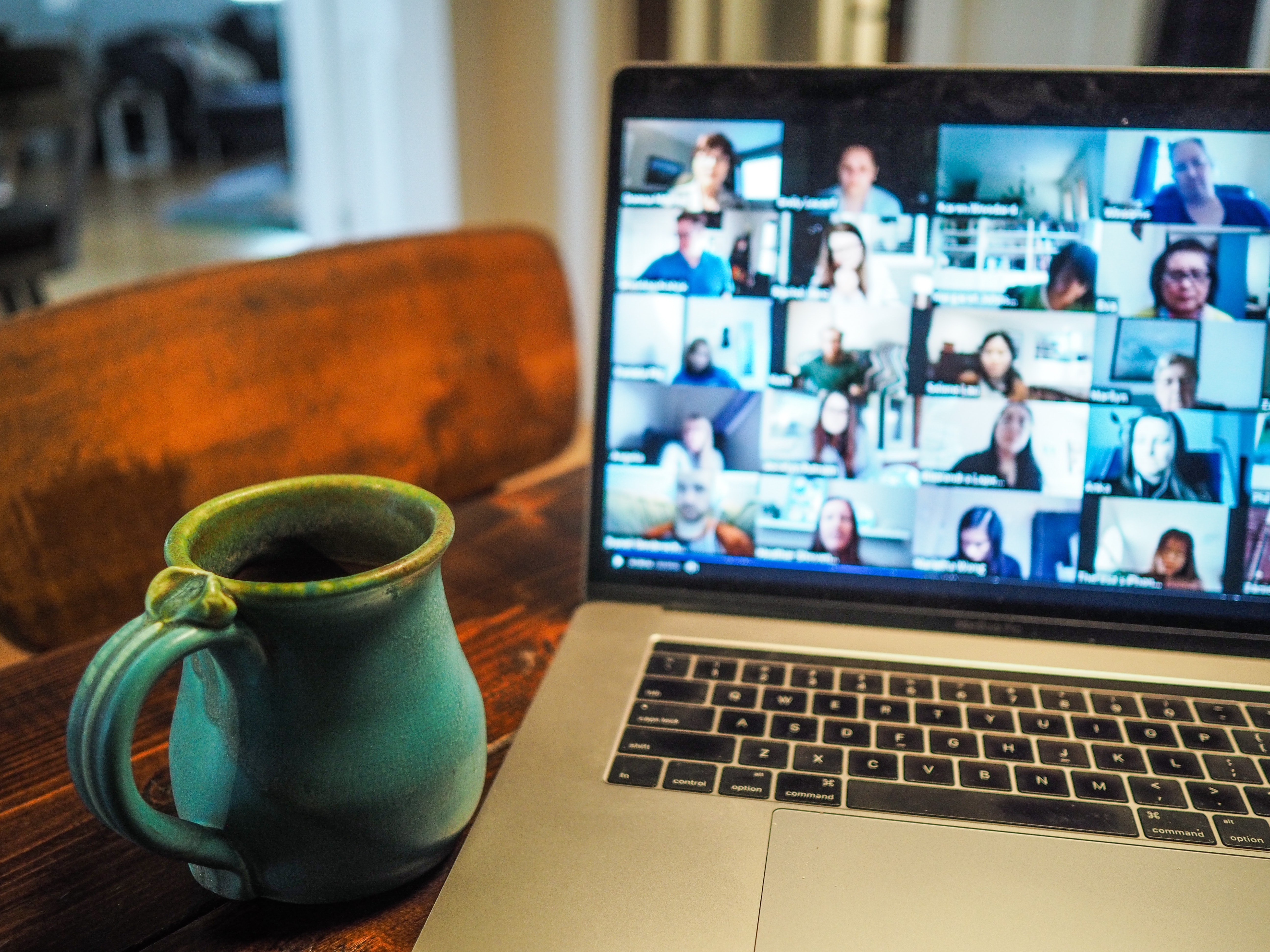
One-shots are always challenging, but perhaps especially so in the virtual learning space. While I have not yet been stuck teaching class as a cat, for about two weeks I couldn’t deactivate a wonky virtual background in Google Meet. And instead of half the students going to the library building and half to their usual classroom, we now have people lost in the wrong Zoom room! But overall, I’ve found my virtual one-shots to be a surprisingly good experience.
Years ago I decided that one of my learning objectives for every one-shot session, whether I actually typed it out in my formal “objectives” list or not, was “Students will remember that the librarians are friendly and helpful, and they will be able to explain at least one method of reaching a librarian to get research assistance.” They might forget where I told them to click, but hopefully they will remember that we want them to succeed and are there to help them do just that.
Forging that kind of connection with a roomful of people is one thing, but in a virtual classroom, it feels a little different. I was nervous about whether I would be able to develop a rapport with the students when we were all little talking heads on each other’s computer screens. I’ve found, though, that it’s not so different from what I do in the physical classroom. Usually the course instructor and I are the first to log on, and we chat with each other as the students trickle in. This lets the students relax a little and to get to know both of us as people.
In one memorable Monday-morning class, I was telling the professor about my comedy-of-errors camping weekend, which we’d had to cut short because the parking lights on my car wouldn’t turn off and we didn’t want to be stranded in the mountains with a dead battery. One of the students jumped in and asked if my car is a Subaru (it is). It turned out that her fiancé is a Subaru mechanic and that Subarus all have a parking-lights button on the steering column due to parking regulations in Japan. Who knew?! (This student and her fiancé, apparently.) That exchange set the tone for a relaxed and enthusiastic class session with lots of student participation and great questions.
In another class, the professor surprised me by explaining that they opened every class with everyone sharing about a pre-arranged topic. For this session, students were sharing something that had meaning to them and why; when they finished, they “tagged” a classmate to go next. Internally, I rolled my eyes (isn’t this college, not second-grade show and tell?). But I soon realized that this was a fantastic way to get the students talking to one another and to build real community even among people who might never meet face to face. I was working from home that day and I didn’t want to feel left out, so I carried my laptop over to show my dog!
A couple of weeks ago, I attended a virtual Teaching & Learning Summit hosted by Gannon University. A diverse group of educators shared the tactics they’ve been using to connect with their students in a virtual space. Dr. Karen Fetter at the University of Pittsburgh has employed scheduled moments of downtime to allow students to settle into the learning space and mindset. Dr. Leighann Forbes of Gannon University shared how she deploys her Bitmoji to put smiles on her students’ faces while also conveying important feedback and course information. Many of the summit attendees use a rotating slideshow to welcome students to the virtual space. Some play background music during the “trickling in” time at the beginning of class.
How are you finding ways to build rapport with students in your one-shot sessions? Are there any new tactics that you want to try? What has been working best for you, or what have you found particularly challenging about forging a connection over the internet?
Diversity and Libraries
I’m lucky enough to work for an institution that values diversity, equity, and inclusion, that regularly offers workshops and safe spaces to discuss diversity on our campus, which has been incredibly helpful as a white woman who wishes to be a better ally. It’s not a hidden secret that many higher education institutions have accepted one group of people over others since it’s conception. I think it is really important to remember this, recognize how far we have come, and continue to do the work. Recent social unrest, though truly horrifying, has forced us to reevaluate where we are in implementing concrete strategies towards diversity. There are two areas I think libraries can focus on in support of diversity; our physical (and virtual) space and our resources.
A library’s role on campus has changed throughout the years. Our physical space is so important. As an undergrad, I spent many, many hours nearly every day in the library and always felt welcome. But what if I didn’t? What if a student on your campus does not feel welcomed? What could that do to their self-esteem, their studies, and their grades? To ensure we meet the basic needs of our students, it is important to work continually to demonstrate our shared values. Is your institution offering workshops on unconscious and conscious bias? Are you hiring people of color? Does your work environment allow for open and honest communication? Do signs and posters show diverse people? These are just a few things to consider that have helped me, as a white woman, understand my role as an ally.
Our ethos is sharing information, access to ALL information, but when systems in place favor the majority over the minority, it’s our responsibility to open the door wider on resources by people of color, widely share these resources, and use them in our courses. Recently, the librarians at my institution discussed purchasing resources by authors of color. I’ll admit, this was not something I immediately sought out to do in the past, but now of course it is something I will prioritize. It’s not enough to just consciously order materials by BIPOC authors, they must also be used. I see this as an opportunity to work with our faculty and encourage them to use these materials by diverse authors in their classes, if they aren’t already.
As we continue into Black History Month, my hope is that these conversations and steps forward continue well beyond the month of February. There is a lot of work to be done, and no doubt we will make mistakes, but our role in contributing to diversity initiatives is an important one. If we work together, I believe we can take important, actionable steps to support our diverse student body.
Recording now available for Connect and Communicate presents: Supporting Innovation: Helping Our Users with Patents
Thank you to everyone who was able to join us for the session on February 9. The recording, slides, and handout are now available.
C&CS Presents: “Go With the Flow: Using Automations and More With Office 365”, 3/3 at 11 am
C&CS Presents
Go With the Flow: Using Automations and More With Office 365 with Adam Haigh
March 3 at 11 am EST
Register Here: https://forms.gle/RwtQ7T4xsMxnNYKv6
Microsoft offers several tools beyond what are commonly found in the standard Office Applications (Word, Excel, and PowerPoint) through its Office 365 platform which we obtained through TechSoup at no cost via their non-profit donation program. The presenters, through their shift into email administration, have discovered the benefits of these tools including Microsoft Teams, SharePoint, Forms, and PowerAutomate which make it easy for staff to collaborate on projects and tasks. Outside of Office 365, Microsoft also offers tools that allow remote control, setup, and management of PCs. Come to this session to learn how you can get more out of your Office365 subscription and much more!
Adam Haigh has been the Technology Librarian in the Director’s Office of the Lower Merion Library System since May 2016. Previously he worked as an academic librarian at Lander University in South Carolina for over 10 years. He is the immediate Past Chair of the Teaching, Learning, and Technology Roundtable and a 2016 PALS Graduate.
All C&CS Sessions are recorded and made available via the CRD website following the presentation.
This project is made possible by a grant from the Institute of Museum and Library Services as administered by the Pennsylvania Department of Education through the Office of Commonwealth Libraries, and the Commonwealth of Pennsylvania, Tom Wolf, Governor.
Support is also provided by the College and Research Division of the Pennsylvania Library Association: https://crdpala.org/.
Preserving Local Heritage
Since it’s creation the Pennsylvania Highlands Community College Library has made it a priority to preserve local history. To this end, we began working with our county government to digitize thousands of local immigration records. We collected these documents and started the process of sorting them to see what kind of information we had to work with. The records were indexed but we found many errors regarding the names of the people involved. This kind of thing is to be expected given that all the files are filled out by hand. Anyone who has worked with historic documents can relate to the struggle to understand faded handwriting. The origins of the people represented in these declarations range from Europe all the way to Turkey. It really shows the rich heritage of our area.
Many of these documents go back to the 1800’s when most countries were still led by royalty. It’s interesting to read someone renouncing their allegiance to kings or queens. Here is a man named Anthony Abraham applying for citizenship and renouncing his loyalty to the Sultan of Turkey in 1905. Imagine the adventures he must have had to get all the way to Cambria County Pennsylvania!
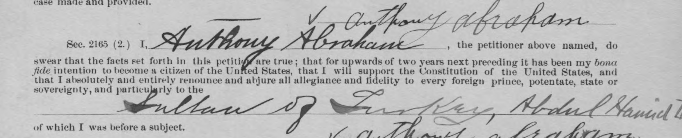
To make these files accessible we’ve begun the process of uploading them to PA Photos and Documents, an online repository funded by the Office of Commonwealth Libraries of Pennsylvania. If you’re interested in our work you can see it here.
If you have any questions about this collection please contact me at akirby@pennhighlands.edu


 Adam Balcziunas
 Alex K.
 Alexandrea Glenn
 Andrea Pritt
 aprilnkelley
 Ashley Purvis
 Bethann Rea
 blj13
blj13 Brendan Johnson
 Amanda Boyer
 Bret Stiffler
 Bonnie Powers
 Christopher Lemery
 clarewithers
 clblibrarian
 Kelly Clever
 Charlotte M. Johnson
 colemanluzerne
 CRD of PaLA
 crdvirtualjournalclub
 cre5314
 csgarth
 Erin B.
 danajkerrigancv
 denisewetzel1
 Darren G. Poley
 elm43
elm43 James D'Annibale
 Annie Jansen
 Jill Hallam-Miller
 jennifercribbs
 Jenn Monnin
 Jen Hasse
 Jessica Showalter
 johnmeier1
 Kelly Safin
 Kim Karim
 Kristen Seikaly
 Kayla Van Osten
 Cecelia Lasley
 librarianjsmith
 Linda Neyer
 mabogino1
 Matthew McNelis
 Meg Massey
 Maggie Savidakis-Dunn
 Rebecca
 miskatoniclibrarian
 Maureen Bentz
 Michele G. Anfuso
 Nicole Miyashiro
 paulmcmonigle
 Rob Sieczkiewicz
 ronlmccoll
 Sam Bardarik
 shannahollich
 smartin592
 Ula Lechtenberg
 It's Academic