Cyber Security in Higher Education
As a follow-up to an earlier blog I wrote about cyber security (“Gone Phishing: Service Continuity after a Cyber Attack”), I would like to share information about an upcoming webinar, “Cyber Security in Higher Education,” sponsored by Scholarly Networks Security Initiative.
Scheduled for Thursday, October 14 at 2:00pm EST.
How can librarians and those in higher education contribute to the cyber security effort?
To register for the program, complete the form: https://us06web.zoom.us/webinar/register/WN_g3NGQLFeQsmfm5jOdnGtOQ
Summary:
This year’s annual cyber security summit will feature speakers talking about the general threat of security intrusions in higher education, the process of library participation in an institutional security audit, and advances in authentication technology. The overall theme of the summit is awareness and taking action. Librarians and network security professionals are welcome, as well as anyone with an interest in cyber security issues in higher education. A panel of responders chosen from among willing registrants to the event will comment on the presentation and ask questions. There will also be ample time for questions from the general audience. Register now!
Speakers:
 Daniel Ayala Managing Partner Secratic LLC Daniel Ayala (@buddhake) is the Managing Partner at Secratic (secratic.com), a strategic information security and privacy consultancy focused on helping companies protect data and information, and be prepared before incidents happen. Throughout his 25 year career, he has led security and privacy organisations in banking and financial services, pharmaceutical, information, higher education, research and library organisations around the world, and both writes and speaks regularly on the topics of security, privacy, data ethics, and compliance. Daniel is also the host of The Great Security Podcast (greatsecuritydebate.net) and the co-founder of Mentorcore (mentorcore.biz).
 Emily McElroy Dean of McGoogan Library University of Nebraska Medical Center Dean Emily McElroy joined UNMC in December 2013. Prior to coming to UNMC, McElroy served for six years as associate university librarian for content management and systems at Oregon Health and Science University (OHSU). Prior to OHSU, McElroy was head of library acquisitions at New York University. She also has held positions at the University of Oregon and Loyola University’s Health Sciences Library. McElroy graduated from DePaul University with a B.S. in history and from Dominican University Graduate School of Library and Information Science in Illinois with a master’s degree in library and information science in 1999. She is a nationally recognized speaker on the management of library resources. An active member of many professional organizations, McElroy has served on advisory boards for major publishers.
 Heather Flanagan Principal Spherical Cow Consulting Heather Flanagan, Principal at Spherical Cow Consulting and Technical Liaison for SeamlessAccess, comes from a position that the Internet is led by people, powered by words, and inspired by technology. She has been involved in leadership roles with some of the most technical, volunteer-driven organizations on the Internet, including IDPro as Principal Editor, the IETF, the IAB, and the IRTF as RFC Series Editor, ICANN as Technical Writer, and REFEDS as Coordinator, just to name a few. If there is work going on to develop new Internet standards, or discussions around the future of digital identity, she is interested in engaging in that work. You can learn more about her at: https://www.linkedin.com/in/hlflanagan/.
By Joshua Cohen
At Elizabethtown College, our library staff started brainstorming how to best gather, organize, and report information literacy assessment data during the summer of 2019. We were also looking for software that included a “guide on the side” style, split-screen tutorial to create some more interactive tutorial modules. At a library conference, earlier that spring, I’d heard some fellow instruction librarians talking about the usefulness of LibWizard software from Springshare to this end. After some preliminary research (a very helpful LibWizard product review in The Charleston Advisor from early 2016 compared it favorably to Google Forms), discussions with colleagues, and weighing various options, we moved forward with the purchase of the software (Kaletski). We hoped to use the software for gathering data in the form of surveys, quizzes, and tutorials which are all included in the Full LibWizard package (SpringShare). Prior to using LibWizard, we’d used a number of other software products, including Survey Monkey, Google Forms, and Microsoft Office Forms. We found that LibWizard was preferable to these other products for purposes of organizing, analyzing, and reporting IL data.
Prior to our purchase of LibWizard, there was no central location for our assessment data. Librarians created their own surveys using individual Google Drive or Microsoft Office 365 accounts. Library staff could also use a shared Google account to create surveys and quizzes in one universally accessible location. Google also allows users to place files into different folders which would theoretically make it easier to organize. However, even with folders, anyone with a Google Drive account knows that these accounts can be difficult to keep well-organized. Purchasing LibWizard seemed to solve this problem. All the surveys, quizzes and tutorials created with the product are viewable by all staff members and easy to identify. However, unlike with Google products, you cannot create folders in which to subdivide them, but after more than a year of using LibWizard, this hasn’t been a problem.
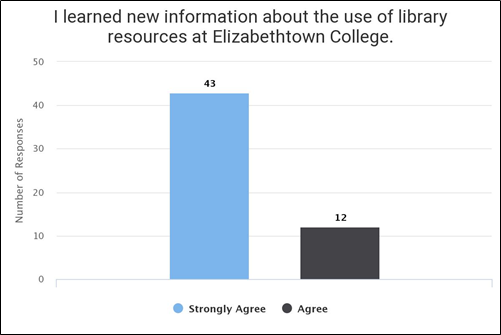
Our college does offer us free access to Word products like Office Forms so we could have used that software for quizzes or surveys, and while there are circumstances in which some librarians have found that it makes sense to use this software, there are significant advantages to using the LibWizard for any data that the library staff might wish to quickly and easily analyze for assessment purposes. For instance, I created surveys for first-year seminar students and instructors, and with the LibWizard software, I could easily pull statistics from these surveys, using filters like a time-range; then LibWizard automatically allows the user to generate bar graphs of these stats. Figure 1 shows a bar graph that I used as part of my Fall 2020 information literacy assessment report, and it took less than a minute to produce it within LibWizard.
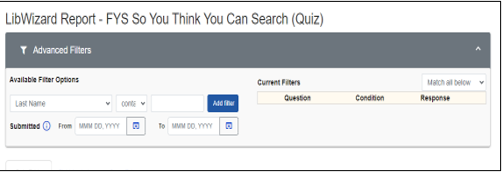
I have found that this is a real time-saver for writing assessment reports, and I have not found any way to easily analyze or organize my data with Google or Microsoft Forms. For instance, Microsoft Forms allows you to create very simple quizzes, and the software will automatically generate average scores for these quizzes, but if you’d like any additional data analysis, you would have to export your data into Excel and complete the analysis on your own through Excel, requiring a certain level of expertise with Excel. LibWizard automatically generates average and mean scores, shows you average scores for each question, and allows you to quickly and easily filter your results by dates or other criteria in the “Advanced Filter” settings, pictured in Figure 2.
As helpful as the simple and user-friendly Google and Microsoft products are, they do not offer any “guide-on-the-side” style tutorial option, and LibWizard does. There is one alternative that I found: free open-source software called Guide on the Side that was created by the University of Arizona Libraries; however, you need to have a Linux operating system to set it up and manage it independently–so that software was not an option for our library. I’ve set up a number of the LibWizard standalone tutorials, and while they have their limitations, they have been useful, and students haven’t reported any trouble completing them. The main flaw with the tutorials is that the split-screen viewing can be a challenge for the user to manage when the tutorial is matched up with a webpage like a database. However, I suspect that this flaw would likely be a challenge for any “guide-on-the-side” tutorial, and despite not working together perfectly, I’ve found that the tutorials work well enough with our databases.
I’ve spoken with librarians who have been disappointed that the quizzes and surveys created in LibWizard are not as visually attractive as those that you can create in Google Forms. I will acknowledge that Google Forms provides very easy-to-use and attractive layouts that you don’t have with LibWizard, but the minimalist design of LibWizard was satisfactory for our needs. If you have already used other Springshare products, then you will already be familiar with the layout of their products. Aesthetic design wasn’t a top priority for us when our library was evaluating the product. The central concern was over whether it would help us with our assessment needs, as well as providing us with the tutorial option, and it has successfully fulfilled both of those needs.
If you are looking for a software tool that will help your library staff to more easily organize and assess IL data, I don’t think you could go wrong with LibWizard. It does have a cost associated with it, but for our library, it’s been worth the cost, and I would recommend at least exploring the software to see if it also meets your library’s IL assessment data collection needs.
Joshua Cohen is the Instruction and Outreach Librarian at Elizabethtown College.
References
James, M. (2015). Guide on the side: READ ME file. GitHub, University of Arizona.
https://github.com/ualibraries/Guide-on-the-Side/blob/master/README.md#about
Kaletski, G. (2016). LibWizard. The Charleston Advisor, 18(1), 21-24.
Springshare. (2020) LibWizard. Springshare. https://springshare.com/libwizard/
CRD Virtual Journal Club Summer Wrap-Up
This past summer, the College & Research Division hosted a virtual journal club, which met online three times to discuss scholarship in the library science field. The CRD Journal Club was originally established in Summer 2018, and typically runs in the summer, spring, and fall of each year. The theme for the Summer 2021 semester was librarians’ collaboration with faculty.
For the first session, the participants read two articles: “The invertebrates scale of librarianship: Finding your niche,” by Samantha Dannick, published in College & Research Library News, and “From service role to partnership: Faculty voices on collaboration with librarians,” by Maria A. Perez-Stable, Judith M. Arnold, LuMarie F. Guth, and Patricia Fravel Vander Meer, published in portal: Libraries and the Academy. The group spent a lot of time discussing different types of collaboration, noting instances which seem to be more authentic partnerships and discussing when they felt like “jellyfish” librarians, as discussed in Dannick’s article.
The second session focused on discussing the article “Kill the one-shot: Using a collaborative rubric to liberate the librarian–instructor partnership” by Nora Belzowski and Mark Robison, published in the Journal of Library Administration. The discussion focused mostly around the rubric implemented by Belzowki and Robison in their article, and how it could positively impact their own instructional scheduling and practices.
For the third and final session, participants discussed the article “Library research sprints as a tool to engage faculty and promote collaboration,” by Jenny McBurney, Shanda L. Hunt, Mariya Gyendina, Sarah Jane Brown, Benjamin Wiggins, and Shane Nackerud, published in portal: Libraries and the Academy. The discussion around the research sprints as described in the article morphed into larger conversations on librarians’ relationship to faculty, as service providers and as colleagues, which can often be complicated by a librarian’s status on campus. Job expectations and the realities of what librarians can (and should) be asked to provide also came up through conversations and examples.
This series’ discussion offered advice for forming collaborative partnerships where both parties have equal benefits from the outcome, and provided different perspectives on barriers to collaboration across different institutions.
Look for our upcoming emails and let us know at crdvirtualjournalclub@gmail.com if you have any suggestions for topics/issues you would like to discuss!
Happy Frankenstein Day?

August 30th, apparently, is “Frankenstein Day.” No, it isn’t a national holiday. In the U.S. that would require a Presidential proclamation or an act of Congress. However according to holidayinsights.com in 1997 Ron MacCloskey from Westfield, New Jersey started naming someone “who has made a significant contribution to the promotion of Frankenstein” and awarding them “The Franky” on the last Friday of October, presumably given its proximity to Halloween. The reason August 30th is heralded as Frankenstein Day is because it is the anniversary date for the birthday of the writer Mary Shelley, the author of The Modern Prometheus, better known as Frankenstein.
While Mr. MacCloskey’s intent was to have a day, or rather a night for partying in celebration of the monster, the literati have transformed it into a cultural celebration of the author and her most famous work. A book which has been adapted and referenced in countless other books, movies, plays, and television shows, from parodies like Mel Brooks’ “Young Frankenstein” to the serious and thought-provoking opera which premiered in 2019.
Without knowing if “The Franky” is still a thing, in honor of Frankenstein Day I would like to nominate two Digital Humanities projects. First let me say both are listed in the Catalogue of Digital Editions, which gathers “digital editions and texts in an attempt to survey and identify best practice in the field of digital scholarly editing.”
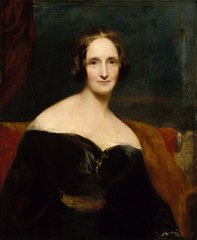
(1797-1851)
The one is an XML-TEI project at the University of Maryland completed in 2009. According to the catalogue’s philological statement, “Frankenstein” provides: “Complete information on the source of the text, the author, date and accuracy of the digital edition, as well as Digital Humanities standards implemented.” The other is “Frankenstein; or, the Modern Prometheus” which claims to be “The Pennsylvania Electronic Edition” edited by a professor at the University of Pennsylvania, and keyed with the help of many others. It has various editions of the novel and critical scholarly aids for the study of it. Both are Open Access resources which give one insight into the text and its author.
Happy Birthday, Mary Shelley!
Got an Appetite for Visual Storytelling? Dig into the Lynd Ward Graphic Novel Prize Winners!
Craving a bit of visual storytelling that lasts longer than a serving of TikTok, YouTube, or Instagram? In a world hungry for image-based content, the graphic novel continues to sustain and grow ever-popular as a visual storytelling specialty.
As noted by Pennsylvania (PA) Center for the Book emeritus director Steven Herb, the “Penn State University (PSU) Libraries have been on the cutting edge of recognizing the graphic novel as an important and emerging medium through our collections, programming, and our leadership in the integration of the form with academic programs studying its scholarly attributes (English, literature, art, popular culture, LGBT studies, women’s studies, history, and science).”
These observations were part of the October 1, 2010, planning proposal for the Lynd Ward Graphic Novel Prize and were supported by examples such as the Pattee Library exhibit, Graphic Novels: Comics as Art, History, and Literature, curated by former Coordinator of Audio-Visual Collections and Fred Waring’s America, Eileen Akin (Jan-Mar 2007), and the Graphic Novel Speaker Series inspired by the exhibit, sponsored and co-sponsored by the PA Center for the Book and various PSU Library departments between February 2007 and March 2010.
Together these two initiatives gave rise to the annual Lynd Ward Graphic Novel prize administered by the PA Center for the Book. The PA Center for the Book is an affiliate of the Center for the Book established in 1977 at the Library of Congress and is sponsored by the PSU University Libraries. It encourages Pennsylvania’s citizens and residents to study, honor, celebrate, and promote books, reading, libraries, and literacy.
Established in 2011 in acknowledgement of Lynd Ward’s contributions to the genre with his introduction of wordless, woodcut novels in American (1929-1937), the Lynd Ward Graphic Novel Prize holds visual work to a standard of being more “than an illustrated text-driven novel” and expects it to demonstrate “artistic and literary quality, ambition, and/or innovation,” while weaving an “engaging and descriptive narrative, in word choice and/or visually,” per the Lynd Ward Prize Selection Criteria.
Administered by PA Center for the Book Assistant Director, Ellysa Stern Cahoy and with support of Advisory Board members, the Lynd Ward Prize is awarded annually to “the best graphic novel, fiction or nonfiction, published in the previous calendar year by a living U.S. or Canadian citizen or resident.”
Titles recognized by the award include King of King Court: A Memoir by Travis Dandro (Drawn & Quarterly), noted by 2020 Judges as the winner for its “deft intermingling of word and image” to effectively convey a deeply personal story of familial trauma and resilience. That same year, New Kid by Jerry Craft (Quill Tree Books/HarperCollins) was selected as the Honor Book for its “nuanced representation of an African-American boy” navigating private [middle] school and home life and its illustration of “how toxic our [visual] ways of ‘reading the other’ can be.”
Dragon Hoops by Gene Luen Yang (First Second), one of two 2021 Honor Books, has also been named the Best Publication for Teens by the 2021 Will Eisner Comic Industry Awards.
The Lynd Ward Graphic Novel Prize winner of 2021 is Guantanamo Voices: True Accounts from the World’s Most Infamous Prison edited by Sarah Mirk (Abrams ComicArts), lauded for its diverse collection of points-of-view presented in “a solid example of graphic journalism.”

A Virtual Celebration and Presentation by Mirk will be held:
Tuesday, November 16, 2021
7:00-8:00 p.m.
Facebook Invite
– Click Here for Virtual Access! –
Mirk will receive a $2,500 prize along with, courtesy of the Library of America, a two-volume set of Lynd Ward: Six Novels in Woodcuts by Lynd Ward (2010).
Previous Lynd Ward Prize award ceremonies, in which creators share details and images of their creative process and vision, can be viewed from the Lynd Ward Prize Playlist on the PA Center for the Book YouTube page.

As the genre expands, the Lynd Ward Graphic Novel Prize continues to acknowledge high-quality work based on its effectiveness in delivering “a sum experience that is superior to its respective components.”
Meanwhile, Penn State’s appetite for the genre continues to grow, for example, with the introduction of Penn State Press’ Graphic Mundi imprint in 2021 (which published Menopause: A Comic Treatment [Graphic Medicine], winner of two 2021 Eisner Awards) and the expansion of scholarly fields, such as Visual Literacy in Graphic Novels/Comics, supported by Comics & Animation PSU Library Guides, among others.
So when the latest Snapchat dematerializes and you’ve exed your last pop-up ad of the day, settle in with a graphic novel – perhaps a wordless tale that deepens one woodcut image per page at a time by Ward himself – if you crave a hearty story with cumulative, synergistic power.
For more information about the Lynd Ward Graphic Novel Prize, visit the PA Center for the Book website or contact Ellysa Stern Cahoy (ellysa@psu.edu), Assistant Director.