CRD Virtual Journal Club
We are excited to share the selected reading for the second session of the Spring 2022 series of the Virtual Journal Club, sponsored by the College & Research Division of the Pennsylvania Library Association!
Our second session focused on inclusive libraries will take place on Thursday, March 17th at 2:00. We will read and discuss: Simms, S., & Johnson, H. (2019). Subtle activism: Using the library exhibit as a social justice tool. Alexandria, 29(1-2), 130-144.
Contact me at akirby@pennhighlands.edu if you’d like to join us in our Zoom discussion of this article.
Still Troubling, Still Useful: Thoughts on Twitter
March is typically a time when students, colleagues, and just about everyone under the (usually cloud-covered) sun experience fatigue. Spring break for many is either here or around the corner, and everyone is capital-T Tired. This extra-unprecedented time of global crises, though, is not typical.* Persistent “return to normal” messaging adds to the stress, at least for me. It’s no wonder that motivation, creativity, and cognition levels seem so low.
When thinking about what does help inspire or motivate me — or remind me what day of the week it is — I came to a surprising conclusion. Aside from people in my life, somehow, it’s content on Twitter.

As a member of Twitter teams for several organizations, Twitter feeds have been valuable sources of updates on issues in librarianship. Colleagues and publications around the world share amazing discoveries and ideas in their tweets. I think I’ll always prefer and miss Google Reader, but this is another way to get updates on topics of interest in one place.
Of course, Twitter and other social media platforms can be deeply problematic (to say the least) with hateful, deceptive, abusive, and just plain terrible content. Users can mute, unfollow or report accounts and tweets, but those aren’t perfect systems. Some users can now also try Safety Mode, a tool the company is rolling out as a way to “reduce the burden on people dealing with unwelcome interactions.”
When the platform seems especially overwhelming, I limit what I do to what’s needed for the task at hand, and then I log off. Finding relevant content quickly is made easier by following or creating Twitter lists and checking those feeds, instead of the main feed or trending topics. Also, I intentionally get very few notifications — another It’s Academic blogger, Kayla Van Osten, shares good reasons why.
Content on Twitter is often mentioned in conversations about misinformation, with plenty to research and read about. Many of us work with our communities on strategies to evaluate information, while also trying to navigate misinformation we come across online in our daily lives. (For more about this: The Thinking Behind Misinformation by Alex K.) Recently, Twitter expanded its pilot of a crowdsourced fact-checking project called Birdwatch, with a feature for users to put notes on tweets they think contain misinformation.
Overall, I’ve found that customizing Twitter for my own well-being takes a little more effort and setup than it used to, but the platform remains a resource for learning and also, for advocacy — take “Librarians fight book bans with Twitter takeover” as one example.
Do you use Twitter to keep up with librarianship, reach your communities, get updates on conferences and CFPs…? What are your recommendations?
* Side note: To whoever keeps jinxing us by saying “things could be worse,” might I suggest saying “things could be better” instead?
Creating a Library App

A few years ago my library investigated the possibility of creating an app. We hoped to create an app that enabled access to key library resources like our databases, the catalog, ebooks, and our contact information. We reached out to several app developers that specialized in libraries, but the high cost of these solutions prevented us from moving forward.
Eventually we stumbled upon the app developer Goodbarber. Goodbarber lets you create an app without the need to code the app from scratch. By using their visual interface you design your app, then add your own links, text, and images. The process is not unlike using WordPress or a similar tool to make a website. When you are done, you can use guides created by Goodbarber to submit your app to the Apple and Google app stores. It’s a technical process that does require some knowhow but it’s doable for a determined tech savvy person. The process entails that you create a Google Developer Account ($100 one time fee) and an Apple Developer Account ($100 yearly). The yearly costs for Goodbarber are less than $600. Which is a fraction of the cost of most app creation options. You can see their pricing here – https://www.goodbarber.com/pricing/content/ Our app can be seen here – https://www.pennhighlandslibrary.org/library-app/
If anyone is curious about using this process to create an app please let me know.
Honoring Black History Month by Noting a Unique DH Project
One digital humanities project which explores the hard history of the enslavement of African Americans in the United States is the “Last Seen” project. It brings to light the brave endeavor by former slaves to reunite with loved ones sometimes decades after emancipation.
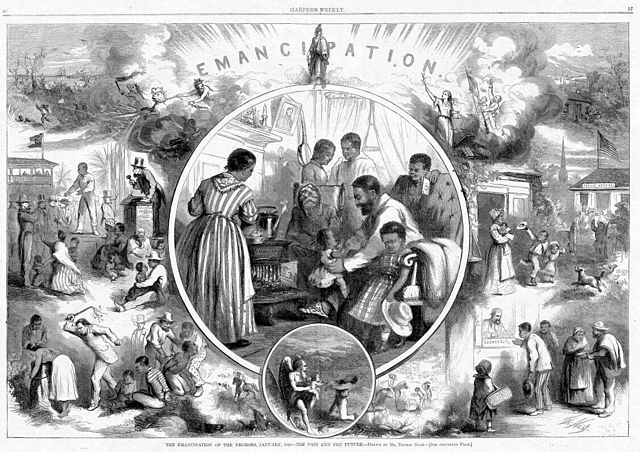
Judith Giesberg, Ph.D., a professor of history at Villanova University, began by partnering with genealogists at Mother Bethel African Methodist Episcopal Church in Philadelphia to discover nineteenth-century newspaper ads that help to tell the story of the separation and survival of black families during and after the U.S. Civil War.
Under the coordination of Dr. Giesberg, graduate students have digitized and transcribed thousands of “Information Wanted” advertisements placed by former slaves in many different newspapers from across North America and as late as the 1920s.
“Last Seen: Finding Family After Slavery” has opened once closed avenues for researchers to trace painfully ruptured genealogies and give voice to formerly silenced African American family histories. While always overseen by the “Last Seen” project team, anyone can volunteer to transcribe digitized ads.
Open Educational Resources as Financial Literacy: A First-Year Seminar Presentation
In Fall 2021, Penn State Harrisburg’s Student Government Association (SGA) reached out to our library director with questions regarding textbooks and available library resources. After a quick back and forth it became clear that our local SGA had a goal of saving student’s money on the high cost of course textbooks. At my campus, this is a common concern, which has only increased over the course of this pandemic. At the time, myself and my librarian colleagues did not have enough time to prepare a broad presentation to offer to students, so we made do with a brief Library Guide which included a list of available textbooks on course reserve in our library, along with a few links to Open Educational Resources (OER). The library guide that includes this information is, rather conveniently, our library’s PA Forward guide.
At Penn State Harrisburg, campus departments are encouraged to develop and offer first year seminar sessions on a variety of topics. In the past, I have presented on science literacy and science information literacy but because the increasing cost of textbooks has been on SGA’s radar – this spring, I opted to develop a new presentation. To fulfill one of PA Forward’s literacy initiatives, I decided to create a presentation all about OERs and outline how students can save money on textbooks by utilizing OERs as supplemental texts. I titled the presentation, “Save Money on Textbooks with Open Educational Resources” and offered it in Spring 2022. If you’re interested in learning more, continue reading below!
Penn State Harrisburg’s First Year Seminar program is run by our campus learning center and presenters must first submit a proposal. Each proposal is reviewed and accepted accordingly and included in the proposal is a list of learning outcomes. For this session, I proposed three:
- Identify and summarize the basics of open educational resources (OER) and how they can benefit you,
- Demonstrate how to locate OER for your academic discipline(s), and
- Analyze and/or integrate OER to enhance personal study skills.
During the 60-minute presentation, I first outlined the “basics” of OER: what they are and why they’re important. Attendees and I briefly viewed relevant news articles about the increasing cost of college textbooks, publishers’ move to an “inclusive access” textbook model, and professors who are concerned about the cost of textbooks who are also wary of free alternatives. We reviewed national survey results about the high number of college students who decided not to purchase required textbooks due to the cost and how, sometimes, their grades were negatively affected by this decision.
Then I began showcasing specific OER repositories such as: ROAM (Penn State’s Repository for Open and Affordable Materials), OpenStax, Open Textbook Library, OASIS, and MERLOT. After a very brief review of each repository, I instructed the students to complete an activity where they would search one of these repositories for OERs that interested them, select one OER, and briefly – but thoughtfully – evaluate it. With the remaining time, the students shared what they found with the rest of us, and I ended my presentation with a short plea to the students. My librarian colleagues and I routinely encourage the faculty members on our campus to include OER in the curriculum, we help them locate relevant OER, and we assist in the adoption and/or creation of OER – I urged the students to advocate for OER themselves. More students reaching out to faculty members asking about using OER in the classroom, could lead more faculty adopting open and affordable course materials.
This was my first time presenting on a financial-related topic and though this presentation is not our usual financial literacy programming for our library, the students shared positive feedback after the session, and I intend to offer a similar session again in the future. If you are interested in offering a similar session at your library, my presentation is openly available in Penn State’s institutional repository here.



 It's Academic