What’s a PTRC?
Do you ever think, “Wow, someone should patent that?” Or do you have students/researchers ask about what the differences between a trademark and a patent are? Do the words intellectual property sound a bit intimidating? Well, there are a multitude of resources available and even centers dedicated to helping with these and many other questions.
The United States Patent & Trademark Office (USPTO) is a federal agency that follows the Constitution’s Article 1, Section 8, Clause 8, “To promote the Progress of Science and useful Arts, by securing for limited Times to Authors and Inventors the exclusive Right to their respective Writings and Discoveries.” Essentially, the social contract between inventors and the public. As a part of the USPTO mission, the office runs a program called the Patent and Trademark Resource Center (PTRC) program. PTRCs are a network of 85 public, academic, state, and even special libraries located across the United States. In fact, the state of Pennsylvania is lucky enough to have 3 PTRCs! They are located at the Free Library of Philadelphia, Carnegie Library of Pittsburgh, and Pennsylvania State University’s University Park campus.
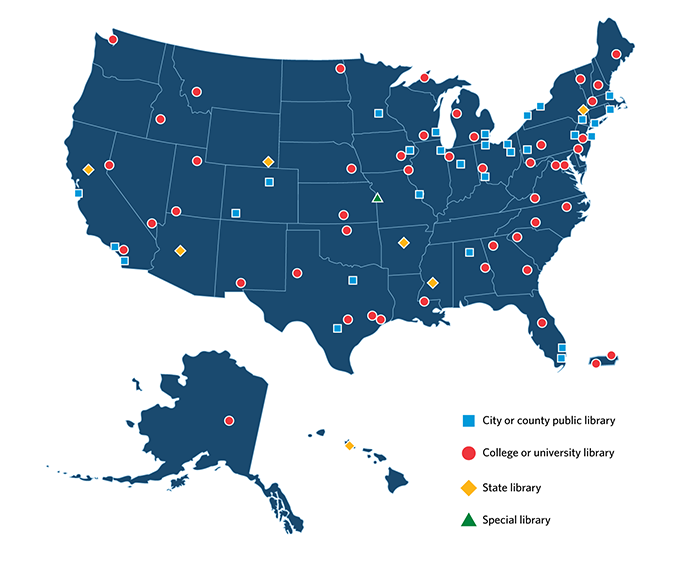
One important consideration is that PTRC services are available to everyone in the community. This means for the University Park PTRC, I do not only limit my help to Penn State faculty or students, rather I work with community members from across the Commonwealth of Pennsylvania as well. Part of this program is to reach everyone. At the University Park PTRC, this also helps me with meeting the Land Grant mission of Penn State University. So what can a PTRC offer?
Each PTRC has an official PTRC Representative to the USPTO who receives yearly training and reports statistics. These representatives are usually librarians who are eager to share their knowledge about the patent and trademark process. It is important to note that PTRC representatives are not lawyers and cannot provide legal advice. Representatives become experts in searching for patents trademarks in databases across multiple platforms. They will also offer classes and workshops on intellectual property basics, intellectual property searching, and using the USPTO website.
As part of my job, I regularly visit classes to share about the PTRC. I also work with Pennsylvania’s Patent Pro Bono Program, which moved to the Penn State Law Intellectual Property Clinic in January of 2023. I provide workshops on trademark searching and patent searching for events, both online and in-person, such as for Global Entrepreneurship Week in November. I have a research guide dedicated to all things intellectual property if you are interested in learning more.
Overall, the PTRC program is a unique resource for everyone. While an institution may not have a PTRC right on campus, that does not mean their students, faculty, and/or staff are out of luck. Feel free to refer them to any of Pennsylvania’s 3 PTRCs for support. If you are interested in learning more yourself, you are welcome to reach out to me at dawetzel [at] psu.edu.
Diamond Open Access?

Plan S seemed promising when it was launched 5 years ago. Early in 2022 cOAlition S, Science Europe and others jointly published an Action Plan for Diamond Open Access. A year later Johan Rooryck, Editor in Chief, Glossa: a journal of general linguistics, proposed “Principles of Diamond Open Access Publishing.”
The principles were meant to move perception of Diamond Open Access away from just a new business model for OA publishing. They are:
Principle 1: Publishing is part and parcel of research and scholarship
Principle 2: Ownership and governance
Principle 3. Equitable by nature and design
Principle 4: A federated and global network of communities
Principle 5: Service provision
Principle 6: Transparent and aligned quality standards
Principle 7: Openness and innovation
Principle 8: Diversity, equity, and inclusion
Principle 9: User rights and privacy
Principle 10: Sustainability
Building on this idea is a group funded by the EU called Developing Institutional Open Access Publishing Models to Advance Scholarly Communication or DIAMAS for short. A DIAMAS report delivered a few months ago, IPSP Best Practices Quality evaluation criteria, best practices, and assessment systems for Institutional Publishing Service Providers (IPSPs) includes an extensive self-assessment checklist for IPSPs based on the best practices delineated by the report.
This all may seem very Euro-centric and oriented to scientific literature but is really a part of a much larger movement for advancing Diamond OA worldwide for all disciplines. So, we look forward to the results of the Global Summit on Diamond Open Access happening in Mexico later this year.
One reason this caught my attention is that last year Falvey library at Villanova University launched the first academic OA journal in the Igbo language of Nigeria. More details on this are in the blog post written by a colleague: “Welcoming a New Academic Journal: Ugegbe.”
Fall Virtual Journal Club Sign-Up and Interest Survey
Greetings!
You are cordially invited to participate in the Fall 2023 series of the Virtual Journal Club, sponsored by the College & Research Division of the Pennsylvania Library Association! Please use this form to indicate which topic(s) you would be interested in reading about in the fall series, as well as indicate your scheduling preferences.
You are welcome to attend one, two, or all three of the meetings to discuss the readings. If you are interested in participating, please feel free to sign up – there is no cost and no commitment beyond your time to read and discuss the articles.
Thanks to everyone who participated in our Summer 2023 series on making the most of the one-shot instruction session!
Please feel free to reach out with any questions.
Thank you, and have a great day!
—
Melissa Correll (she/her)
Student Success Librarian
Assistant Professor
Liaison to the School of Education & HAPS
Arcadia University
Goals, Objectives, Outcomes
For a while now, I’ve been frustrated by the term information literacy. It seems like the perfect term to describe the way we all should be in this changing landscape of information (“literate”) but then when we try to talk about it with people outside librarianship, they are flippant or dismissive. Students already believe they are information literate, although studies show that their confidence levels exceed their actual skills. And teaching faculty often define information literacy as being able to search databases. Which is true, yes, but it’s so much more.
So, as a result, I’ve been asking myself how do we talk about information literacy without saying those words?
I don’t think it can be boiled down to a word or phrase, which makes marketing the message a little more complicated. I’ve begun to think about it in terms of goals, objectives, and outcomes. This framework is found in many instructional design and pedagogical modules, but even before the assessment or learning activity development. In L. Dee Fink’s Creating Significant Learning Experiences, he starts out the process of designing a course with questions about goals. But rather than listing the concepts that relate to the subject matter, he asks “What would I like the impact of this course to be on students, 2-3 years after the course is over?”

Now, librarians are often not the instructors of record for specific courses. But we can think of our programmatic goals in a similar way. For example, one of the goals the Teaching & Learning Committee here at the University of Pittsburgh came up with is:
To empower our community to see themselves as savvy consumers and creators of information.
As you may notice, this definitely has markings of information literacy and the ACRL Framework, but is more of a conversation starter than the term “information literacy.” Once we have our goals set up, we can then talk about specific objectives and outcomes for various interactions with students, whether one-shot, tutorial, or teaching consultation with faculty.
What are some ways you talk to your stakeholders about information literacy? Do you have other terms that you use?
Understanding Your Strengths Workshop
Join dynamic trainers Jolene Pickens and Brianna Campbell who will help you understand your strengths! After completing the online Clifton Strengths Assessment (pre-session required work!), you will receive individual custom reports on your top 5 strengths. But reading a report isn’t enough! Spend 90 minutes with these Gallup certified trainers to help you analyze what you naturally do well and actionable items for further growth and success.
Thanks to generous grant support, we can offer this session valued at over $125 per person, for FREE for the first 40 registrants. Act quickly and register now!
This live session will be Wednesday, August 30, 2023, 2:30 pm – 4:00 pm. It will be on Zoom and will not be recorded.
Registration deadline is Tuesday, August 22, 2023. Posted on behalf of the College & Research Division of the Pennsylvania Library Association, Andrea Pritt, 2023 Chair


 Adam Balcziunas
 Alex K.
 Alexandrea Glenn
 Andrea Pritt
 aprilnkelley
 Ashley Purvis
 Bethann Rea
 blj13
blj13 Brendan Johnson
 Amanda Boyer
 Bret Stiffler
 Bonnie Powers
 Christopher Lemery
 clarewithers
 clblibrarian
 Kelly Clever
 Charlotte M. Johnson
 colemanluzerne
 CRD of PaLA
 crdvirtualjournalclub
 cre5314
 csgarth
 Erin B.
 danajkerrigancv
 denisewetzel1
 Darren G. Poley
 elm43
elm43 James D'Annibale
 Annie Jansen
 Jill Hallam-Miller
 jennifercribbs
 Jenn Monnin
 Jen Hasse
 Jessica Showalter
 johnmeier1
 Kelly Safin
 Kim Karim
 Kristen Seikaly
 Kayla Van Osten
 Cecelia Lasley
 librarianjsmith
 Linda Neyer
 mabogino1
 Matthew McNelis
 Meg Massey
 Maggie Savidakis-Dunn
 Rebecca
 miskatoniclibrarian
 Maureen Bentz
 Michele G. Anfuso
 Nicole Miyashiro
 paulmcmonigle
 Rob Sieczkiewicz
 ronlmccoll
 Sam Bardarik
 shannahollich
 smartin592
 Ula Lechtenberg
 It's Academic