Making Students Gritty
I am currently enrolled in a MOOC that examines designing and developing educational technologies. One of the topics in the course is helping students to develop non-cognitive skills that will help them succeed in school, specifically perseverance or, as it is sometimes called, “grit.” I hate to admit it, but I never took time to think about the development of non-cognitive skills that help students succeed. Maybe that’s because of the current focus on assessment and measuring skills and because everything I’ve ever learned about writing goals in education stresses writing goals that are specific and measurable; non-cognitive skills are often anything but specific and measurable. But this section of the course really got me thinking about how librarians can help to foster non-cognitive skills.
The following brief video clip was assigned as part of the lesson in the course, and in it Angela Duckworth discusses her theory of grit as a better predictor of success than IQ.
https://www.youtube.com/watch?v=H14bBuluwB8
After watching the video, I got to thinking how we as librarians help encourage our students to become grittier. I realized that fostering grit is an inherent part of information literacy and of the research process, especially when students receive encouragement during this time.
Students, particularly first year students who have never been required to use scholarly resources, often approach the library research process with an air of confidence – they are master searchers because they have been Googling since grade school. But library searching can quickly shatter this confidence because it isn’t always easy to find the answers they are looking for on the first search try, and especially on the first page of search results. Rather than students thinking this lack of success is natural because library databases are more difficult to search than Google and scholarly resources on a topic aren’t always as easy to uncover as websites, students seem to think the fault is within them. How many times does a student say to us, “This might be a stupid question, but…” or “Everyone else can find information on their topic, but I can’t,” or something along those lines? These are the teachable moments where I, without realizing it, have invoked Dr. Dweck’s growth mindset that was referenced in the video. I have explained to students that databases are difficult to search and that these search tips are easily forgotten if you don’t use them every day, but the more and more you use them, the better you will get at searching and understanding how to search databases. We must all make sure that when we are teaching students either at the reference desk or in a session, we are letting them know that an inability to find what they need does not mean they are stupid and incapable; it just means they need some guidance but they will get it in time.
In addition to utilizing growth mindset during information literacy moments, the research process itself teaches students that it’s natural to have to search multiple times in multiple ways before finding an answer. They are taught that it’s natural to not be able to find what you are looking for on the first page of results. And they are taught that it’s okay to not know the best way to search right away but they can ask for help and learn better ways to search. Essentially this process teaches them to not expect to get it right the first time (even professionals don’t always get it right the first time), but to keep digging until you find what you need and to seek advice to learn how to improve if you aren’t finding what you’re looking for. This teaches students that they can find what they need; failure is a natural part of succeeding but in order to succeed they must keep trying.
Essentially in our quest to teach students specific, measurable goals, our role as educators who work within a system with ever shrinking budgets often causes us to overlook the importance of non-cognitive skills. Have you ever thought about non-cognitive skills and your role as a librarian? How do you think we can help make students grittier? Please share your thoughts on these questions and on this topic.
PaLA West Branch “Chapter Chatter” Event
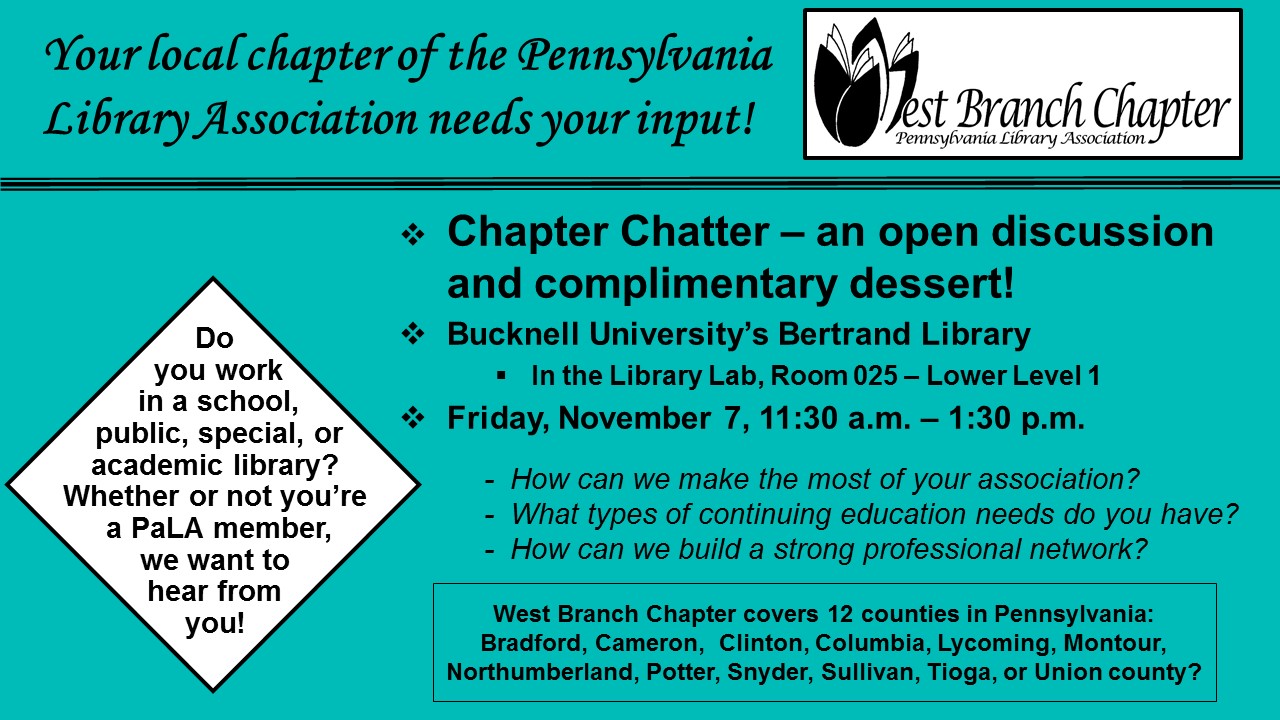
West Branch Chapter invites you to a “Chapter Chatter” event!
Please join the West Branch Chapter of PaLA on Friday, November 7, at Bucknell University, for discussion and dessert. This meeting is open to PaLA members and non-members – please share this with all of your library colleagues!
RSVP to Barbara McGary by Thursday, November 6, bmcgary@jvbrown.edu. Hope to see you there!
Alison Gregory, Director of Library Services, Lycoming College
Discovery and the Future of the Catalog
A Panel Discussion
Wednesday, November 12, 1:00pm
How’s that new discovery service really working out in your library?
Join the Connect & Communicate series’ panel of academic librarians, from colleges and universities in Pennsylvania, for a discussion about discovery service and the future of the catalog.
Panelists include:
Sara Pike (Shippensburg University of PA)
Robert Flatley (Kutztown University of PA)
Sarah Hartman-Caverly (Delaware County Community College)
Amanda Avery (Marywood University)
Jamey Harris (Mansfield University)
Ashley Esposito (Shippensburg University of PA)
The Connect & Communicate Series Planning Committee is pleased to offer this virtual discussion, in which panelists will discuss what they learned and the challenges they encountered as they worked through the process of selection, implementation, and assessment of discovery services. Find out how discovery has changed instruction in their libraries, what faculty and students think about it, and where things are headed in the future.
Register at the following link: http://goo.gl/forms/0yUIOkAXYv
Join in on the conversation on Wednesday, November 12, at 1:00 p.m. at http://centralpenn.adobeconnect.com/crdccs/
- For this program, participants will need speakers to hear the presenter speaking, but will not need any additional audio equipment. Participants may ask questions via the chat box; moderators will monitor the Chat box and facilitate question and response.
- A recording of the program will be made available to PaLA members following the program.
Before the Discussion:
To test your computer (recommended): http://centralpenn.adobeconnect.com/crdccs/
To run the Adobe Connect Meeting Connection Diagnostic:http://admin.adobeconnect.com/common/help/en/support/meeting_test.htm
If you would like to be emailed directly about this and other upcoming Connect & Communicate Series events, you may provide us with your name and email address here: http://goo.gl/4urXl . (If you submitted previously, you are still on our list.)
Please continue to share your ideas for programming topics, speakers, or formats with us! We’re getting some great suggestions and themes are starting to emerge, but we could also use some more speaker names. If you or someone you know is doing something great in Pennsylvania’s academic libraries, tell us about it!
The Connect & Communicate Series of online programming offered by the PaLA College & Research Division aims to help foster a community of academic librarians in Pennsylvania. Please contact Jill Hallam-Miller at jillhallam-miller@centralpenn.edu or at 717-728-2415 with questions.
GSU e-Reserves Copyright/Fair Use Decision Overturned
On Friday the 11th Circuit Appeals Court overturned the Cambridge University Press, Oxford university Press, and Sage Publications versus Georgia State University ruling. Though the new ruling overturns a few of the fair use decisions made by the lower court, some library advocates have been blogging that the important rulings are still in place. If you are interested in reading further on this case and drawing your own conclusions about its implications for libraries, here is a brief current bibliography:
“11th Circuit Rules on Georgia State Fair Use Case” — The Copyright Librarian
“A Win for Publishers” — Inside Higher Ed
Social Justice in The Information Society
Access to information has never before been easier or more convenient. Conversely, the structures that have allowed technology to make information accessible have also helped to restrict access. Please join us for an event that will raise the awareness of the social, political, economic, technological and ethical issues surrounding the access to information.
Social Justice in the Information Society is a four part speaker series which will give faculty, staff, students, and community members the benefit of participating in a forum with a highly respected scholar doing critical work in the interdisciplinary field of information science. Invited speakers will be asked to present on the ethical and social justice issues associated with information access and the information society. The speakers will videoconference into the forum and a local scholar will navigate the event. Following the presentation, the guest lecturer and facilitator will participate in a Q & A period so the audience can interact with the material and the lecturer. These events will be free and open to the public and a dessert reception will follow.
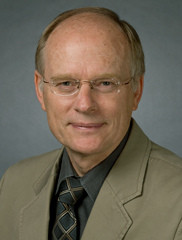 The Ethics of Information Access
November 4, 2014, 7:00 p.m.
Marywood University
Swartz Center, Conference Room B.
2300 Adams Avenue, Scranton, Pennsylvania 18509
Dr. Johannes Britz, Provost & Vice Chancellor of the University of Wisconsin-Milwaukee will discuss the implications of, and raise awareness to, the social, political, economic, technological, and ethical issues surrounding access to information. This event will be facilitated by Dr. Aaron Simmons, Assistant Professor of Philosophy, Marywood University
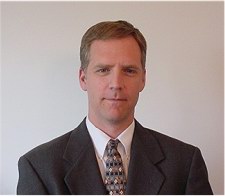 Privacy, Security, and Government Surveillance
Wikileaks, Big Data and the “New Accountability”
November 10, 2014, 7:00 p.m.
The University of Scranton
Moskovitz Theater, The DeNaples Center
900 Mulberry Street, Scranton, Pennsylvania 18510
Dr. Adam D. Moore, Associate Professor of the Information School & Adjunct Associate Professor of the Philosophy Department at the University of Washington argues that accessing and sharing sensitive information is morally suspect and that we simply do not owe each other the level of information access promised by “big data” or Wikileaks. The “Just Trust Us,’ “Nothing to Hide,” and “Consent” arguments will be presented and critiqued. The event will be facilitated by Dr. Michael Jenkins, Assistant Professor of Criminal Justice, University of Scranton.
The last two forums in the series will be scheduled in the spring semester.
This speaker series has been funded by the Marywood University/ University of Scranton Cooperative Grant. For more information email lchristianson@maryu.marywood.edu or george.aulisio@scranton.edu


 Adam Balcziunas
 Alex K.
 Alexandrea Glenn
 Andrea Pritt
 aprilnkelley
 Ashley Purvis
 Bethann Rea
 blj13
blj13 Brendan Johnson
 Amanda Boyer
 Bret Stiffler
 Bonnie Powers
 Christopher Lemery
 clarewithers
 clblibrarian
 Kelly Clever
 Charlotte M. Johnson
 colemanluzerne
 CRD of PaLA
 crdvirtualjournalclub
 cre5314
 csgarth
 Erin B.
 danajkerrigancv
 denisewetzel1
 Darren G. Poley
 elm43
elm43 James D'Annibale
 Annie Jansen
 Jill Hallam-Miller
 jennifercribbs
 Jenn Monnin
 Jen Hasse
 Jessica Showalter
 johnmeier1
 Kelly Safin
 Kim Karim
 Kristen Seikaly
 Kayla Van Osten
 Cecelia Lasley
 librarianjsmith
 Linda Neyer
 mabogino1
 Matthew McNelis
 Meg Massey
 Maggie Savidakis-Dunn
 Rebecca
 miskatoniclibrarian
 Maureen Bentz
 Michele G. Anfuso
 Nicole Miyashiro
 paulmcmonigle
 Rob Sieczkiewicz
 ronlmccoll
 Sam Bardarik
 shannahollich
 smartin592
 Ula Lechtenberg
 It's Academic