Children’s Literature Conference
Join us for our 19th Annual Pitt-Greensburg Children’s Literature Conference, Friday May 1, 2015
Educators, librarians, and writers are primary audience for this annual event.
Conference fee: $70 if postmarked on or before March 31, 2015, $80 thereafter.
Collaboration with the Campus Community
Hi! My name is Hilary Westgate, and I’m the Information Literacy Librarian at Misericordia University and part of the new blog team for the PaLA-CRD blog! I’m the liaison to the English, Communications, Fine Arts, and Religious Studies departments, the FYE program, and the Writing Center, and I also assist with our outreach programs and services. I attended Rutgers University for my MLIS and graduated in May of 2012, and I came to Misericordia in August of that year, so I am still fairly new to the profession. I’m honored to be a part of this blog team and hope that I can bring you some interesting and useful discussions!
I’d love to open up a conversation here about collaboration with other departments and groups on campus. Since I’ve been at MU, I’ve been fortunate to work with staff and faculty members from other departments who are interested in pairing with the library on special programs and projects. In particular, the Student Success Center and the Writing Center have been amazing partners in collaboration. As a couple of examples, we have offered workshops together in which librarians and the Writing Center coordinator have co-taught about citation styles and formats, and I have offered cross-training opportunities for Writing Center tutors about aspects of their work that coincide with where the library can help.
Our most recent project in this partnership is a satellite Writing Center in one of our new study rooms in the library. We recently had eight new study rooms installed on the second floor of the library, and they are extremely popular with our students, especially because the walls are white boards! It’s amazing to see students filling up the walls with words and diagrams as they study. For three evenings during the week before Spring Break, from 5:00—9:00 p.m., we had writing tutors come to the library and set up to offer their tutoring services in a library study room. At the same time, some writing tutors remained in the original Writing Center location. Unfortunately, for our very first try with this outreach project, the writing tutors did not have students drop in to meet with them. We are looking forward to tweaking our approach a bit to offer the same service in April during the week before finals, and we are hoping for greater visibility and increased attendance from our students. We now know what we would like to change and improve for next time!
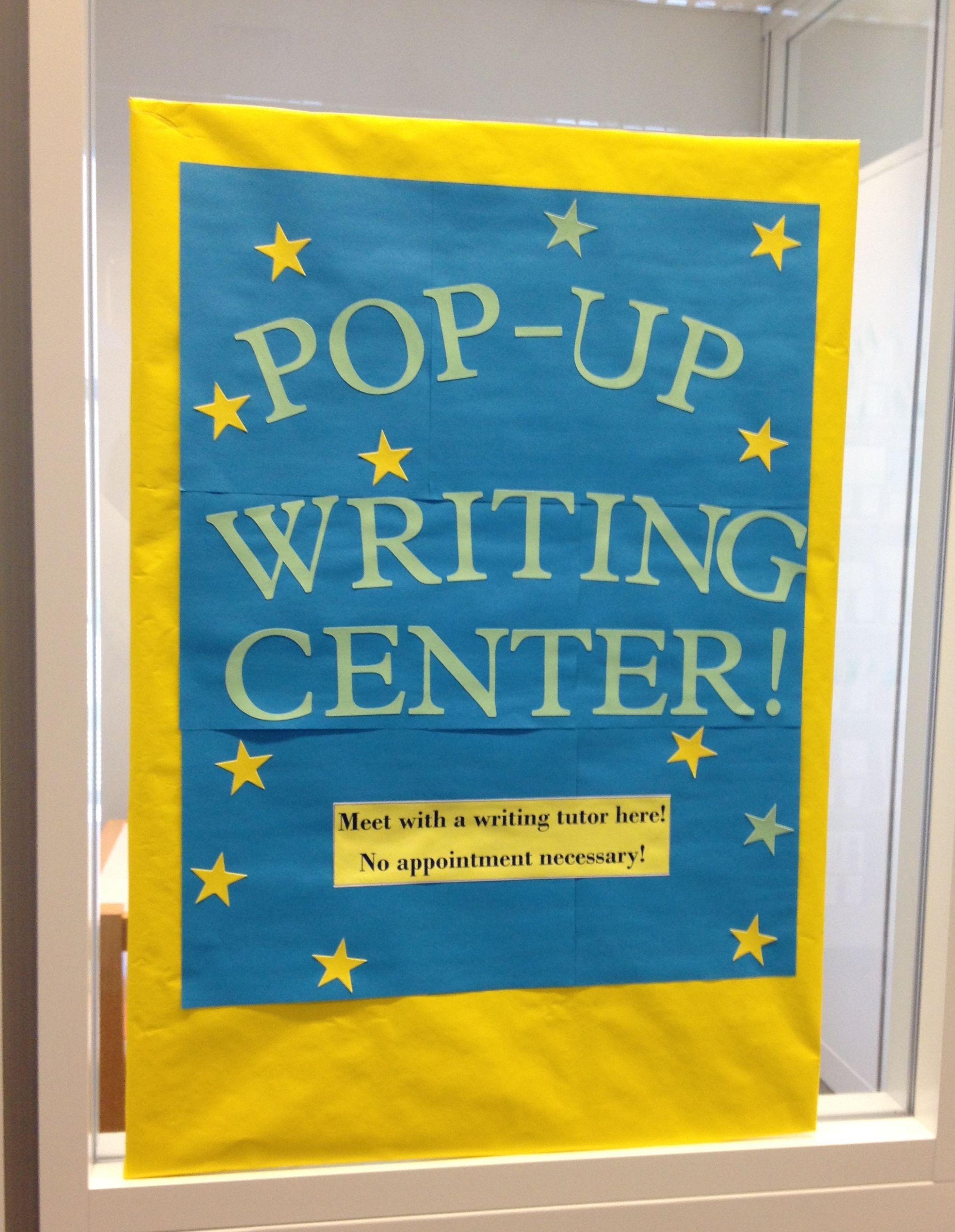
This sign was placed in the window of the designated study room, along with other directional flyers throughout the building.
What are some of the ways in which your library works with other departments and groups on your campus? What has worked well (and not so well) for you? Please share in the comments!
Connect & Communicate Spaghetti Session
Spaghetti Session
A Connect & Communicate Series Discussion
Friday, March 13, 1:00pm
During this hour, we’ll discuss a variety of topics suggested by PA academic librarians through our Padlet wall at http://padlet.com/amynsnyder/CandC. You throw your ideas (spaghetti) on our wall (Padlet), and we’ll see which ones stick. We’ll spend some time discussing ideas and possibly shaping some of them into topics for full-length discussion or presentation.
This will be an informal discussion, during which all attendees are encouraged to participate. The easiest way to participate is through the use of a headset with microphone, but attendees may alternately participate via chat.
Throw spaghetti at http://padlet.com/amynsnyder/CandC
Register at http://goo.gl/forms/ADI3BpdEGU
Join the conversation on Friday, March 13, at 1:00 p.m. at http://centralpenn.adobeconnect.com/r1joxmjimh2/
- For this program, participants are encouraged to utilize a headset with microphone. However, a headset is not required, and participants may join the discussion via the meeting room chat box.
- A recording of the program will be made available to PaLA members.
Before the Discussion:
- To test your computer (recommended): http://centralpenn.adobeconnect.com/r1joxmjimh2/
- To run the Adobe Connect Meeting Connection Diagnostic: http://admin.adobeconnect.com/common/help/en/support/meeting_test.htm
If you would like to be emailed directly about this and other upcoming Connect & Communicate Series events, you may provide us with your name and email address here: http://goo.gl/4urXl . (If you submitted previously, you are still on our list.)
Please continue to share your ideas for programming topics, speakers, or formats with us! We’re getting some great suggestions and themes are starting to emerge, but we could also use some more speaker names. If you or someone you know is doing something great in Pennsylvania’s academic libraries, tell us about it!
The Connect & Communicate Series of online programming offered by the PaLA College & Research Division aims to help foster a community of academic librarians in Pennsylvania. Please contact Jill Hallam-Miller at jbhm001@bucknell.edu or at 570-577-2055 with questions.
WPWVC Virtual Poster Session Now Online
Winter is a difficult time to travel to a conference: Just ask your colleagues who were “lucky” enough to attend ALA Midwinter in snowbound Chicago in February.
To avoid the ice and the snow yet still provide a professional development opportunity for its members, the Western Pennsylvania/West Virginia Chapter of the Association of College & Research Libraries (WPWVC/ACRL) is now hosting the 2015 Virtual Poster Session.
This online event, a first for the chapter, features digital posters on the theme of “Building Community @ Your Library.” The presentations provide examples of how academic libraries and their staff can build community with their native audiences as well as with external groups.
Featured posters include–
- “Building Community @ the Bevier Engineering Library” by Anne Schwan and Judy Brink, University of Pittsburgh
- “Hello Neighbor: Building Community with the High School Next Door” by Carrie Bishop, Penn Sate-DuBois
- “Creating Community through the Sharing of Primary Sources: Or, That’s Why They’re Known as Special Collections!” by Clare Withers and Jeanann Haas, University of Pittsburgh
All posters were peer-reviewed by members of the WPWVC/ACRL. This virtual programming was envisioned and organized by David Kupas, University Of Pittsburgh-Johnstown, who is the Chair of the WPWVC Program Committee.
As part of this online engagement, WPWVC/ACRL Website Administrator Stephanie Gillespie of Duquesne University also hosted a virtual chat via Twitter, in which presenters logged on to discuss and answer questions about their posters. This session took place on Tuesday, February 24, from 3 to 5 p.m.
It’s not too late, though–you can read the discussion and continue to contribute to it by tweeting to the WPWVC Twitter account, @wpwvcacrl, and by using the hashtag, #wpwvcvirtual15.
Save the date: ACLCP Spring Conference
Date: Thursday, April 16, 2015
Location: Holiday Inn Harrisburg East, Harrisburg
Save the date for the ACLCP (Associated College Libraries of Central Pennsylvania) Spring Conference! This year’s theme is “The Evolving Academic Library”. Take this opportunity to learn about the continuing changes in physical space, the new generation of students, and even our very jobs themselves.
Attend the conference and discover how libraries continue to evolve and what your job might look like in the near future. Stay for the afternoon and learn about Generation Z, the next generation of students who are soon to hit college campuses.
Details on the programs are pending, so stay tuned, but please note that this year’s conference takes place on a THURSDAY.
For more information, contact the ACLCP Programs Committee Co-Chairs, Ben Hoover (bahoover@bucknell.edu) and Denise Shorey (dshorey@ycp.edu).


 Adam Balcziunas
 Alex K.
 Alexandrea Glenn
 Andrea Pritt
 aprilnkelley
 Ashley Purvis
 Bethann Rea
 blj13
blj13 Brendan Johnson
 Amanda Boyer
 Bret Stiffler
 Bonnie Powers
 Christopher Lemery
 clarewithers
 clblibrarian
 Kelly Clever
 Charlotte M. Johnson
 colemanluzerne
 CRD of PaLA
 crdvirtualjournalclub
 cre5314
 csgarth
 Erin B.
 danajkerrigancv
 denisewetzel1
 Darren G. Poley
 elm43
elm43 Heather Burychka
 James D'Annibale
 Annie Jansen
 Jill Hallam-Miller
 jennifercribbs
 Jenn Monnin
 Jen Hasse
 Jessica Showalter
 johnmeier1
 Julie Durci
 Kelly Safin
 Kim Karim
 Kristen Seikaly
 Kayla Van Osten
 Cecelia Lasley
 librarianjsmith
 Linda Neyer
 mabogino1
 Matthew McNelis
 Meg Massey
 Maggie Savidakis-Dunn
 Rebecca
 miskatoniclibrarian
 Maureen Bentz
 Michele G. Anfuso
 Nicole Miyashiro
 paulmcmonigle
 Rob Sieczkiewicz
 ronlmccoll
 Sam Bardarik
 shannahollich
 smartin592
 Ula Lechtenberg