Gimme a Gimmick
I recently listened to the ACRL-CHOICE Webinar, “Positioning your Library Marketing for Success,” sponsored by Springer. The archived webcast recording is available at: http://acrlchoice.learningtimesevents.org/archive-sep152015/
While I found the webinar to be very enlightening and informative, I could not help thinking nearly the entire time, gimme a gimmick. Gimmick as defined as a marketing term meaning a special, unique, or quirky feature to make something ‘stand out’ from the ordinary. The presenters offered case studies of successful marketing activities at a few institutions. My interpretation of the title was one of delight and hope that a candid discussion about the strategies of positioning your library for successful marketing might include, at minimum, a summary of the ‘behind-the-scenes’ discussions and growing pains to accomplish these activities. However, instead we were presented with great marketing gimmick ideas patterned after popular ideals to draw attention to the library.
The first gimmick was an example from the University of Maryland Libraries and their use of a robot cartoon character to promote their inter-library loan service, UBorrow, that had just went to a fully automated system. While I was very impressed with their branding of this new service and thought that the robot image would stand out to students, I could not help but wonder if the students not living in ‘library land’ understood the underlying meaning of a self-automated service and the image of a robot. Further, I pondered the idea of the future of librarianship and wondered if this robot with glasses was not forecasting the method of retrieving materials. After all, hotels have already experimented with robots offering room service to guests.
Creative t-shirts, popular songs, and swag are not new ideas to assist the library with standing out and featuring their services however, larger open house events in connection with these items may be a novel idea. At Texas A&M Libraries, they hold a very large open house event one week before the beginning of classes. The open house began as a grassroots effort and now is a two and a half hour performance boasting 4,300 students. The underlying goals of the open house are to serve as an ice-breaker for students to come into the library.
The USTA Libraries blue crew aimed to attract attention via uniforms and branding as the next gimmick highlighted to successfully increase the number of reference transactions. Similar to the big box computer store, the USTA blue crew wore t-shirts, cardigans, button down shirts, polos, and more. The blue crew also rolled out a series of posters with cartoon images, holiday focused events, button branding contest, online connected branding and more. Before the yearlong campaign began, everyone underwent a refresher customer service workshop.
The final and ultimate gimmick was utilized to highlight Texas A&M Libraries Special Collections science fiction focus. The team was able to attract George RR Martin to come to the library and quickly turned the event into a University-wide and beyond event that took a year to plan and cost $32,000. The event became so large that it attracted the attention of the HBO cable channel and ended up being attend by more than 3,000 people. The team also came up with an exclusive dinner event and charged $400 per person and making back the money they spent on the event as a whole. Finally, Mr. Martin donated a first edition book to special collections.
Ultimately, at the end of the day, I feel that it is very difficult to measure the success of marketing gimmicks because they are primarily based on the number of participants and positive responses. If gimmicks are duplicated at other institutions and do not produce similar results can the flaw be identified as the lack of knowing your target audience? How do students decide to engage? With gimmicks or gab (word of mouth)? Do students follow the crowd, social media, or happenstance? Should we include students in the creation of gimmicks for the library? Do we use gimmicks at the end of the day to attract student participation or attention from our peers and administrators? Or is it both? When you are in the business of selling information and ideals, do we need a gimmick or just the facts? So, what’s your current gimmick? Share below :)
Register Now for the Connect & Communicate: Framework Un-Conference!
Join CRD’s Connect & Communicate Series
for a Framework “Un-Conference”!
September 17, 2:00pm EST
Please join us for a panel discussion in which speakers present what they’ve done, what they’re doing, or what they plan to do with the ACRL Framework for Information Literacy for Higher Education in their academic libraries. Leslie Worrell Christianson, User Services Librarian and Assistant Professor at Marywood University will facilitate the discussion.
There will be time for YOU to ask questions of the panelists, to provide feedback, and to discuss the presentations.
You can register* at the following link: http://goo.gl/forms/ibuKG999al
Registered participants will receive instructions for linking to the discussion via email on September 16th.
If you do not receive an email, please contact Jill Hallam-Miller at jbhm001@bucknell.edu
For this program, the best way to parti cipate is via USB headset with microphone. Participants may alternately use speakers, and ask questions via the chatbox; moderators will monitor the chatbox and facilitate question and response.
If you would like to be emailed directly about other upcoming Connect & Communicate Series events, you may provide us with your name and email address here: http://goo.gl/4urXl
Please continue to share your ideas for programming topics, speakers, or formats with us! If you or someone you know is doing something great in Pennsylvania’s academic libraries, tell us about it!
The Connect & Communicate Series of online programming offered by the PaLA College & Research Division aims to help foster a community of academic librarians in Pennsylvania. Please contact Jill Hallam-Miller at jbhm001@bucknell.edu or at 570-577-2055 with questions.
*Registration is limited to the first 100 participants. If you register, but cannot attend, please email Jill Hallam-Miller at jbhm001@bucknell.edu to open your space for someone who can attend. Thank you!
Same old, same old… what does it mean to be “technologically savvy”?
A few days ago, a member of the Facebook group ALA Think Tank posted a link to an article in Time magazine. The article, which is actually from May, has an alarmist headline: “This Is Millennials’ Most Embarrassing Secret,” and goes on to inform us that we (as a country) lose “billions” a year because of it. The article addresses how today’s young adults lack basic technological skills and that it costs their employers money. Some of these skills involved using email, Microsoft Office products, and antiquated and inefficient systems already present in whatever organization employs them.

Kickman, Commodore 64. I mastered this game. Eight levels (the eighth repeated endlessly).
A hearty discussion ensued on the Facebook group about Millennials, technology, “digital natives,” and the role of librarians to teach certain skills. My impression? Young people today are just like young people twenty years ago, and I am growing tired of anyone who isn’t a young person (myself included) placing expectations on them and becoming concerned when the young people don’t fit those stereotypes.
I can buy into labels. I grew up solidly within the boundaries of Generation X. Just like with horoscopes (Gemini!), and Myers-Briggs personality tests (ESTJ!). I can read into the supposed characteristics of the MTV Generation and find all sorts of similarities, nostalgia, and applicable values. And because of my birthdate and generation, I am now moving into an age range where I can probably start voicing curmudgeonly concerns about younger generations. But I don’t really want to.
The article in Time quotes a 2011 Inside Higher Education article, “What Students Don’t Know,” by Steve Kolowich that talks a lot about exploding the “myth” of the digital native. The article references the ERIAL (Ethnographic Research in Illinois Academic Libraries) project — a series of studies conducted at Illinois Wesleyan, DePaul University, and Northeastern Illinois University, and the University of Illinois’s Chicago and Springfield campuses. The resulting paper Libraries and Student Culture: What We Now Know was published by the American Library Association in 2012. Some of the findings included the fact that students were “basically clueless” about the logic underlying how Google organizes and displays results, and that many students “described experiences of anxiety and confusion when looking for resources…”
Is this unique to the younger generation, to 2015? I remember college, even if it was 20+ years ago. I also remember my level of technical ability. My father was very interested in computers and as a result, we had a Commodore 64 when I was in high school and the Commodore 64 used to come with an instruction manual that contained small 10-20 line BASIC programs that would enable a note to play or a ball of color to bounce across the screen. I used to love to type in those programs (the 1987-equivalent of cut-and-paste) and feel like I really had power to develop software. Obviously, I did not. I might have known more than someone who did not own a Commodore 64, but that was the extent of my abilities. Other skills in my possession at the time I entered college were the ability to program VCR to record a television show and the ability to replace fuses in my aging Volvo stationwagon. I could also convert music from vinyl records into cassette tapes. WordPerfect 5.1? A former colleague and mentor who now refers to herself as a “technodinosaur” taught me how to punch in formatting codes like a pro.
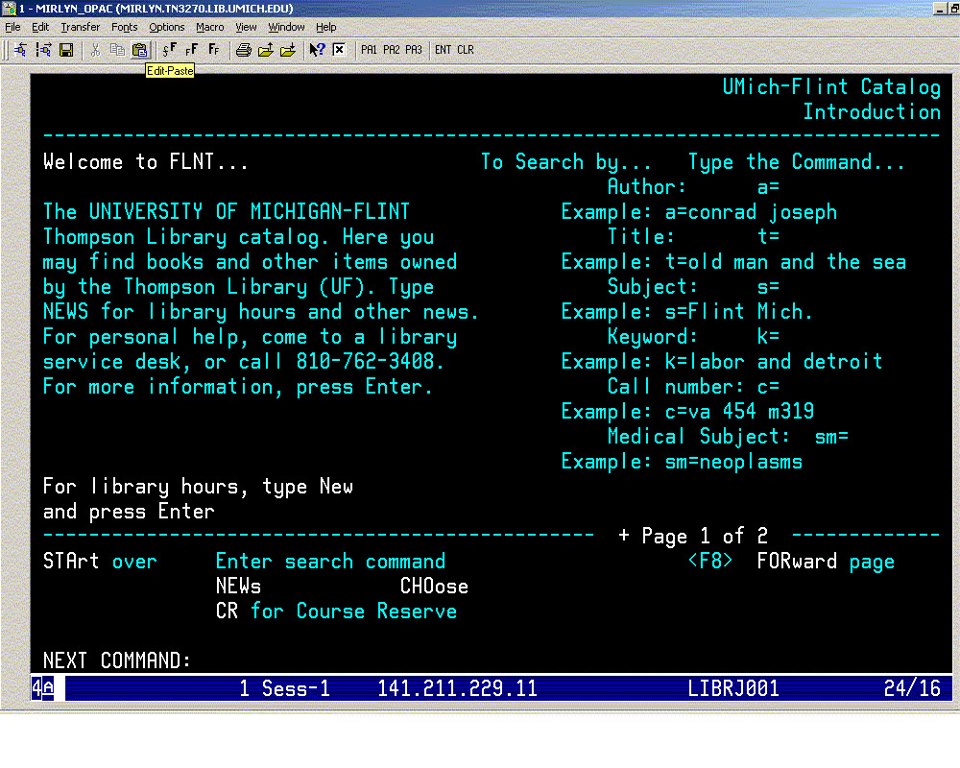
Did any of these skills enable me to be an effective user of my college library’s extensive card catalog my freshman year? I remember the anxiety. I remember the confusion. Add to that my university’s first online catalog (Note: image link is to another university, but you get the idea). No one taught me how to use it. I noticed the little terminals with their black screens and green text sitting in various places around the library and in addition to discovering I could type words into it to find books, I also figured out how to hack in through the back-end and check my email using the Pine email client. I apologize, but if I had library instruction in 1990, or any other guidance other than “go to the library,” I don’t remember it.
To make matters worse, I was a Russian Studies major but I did not fully grasp the concept of a research paper. Why would I want to write a paper that involved regurgitating information I found in other books? I wanted to (and thought I was supposed to be doing) original research. I had no real idea of what that meant, but I had an inkling that to truly write a stellar paper about the Khazars, I would have to become instantly fluent in Russian and Arabic and perhaps travel internationally. This filled my young heart with dread, and although I did ultimately end up turning in an acceptable paper, I have no idea how I managed. All I remember was the apprehension and the feeling that I was doing something incorrectly.
So here are my thoughts. First, as librarians, I propose that we as a profession spend a lot more time enhancing, resolving, linking, and cleaning metadata. Metadata is something that we know about and it is an area where we really can shine. We already create a lot of it. Second, as a profession we can invest time and energy into making the metadata, and the systems that index and utilize it better. This is a real challenge, since the way that Google and Amazon and Netflix do this may (or may not) violate privacy principles that we, as librarians, hold dear. Third, let’s stop making assumptions, negative or positive about students, and instead, happily teach them without those expectations. Maybe we need to understand a little bit about what they already know, but maybe it is not the most important thing. School is all about learning, not about pointing out what people don’t know yet. Most toddlers understand the concept of swiping and tapping through screens on a smartphone, but does that make all toddlers technologically savvy? The fact that today’s incoming college freshman have been raised with Google and smart phones means that they can type words into a search box and see results, and that they can use a smart phone. The fact that I could program a VCR to record a television program in 1990 says nothing about my ability to follow catalog card references. When I was eighteen, I had a lot to learn. Come to think of it, I still feel that way, and sometimes it takes me a few attempts to find the citation, article, or book that I really need.
Labor Day — A Good Time to Reflect on the Purpose of Education
One of the ongoing features of our school’s library is a display of materials that speaks to a certain theme, which we change every month or so. Right now, the theme is Labor Day, with books about labor, unions, and related employment topics. This reminded me of an ongoing debate in higher education, one that is discussed somewhat differently by students and by educators, but it generally has the same main theme: What is the purpose of education, especially higher education?
For many students, and I would suspect an overwhelming number of students at our school, the purpose of their pursuit of higher education is to get a job. Sure, most of them don’t mind learning some other things along the way, but most of them seem largely concerned with how the courses they take (and the assignments they are required to complete in them) will help them get a job once they graduate from school.
On a related side note, I want to mention that our school has gone through a number of fundamental changes over the years of its history–it started as a Business School, with the explicit charge of training its students for their chosen vocations. As the employment landscape changed, fields of study were added and removed (for example, we used to have a Travel and Tourism program), but in recent years we have made the transition from Business School to College. We now award Bachelor’s degrees as well as Associate degrees, and more recently we added a Master’s program. Our latest curricular additions have been in Health Sciences areas. However, we have added both specific career-path programs (preparing students to be OTAs or PTAs) and career enhancement programs (Bachelor of Health Sciences programs which have primary goals of helping already-trained professionals to advance to supervisory and management positions.) We continue to offer degree programs which correlate strongly with specific careers paths (such as criminal justice, legal studies, and medical assisting) in addition to business and communications programs.
So…here at the start of the 2015-16 school year, as we deal with the lingering effects of the Great Recession and what seem to be ever-increasing higher education costs–what do we say to those who question the value of higher education? Those asking the loudest are especially interested in why students are almost always required to take classes in multiple disciplines instead of only taking classes devoted to their chosen major and/or field of study. Why do medical assisting students at my school need to take English and social sciences classes? Why does a music education major at my alma mater (a liberal arts college) need to take a science class? In our positions as librarians, I believe we are well-situated to help students with a good answer to this. Since we are not the direct instructors of their English/science/history classes, students often complain to us about not understanding why they need this class (when they’re asking for our help with research or in-text citations). First, we can help them to realize that part of the reason they might not excel at these ‘other’ types of classes is because the subject is not only foreign but the ways of thinking about these ‘other’ subjects is different than how they think regarding their chosen field. Taking these classes outside their comfort zone can help them develop different types of thinking–and different types of skills. And for almost any job a student might look for in the future, their prospective employer is going to need them to not only be able to perform their technical job functions–they’ll also need them to perform well at soft skills such as communication, teamwork, and problem solving.
Well-rounded curricula produce well-rounded students–who become well-rounded, productive employees. (That’s the master plan, anyway, in my opinion at least.) When my next student asks, why do I need to take a history class, I’m an IT major? I’ll respond: classes such as history will help you think in different ways–and being able to think in different ways will help you get and keep a better job.
Connect & Communicate seeks Framework panelists
Have you successfully incorporated the Framework for Information Literacy for Higher Education into your library instruction? Are you using the Framework in this semester’s instruction? Do you have a great idea for using the Framework, but you’d like feedback before you try it out?
The Connect & Communicate Planning Committee (PaLA College & Research Division) seeks statements of interest from potential panelists who are ready to share their Framework success stories, plans, and ideas with the Pennsylvania academic library community!
You don’t have to be an expert! Just have an idea that you want to share!
Panelists will each be asked to speak for up to five minutes. Immediately following will be a virtual unconference giving attendees an opportunity to ask questions and provide feedback about the presentations or pose new questions. The program is tentatively scheduled for September 17, 2015.
Submit your proposed presentation details at http://goo.gl/forms/X7LyPQYD24
Proposals must be received no later than September 10th.
Please contact Jill Hallam-Miller, Connect & Communicate Planning Committee Chair, at jbhm001@bucknell.edu or at 570-577-2055, with questions.
The Connect & Communicate Series of online programming offered by the PaLA College & Research Division aims to help foster a community of academic librarians in Pennsylvania.


 Adam Balcziunas
 Alex K.
 Alexandrea Glenn
 Andrea Pritt
 aprilnkelley
 Ashley Purvis
 Bethann Rea
 blj13
blj13 Brendan Johnson
 Amanda Boyer
 Bret Stiffler
 Bonnie Powers
 Christopher Lemery
 clarewithers
 clblibrarian
 Kelly Clever
 Charlotte M. Johnson
 colemanluzerne
 CRD of PaLA
 crdvirtualjournalclub
 cre5314
 csgarth
 Erin B.
 danajkerrigancv
 denisewetzel1
 Darren G. Poley
 elm43
elm43 James D'Annibale
 Annie Jansen
 Jill Hallam-Miller
 jennifercribbs
 Jenn Monnin
 Jen Hasse
 Jessica Showalter
 johnmeier1
 Kelly Safin
 Kim Karim
 Kristen Seikaly
 Kayla Van Osten
 Cecelia Lasley
 librarianjsmith
 Linda Neyer
 mabogino1
 Matthew McNelis
 Meg Massey
 Maggie Savidakis-Dunn
 Rebecca
 miskatoniclibrarian
 Maureen Bentz
 Michele G. Anfuso
 Nicole Miyashiro
 paulmcmonigle
 Rob Sieczkiewicz
 ronlmccoll
 Sam Bardarik
 shannahollich
 smartin592
 Ula Lechtenberg
 It's Academic


#/media/File:PineScreenShot.png)