2016 Southwest Chapter Spring Workshop
2016 PaLA Southwest Chapter Spring Workshop: Ensuring the Future: Preserving the Past
Date: Friday, May 20, 2016 from 8:30 AM to 3:00 PM
Location: Westmoreland County Community College Commissioner’s Hall – Youngwood, PA
Sessions include:
-
Using Library Statistics
-
Preserving your Past
-
Attracting Authors
-
Policy checklist: Basic Policies for Every Library
-
QuickBooks 101
So….don’t wait another minute….click this link and visit the Westmoreland County Community College on Friday, May 20th!!!! Registration deadline is 5/6/16!!
Registration for South Central Chapter Workshop Open
Please excuse any cross-posting
The South Central Chapter of the Pennsylvania Library Association invites you to attend its spring workshop:
“Technology in Practice: Learn it, Try it”
Monday, May 16, 2016
HACC McCormick Library, Harrisburg, PA
Workshop topics to include:
- practical application of technology tools for instruction and interactive learning (with optional open lab time),
- the POWER Library PA Photos & Document service,
- simple and inexpensive digital collection preservation,
- tech clubs for teens and kids, and
- migrating to an open source ILS.
We will have both large group and break-out group sessions. Light breakfast treats and lunch are included in the cost of registration.
A social event is planned following the workshop. If there is good weather, we will take a stroll at Wildwood Park to see ‘Art in the Wild’, and no matter the weather, dinner at Appalachian Brewing Company.
Registration is open until May 6!
Find a full workshop description and registration information our website at: http://www.palibraries.org/event/SCC2016Workshop
(PaLA members, log in before registering to receive the member rate.)
Want to download the printable PDF flier? It is available at http://tinyurl.com/SCC2016Workshop
Contact Amy Snyder at ansnyder@pacollege.edu with your questions, and be sure to register by May 6!
———-
These optional PaLA South Central Chapter Socials also on Monday, May 16 are open to workshop attendees and non-attendees. See each event for details and to RSVP.
4:00 PM
Join us for a short walk (weather dependent)! Check out Art in the Wild at Wildwood Park on a leisurely afternoon stroll. More information at http://tinyurl.com/SCC2016ArtWalk
5:00 PM
Join us for dinner! More information at http://tinyurl.com/SCC2016ABC
Library Services by Design:
Supporting Future Forward Workplace Competencies
Fourthannual PA Forward Information Literacy Summit
State College at the Pennsylvania State University
July 21, 2016
The deadline for breakout session proposals is April 30. Don’t miss out on the chance to present your idea. Please see the attached file for details on proposal guidelinesPAFILS2016-CFP[3]
Ode to Dissertations and Theses
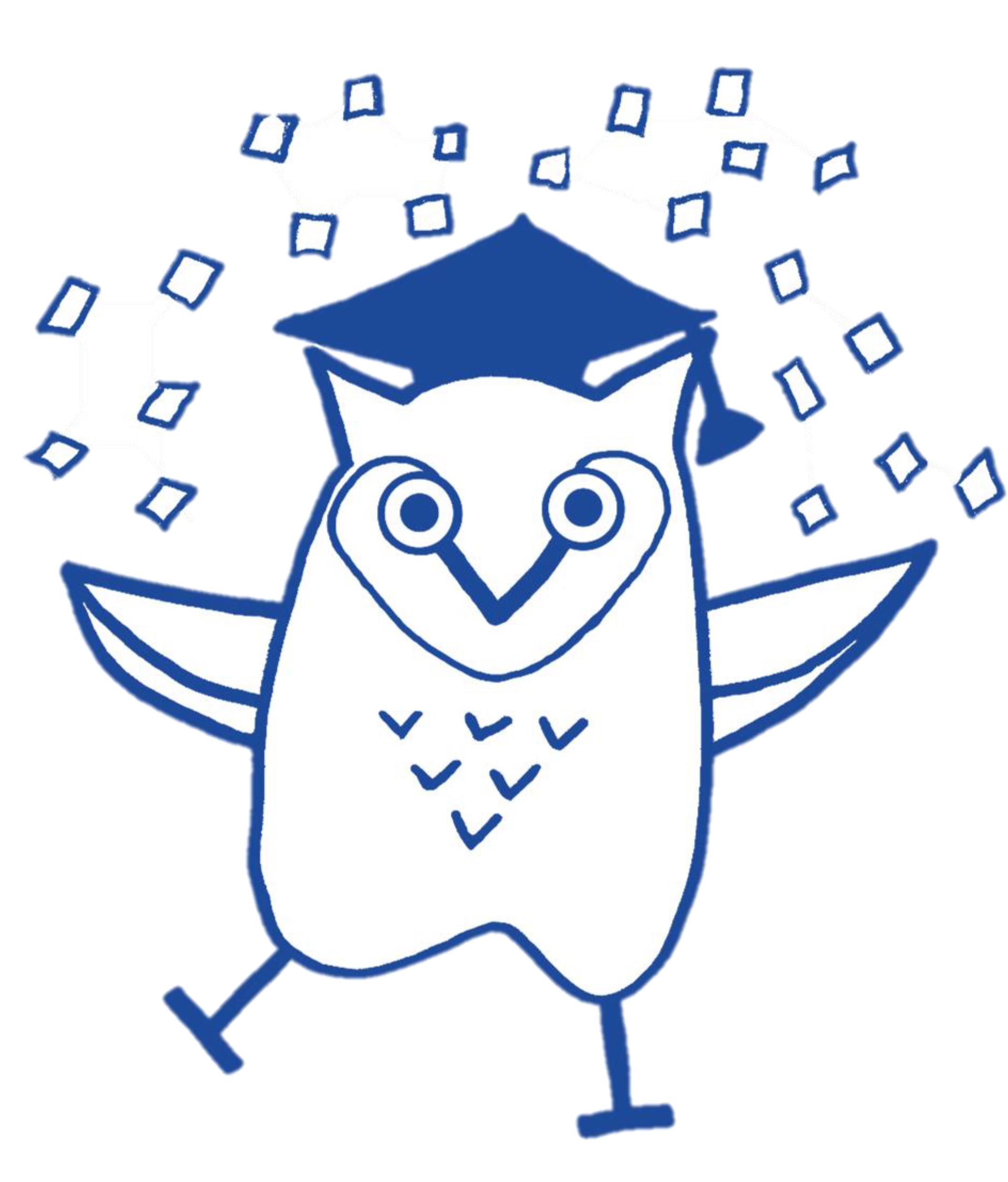 On April 21, my campus, Penn State Wilkes-Barre, is celebrating its second research fair. We are anticipating over 100 posters and participation by a quarter of our student body. This year, one of our faculty proposed changing the name from “Undergraduate Research Day” to the “Celebration of Scholarship,” and we decided we would highlight not only student work, but faculty work as well.
As part of the activities for the day, my colleague and I devised a “Pin the Tassle on the Owl” game, where we ask people to match the faculty member with their dissertation title (or, in absence of a dissertation, another significant publication). This is an especially fun game for me, as I have an obsession with theses and dissertations. It started when I was working in a special collections library, where we had a huge card catalog filled with cards relating to theses and dissertations on campus. One set was arranged by author, and the other by department. It was common for students beginning their degree programs to visit and to search through their department’s history of scholarship, looking either for ideas, or for things to avoid.
This obsession is also partially fueled by the fact that I, personally, have never written a master’s thesis or a dissertation. I often find myself daydreaming about topics that would interest me for long enough to complete a PhD program, but the topics that really interest me are ones that I am not sure I could use to further my career in a meaningful way. My sister, who actually has a PhD in astrophysics, has told me that writing a dissertation is “not rocket science,” but I think she is being modest.
The easiest way to search for dissertations is using a tool like ProQuest’s Dissertations and Theses, which indexes more than 2 million items. If your university does not subscribe to Dissertations and Theses, there are numerous other ways to access content for free, usually by going to Google Scholar and adding “dissertation” to your search term, or searching within an institution’s institutional repository.
One of my favorite titles ever is from a friend who wrote her Master’s thesis in American Studies: From Old Maids to Action Heroes: Librarians and the Meanings of Librarian Stereotypes. Just this morning, while driving to work, and listening to Harry Potter and the Half-Blood Prince on audio book for the umpteenth time, I found myself wondering how much scholarship the series had spawned. By searching for “Harry Potter” in the abstract field in Dissertations and Theses, I discovered that there are over 100 items. I want to read them all. Does J.K. Rowling know about these? Would she want to read Harry Potter and social constructs: How J.K. Rowlings’s message of equality fails? Is she aware that Dumbledore’s method of teaching is known as ‘inquiry-based,” as we are informed by Learning in Harry Potter: Metatextual Transformations? Could she ever have imagined that there would be not one, but at least two works of scholarship focused entirely on the food she invented for her Harry Potter series?
Children’s literature is an area where I am sure I would be able to find a topic that would interest me for the duration of a PhD program, but where would it get me? I have no interest in either teaching English or becoming a children’s librarian. And besides, someone has already written Let them run wild: Childhood, the nineteenth-century storyteller, and the ascent of the moon. The field of Digital Humanities probably exists because of people like me, who like technology but also humanities subjects. In 2004, a doctoral candidate at the University of Montreal somehow used Anne of Green Gables as a way to “show the implications of hypertext networking with regard to other understandings and practices of memory.” I am not sure exactly what that means, but it certainly sounds impressive (van der Klei, Alice. 2004. The practice of memory in hypertext wor(l)ds).
I like to play a game that involves searching for dissertations discussing my latest binge-watch television shows. I plan to read Anthony Soprano; Aristotelian Tragic Hero, Anti-Hero, or Thug; and Why We Watch as soon as it is fully available online (many people “embargo” their dissertations for five years, usually in case they plan on converting said dissertation into a book). TV Nostalgia for the Boomer Home and Housewife is the only dissertation I have found so far that might analyze Betty Draper of Mad Men, so I have downloaded it to skim once I actually finish watching the series. There are also all of the celebrities who have advanced degrees. Actress Mayim Bialik’s dissertation is about something called “Prader-Willi syndrome.” Queen musician Brian May’s dissertation from Imperial College London actually sounds like a song title: A survey of radial velocities in the zodiacal dust cloud.
Two dissertations focus on my hometown of Columbia, Maryland – a planned community that has a somewhat unique history. The top hit for my current home, Scranton, Pennsylvania, is a thesis entitled When Coal Was King, but its focus is not the obvious. In truth, it was written for someone earning a Master of Fine Arts in Metal and Jewelry Design from the Rochester Institute of Technology. How cool is that?
People spend a lot of time, effort, and money to complete a master’s thesis or dissertation. Often these publications are overlooked, or they do not score high in relevancy rankings in discovery systems. It used to drive me crazy that the cataloging department decided not to assign formal subject headings to theses and dissertations in our catalog at my prior institution. For example, another friend of mine wrote her master’s thesis in 2000 on Catholic Americanism at the movies, 1930-1947. Unfortunately, even though there are several Library of Congress subject heading construction that address the topic (Catholic Church–In motion pictures, for example), it is almost impossible to locate this thesis without knowing it exists in the first place. Perhaps other books have been written on this topic, both before and after the thesis, but if scholarship really is a conversation, then it is useful to hear all of it, and not just snippets.
If you have access to Dissertations and Theses, or if your institution has an institutional repository that contains ETDs (electronic theses and dissertations), take a look now and then. It can be inspirational. While writing this post, I discovered that no one appears to have tackled the idea that I had in the car this morning. So maybe I’ll consider that dissertation after all.
I have already spoken to the need for increased special needs service considerations in my earlier post “Accessibility in college libraries…we can do more…it’s easy…I promise” where I offered a few best practices and easily (and freely) attainable Assistive Technology/Accessibility aids to add to your resource toolkits. However, I thought it pertinent to follow those thoughts with a somewhat wider look at access from an organizational perspective.
Late in 2015 the Association of Research Libraries published Research Library Issues vol. 286 which took a closer look at diversity in libraries. Once facet of that issue, penned by Darlene Nichols and Anna Ercoli Schnitzer from the Univ. of Michigan Libraries, focused on developing research libraries which serve patrons and staff of all abilities. This brief article shares that movements toward inclusion or Universal Design are gaining momentum not only in practice, but also in legislation, and those who take a bit of time to consider how they may reshape or add to their service offerings are far better positioned to leverage the advantages.
While few of us have the professional clout to significantly restructure larger organizational elements to better align with ADA standards, there are a host of smaller initiatives we can undertake which are well within the scope of our profession and can offer demonstrable improvements to accessing our collections and services. My original post outlined a number of simple tech options to enhance your services, but what about how those services are shared? How can you ensure that visitors to your resource collection are really able to easily find and employ them? When considering access, your scope must extend beyond wheelchair ramps and screen reading software…you need to look at your resource base holistically. From inception to completion—both electronic and physical. Below is some food and links for thought:
Electronic
A few great spots to brush up on your grasp of those benchmarks are ARL’s Web Accessibility Toolkit, and WWW3’s Web Accessibility Initiative. Both of these sites will outline where you need to be so that you can take steps to ensure that your website copy, subject guides, whitepapers, or any electronic information or resources are crafted in a manner which meets accessibility guidelines. This could take the form of anything from developing high contrast overlay for your web site to providing text-based materials in alternative formats (DAISY, ePub, PDF etc).
A touch more ambitious , but nonetheless VERY cool, are those who’ve gone farther down the customization road and worked with organizations such Boopsie to develop standard and ease of access apps for the Android/iOS marketplace to allow for users on mobile platforms a custom and uniquely arranged content and collection discovery experience. This growing movement increases ease of access for all by leveraging the streamlined visual literacy approaches and increases focus on key points of action, as well as the individual customizations or enhancements that the mobile device owner would have added in, such as screen zooming tools, text to speech elements, or peripheral braille displays.
Physical
In-Person service accessibility is, of course, key to most organizational approaches to ADA compliance. But the fact that it has been addressed at some point shouldn’t allow us to rest on our laurels. When’s the last time you considered how far back on the counter your pamphlets or resource guides sit? Is your signage sufficiently prominent, bold, and offers audio or braille interface for those with special needs? Are your OPAC/public PC monitors adjustable in height and angle for those unable to position themselves? The Association of Specialized and Cooperative Library Agencies, IMLS, and many more offer simple guidelines and benchmarks to follow, and RESNA’s Catalyst Project can plug you into your own state’s (often free) Assistive Technology resources.
Finally, this post would be incomplete without a direct nod toward the most important element of making your services and resources truly universal in design…staff training. Without and informed and caring staff to implement, none of the prescribed tools or approaches will have the desired effect. The last thing you want is the conversation on how to best serve ALL patrons, including those with special needs) to begin when that first special needs patron comes in. Be proactive and look to the tools mentioned in this post as a guideline. Staff training in this area doesn’t need to be a separate, mandatory, hard sell. The resources and best practices are readily available and easy to digest. Even if this element merely takes the form of honest conversations behind staff doors, it is critical to consider and prepare to serve ALL patrons—and technology and an active online community make it ever easier to stay plugged in to the best ways to continue doing so.


 Adam Balcziunas
 Alex K.
 Alexandrea Glenn
 Andrea Pritt
 aprilnkelley
 Ashley Purvis
 Bethann Rea
 blj13
blj13 Brendan Johnson
 Amanda Boyer
 Bret Stiffler
 Bonnie Powers
 Christopher Lemery
 clarewithers
 clblibrarian
 Kelly Clever
 Charlotte M. Johnson
 colemanluzerne
 CRD of PaLA
 crdvirtualjournalclub
 cre5314
 csgarth
 Erin B.
 danajkerrigancv
 denisewetzel1
 Darren G. Poley
 elm43
elm43 James D'Annibale
 Annie Jansen
 Jill Hallam-Miller
 jennifercribbs
 Jenn Monnin
 Jen Hasse
 Jessica Showalter
 johnmeier1
 Kelly Safin
 Kim Karim
 Kristen Seikaly
 Kayla Van Osten
 Cecelia Lasley
 librarianjsmith
 Linda Neyer
 mabogino1
 Matthew McNelis
 Meg Massey
 Maggie Savidakis-Dunn
 Rebecca
 miskatoniclibrarian
 Maureen Bentz
 Michele G. Anfuso
 Nicole Miyashiro
 paulmcmonigle
 Rob Sieczkiewicz
 ronlmccoll
 Sam Bardarik
 shannahollich
 smartin592
 Ula Lechtenberg
 It's Academic