Revisiting the Discovery Tool: a Periodic Exercise
The academic library has always been a place to develop and adopt new technology, tools and services. Over the last several years we have witnessed a great increase in the reliance on discovery tools. All the big players are here. EDS, Ex Libris and OCLC are some of the very prominent names we have seen in Pennsylvania. And let us not forget Pennsylvania’s own VuFind! Call them what you will, debate has continued as these tools are refined and adopted. It is always good to give a good hard look at what we offer our patrons. As we instruct students in class or assist them at the research help desk, do we see an improvement in their ability to find quality sources? Are these tools really successful in drawing users to our resources or will the familiarity of the “web” always come first? Does it matter? Let’s look again at some of the concerns.
In 2014, Marc Perry wrote a piece in the Chronicle of Higher Education referring to these issues as “the messy world of discovery tools.”[I] The word “messy” jumps out. He identified some of his concerns based on his thorough research. Have we made progress since then? Have we found a balance? One does not need to perform a rigorous study to make similar observational conclusions about discovery tools today.
While a visit to the website of many of the academic libraries in Pennsylvania will show that these products have a strong presence, not every school uses the same system. Sure the products are similar but as practice points out, even slight differences can confuse, delay or even deter a new researcher from continuing to use them. How many times do students approach you about how they “found this source on Google Scholar, do we have it?” When you tell them “Why yes, and here is how easy it is to find”, are they really listening? Do you find students tuning you out when you try to lead an instruction session about a discovery tool? Practice shows this can be a daunting obstacle for even the most skilled instructor. Yet we somehow persevere in our commitment to illustrate how useful the discovery service can be. And they can be. WE know that in our library world, but put yourself in the chair of the student. We are asking them to learn a new way of seeking information for their scholarly efforts. They seem to want grab and go. And why not, that is what they are used to doing for everything else in their lives. Experience shows most of our first-year student’s feel they have been, and can continue to be successful with the internet alone. Our discovery tools don’t yet truly emulate the familiar web search. Any experienced library instructor will try to convey that when it comes to modern research it is not simply one or the other- internet or discovery.
What about those subject-specific databases? Do we do a disservice to our students by tacitly pointing them away from the specific knowledge and tools provided by a focused database? Can you limit results in your discovery tool to “articles written by registered nurses” or would it be easier to point them to CINAHL? How about a company profile for business students? The databases are each different and information can be missed in large indexes of aggregated content. It is sometimes the case that students find the proprietary interface of a standalone database more intuitive and relevant.
Then one might want to consider what we tell/sell our students. “Hey check out this box, it searches everything we have!” It sounds like the best way to go and many students are drawn to the idea. But has this really come to fruition? Promises are made by vendors yet results prove that not every database and discovery service play well together. This has the potential to miss relevant results. About relevancy, are we convinced that the “relevancy-ranking” is not impacted by vendor? Observation shows that when a discovery tool vendor also packages content in databases, bias and business appear to impact results no matter how you configure your particular tool.
If the “one-stop box” approach is our primary answer to the “googlefication” of university research, why do most of our websites still offer links to databases, libguides, legacy catalogs, etc.? Probably because at our core we know we are not quite there with discovery layers alone. Every layer we add has the potential to stall research. It does not serve the mission of easy, quality research if students find an overwhelming amount of results or a dead link or at the end of a search. Are we making progress? Absolutely. Will these tools go away? Probably not.
Time and Effort
The work that is asked of us to maintain these tools is overwhelming. You may have a team at your college or university. You may be solely responsible. Either way the library world salutes you. While progress has been made some issues are likely never to go away:
- different indexing
- ever-changing licensing agreements
- decisions to go with a cheaper competitor
- learning curves
- interaction with campus IT departments
- systems that don’t speak to each other
- the dropping/adding of databases and records
- how the results appear at your institution
- broken links/gateway errors
- lag time of vendor response to issues
- vendor bias and competition
These are a few of the many concerns of supporting the discovery tool from the back end. This doesn’t even include uploading cataloging and holdings information for books and serials. The hours/months/years of continuous work in simply maintaining the tools is incredible and often insurmountable. So once again- thanks to all those in our libraries that try very hard to keep up. We know it is a necessary yet often untenable position to be in.
So what do we need to remember? First and foremost, we are making great improvements but we need to keep assessing. Things are better yet many of the same issues remain with each periodic review of discovery tools. This is unlikely to change anytime soon. We should also never forget the user experience. WE see the value, do they? It should be considered one of the larger missions of our libraries to properly market the true value of these tools. Lastly, ask ourselves often if discovery tools should be the only gateway to information students are expected to use.
Do YOU see a day when it will be enough to simply provide one box to rule them all?
[I] Parry, M. (2014, April 25). As Researchers Turn to Google, Libraries Navigate the Messy World of Discovery Tools. Chronicle of Higher Education. p. 18.
The Natural Enemy of the Librarian?
A friend of my shared this article with me on Twitter a few weeks ago, The Natural Enemy of the Librarian and it made me laugh. First because I started reading it on my phone and it was a serious TL;DR. But also because after I got on a computer I was amused to find out that Charles Cutter had declared the architect the natural enemy of the librarian in 1876! Many of the points raised in this article have been reflected in the discussions that have been happening in my library all year. As we have prepared for a library renovation that will start in just a few weeks there has been an ongoing debate between form and function.
Since September, we have met with a parade of architects, vendors, project managers, book movers, regular movers, and campus partners to try to coordinate everything that needs to happen before any construction can occur. I’m happy to report none of while not all of these conversations have gone completely smoothly I don’t think any of them are our natural enemy.
I think some of the push and pull between design and practicality has been alleviated by the current trend in libraries to become more of a collaborative work space rather than a warehouse for books & journals. We were willing to sacrifice some shelf space to incorporate more open spaces. Both sides compromised on the service desk, which is remaining large, but will now become a single point of service for both circulation and reference functions. I’m looking forward to seeing how this flexible furniture and open spaces can be made functional for classes who want to have work days in the library but maybe don’t need the formality of the library classroom.
In any case, at least at my library, I think we can officially declare an end to the 140 year war between architects and librarians! Unless they take away more book truck storage…
Happy World Intellectual Property Day
Let’s look at the case of Madonna and Tupac (https://www.theguardian.com/music/2017/jul/19/madonna-halts-tupac-breakup-letter-auction-whitney-sharon-stone).
Personal letters are at stake and the questions the courts seem to concentrate on was property, merely property. Who owns the letters and what they can do with them. However, the content of the letters are more of major concern. First, the information is personal, private, intimate not for public consumption. But, probing minds always deem public figures as fair game to expose most any details of their personal lives. And, to make matters worse, fame (infamy) seems to be dependent not on the most honorable actions made by famous people, but more on their worse sides. Some very famous public figures live on the fact their fame is dependent on how awful the decisions or actions they make are made public. But the second fact is, the letters could be protected under copyright and the author has considerable rights to keep them under wraps – currently up to 70 years after the author’s demise. Empowering Intellectual Property by having a special day to celebrate should encourage us all to consider not only intellectual property but also privacy, moral rights and dignity. Tupac Shakur died tragically, respect the deceased. Madonna is a super stellar singer, actress and accomplished artist, respect the living.
Register for the CRD Spring Workshop
Registration is now open for Open Educational Resources in Pennsylvania Academic Libraries, the CRD Spring Workshop, on May 24 at Shippensburg University.
The full-day program will feature keynote speaker Steven Bell of Temple University, an OER panel discussion, and presentations on OER efforts at Pennsylvania colleges and universities.
Registration, including breakfast and lunch, is $45 for PaLA members, $65 for non-members, and $10 for students. Registration closes May 15.
Register here: CRD Spring Workshop Registration
For more information, check out the Workshop brochure.
Break outside the box: Gamification with BreakoutEDU
By Dana J Kerrigan, MA, MSLIS
Are you ready to teach outside of the box?
BreakoutEDU is an immersive games platform that sparks student engagement and facilitates collaborative team building. It is an open-source project created by James Sanders and Mark Hammons, two educators and leaders in educational technology.
Embracing gamification in education and playing off of today’s popular escape rooms, the idea of BreakoutEDU is for players to “break in” to a box through solving a variety of puzzles in a timed environment.
BreakoutEDU’s kits currently retail for $150 each, which includes one year of platform access to 12 subject packs with nearly 800 already-made games; over a dozen featured digital games are also available. Users can also opt to build their own kits, and users can create their own games.
BreakoutEDU can be used for introducing new concepts, reinforcing concepts, building leadership skills, practicing subject-area skills, reviewing material, etc. The pre-made games are easily customizable as well. Each game includes a variety of puzzles, each tapping into different learning styles and strengths.
The potential benefits of BreakoutEDU are only limited by the imagination of the game facilitator/ game creator. The most prominent benefits can be viewed in this word cloud (image created by Dana Kerrigan via WordArt): 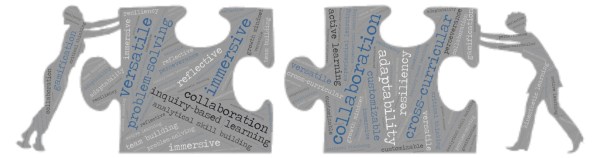
Our campus purchased three kits late in the fall semester, and have been using them successfully across campus in classrooms, orientations, leadership training, etc. with students, faculty, and staff. The themes of each “breakout” session vary, as do the success rates of the teams participating. We follow each session with a debrief, focused on reflection of lessons learned. Lessons are related to content covered, individual contributions, group dynamics, teamwork, etc. Sessions where we have enough participants to have teams compete against each other as well as the ticking clock have proven to be the most fun, as the competition spurs excitement. Regardless of the outcomes, we notice development in the participants’ critical thinking, collaboration, communication, and resilience; through observation we are able to gain a better understanding of how our students think.
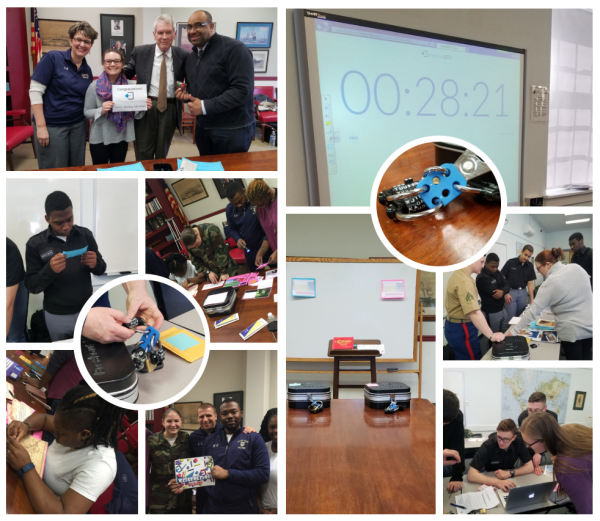
(photos courtesy of Dana Kerrigan, Lucy Manley, and Kathleen Farlie, Valley Forge Military College)


 Adam Balcziunas
 Alex K.
 Alexandrea Glenn
 Andrea Pritt
 aprilnkelley
 Ashley Purvis
 Bethann Rea
 blj13
blj13 Brendan Johnson
 Amanda Boyer
 Bret Stiffler
 Bonnie Powers
 Christopher Lemery
 clarewithers
 clblibrarian
 Kelly Clever
 Charlotte M. Johnson
 colemanluzerne
 CRD of PaLA
 crdvirtualjournalclub
 cre5314
 csgarth
 Erin B.
 danajkerrigancv
 denisewetzel1
 Darren G. Poley
 elm43
elm43 James D'Annibale
 Annie Jansen
 Jill Hallam-Miller
 jennifercribbs
 Jenn Monnin
 Jen Hasse
 Jessica Showalter
 johnmeier1
 Kelly Safin
 Kim Karim
 Kristen Seikaly
 Kayla Van Osten
 Cecelia Lasley
 librarianjsmith
 Linda Neyer
 mabogino1
 Matthew McNelis
 Meg Massey
 Maggie Savidakis-Dunn
 Rebecca
 miskatoniclibrarian
 Maureen Bentz
 Michele G. Anfuso
 Nicole Miyashiro
 paulmcmonigle
 Rob Sieczkiewicz
 ronlmccoll
 Sam Bardarik
 shannahollich
 smartin592
 Ula Lechtenberg
 It's Academic