Integration of a Distinctive Collection
It has been 175 years since the Order of Saint Augustine (OSA) established Villanova University. The major library for the University, Falvey Memorial Library, is a complex of three interconnected structures. Thought of as a single entity, the building hosts a variety of offices, classrooms and conference spaces designed to support various campus activities and academic services; some not typically affiliated with the traditional function of a library. This however has increasingly become the new norm for a lot of libraries, particularly on university campuses where space is at a premium. Learning support centers, IT and communication-related areas, innovation and makerspaces, even a virtual reality laboratory have been incorporated into the main university library at Villanova.
In the process, every nook and cranny has been evaluated for maximum utilization. Nevertheless, for multiple reasons and for many years, one space existed in a kind of bubble. Its location was considered remote and its purpose was obscure. Off the beaten path and inaccessible to many, “The Augustinian Room” was the home of the Augustinian Historical Institute (AHI) at Villanova University. Its situation recalls something from the musical “The Music Man.” In that show, the library building belongs to the town, but the books belong to the head-strong librarian. In the case of the AHI, the room is in the library and is the property of the University, but its contents are owned by the OSA.
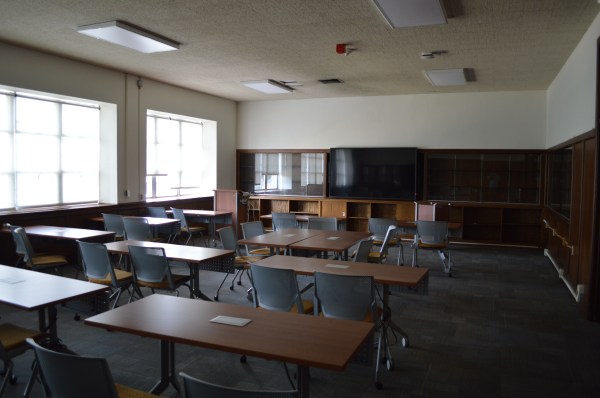
Room 301 Falvey Hall, formerly the “The Augustinian Room,” is currently being used as student
study space and an occasional conference room. Photo taken by Justin D’Agnese, 25 August 17.
A few years ago, several Augustinian provinces in North America corporately agreed the books and other materials in the AHI collection be held collectively, to maintain ownership by the OSA. The collection would merely be housed by Villanova University in its library. Even though the AHI had a storied past, producing scholarship and even sponsoring archaeological digs, in recent years it had basically become a non-circulating research collection focused on the OSA. The Augustinian presence is still very strong at Villanova, as seen by the development of another institute for the study of the life and writings of St. Augustine, and other initiatives associated with the heritage of the OSA by the Office for Mission and Ministry at the University. A long-standing body of materials collected to gather scholarly resources relevant to the study of the OSA at one of the Augustinians’ flagship insititutions, what haunted the AHI was that it was too little known, including by folks at Villanova, and too little used by the scholarly community in general.
The OSA founded the University in the mid-19th century. The seminal AHI collection was originally in Riverdale, N.Y. and brought to Villanova in the early 1970s. It was in the library but maintained a separate identity until 2016. Integration began when items were identified in the Library’s catalog as: “On deposit from the Order of Saint Augustine as part of the Augustinian Historical Institute.” However, even this potential online visibility did not show it as anything more than more holdings. The greater solution is still getting worked out, through the active collaboration of the subject librarian who curates the collection, and the heads of special collections, access services, and cataloging. Cross-departmental cooperation and internal communication are key to integrating a distinctive collection, and this is an excellent example of the kind of protected but hidden special collection that are good for a library’s identity, but which vex librarians.
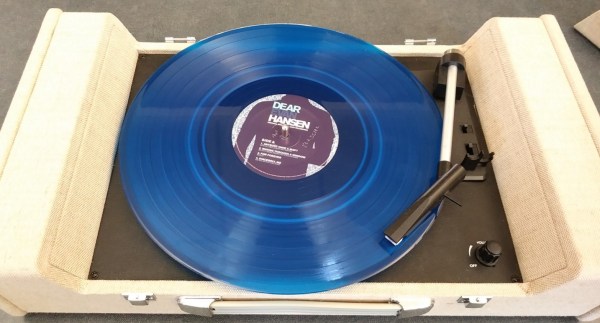
Image courtesy Jessica Showalter
The Penn State Altoona Eiche Library has been adding vinyl lps to their collection to keep up with the recent resurgence of interest in records. Library Director Bonnie Imler shares what she’s learned about developing a vinyl collection for other libraries considering one.
The American Libraries magazine recently summarized a report from the Recording Industry Association of America that gives details about this resurgence of vinyl. According to the original report, digital downloads are nosediving, whereas “[v]inyl continues to be a bright spot among physical formats, with revenues up 10% to $395 million.”
To respond to this growing interest, the Eiche Library has added dozens of records to their collection over the past two years, as well as two turntables available for patrons to borrow. Imler worked with library staff to determine logistics for cataloging, storing, and lending the records.
Collecting the records
The library utilized several strategies when deciding which records to add to the collection. Early on, the library solicited suggestions from patrons using a suggestion box. Placing the suggestion box at the circulation desk helped to generate excitement. Imler also consulted several lists of “Top 100 Records,” ranging from jazz to classic rock, to grunge music, to contemporary artists. As the collection continued to grow, Imler went to a surprising, but useful, source: Urban Outfitters’ list of best-selling vinyl for the year.
“Looking at their website gives me an idea of what the traditional college-age group is interested in and what new artists are trending,” Imler said.
Displaying the records
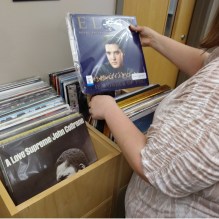
Image courtesy Jessica Showalter
One of the challenges of adding records to the collection was determining the best way to display them.
The records are cataloged with call numbers, but if they were shelved spine-out as books are, they would be difficult to browse. Imler worked with the campus carpenter, Tom Vogel, to design a more user-friendly solution. Vogel built wooden display cases that resemble the bins once used to house records in music stores.
“A big advantage of these cases is that students can leaf through and see the amazing cover art,” Imler said.
Playing the records
Many patrons have shown curiosity about the record collection, but not all of them own turntables for playing them. To address that need, the Eiche Library acquired two turntables that patrons can check out for 14-day loans. When deciding which turntables to purchase, Imler’s main criteria were that the turntables be portable and include USB ports that enable conversion to digital files. Staff noted that some patrons have never used a turntable before, so they offer a quick tutorial if needed.
“The records and turntables have been popular with patrons, so we plan to continue developing our vinyl collection in the future,” Imler added.
Jessica Showalter is an Information Resources and Services Support Specialist at Penn State Altoona’s Eiche Library. Say hello on Twitter @libraryjms
Introduction
One-shot library instruction sessions provide little enough time to present information literacy concepts, let alone to assess student comprehension before and after the lesson. This semester I piloted an attempt to incorporate assessment into one-shot sessions for gen ed writing classes. The lesson plan for these classes focused on an introduction to the library’s resources and basic research skills.
My goals for incorporating assessment into these classes were to:
- determine the effectiveness of the library instruction session.
- make improvements to the lesson plan.
In order to get pre-test data, I created an online self-paced tutorial in LibWizard (Springshare) and a seven-question quiz on the topics covered in the tutorial. This tutorial aligned with my basic lesson plan, provided brief videos I had created on these topics last semester, and incorporated some hands-on experience.


In addition to providing pre-test assessment data, my goals for implementing a pre-session tutorial and quiz were to:
- distribute self-paced resources for students to re-use as needed.
- increase time in class for more advanced topics.
Methods
Once I had the tutorial and quiz, I needed to distribute it to the students. Both could be linked directly to Springshare, but I wanted to host them on a platform the students were already familiar with: the learning management system (LMS). At West Chester University, the LMS is Desire2Learn (D2L). Hosting the pre-session module in D2L would also give professors more control in seeing completion rates and to use the quiz as extra credit if they wanted to.
I worked with on-campus D2L specialists to learn how to create and work with the kind of module I wanted. After the specialists set up a library course shell, I created a module with the embedded tutorial and a D2L version of the quiz.
At this point I contacted one of the writing professors, and she was happy to work with me to pilot this assessment in her class. D2L made it easy for me to add the professor into the library course so that she could copy the pre-session module into her writing course. She instructed the students to go through the tutorial and take the quiz prior to the day of their library instruction session. She also added me to her course so that I could view the results, but another method would be for the professor to export and send the results (this is what the professor for my second pilot class did).
On the day of the session, I delivered my lesson plan. As a class we took the quiz again to obtain post-test data, this time using Socrative. One student remarked that it was interesting to see the distribution of participant responses for each question.
Results
The pre-session D2L module and post-session Socrative quiz were administered to two classes. Once I had the pre- and post- test data, I calculated the percentage of response accuracy for each potential response. Some quiz questions only allowed one correct answer, but for multi-select questions I calculated accuracy of responses for each response option.
Question 2: Which statements about topic mapping are true? (check all that apply)
☐ There is only one correct way to design a topic map.
☒ Topic mapping narrows down your focus for your assignment.
☒ Topic mapping develops keywords to use in the search bar.
☐ Topic mapping tells you what citation style to use.
| Correct response | option is checked when it should be checked | option is unchecked when it should be unchecked |
| Incorrect response | option is checked when it should be unchecked | option is unchecked when it should be checked |
The ideal for correct response accuracy is 100%. The ideal for incorrect response accuracy is 0%. I calculated the improvement percentage for each type of answer (an increase in correct response accuracy between pre- and post-test; a decrease in incorrect response accuracy between pre- and post-test). I added those two improvement rates together to get a total improvement rate of 21.37% and 12.89% respectively. Between the two classes, the improvement in student comprehension averaged 17.13%.
|
Response Accuracy to Information Literacy Quiz, Pre- and Post- Test (%) |
|||||||
| Class 1 | Pre-test | Post-Test | Improvement between pre- and post- test | Class 2 | Pre-test | Post-Test | Improvement between pre- and post- test |
| Correct response accuracy | 73.41 | 86.31 | 12.9 | Correct response accuracy | 79.05 | 84.45 | 5.4 |
| Incorrect response accuracy | 18.38 | 9.91 | 8.47 | Incorrect response accuracy | 17.44 | 9.95 | 7.49 |
| Total Improvement | 21.37 | Total Improvement | 12.89 | ||||
I also administered the Socrative post-test to three additional gen ed writing classes without the pre-session module.
|
Response Accuracy to Information Literacy Quiz (%) |
|||||
| Post-Test Response Accuracy to Information Literacy Quiz, Post-Test Only Classes | Post-Test Response Accuracy to Information Literacy Quiz, Classes 1 & 2 | ||||
| Class 3 | Class 4 | Class 5 | Average | Average | |
| Correct response accuracy | 87.32 | 87.02 | 83.85 | 86.06 | 85.38 |
| Incorrect response accuracy | 4.9 | 8.98 | 7.86 | 7.25 | 9.93 |
Discussion
The 17.13% improvement in comprehension from pre- to post- test in classes 1 and 2 is modest but promising. However, comparison to classes 3-5, which did not view the pre-session tutorial, actually shows a decrease in comprehension when the tutorial was viewed. Classes 1 and 2 showed a lower percentage of correct responses and higher percentage of incorrect responses than classes 3-5. This finding could be due to one of several reasons:
- Small sample size. The range of accuracies is broad (e.g. 12.89%-21.37% improvement in classes 1 and 2). Natural variations in class composition play a greater role when the sample size is so small.
- Discrepancy in lesson delivery. Did my in-class delivery change or leave out details in classes 1 and 2 under the assumption that the tutorial was effective?
- Ineffective tutorial. Was the tutorial confusing rather than helpful?
Clearly more data is needed to determine if administering this particular pre-session module is less effective than only administering a post-test.
Calculating the percentages was a time-consuming, manual process. Exported data from D2L and Socrative did not match each other in format. Also, Socrative’s data counts students who logged into the quiz but didn’t answer a question as an incorrect response. For example, if 20 students were logged in but only 18 responded to a question, even if all 18 students responded correctly, Socrative would still count two incorrect responses. I manually made sure percentages were calculated based on actual number of students responding, not total students logged in but potentially dormant. Future iterations of this assessment should include a process to automate or streamline the data collection and evaluation.
Conclusion
Having completed these pilot classes, I made some progress on my initial goals for assessment.
- Determine the effectiveness of the library instruction session. The assessment needs to be administered to a larger sample size of classes to get more accurate averages and determine if the pre-session module is more helpful than harmful.
- Make improvements to the lesson plan. Analyzing the results of the quiz, both pre- and post- test, revealed troublesome topics for the students (particularly Boolean operators). I took this insight and adjusted my lesson delivery to take more time with Boolean.
- Distribute self-paced resources for students to re-use as needed. Feedback from students is needed to determine the effectiveness of the tutorial. Analytics indicate students are not returning to the materials after completing the pre-session module.
- Increase time in class for more advanced topics. This goal was more idealistic than I realized. I still spent considerable class time demonstrating the tutorial topics for clarification and for students who did not complete the pre-session module. Future iterations of this lesson plan should include more flipped classroom activities to increase student engagement and comprehension.
With further data collection and a streamlined process, this type of pre- and post- test assessment could be a viable and effective process to inform iterative lesson planning for one-shot library instruction sessions.
Evaluating Information Literacy Instruction
Recently, I was offered the privilege of an in-person interview with Bethany College in Bethany, West Virginia, for the position of Research and Instructional Librarian. Unfortunately, circumstances did not allow for me to make the five-and-a-half hour drive across Pennsylvania, and I had to decline the opportunity. Part of my interview would have included a presentation on how I would completely renovate the current information literacy instructional process at the college. With my limited background in academic libraries, this really was a challenge. With some research, however, I secured some guidance on how I would have went through with the information literacy critique and renovation had I done the presentation.
An academic library is not an island and does not operate solely without the connections and support between other departments and campus units. Factors such as the library’s budget, the educational needs of the academic community, and the resources currently available to instruct must be taken into consideration. For this reason, an academic library should have in place a written mission statement for its instructional program. This statement of purpose should consider the educational mission of the institute and the needs which are becoming increasingly more intricate as diversity and inclusion surge within higher education. (I can testify for that having been the secretary for the Center of International Education at my local community college for two years. I regularly interacted with students from all over the globe and often had to overcome language barriers, sometimes with the help of a translation app on my smart phone!) Not to be forgotten are those non-traditional students who take courses online. How does the library’s mission statement reflect those students’ needs? Will the library’s instructional literacy’s impact extend beyond its institute and even that of the college’s, influencing a student’s self-development, career paths, and lifelong learning?
The second step of evaluation is to identify the content of instruction. Content will vary among academic institutions, but it is critical that the objectives of the learning outcomes are closely aligned with the Association of College & Research Libraries’ Information Literacy Competency Standards for Higher Education. These standards assist academic librarians with general campus discussion in identifying information literacy, and coupled with the Association of College & Research Libraries’ Objectives for Information Literacy Instruction, provide guidance in establishing measurable outcomes for any given information literacy program.
Identifying the modes of instruction is the next step. Here is where I see the use of surveys as a very beneficial tool in gauging just how and where students receive their information literacy instruction, and the impact, if any, it makes on their education and coursework. Additionally, surveys designed for faculty, staff, and department administration can ascertain their needs as well. The feedback from these surveys can be a driving force in directing information literacy instruction to better benefit all involved. Perhaps students might not understand the importance of a reference interview when conducting research for a project and do not know where to begin. Could embedded librarians make a huge difference in online courses? How do we reach out to distance learning students to create an atmosphere of inclusion so that they feel they belong to the academic family? Students will be conducting research at all facets of their education, whether it be as an undergraduate, an intern, or working on their capstones, so it is crucial that librarians are implementing effective instructional programs to reflect the total campus learning environment every step of the way. Even reaching out to incoming freshmen at orientation is desirable; making our presence known from the very beginning that we are here to help sets the wheels in motion that our library should be a dedicated and cherished cornerstone in our students’ campus experience. Virtual tours of the library facilities and meet-the-staff videos can reel in distance learning students to increase the likelihood that they will use the library remotely.
Evaluation of the instruction programs should be an on-going process. Regular meetings with faculty, staff, and department administration can determine if the specified outcomes are being implemented and if any needed changes in direction is necessary. There needs to be ongoing support for continuing education, training, and development. New librarians, such as myself, coming on board with no prior information literacy instructional experience, can develop and nurture these skills through structured training sessions. Continual training for those librarians who are already conducting information literary instruction will ensure that their qualifications are constantly being challenged and sharpened. Sensitivity and responsiveness to changing technologies and the overall chemistry of the campus environment is essential. What worked even three years ago may not work now. Make sure your library has the essential tools needed to conduct effective instruction, budget withstanding.
I wonder if I would have been offered the position at Bethany College, and if so, how I would have gone about redesigning and evaluating their current information literacy instructional programs. I certainly would have been up for the challenge. How does your library evaluate your information literacy instruction? What is your greatest obstacle when doing so? Do you feel as though you have that open communication with other campus departments and faculty? For academic librarians, information literacy instruction is a very crucial facet of this profession, one that requires reaching out to the students to instill lifelong appreciation for acquiring what is accurate and conducive to learning and the ability to retain and utilize reliable resources for a more productive lifestyle.
Thanks to http://www.ala.org/acrl/standards/guidelinesinstruction for the help!
#BUDSC18 Call for Proposals
Bucknell University will host its fifth annual digital scholarship conference (#BUDSC18) from October 5th-7th. The theme of the conference is “Digital Scholarship: Expanding Access, Activism, and Advocacy.”
#BUDSC18 will bring together a community of practitioners–faculty, researchers, librarians, artists, educational technologists, students, administrators, and others–committed to promoting access to and through digital scholarship. We consider “access” in the broadest possible terms: accessible formats and technologies, access through universal design for learning, access to a mode of expression, access to stories that might not otherwise be heard or that might be lost over time, access to understanding and knowledge once considered beyond reach.
We encourage proposals that explore or critique digital scholarship as it relates to access, broadly conceived. Topics may include, but should not be limited to, the following:
- Accessibility of digital platforms and technology
- Access to resources to engage in or produce digital scholarship
- Digital scholarship and social change
- Sustainability and future access to digital scholarship
- Digital scholarship and multimodal/interdisciplinary access
- Access to digital scholarship beyond the academy
- The public mission of digital scholarship
- Creating opportunities for diverse voices and perspectives
- Designing for access, activism, and advocacy
Submissions may take the form of interactive presentations, project demos, electronic posters, panel discussions, work-in-progress sessions, workshops, lightning talks, or other creative formats.
We look forward to building on the success of the last four years, in which we have come together to discuss challenges, share working models, reflect on projects, and inspire new avenues for actively including students in public scholarly pursuits. For more information, please view our highlights from the 2017 meeting, the conference website and this year’s call.
Proposal Submission Form: https://goo.gl/forms/4nVllpVvaLEW9Jc02
Proposals are due: Friday, June 15th, 8:00 PM, Eastern Time (US).
Notifications will be sent by July 15th.
If you have any questions please contact: budsc@bucknell.edu


 Adam Balcziunas
 Alex K.
 Alexandrea Glenn
 Andrea Pritt
 aprilnkelley
 Ashley Purvis
 Bethann Rea
 blj13
blj13 Brendan Johnson
 Amanda Boyer
 Bret Stiffler
 Bonnie Powers
 Christopher Lemery
 clarewithers
 clblibrarian
 Kelly Clever
 Charlotte M. Johnson
 colemanluzerne
 CRD of PaLA
 crdvirtualjournalclub
 cre5314
 csgarth
 Erin B.
 danajkerrigancv
 denisewetzel1
 Darren G. Poley
 elm43
elm43 James D'Annibale
 Annie Jansen
 Jill Hallam-Miller
 jennifercribbs
 Jenn Monnin
 Jen Hasse
 Jessica Showalter
 johnmeier1
 Kelly Safin
 Kim Karim
 Kristen Seikaly
 Kayla Van Osten
 Cecelia Lasley
 librarianjsmith
 Linda Neyer
 mabogino1
 Matthew McNelis
 Meg Massey
 Maggie Savidakis-Dunn
 Rebecca
 miskatoniclibrarian
 Maureen Bentz
 Michele G. Anfuso
 Nicole Miyashiro
 paulmcmonigle
 Rob Sieczkiewicz
 ronlmccoll
 Sam Bardarik
 shannahollich
 smartin592
 Ula Lechtenberg
 It's Academic