Thinking About Deficit Thinking and First-Year Seminar
I was able to attend the LOEX Conference in Houston in May and I saw a lot of great presentations. The one that has stayed with me was Eamon Tewell’s lecture, “The Problem with Grit: Dismantling Deficit Models in Information Literacy Instruction”. You can view the slides & handouts from his presentation here.
After listening to the talk, my interpretation of deficit thinking is the idea that a student is lacking something and if they just try hard enough they can overcome that deficit. We see this type of thinking in the library when we assume that students are empty vessels just waiting for us to fill them up with the skills they need to succeed. Eamon gave the example of one of the traditional one-shot requests for database demonstrations as an example of deficit thinking. In this situation we think that when the session goes well it’s because we were great but when it doesn’t it’s because the students weren’t prepared enough.
Using my new understanding of deficit thinking I started to review how our library has interacted with First Year Seminar (FYS) in the three years that I’ve worked there. The first two years we definitely approached these interactions with a deficit mindset, assuming that students were empty vessels and we could tell them everything they needed in a 90 minute session. We knew these sessions were not resonating with students so last year we created a new session on source identification & evaluation. We showed two short videos and gave a mini-lecture but the majority of class time was spent on a source evaluation activity. We gave groups of students different types of sources and asked them to sort them into one of three categories using a provided set of criteria. Each group then shared their decision with the class. We felt like this activity worked much better for the students than our previous attempts and looking at it through my lens of deficit thinking I think it had something to do with the fact that we allowed students to use skills they already had. I can also see how we could have eliminated even more of our deficit thinking if we had not given them criteria for evaluation but let the students show us the criteria they use for source evaluation.
In addition to Eamon’s talk at LOEX another presentation that has influenced my approach to FYS is a Credo webinar I watched in the fall, “Predictable Misunderstandings in Information Literacy: Research Findings”, by Lisa Janicke Hinchliffe. In this webinar, Lisa presents the results of a survey of academic librarians she completed asking them to identify first-year students’ misconceptions about research. She identified 11 misconceptions about research that students bring with them to college. These misconceptions reinforce that students are not empty vessels, they are come to college with ideas and strategies for research that have been successful for them to this point. Thinking about how to identify and overcome these misconceptions in our first-year students has been great food for thought.
Thinking about deficit thinking and predictable misunderstandings and the way that FYS is structured at our school made the librarians realize that there isn’t a way to create a one-size-fits-all session that we can deploy in each FYS section. So this year we decided to share Lisa’s list of misconceptions with the FYS faculty to get them thinking about areas where we can team up with them to try to help our students be more successful. I’m looking forward to seeing how this approach works in the fall. Have any of you tried something like this or reflected on your teaching practices through the lens of deficit thinking? If so I’d love to hear about it.
C&CS Transparency in the Tenure Process Available
Greetings from ALA!
We did want to make sure that everyone knows: Heidi, Rachel and Elizabeth did an awesome job Thursday on afternoon, for their Transparency in the Tenure Process session. While focused on some of the issues that archivists specifically face, many others may want to watch it to get an understanding of the different types of tenure processes for librarians across institutions.
Kudos to both Amy Snyder for moderating and Sara Pike for doing our live closed captioning.
Video of the session for those not able to attend is available via this YouTube link.
Their slides are available here: link to slides
Please feel free to contact the C&CS team at this link if you have a proposal for a session.
C&CS Presents
The Feminist Reference Desk: A Discussion on the “Mommy Librarian”
and Neutral Library Spaces
with Maura Seale, Celia Emmelhainz, Erin Pappas, and Nina Clements
July 9, 2018: 1 pm Eastern (10 am Pacific)
~Register here for the Zoom link!~
The recent book, The Feminist Reference Desk, has brought together several pieces of librarian and feminist theory including intersections of emotional labor and reference transactions, the feminist ethic of care, what neutrality means in our current library spaces, intersectionality at the reference desk, feminist disability studies and the reference desk, and other aspects of feminist pedagogy.
Celia, Erin, and Maura will provide a brief overview of their chapter, “Behavioral Expectations for the Mommy Librarian: The Successful Reference Transaction as Emotional Labor.” In it, they argue that RUSA’s Guidelines for Behavioral Performance of Reference and Information Service Providers rely on and reproduce expectations for gendered emotional labor in reference work, while undermining professional authority. They further challenge the idea that, on the librarian side, reference transactions occur in neutral sites divorced from social contexts. They will then open it up to a broader discussion about emotional labor in libraries, including how it is/is not valued and assessed.
Nina will also provide a brief overview of her chapter, ““Nothing More than a Gear in your Car:” Neutrality and Feminist Reference in the Academic Library.” Like the chapter above, she challenges the idea that the library, specifically the academic library, is a neutral space. Instead, it is a politicized space. The thrust of the chapter challenges that the notion of neutrality is a means of reproducing the dominant ideologies of a group, such as patriarchy. Hopefully, this overview will lead to an interesting discussion of the notion of neutrality in our society.


Maura Seale is History Librarian at the University of Michigan and was previously a Collections, Research, and Instruction Librarian at Georgetown University. She edited, with Karen P. Nicholson, The Politics of Theory and the Practice of Critical Librarianship, which was published by Library Juice Press in March 2018. She has also written about critical library pedagogy, race and gender in librarianship, and the political economy of libraries. She welcomes comments @mauraseale on Twitter.
Celia Emmelhainz is the Anthropology and Qualitative Research Librarian at the University of California, Berkeley. She has led workshops internationally on ethnographic assessment in libraries, and publishes on critical librarianship and on qualitative research studies in academic libraries. Comments welcome @celiemme on Twitter.
Erin Pappas is Research Librarian for the Humanities at the University of Virginia. She has presented and written on international digital libraries and DH projects, early-career mentoring, and occasionally conducts improv workshops for librarians, with Kate Dohe. You can find her on Twitter @erin_pappas, but usually only during conferences.
Nina Clements is Librarian & Information Literacy Coordinator at California State University Channel Islands. She is interested in information literacy as well as the intersection of the arts and librarianship. You can find her on Twitter @biblioscribbler.
Social Capital
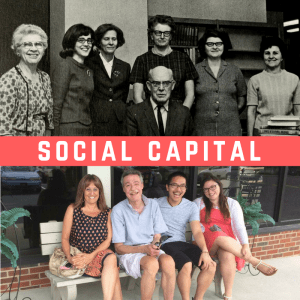 While it’s great to highlight library services and collections, it is called “social” media for a reason. At Bishop Library we’ve found that audiences want to learn and relate to people in the library. Sure you may have spent hours making the perfect Canva ad highlighting a library event, but you will most likely get far more feedback spotlighting people. Not all staff are up for this, but most are willing to participate and enjoy the attention. We’ve tried to highlight staff with short biographies, interests and fun facts.
The best part this is often an easy thing to do ahead of time and with a small staff this is crucial. We use the social media management platform Hootsuite to schedule out as many posts as possible.
Highlighting staff members during national or college-wide events draws attention from alumni and current members of the college community. Your post or tweet may also be shared by the college and wider audience. Staff member Becky Chanas’ unique shirt (in the Instagram post seen here) on election day was a hit on Instagram.

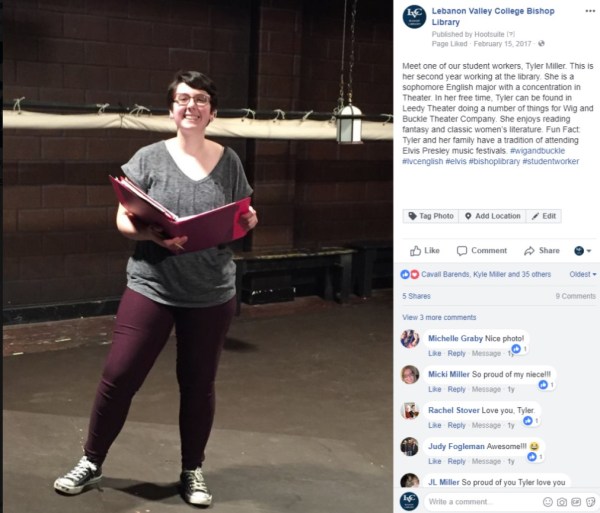
If you have student staff members this is a perfect way to connect to your student workers’ social capital. We created a series of posts spotlighting student workers. The example below of student worker Tyler Miller was scheduled to be posted on the opening night of the college theatre group’s production of A Midsummer Night’s Dream. Not only did this create more engagement and comments than a typical post it also gained us some new followers.
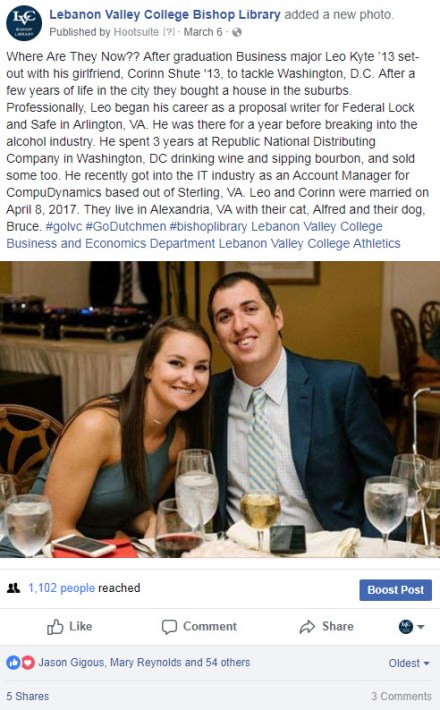
Also don’t underestimate the power of your alumni. Working off the momentum established with student worker profiles, we reached out to former library student workers for a “Where Are They Now?” posts. The majority of former student workers reached out to responded within a few days with a photo and short update on their lives, leaving just editing and scheduling for me to do. I worked hard to tag all their respective departments and former student activities in the posts. Former student worker Leo Kyte, seen here with his wife Cornin (also an LVC grad), created the most buzz we’ve seen from this series of posts.
So when in doubt on what to post, leverage the appropriate social capital (including your best friend’s sister’s boyfriend’s brother’s girlfriend) and reap the rewards.
Photo credits in order of appearance.
- Lebanon Valley College Archives. “Library Staff.” Quittapahilla Yearbook, Internet Archive, 1969, https://bit.ly/2Ll3tFj.
- Bentz, Maureen. “Library Staff Catching Up and Keeping Cool.” Facebook, 2017, https://bit.ly/2JpoxgD .
- Bentz, Maureen. “Meet our Library technician, Becky.” Instagram, 2016, https://bit.ly/2kLChV7.
- Miller, Tyler. “Meet One of Our Student Workers, Tyler Miller.” Facebook, 2017, https://bit.ly/2sv0XWi.
- Kyte, Leo. “Where Are They Now?? After Graduation Business Major Leo Kyte ’13 Set-out with His Girlfriend, Corinn Shute ’13, to Tackle Washington, D.C.” Facebook, 2018, https://bit.ly/2LlrwUD.
BUDSC18 Extends Call for Proposals
Bucknell University will host its fifth annual digital scholarship conference (#BUDSC18) from October 5th-7th. The theme of the conference is “Digital Scholarship: Expanding Access, Activism, and Advocacy.”
#BUDSC18 will bring together a community of practitioners–faculty, researchers, librarians, artists, educational technologists, students, administrators, and others–committed to promoting access to and through digital scholarship. We consider “access” in the broadest possible terms: accessible formats and technologies, access through universal design for learning, access to a mode of expression, access to stories that might not otherwise be heard or that might be lost over time, access to understanding and knowledge once considered beyond reach.
We encourage proposals that explore or critique digital scholarship as it relates to access, broadly conceived. Topics may include, but should not be limited to, the following:
- Accessibility of digital platforms and technology
- Access to resources to engage in or produce digital scholarship
- Digital scholarship and social change
- Sustainability and future access to digital scholarship
- Digital scholarship and multimodal/interdisciplinary access
- Access to digital scholarship beyond the academy
- The public mission of digital scholarship
- Creating opportunities for diverse voices and perspectives
- Designing for access, activism, and advocacy
Submissions may take the form of interactive presentations, project demos, electronic posters, panel discussions, work-in-progress sessions, workshops, lightning talks, or other creative formats.
We look forward to building on the success of the last four years, in which we have come together to discuss challenges, share working models, reflect on projects, and inspire new avenues for actively including students in public scholarly pursuits. For more information, please view our highlights from the 2017 meeting, the conference website and this year’s call.
Proposal Submission Form: https://goo.gl/forms/4nVllpVvaLEW9Jc02
Proposals are due: June 30th, 8:00 PM, Eastern Time (US).
Notifications will be sent by the end of July.
If you have any questions please contact: budsc@bucknell.edu


 Adam Balcziunas
 Alex K.
 Alexandrea Glenn
 Andrea Pritt
 aprilnkelley
 Ashley Purvis
 Bethann Rea
 blj13
 Brendan Johnson
 Amanda Boyer
 Bret Stiffler
 Bonnie Powers
 Christopher Lemery
 clarewithers
 clblibrarian
 Kelly Clever
 Charlotte M. Johnson
 colemanluzerne
 CRD of PaLA
 crdvirtualjournalclub
 cre5314
 csgarth
 Erin B.
 danajkerrigancv
 denisewetzel1
 Darren G. Poley
 elm43
 Heather Burychka
 James D'Annibale
 Annie Jansen
 Jill Hallam-Miller
 jennifercribbs
 Jenn Monnin
 Jen Hasse
 Jessica Showalter
 johnmeier1
 Julie Durci
 Kelly Safin
 Kim Karim
 Kristen Seikaly
 Kayla Van Osten
 Cecelia Lasley
 librarianjsmith
 Linda Neyer
 mabogino1
 Matthew McNelis
 Meg Massey
 Maggie Savidakis-Dunn
 Rebecca
 miskatoniclibrarian
 Maureen Bentz
 Michele G. Anfuso
 Nicole Miyashiro
 paulmcmonigle
 Rob Sieczkiewicz
 ronlmccoll
 Sam Bardarik
 shannahollich
 smartin592
 Ula Lechtenberg