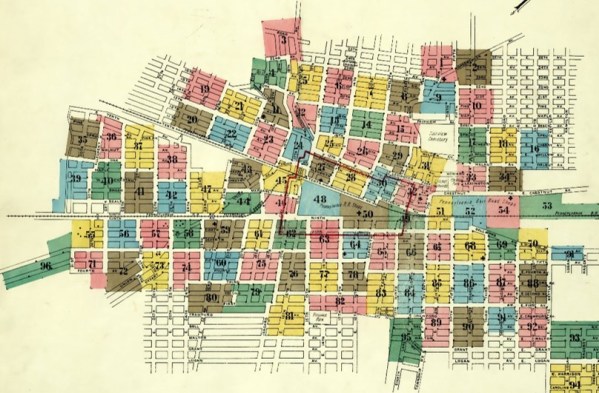
Sanborn Fire Insurance Maps provide oodles of information for the personal archivist. Recently I tracked down information about my current home, my family history, and my city’s history using Penn State Libraries’ digitized Sanborn maps of Pennsylvania. My interest was personal, but the same methods could be applied to research historical figures or sites. Here’s how I used the maps.
Accessing the maps
Penn State Maps Library offers free online access to Pennsylvania Sanborn maps up to 1923 (later issues will be forthcoming in 2019 as copyright runs out and they become public domain). Sanborn mapmakers began creating the maps in 1867 for insurance purposes. The maps are very beautiful—they were hand drawn, printed lithographically, and hand colored with bright yellow, pink, blue, and green ink.
The Penn State Sanborn Maps collection covers over 500 cities and towns across the state. To view the maps, click on the city name from the alphabetical list and choose the year you want to see. Many of the city maps have multiple sheets that zoom in on different parts of the city, so you may need to browse until you find the exact location you are seeking. You can also download or print the maps.
In addition, Penn State has shared the maps with the Digital Public Library of America, so you can also access the maps there.
 Your home’s history
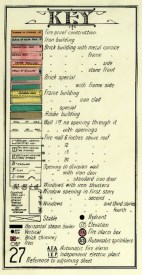
If you live in Pennsylvania and your home was built before 1923, you may be able to find it on a Sanborn map. Using the Sanborn key, you can see information about your home’s construction materials, building use, property boundaries, number of stories, water facilities, windows and doors, etc. at the time the map was created.
I tracked down my house, which was built in 1909, and printed and matted the map for display. Visitors often ask about the map, and we usually end up trying to look up their houses, too!
Your family’s history
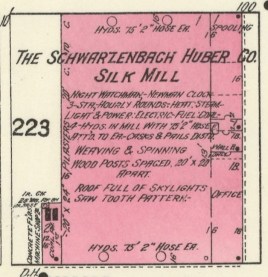 Using the maps in conjunction with genealogical records is a way to flesh out your family’s history. You can find the street addresses for family homes, workplaces, schools, churches, and so on. Then you can try to locate that neighborhood in the Sanborn maps collection to add to your personal archive.
For example, I looked up the silk mill where my maternal great-grandparents met. The family legend is that my great-grandmother was working at a sewing machine when my great-grandfather walked past with a skein of silk. Some of the silk got caught in her earring, and the rest is history.
Your city’s history
Several projects compare present-day maps with historical images to track a city’s development over time, for example this one of New York City and this one of Washington, D.C. Using Sanborn maps, you could do something similar with your town. When I studied a Sanborn map of my community, I found to my surprise that my neighborhood used to be an independent city of its own before being incorporated into a neighboring city in the late nineteenth century as the railroad industry grew.
What if you’re looking for a map outside PA?
Consult the Penn State Maps library manager Heather Ross’s library guide for more on Sanborn maps from other states and even select locations outside the United States.
Jessica Showalter is an Information Resources and Services Support Specialist at Penn State Altoona’s Eiche Library. Say hello on Twitter @libraryjms
- With Our Powers Combined: Teaming Up with the Writing Center to Improve Information Literacy Practice
- Promoting Evidence-Based Practice and Information Literacy through an Undergraduate Nursing Journal Club
- An Interview with Chris Ritter, Head Librarian of the Antique Automobile Club of America (AACA)
- Marketing a Library Science Program: Personalization with Purpose
- Collaboration at the Center: Librarian, Faculty, and Students Partner to Revive Their Curriculum Lab
- Using a Workflow to Reduce Database Costs without Affecting Collection Needs
- News Briefs from PA Libraries
On Teaching Information as Obligation
Dispositions outlined under the ACRL Framework suggest several ways students should gather, analyze, synthesize, create, and ultimately disseminate information. Too often these performative practices are limited by the language and parameters of the framework to purely academic contexts, however. While following the new framework, librarians typically guide students to interact with information as students only, thus limiting discussion of their eventual responsibilities as professionals, academic or otherwise. Outside departments of journalism, or those disciplines incorporating pedagogical coursework, students rarely learn how to curate information once they pivot toward a professional setting.
One field librarians overlook in this sense is healthcare. While medical and allied health departments often include communication coursework aimed specifically at preparing students to speak and interact with patients in their care, librarians are given little explicit direction in the framework for supplementing this instruction.
We are told learners who recognize that information has value should “see themselves as contributors to the information marketplace rather than only consumers of it” and “are inclined to examine their own information privilege.”[1] These respectable outcomes, however, tell us little about the ways newly-minted nurses, physical and occupational therapists, or athletic trainers, can transfer information and impart at least a fundamental level of information literacy to their patients. I fear we are doing too little to acknowledge, let alone instructionally address, the fact that these students will soon transition from seeking, vetting, and consuming information for themselves to serving a public eager to do the same for themselves.
We know that patients, caregivers, and others routinely seek supplemental healthcare information during times of sickness or injury. We also know that an abundance of misinformation is easy to find and often even impossible to avoid. As authorities in their field, healthcare professionals should feel comfortable providing valid information to patients. They should also recognize that patients are more and more likely to seek second opinions, alternative treatments, and all the knowledge they can possibly obtain.
It seems to me that librarians may provide a significant service by teaching healthcare students (and those in other disciplines as well) that they have an obligation to pass on to others both knowledge and the basic skills to discern, access, and acquire it. There is no frame entitled “Information as Obligation,” but in reality it will come with the job for many of the students we teach. Are we currently doing enough to prepare them for it?
[1] ACRL Framework for Information Literacy for Higher Education, 2015, http://www.ala.org/acrl/standards/ilframework

PROTECTING PRIVACY: West Branch Chapter Spring Workshop
Thursday May 31, 2018 at Lycoming College in Williamsport
Join the West Branch Chapter of the Pennsylvania Library Association as they help you protect the privacy of your patrons, your community, and yourself. The PROTECTING PRIVACY workshop features dynamic keynote speakers and informative sessions on online privacy, identity theft & social media.
Workshop Schedule
8:30 – 9:00 Registration, breakfast
9:00 – 9:15 Welcome/Opening remarks
9:15 – 10:15 “The Human Firewall” Lisa Bock, Associate Professor, Pennsylvania College of Technology
10:15 – 10:30 Break
10:30 – 11:30 “The Current State of Fake News” Linda Beck, Adjunct Faculty, Harrisburg Area Community College and Lebanon Valley College
11:30 – 1:00 Lunch and Chapter business meeting
1:00 – 1:45 “Avoiding and Recovering from Identity Theft” Sara Weiser, PSECU Financial Education Manager
1:45 – 2:30 “Nothing to Hide: Youth and Privacy in a Digital World” Tess Wilson, LYNCS Librarian at the Carnegie Library of Pittsburgh
2:30 – 2:45 “The Intersection of Libraries and Privacy” Carrie Gardner Ph.D. Principal consultant, Clairmaxine
Registration is still open!
Registration fees: Members $40 Non-members $60 Student members $20 (breakfast & lunch included). PaLA will not issue refunds for cancellations or no-shows. Substitute attendees permitted with proper notice. You can register at: http://www.palibraries.org/event/2018WBWorkshop
This project is made possible in part by a grant from the U.S. Institute of Museum and Library Services as administered by the Pennsylvania Department of Education and the Commonwealth of Pennsylvania, Tom Wolf, Governor, and through the College and Research Division (https://crdpala.org/ ) of Pennsylvania Library Association

C&CS Series Presents
Unique PA Academic Library Book Clubs:
Food For Thought and Brew Pubs
May 30, 2018– 1pm
Online Zoom Session
Join us as we learn about these two programs from HACC Gettsysburg and Susquehanna University. Through a strategic grant, HACC’s Gettysburg Campus has offered Food for Thought sessions to help students become academically, socially, and emotionally successful. The Book Club was started in the Spring of 2017 as a way to promote leisure reading, especially for our developmental reading population. Books were originally selected based on their movie adaptation to entice readers with the reward of watching a movie after the group discussion.
Susquehanna University’s Brew Pub Book Club is an off-campus collaboration between Blough-Weis Library, the Student Library Advisory Committee and a local, award-winning brewery located in downtown Selinsgrove, PA. Monthly meetings over the past two academic years have focused on high-quality, thought-provoking pieces that are short but still engaging enough to spark meaningful conversation. Librarians will discuss the importance of providing students an opportunity for leisure reading, highlighting diverse stories and authors and why holding the event off-campus with community members has been integral in improving town-grown relations. We will hear from these panelists describe their sessions in more detail, and allow time for discussion.
Katherine Furlong (Susquehanna University)
Katherine Furlong has been University Librarian at Susquehanna since 2014. Her career has been centered on liberal arts college libraries, working at Lafayette College and Gettysburg College. She has written and presented extensively on library administration, management and instruction.
Ryan Ake (Susquehanna)
Ryan Ake joined Susquehanna University as Outreach & Collection Development Librarian in January 2015. He is responsible for all outreach activities of the library and oversees all print and electronic collections. His main areas of interest include ancient Mediterranean history, local & genealogical research, collection assessment, community outreach and digital humanities research.
Kathleen Heidecker, HACC
Kathleen earned a Bachelor’s of Art in English/Writing from Goucher College and her Master’s in Library Science from UNC-Chapel Hill. She has worked as a librarian at a four-year residential college, an elementary school, and a public library before discovering the perfect fit at the Gettysburg Campus Learning Commons in 2008. She usually teaches about forty classes a semester, advises the campus Phi Theta Kappa chapter, and is involved in college governance.
Wendy Brubaker, HACC
Wendy received her Bachelor’s of Science in Education and Master’s in Reading Education and worked as a public school educator for six years before joining HACC in 2006. She continues to teach developmental reading, integrated reading and writing and Foundational Studies courses since that time. For five years, Wendy was the Gettysburg Campus advisor of Phi Theta Kappa and has served as a health career advisor since 2012. Wendy has received the Outstanding Student Service Award – HACC Gettysburg Campus in 2016, the Adjunct Teaching Excellence Award – HACC Gettysburg Campus in 2015 and the Paragon Advisor Award – PTK 2011. As of April 30th, Wendy will begin a full-time position as the Campus Director of Student Development and Multicultural Programing.


 Adam Balcziunas
 Alex K.
 Alexandrea Glenn
 Andrea Pritt
 aprilnkelley
 Ashley Purvis
 Bethann Rea
 blj13
blj13 Brendan Johnson
 Amanda Boyer
 Bret Stiffler
 Bonnie Powers
 Christopher Lemery
 clarewithers
 clblibrarian
 Kelly Clever
 Charlotte M. Johnson
 colemanluzerne
 CRD of PaLA
 crdvirtualjournalclub
 cre5314
 csgarth
 Erin B.
 danajkerrigancv
 denisewetzel1
 Darren G. Poley
 elm43
elm43 James D'Annibale
 Annie Jansen
 Jill Hallam-Miller
 jennifercribbs
 Jenn Monnin
 Jen Hasse
 Jessica Showalter
 johnmeier1
 Kelly Safin
 Kim Karim
 Kristen Seikaly
 Kayla Van Osten
 Cecelia Lasley
 librarianjsmith
 Linda Neyer
 mabogino1
 Matthew McNelis
 Meg Massey
 Maggie Savidakis-Dunn
 Rebecca
 miskatoniclibrarian
 Maureen Bentz
 Michele G. Anfuso
 Nicole Miyashiro
 paulmcmonigle
 Rob Sieczkiewicz
 ronlmccoll
 Sam Bardarik
 shannahollich
 smartin592
 Ula Lechtenberg
 It's Academic