During my seven years as a textbook specialist and buyer for Northampton Community College’s campus store, the start of each semester was characterized by repeated questioning, frustration, and bewilderment from students and parents alike concerning the rising cost of textbooks and course materials. Having attended Northampton Community College as a student myself back in the nineties, I completely empathized with the students’ dilemma and assured them that it was the publishers who set the prices and that the college’s mark ups on these items were reintegrated into the college’s monetary resources for financial aid, scholarships, and technology updates, to name a few. Nonetheless, there seemed to be a stigma attached to the campus store, as though not only did we relish in charging $280 for a calculus textbook, but that we also pocketed half of that money to afford our private vacations to Fiji. I often contemplated that the students were visualizing what was going on behind the scenes; the campus store associates engaging in a nightly ritual of laughing and dancing around a boiling cauldron, rubbing our hands in glee as we surmised the financial destruction of those sorry souls emptying out their wallets and checkbooks in our honor.
Nothing could have been further from the truth. It was a constant battle between the campus store and the sales representatives. I understood their motives; they needed to stay in business and therefore needed to push their products. But a packaged item consisting of loose leaf pages (ideal so the student would only have to take the chapter he or she needed to class that day in a binder as opposed to lugging around a heavy textbook) and an access code (which could provide online tutorial assistance for assignments and quizzes, or even an electronic version of the textbook) presented issues which agitated the students. Packaged course materials could not be returned if the access code had been used, even if the student dropped the class, for the simple fact that I could not ship an used item back to its vendor. Wholesale vendors such as MBS and Nebraska Book Company would not accept used access codes as well, and often did not allow for us to sell them loose leaf versions of textbooks, since there was no guarantee that all of the pages would be intact. This determined the campus store’s decision to not buy back loose leaf versions of textbooks, which naturally caused the students a great deal of frustration.
Electronic versions of textbooks were also increasingly becoming an option presented by vendors. While this usually came at a cheaper cost than a physical textbook, a majority of students were reluctant to purchase an ebook. Being a community college, our population of students was extremely diverse. Non-traditional students returning to college after decades were not comfortable with reading a textbook online and would much rather have preferred a physical book to hold, take notes in, and highlight. (Interestingly, a lot of traditional students felt the same way.) One major obstacle was that for students wishing to bring their ebooks to class, they needed access to a laptop. (At the time that I worked at Northampton Community College’s campus store, ebooks could not be downloaded onto Kindles or NOOKs.) A majority of students could not afford a laptop. Eventually, the college’s financial aid department started including the cost of a laptop as a necessity which it would cover. However, students often wanted something tangible which they could sell back at the end of the semester. I often had to explain to them that they were getting their savings upfront at the time of purchase; they were saving more money by purchasing an ebook rather than a physical textbook.
Regardless of the affordable options we tried to implement at the campus store, students regularly questioned me if our library carried any of the textbooks we sold. More often than not, I had to tell them that due to ever-changing editions and the limitations of the library’s space, textbooks were not carried by our library. There would be no plausible way that the library could carry multiple copies of Campbell Biology textbooks, for example. Between the college’s library not carrying copies of textbooks, loose leaf versions not being bought back by the campus store, and the escalating cost of course materials, the textbook-selling industry was really taking a hit, and I was at the forefront.
Our academic libraries are aware of these problems and are investigating the implementation of open educational resources. The theme of the Pennsylvania Library Association College & Research Division Annual Spring Workshop, held at Shippensburg University on May 24th, was focused on the topic of open educational resources in our state’s academic libraries. Temple University’s Associate University Librarian for Research & Instructional Services, Steven J. Bell, keynoted a presentation entitled “It’s Up to the Librarians: Working Together for OER Adoption.” Bell is a regular, fervent advocate for textbook affordability, and believes that an increased awareness of the cost of textbooks is finally taking hold with faculty and staff, thereby marking “more progress and positive developments than anytime in the past.”
These advancements have reached significant levels, showing much promise. Last March, the U.S. Congress included funding for a $5 million pilot open textbook grant program in the Fiscal Year 2018 omnibus bill (https://sparcopen.org/our-work/open-textbooks-fy18/). A first major investment by our Congress in open educational resources after nearly a decade of advocacy, this funding is bringing full awareness to the issue that the high cost of college textbooks is often an overlooked impediment to financing one’s higher education. (A common complaint I often heard in my years as a textbook specialist was that sometimes the textbook cost as much as the course!) With better funding for the cost of course materials, students can be ensured that they have access to the necessary resources for their curriculum and not have their grades suffer as a result, since oftentimes students choose to not purchase the textbooks required simply because they cannot afford them.
Bell mentions other areas of increased development with open educational resources. SPARC (the Scholarly Publishing and Academic Resources Coalition) has recently instituted an Open Education Leadership Program, a two-semester professional development initiative which arms its participants with the know-how in perpetuating the advancement and inclusion of open educational resources in college campuses and libraries (https://sparcopen.org/our-work/open-education-leadership-program/). Piloted in the fall of 2017 with fifteen participants, the Open Education Leadership Program demonstrated much success and has garnered “overwhelming interest and institutional support.” Such promise signifies that the next generation of open educational resources leaders is being prepared to infiltrate higher education and make it accessible to everyone. The allure of open educational resources is that they are licensed under an open license and are available to the public free of charge.
Retaliations from the publishing companies is another topic Bell touches upon in his presentation. As I have mentioned from my own personal experiences, vendors often tried to increase the appeal of their course materials (or “learning platforms” as Bell says publishers prefer to call their products) by bundling loose leaf versions of textbooks with access codes, peppered with the declaration that the students would incur savings upfront. Prior to visiting me at the campus store, the sales representatives would often meet with the faculty first and pitch these cost-saving alternatives to the traditional textbook. The faculty were often impressed and made the adoption. When the sales representatives would come to inform me that an entire department was going with this particular bundle, I immediately became the barking chihuahua, nipping viciously at the ankles in an effort to remind them that this was not helping out the students in the long run. There had to be a better alternative.

“Run, sales representative, run!”
While the concept of open educational resources was not an option by the time I left the textbook industry in 2013, I am pleased to see Bell’s report of many statewide initiatives taking root and addressing the issue of textbook affordability. Pioneering libraries in Oregon and Georgia influenced Bell to advocate for open educational resources in Pennsylvania. A slew of other library partnerships soon followed suit, such as LOUIS: The Louisiana Library Network and OhioLINK (Ohio’s academic library consortium). Bell is also pleased that while at the Annual Spring Workshop, a panel session announced information about the Affordable Learning PA project, which is an initiative crafted by PALCI and funded by a Library Services and Technology Act grant with the goal of creating a statewide affordable platform for textbooks.
It is a work in progress, and it is going in the right direction. One of the biggest victories Bell alluded to is that of the Pennsylvania HB 712, an Act providing for availability of electronic textbooks at institutions of higher education (https://openstates.org/pa/bills/2017-2018/HB712/). It requires that no later than January 1, 2020, an electronic counterpart, in whole or in part, for any textbook offered for purchase at an institution of higher education must be available as an alternative. This electronic version may be copy-protected and must contain the same content as the printed version. This act was referred to the Committee on Education on March 6, 2017.
Bell is confident that we can continue to push for more open educational resources. Academic librarians can be the cheerleaders by creating OER awareness, advocating for OER training, developing standard and shareable resources, issuing surveys among the students, faculty, and staff, and obtaining funding by continuing to engage our legislation on this purposeful mission. Academic librarians can foster relationships with the employees at the college campus store by discussing their concerns with one another. I can honestly say that in my seven years working at a college campus store, I do not believe I ever once had any interaction with one of the college’s librarians about textbook affordability. Pay a visit to your campus store. I can guarantee you that the employees there would much rather see you approaching them than a sales representative! But of course, please do not forget to bring donuts.
I would like to give an appreciative thank you to Steven J. Bell for sharing his presentation slides with me! I am so very happy that this issue is being addressed and that proactive solutions are moving us forward in a positive direction!
Thanks to everyone who participated in yesterday’s discussion on PA Academic Library Book Clubs: Food for Thought and Book Club at the Brew Pub.
The C&CS team decided to try something new this time, with the permission of our presenters, by placing the video on YouTube in order to make the video more accessible and use YouTube’s closed captioning for recorded sessions. We will also be able to collect more detailed statistics about the videos and our sessions.
At the moment, you will only be able to access the video via the link below, as it is an “unlisted” video. We would like your feedback about creating a YouTube channel for the C&CS sessions, and you can contact Erin Burns at eburns@psu.edu or any member of the C&CS team (found listed on the page https://crdpala.org/connect-communicate/ )with suggestions or concerns you might have. You can also use this page to submit any ideas for future C&CS sessions, as we have a form available.
Please let us know if you have any problems accessing this video below.
Thanks again to Diane Porterfield and Sara Pike for moderating and live captioning.
Save the Date: Assessment in Action
The College & Research Division will host the ACRL Roadshow
ASSESSMENT IN ACTION
Demonstrating and Communicating Library Contributions
to Student Learning and Success.
Friday, August 17th, 2018
Arcadia University
Glenside, Pa
In this day-long workshop on strategic and sustainable assessment, participants will identify institutional priorities and campus partners, design an assessment project grounded in action research, and prepare a plan for communicating the project results.
SAVE THE DATE
MORE DETAILS SOON!
Caregiver Support
I am a little late posting this month because of changes in my own life and it occurred to me that this might be a topic for the blog. Although support of caregivers might seem to be more in the realm of public libraries, so many families are affected by loved ones with dementia that students, faculty, and staff at our institutions might welcome information that we can provide.
When dementia strikes, it is not always gradual. A functional human being can rapidly become completely dependent on others and most of us are not prepared. Also, many caregiver support groups are designed for those who do not work and so they are scheduled during the day. Academic libraries would be doing a great service to offer lunchtime or evening sessions with speakers and resources for those who are struggling to balance care with full-time work or students who are coping with dementia in their families. We can also assist with searches for reliable medical information and clinical trials.
Here are some helpful resources.
Lewy Body Dementia Association
Although dementia is not always a disease the elderly, you may also want to partner with your local Area Agency on Aging.
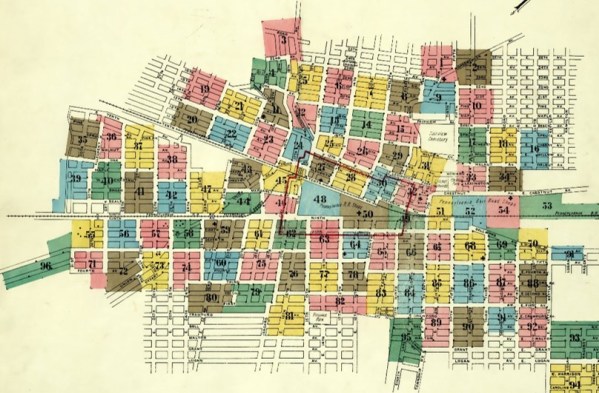
Sanborn Fire Insurance Maps provide oodles of information for the personal archivist. Recently I tracked down information about my current home, my family history, and my city’s history using Penn State Libraries’ digitized Sanborn maps of Pennsylvania. My interest was personal, but the same methods could be applied to research historical figures or sites. Here’s how I used the maps.
Accessing the maps
Penn State Maps Library offers free online access to Pennsylvania Sanborn maps up to 1923 (later issues will be forthcoming in 2019 as copyright runs out and they become public domain). Sanborn mapmakers began creating the maps in 1867 for insurance purposes. The maps are very beautiful—they were hand drawn, printed lithographically, and hand colored with bright yellow, pink, blue, and green ink.
The Penn State Sanborn Maps collection covers over 500 cities and towns across the state. To view the maps, click on the city name from the alphabetical list and choose the year you want to see. Many of the city maps have multiple sheets that zoom in on different parts of the city, so you may need to browse until you find the exact location you are seeking. You can also download or print the maps.
In addition, Penn State has shared the maps with the Digital Public Library of America, so you can also access the maps there.
 Your home’s history
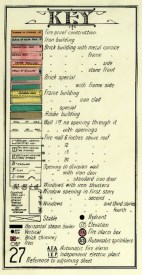
If you live in Pennsylvania and your home was built before 1923, you may be able to find it on a Sanborn map. Using the Sanborn key, you can see information about your home’s construction materials, building use, property boundaries, number of stories, water facilities, windows and doors, etc. at the time the map was created.
I tracked down my house, which was built in 1909, and printed and matted the map for display. Visitors often ask about the map, and we usually end up trying to look up their houses, too!
Your family’s history
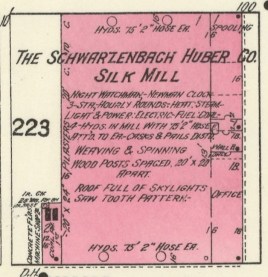 Using the maps in conjunction with genealogical records is a way to flesh out your family’s history. You can find the street addresses for family homes, workplaces, schools, churches, and so on. Then you can try to locate that neighborhood in the Sanborn maps collection to add to your personal archive.
For example, I looked up the silk mill where my maternal great-grandparents met. The family legend is that my great-grandmother was working at a sewing machine when my great-grandfather walked past with a skein of silk. Some of the silk got caught in her earring, and the rest is history.
Your city’s history
Several projects compare present-day maps with historical images to track a city’s development over time, for example this one of New York City and this one of Washington, D.C. Using Sanborn maps, you could do something similar with your town. When I studied a Sanborn map of my community, I found to my surprise that my neighborhood used to be an independent city of its own before being incorporated into a neighboring city in the late nineteenth century as the railroad industry grew.
What if you’re looking for a map outside PA?
Consult the Penn State Maps library manager Heather Ross’s library guide for more on Sanborn maps from other states and even select locations outside the United States.
Jessica Showalter is an Information Resources and Services Support Specialist at Penn State Altoona’s Eiche Library. Say hello on Twitter @libraryjms


 Adam Balcziunas
 Alex K.
 Alexandrea Glenn
 Andrea Pritt
 aprilnkelley
 Ashley Purvis
 Bethann Rea
 blj13
blj13 Brendan Johnson
 Amanda Boyer
 Bret Stiffler
 Bonnie Powers
 Christopher Lemery
 clarewithers
 clblibrarian
 Kelly Clever
 Charlotte M. Johnson
 colemanluzerne
 CRD of PaLA
 crdvirtualjournalclub
 cre5314
 csgarth
 Erin B.
 danajkerrigancv
 denisewetzel1
 Darren G. Poley
 elm43
elm43 James D'Annibale
 Annie Jansen
 Jill Hallam-Miller
 jennifercribbs
 Jenn Monnin
 Jen Hasse
 Jessica Showalter
 johnmeier1
 Kelly Safin
 Kim Karim
 Kristen Seikaly
 Kayla Van Osten
 Cecelia Lasley
 librarianjsmith
 Linda Neyer
 mabogino1
 Matthew McNelis
 Meg Massey
 Maggie Savidakis-Dunn
 Rebecca
 miskatoniclibrarian
 Maureen Bentz
 Michele G. Anfuso
 Nicole Miyashiro
 paulmcmonigle
 Rob Sieczkiewicz
 ronlmccoll
 Sam Bardarik
 shannahollich
 smartin592
 Ula Lechtenberg
 It's Academic