Year in Review: Two Librarians Reflect on One Year of Blogging (and Two New Jobs!)
by Michele Anfuso and Jessica Showalter

In January 2018, Michele Anfuso and Jessica Showalter began writing monthly blog posts for the Pennsylvania Library Association’s College & Research Division blog, It’s Academic. In this co-written post, they reflect on one year of blogging and how it has affected their professional and personal development. Both bloggers will continue blogging for It’s Academic in the upcoming year.
Michele writes:
This has been an incredible year for me as a fledgling librarian, and I have been pleased with my progress as a blogger for the Pennsylvania Library Association’s College & Research Division. When I first started blogging back in January, I had very little experience working in academic libraries, other than two internships during my time as a graduate student. I had just started my second position in a public library setting as a Circulation Desk Lead the previous month when I wrote my first article for the College & Research Division’s blog, entitled ”Straddling the Fence of Both the Academic World and Public Libraries,” in which I discussed my unfolding journey as a graduate student earning my Master in Library Science while desperately trying to accumulate enough professional experience to appeal to potential employers. Interviews for both academic and public libraries popped up for me during this time, and I was very pleased, if not honored, to be considered as a potential candidate for Villanova and Arcadia Universities. Sadly, I did not secure either one of those positions, but just to say I was interviewed by these prestigious institutes of academia has been a highlight for me.
I left my position as a Circulation Desk Lead in May when I was offered to serve as Library System Administrator for Bradford County, but personal challenges eventually prevented me from making the three-hour move, and I had to decline the opportunity. It is something which I deeply regret now. For three months, I was unemployed and felt like a failure as a librarian. Nonetheless, to keep up with my blogging, I took advantage of my extra time to attend webinars, such as “Open Access 2020: Looking at the Future,” so that I could stay in the loop concerning academic libraries. I wanted to stay relevant even though I was not working, and the College & Research Division blog gave me that opportunity. It would not be until mid-October when I finally secured my first job as an academic librarian. Now I feel as though I can contribute so much more to the blog and I am looking forward to new challenges and to the ideas I can churn out for 2019. In the spring, I will be conducting my first information literacy sessions, and yes, I am nervous. I want to make a good impression and come across as confident and thorough in what I am trying to convey. It is my hope that I can get some crucial feedback from my fellow College & Research Division bloggers!
Jessica writes:
My New Year’s resolution last year was MORE WRITING. Love of writing was part of the reason I went to grad school for English, but after graduating in 2015, my writing practice took a nosedive. To get back on track with personal writing projects, I committed to weekly writing dates with my writing partner Jeannette and to finishing a NanoWriMo challenge. However, I dreamed of finding a way to integrate my love of writing into my job, too. While I have enjoyed working as a library staff member at the Penn State Altoona Library for four years, I wanted to expand beyond my job duties of course reserves, interlibrary loan, and working at the circulation desk. When I saw the call for bloggers for It’s Academic, I took the leap and applied.
I call it a “leap” because that’s what it felt like for me. I was afraid that since I was a staff member (not a librarian) and I don’t have an MLIS, I would be disqualified. Happily, I was wrong! The Pennsylvania Library Association welcomed me. But if I thought applying was nerve-wracking, imagine the cold sweats I had when I had to click the “Publish immediately” button on those first few blog articles…
Writing for It’s Academic was a whole different animal than writing a dissertation about 19th-century US culture. I needed to learn an entirely different skill set, and I needed to learn it fast. How to track down a lead, how to cold call for an interview and then transcribe it, how to write for the web, how to find copyright free images, how to share my posts on social media, the list goes on and on. Not to mention, I needed a crash course in the latest library trends so I could situate my articles in context. Along the way, I presented at my first Pennsylvania Library Association conference and signed up for its 2019 Mentoring Program. Looking back, I learned a lot.
The biggest surprise was that blogging contributed to a career change–starting in January 2019, I will begin working as the Student Engagement & Outreach Librarian at Penn State Altoona. Lessons learned from blogging absolutely helped me prepare for the interview process, and I will be applying them to my new role in the coming year as well. I can’t wait to get started!
Michele Anfuso is the Information Services/Interlibrary Loan Librarian at Lehigh Carbon Community College’s Rothrock Library and a library assistant at Lower Macungie Library.
Jessica Showalter is an Information Resources and Services Support Specialist at Penn State Altoona’s Eiche Library. Say hello on Twitter @libraryjms
Librarian/Adjunct Instructor
Back in May, I was lucky (?) enough to be asked to teach a section of First-Year Seminar at W&J. I had never taught a semester-long, course so I was nervous to take on this challenge. At W&J our FYS classes have shared learning outcomes but you can create your course around any topic that you would like. I called my course, The Secret Life of Information, the same title a previous library staff member had used when they taught FYS several years ago. Throughout the semester we talked about everything from time-management, study skills, and stress-coping techniques to the Research Process, Source Evaluation, and Copyright Law. In addition to working with the students in class, I also served as their academic advisor and got to work with them to plan their spring class schedule. I got really invested in my students and I look forward to following their successes in college. Many things went well in this class and others did not. I thought I’d share some of my favorite assignments/interactions.
For mid-term, my students chose a current topic in information and did an annotated bibliography. In addition to the annotated bibliography, I asked them to attach a “memo” to their assignment in which they told me about two sources they didn’t include in their bibliography and why. Through this assignment and the memo in particular I could really see how attending the library session on searching library resources and evaluating sources had helped. Many students reflected that they had found sources using Google that they would previously have used for assignments but after learning about the library’s resources and how easy it was to use filters in our discovery tool, they knew they could find more scholarly articles on their topics. It was nice to see that connection and hear that feedback which we often miss out on after our one-shot interactions.
Later in the semester, I invited another librarian to class to talk to the students about copyright and fair use. My colleague Beth & I worked together to come up with a lecture session where she reviewed copyright basics and then we talked about sampling in music and listened to a few examples. We used Weird Al, Robin Thicke/Marvin Gaye, Girl Talk, and Vanilla Ice/Queen to talk about fair use. After that I split the students into groups and assigned them to three well-known copyright/fair use cases: The Prince Dancing Baby, the Sony Betamax case, and Hustler vs. the Moral Majority. The students used the rest of the class period to prepare for a debate that would be held during the next class. Each group got to present their side of the case, for copyright infringement or for fair use, give a one-minute rebuttal to the other side’s argument, and then the rest of the class acted as the jury. The students did a nice job with their arguments addressing all four factors of fair use, even when they didn’t personally agree with the side of the case they had been assigned to. The Betamax students had a really hard time arguing against what allows us to have OnDemand streaming now. Some of the students seemed to really latch on to this assignment, treating it as their own personal episode of Law & Order which made it really fun to grade.
We also did a class session using Legos to recreate an experiment on whether following step-by-step instructions versus free building affects creativity and then used our in-class results to connect to where you can find information in a scholarly article. This session was one of my favorites and in hind-sight I would have put it in a different place in the semester because it opened the door to talk more about scholarly communication and the ways that scientific results can be reported.
I don’t know if I’ll be asked to teach FYS again but I hope that I will because I feel that I learned so much and I want to have the opportunity to do it again, but better! Having said that, I am looking forward to the Spring Semester when I can remove “/Adjunct Instructor” from my work role and just focus on being a librarian again.
Best wishes for a restful holiday break to all!
Content Cafeterias: Libraries Getting Locked-In
 More and more librarians are expressing distress over the aggressive behavior of academic publishers. It seems a new level of pushiness has accompanied the commodification of intellectual contributions which are getting prepared, one could say sliced and diced, and served up for consumption. Can we prevent the library from simply becoming the content cafeteria supplied by only a few select provisioners? One way to subvert this is to avoid getting locked-in by the content providers with which we deal. They use lock-in because it is good business for companies. Even so, a good first step toward leading a more cooperative approach is for librarians to get a better understanding of the concept.
The concept of “Lock-In” is not new to the business world but is something of which librarians and faculty need to be aware. The model in the globalized marketplace of just producing a good product seems no longer viable. Apparently, a well-designed business model these days needs several struts. Lock-In is just one of them. Zott & Amit (2010) describe a four-wheel drive: 1) Novelty = “Adopt innovative content, structure or governance,” 2) Lock-In = “Build in elements to retain business model stakeholders, e.g., customers,” 3) Complementarities = “Bundle activities to generate more value,” and 4) Efficiency = “Reorganise activities to reduce transaction costs.” Each one is semi-autonomous but needs to work well with the other three to get traction.
Librarians, therefore, can focus on the one where they have the most leverage. Sorescu, et al. (2011) states, “Lock-in refers to business models that emphasize retention of activities and actors.” Openness is an important way all libraries can resist this. Openly disclose what things cost, foster open content, promote open access, support open source solutions, and open wide the portfolio of content acquisition streams.
Let’s face it, universities and libraries make decisions based on what’s in the best interest of doing business, too. The problem is that the way of doing business in the name of ease, expediency and efficiency is to close-off options for competition and by extension freedom of expression and ideas. Librarians need to start talking with their administrations about adopting an open-business model. “An open-business model examines the creation of value between stakeholders, rather than simply considering the value created within the boundaries of a single firm” (Coombes & Nicholson 2013). This can take shape in lots of ways. We may no longer seal business deals with a handshake, but extending our hand in friendship to as many others as possible is a better way to do business.
Works Cited:
Coombes, Philip H., and John D. Nicholson. 2013. “Business Models and Their Relationship with Marketing: A Systematic Literature Review.” Industrial Marketing Management 42 (5): 656–64. https://doi.org/10.1016/j.indmarman.2013.05.005.
Sorescu, Alina, Ruud T. Frambach, Jagdip Singh, Arvind Rangaswamy, and Cheryl Bridges. 2011. “Innovations in Retail Business Models.” Journal of Retailing 87 (July): S3–16. https://doi.org/10.1016/j.jretai.2011.04.005.
Zott, Christoph, and Raphael Amit. 2010. “Business Model Design: An Activity System Perspective.” Long Range Planning 43 (2–3): 216–26. https://doi.org/10.1016/j.lrp.2009.07.004.
Embrace Your Identity
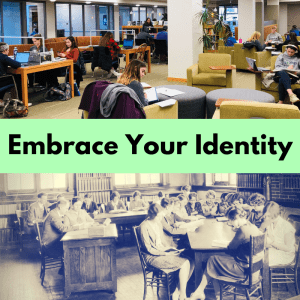 In the summer of 2016 the first floor of our library was renovated and collaborative study spaces were an integral part of the design. The first semester we were open, fall 2016, students flocked to our new spaces and settled in to new habits, or maybe old habits.
A library is a space typically known for quiet, not noisy collaboration and group work (although it happens). Administrators encouraged collaboration with the architecture and seating spaces, but students have yet to embrace this concept. We created special signage letting students know that collaboration, and dare I say it… noise was and is encouraged on the main floor. Also noting that quiet space is available upstairs. However, the students didn’t seem to embrace this. They associate the library with quiet and have told us if they want something noisy they will go elsewhere.
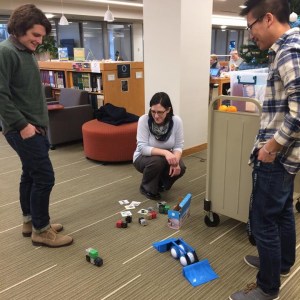
This held true for first finals programming we did in 2016. We collaborated with the Lebanon County Library Libraries and brought some of their STEM robots to campus letting students test drive them in our new open floor plan.
While some students enjoyed something different, many felt it was too distracting leading up to finals. We heard time and again that the library was their place to escape the noise and chaos surrounding them in other spaces and the library was their quiet place to focus on academic pursuits. In response to this, we have made a conscious effort to be respectful of students the week before finals (when all their papers are due) and during finals by having the entire building go, drum roll please…. quiet.
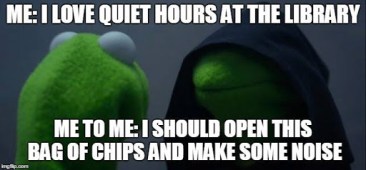 Students on the social media committee have become quite adept at creating meme’s (using free meme generators) to celebrate our early quiet hours based on whatever finals theme we have selected.
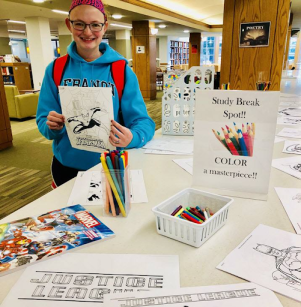
Our new strategy is finding new and quiet ways of helping overburdened students de-stress. Crafts, coloring, dot-to-dots, bubble wrap, Sudoku, word searches, play dough, and candy giveaways on a limited budget have been our recent mainstays.
However, we are always searching for new and fun, quiet and inexpensive activities to brighten our students’ finals periods. If money was no object, I would love to host a silent disco at the library. So far the expensive price tag and knowledge that they would prefer to do a puzzle here stands in my way.
Photo credits in order of appearance:
- Bentz, Maureen, “It’s beginning to look a lot like #finals…,” Instagram, 2018, https://bit.ly/2QtHint
- Lebanon Valley College. “Lebanon Valley College-Reader’s Club,” Oversize Photograph Boxes, Lebanon Valley College Archives Photograph Collection, circa 1931, Annville, PA.
- Bentz, Maureen, “De-Stress at the Library 2016,” Facebook, 2016, https://bit.ly/2nES8WR
- “Finals,” Facebook, 2017, https://bit.ly/2MQanDV
- Bentz, Maureen, “Finals,” Facebook, 2018, https://bit.ly/2OA4vz1
C&CS Code For Her available for viewing
Thank you to Carmen Cole and Joss Pena for their presentation of their Code for Her project at Penn State. Video is available below. Thank you to Ronalee Ciocco for moderating today’s session.
This is also the last program of the year from the Connect & Communicate Series. Thank you so much for our presenters for being willing to do these sessions. Thank you to the team members for all their hard work this year. And thank you to the CRD board and PaLA for supporting us with the Zoom software.
We are hard at work organizing sessions for Spring 2019. In the meantime, have a great holiday and we’ll see you in the New Year!


 Adam Balcziunas
 Alex K.
 Alexandrea Glenn
 Andrea Pritt
 aprilnkelley
 Ashley Purvis
 Bethann Rea
 blj13
blj13 Brendan Johnson
 Amanda Boyer
 Bret Stiffler
 Bonnie Powers
 Christopher Lemery
 clarewithers
 clblibrarian
 Kelly Clever
 Charlotte M. Johnson
 colemanluzerne
 CRD of PaLA
 crdvirtualjournalclub
 cre5314
 csgarth
 Erin B.
 danajkerrigancv
 denisewetzel1
 Darren G. Poley
 elm43
elm43 James D'Annibale
 Annie Jansen
 Jill Hallam-Miller
 jennifercribbs
 Jenn Monnin
 Jen Hasse
 Jessica Showalter
 johnmeier1
 Kelly Safin
 Kim Karim
 Kristen Seikaly
 Kayla Van Osten
 Cecelia Lasley
 librarianjsmith
 Linda Neyer
 mabogino1
 Matthew McNelis
 Meg Massey
 Maggie Savidakis-Dunn
 Rebecca
 miskatoniclibrarian
 Maureen Bentz
 Michele G. Anfuso
 Nicole Miyashiro
 paulmcmonigle
 Rob Sieczkiewicz
 ronlmccoll
 Sam Bardarik
 shannahollich
 smartin592
 Ula Lechtenberg
 It's Academic