With a Little Help from my Friends (Interlibrary Loans)
My first three months as an interlibrary loan librarian for a community college have been a very rewarding experience. Using OCLC WorldShare®, I have been able to connect with libraries all over the United States for both lending and borrowing purposes. Naturally, there are regulars with whom I do consistent business; those libraries who are in the locality and whom I can rely upon for fast and secure lending. We know where each other is located within the area and have probably attended a seminar or conference together at some stage in our careers. In my case of working two part-time jobs, I see interlibrary loans being requested from the public library where I also work and I think to myself, “Why bother even shipping that out? Save the postage and I’ll run it over there the next time I work, which is usually three nights a week.” I am enthralled by the connectivity between our institutes, no matter the type of library or the population served.
Then there are those libraries who are on the other side of Pennsylvania or on the other side of the United States helping me out with journal articles and printed material. It is a wonderful, reciprocal relationship and I am very appreciative to OCLC WorldShare® for making interlibrary loaning a smooth operation. (Which makes me wonder: What was it like for libraries prior to automated systems and OCLC? I can only imagine how much more taxing it most likely was to obtain rare articles and all those photocopies. Oh, the photocopies!)
For all the conveniences OCLC WorldShare® has to offer, there are many incidences when an article is either unavailable or comes at a cost. I have yet to have a patron agree to pay for a copy of an article. This is when I turn to my helpful librarian friends on the OCLC interlibrary loan distribution list. To contact the list owners directly please send your message to ILL-L-request@OCLCLISTS.ORG.We are quite an active group and really pull through for one another. If you work on interlibrary loans, I highly recommend this feature of OCLC. I have had responses within minutes of my requests, and I cannot thank enough the speediness and attention with which other librarians pull through for me.
However, there are times when even the extremely resourceful librarians on the OCLC interlibrary loan distribution list cannot provide me with a particular periodical. Drawing upon my passion to one day work as an academic librarian in New Zealand, I have subscribed to a few mailing lists for libraries in that corner of the globe. One list, in particular, is the NZ-Libs, a discussion of library and information services in New Zealand. As a last resort, I reach out to them to see if perhaps they might have access to a periodical which could be more popular in that hemisphere. (For instance, some south Asian and Oceania periodicals are extremely hard to find or come at a cost on OCLC WorldShare®, but a country like New Zealand or Australia might have obvious easier access to such publications.) As with my OCLC distribution list, my kiwi librarian friends are quick to answer me and assist me with my search. It really is a refreshing experience when you start to realize that we are alike no matter where we may be situated on the globe. Our academic library in little Schnecksville, Pennsylvania, is run similarly to the university libraries in the bustling metropolis of Auckland.
Aside from assisting one another in fulfilling interlibrary requests, we are also forging connections and developing a rapport with one another not only as fellow librarians but as human beings. It is so interesting to hear each other’s stories of how procedures are conducted at individual libraries and how we are all helping one another to harvest and disseminate knowledge; it is empowering in a lot of ways! Or it is encouraging when I make connections with academic and public libraries in New Zealand because I feel like it gives me a little more insight into their culture, and now I can place names with positions and locations, which can be extremely useful for when I try to make the immigration. (Unless of course, I can get into that country based solely on my attractive looks… ha ha ha.)
Are any of you serving as your library’s interlibrary loan librarian? Are you subscribed to the OCLC interlibrary loan distribution list? What other tricks might you have up your sleeve to pull off requests for rare periodicals and printed materials, or to fray the costs for some these requests? Do your patrons agree to make the payments to obtain such resources? Or do you absorb the costs for your patrons? I am intrigued to learn about how you handle those circumstances.
Digital Badges C&CS Session, Jan 30 at 1pm
Digital Badges
Presented by Torrie Raish and Emily Rimland, Penn State University
Wednesday January 30, 2019 at 1pm
Click here for registration to access the Zoom link
Many of us are likely familiar with micro-certification or digital badges in general but may want to learn more details about how it can be used to benefit learners, instructors, and librarians. The presenters will provide an overview of their digital badge programs and use cases and will focus on best practices of designing and implementing a program that will be useful to anyone considering new modes of meaningful instruction. The presentation will have natural conversation points and the presenters will foster an interactive discussion.
V ictoria Raish is the Online Learning Librarian for Penn State. She has been involved in digital badging initiatives since 2012. She has worked on these initiative for NASA and for Penn State University. She has her Ph.D. from Penn State University in Learning, Design, and Technology and is invested in improving the learning experience for all online learners.
Emi ly Rimland is an Information Literacy Librarian and Learning Technologies Coordinator at Penn State. She enjoys providing instruction, reference, and outreach services to undergraduate students and holds an MLIS from the University of Pittsburgh. She is the founder of the ACRL Digital Badge Interest Group and was a Teaching and Learning with Technology Faculty Fellow at Penn State. She recently wrote a spotlight article about Penn State’s badging program for American Libraries magazine: https://americanlibrariesmagazine.org/2019/01/02/making-microcredential-psu-libraries/
If you cannot attend the session live, feel free to sign up anyway. Link for viewing will be sent out after the session and be made available on the C&CS page. https://crdpala.org/connect-communicate/
We would like to thank the CRD and PaLA for continuing to support the Connect and Communicate Series.
If you have any questions or would like to propose a session, please contact Erin Burns at emb28 at psu.edu or any member of the C&CS team listed on the C&CS webpage above.
Tidying Up in 2019
When I was deciding what to write about for my first blog post, I followed the advice we give students: Choose a topic that interests you. This guidance led me to my current favorite Netflix series, “Tidying Up With Marie Kondo.”

For anyone not familiar with Kondo’s KonMari method of organizing, this article from Newsweek is a good summary. Her 2012 book, The Life-Changing Magic of Tidying Up, is likely a hold-shelf favorite at your local library.
The phenomenon is not just about organizing. The KonMari method focuses on sorting items by category and appreciating all of them — even the things that are heading out the door. Items that are kept should have value to you or “spark joy,” according to Kondo. For me, the idea of cherishing things that bring you joy is a strong message on its own.
As I watched the show, and browsed gleeful #konmari posts from coworkers, friends and acquaintances, I began to think about how this could be applied at work.
Although I’ve not seen anyone walk through the stacks tapping on books to “wake them up,” there are other examples in academic libraries. We redesign LibGuides and update them with useful, current content. We develop our collections, clean our work spaces, and revamp lesson plans. We switch out displays and rearrange furniture based on our patrons’ interests and current needs. The end results, in their own ways, spark joy.
This can also be applied to professional development, service, long-term projects and daily routines. Tasks like going through email, writing reports, creating manuals, and digging into meeting minutes can involve lots of “clutter” or messy, overwhelming details.
Unlike a home-tidying project, we can’t shred, recycle or donate tasks that we are obligated to finish. Instead, we can consider what we appreciate about them, or why the end result is meaningful or valuable.
A few colleagues were recently joking about having mindfulness practices ready for their multiple (truly, many) committee responsibilities. We laughed, but there’s truth in that. Pausing for a moment to remember the big picture can help us regain focus in our work and our homes.
What sparks joy? What is the goal? These are reminders I’ll be thinking of more in 2019, partly due to what I’ve learned from watching Marie Kondo in action. The process may not be neat, but the results are often worth it.
“Here we go again”: Getting Creative with Library Displays
Here we go again… Does anyone else feel the sense of boredom when it comes to trying to create displays and programming for the same events year after year? It’s striking me quite hard at the moment as our college cadets have been off campus for a month, and are returning just in time for Martin Luther King Jr. Day.
Our students celebrate MLK Day every year… How do we come up with new and innovative ways to re-engage not only our students, but also ourselves for these special events?
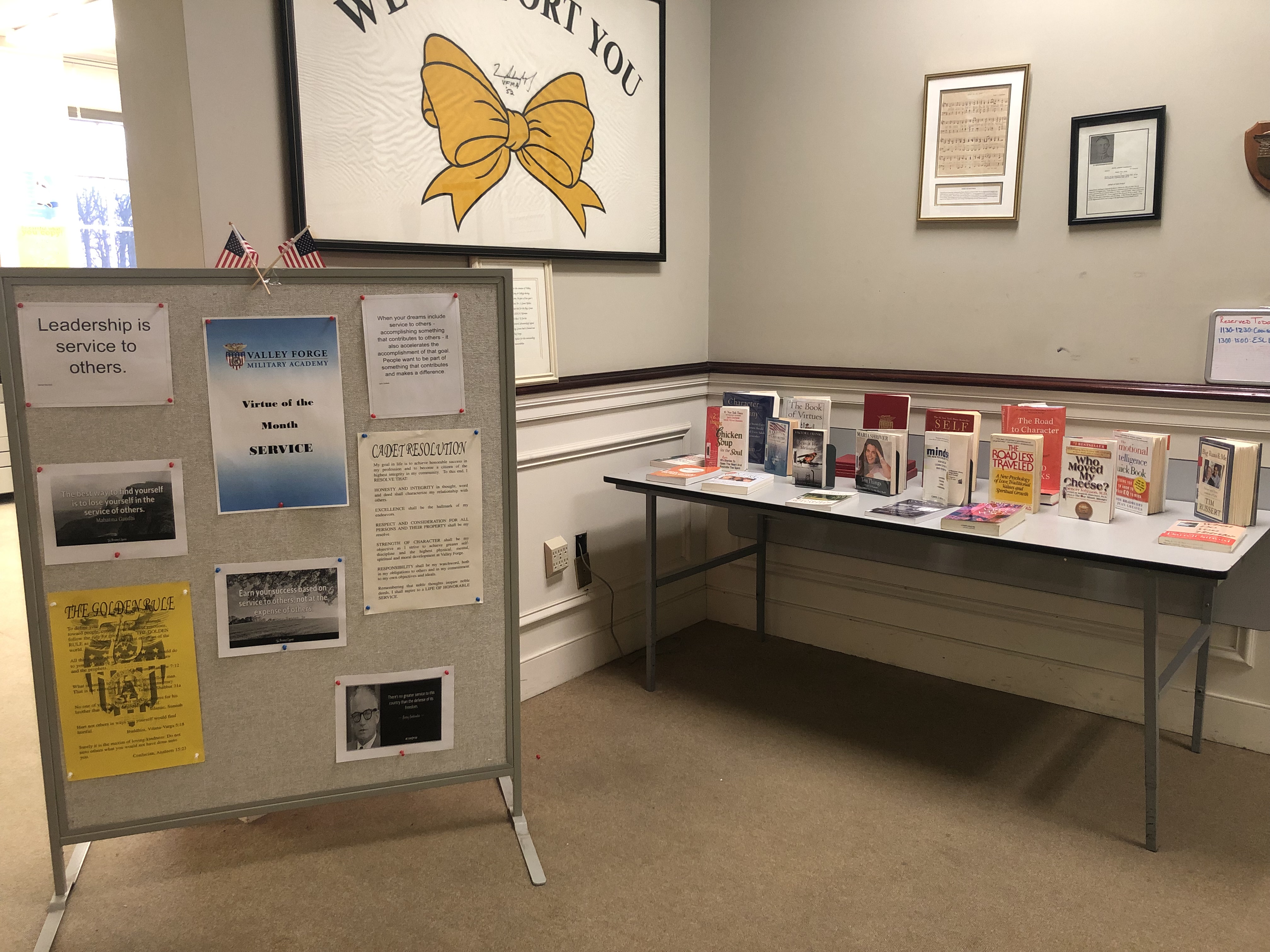 At Valley Forge Military Academy & College, we honor a “Virtue of the Month” tied in with the five pillars of our institution, and integrate it across campus. We have a speaker come in for a session in our chapel; some faculty integrate the virtue into their lesson plans. We at the library create a recommended reading list, and create a small display featuring those books. We have the physical books displayed, and then also feature the titles in the “Recommended Reading” section of our online catalog!
We also tap into things that are unique to our campus, like the birthdays of our service 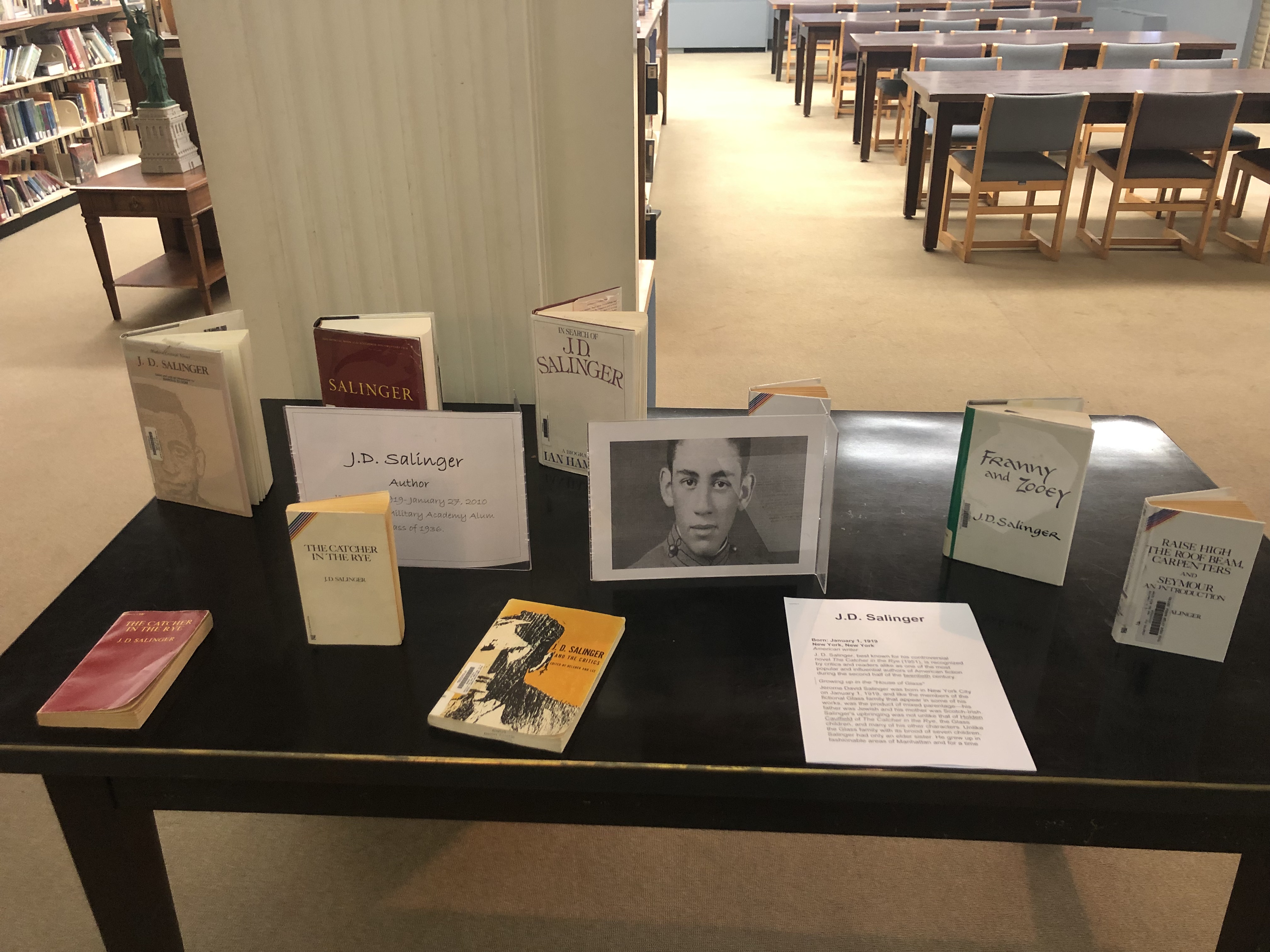 branches, and POW MIA Recognition Day (our library houses our campus POW MIA tribute). And for January 2019, we’re celebrating what would have been the 100th birthday of the creator of one of my favorite fictional teen boys, Holden Caulfield, none other than Mr. JD Salinger (class of 1936)!
We do similar displays throughout the year, but felt like we hit a rut. We started paying attention to news stories and social media feeds, trying to get an in on something new, something unique… We heard about National Cocoa Day (December 13th) from an ALA Store email listserv, and thought, hey, it’s during finals week, why not celebrate? So we did! It was a HUGE success, and we kept the cocoa flowing late into our extended hours.
Libraries are in the information business… no one knew about National Cocoa Day – until we told them! So – we’ve since discovered National Today, a website featuring over 1100 celebration days and suggestions for how to celebrate! We’re gearing up for National Lego Day coming up on January 28th, and have purchased some Lego Classic sets to have on reserve here in the library. This event will also launch our having board games and puzzles on reserve as well. We’re hoping that it could also be an impetus to get more involved with Makerspaces…
Get creative! Know your audience; know your mission statement. Create a tie-in, and go for it!
That being said: Happy National Hat Day (January 15th)! Don’t be a phony; go put on your red hunting cap, and read some Catcher in the Rye (or maybe sip on some cocoa while playing with Legos)…
(images credited to Baker Library at Valley Forge Military Academy & College)
The Librarian in Winter
Of the many lulls librarians experience during the academic year, none feels as pronounced as the semester break that hinges on the turn of the calendar. In mid-December the suddenly quiet library recalls the bygone days of solemnity that the new era of open commons replaced; for a time, even new libraries feel older than they are. The librarian knows this is temporary, a mere hibernation, yet by January the quietude proves intoxicating.
Like Janus, the Roman god of transitions, endings, beginnings, and other dualities of time, the librarian sees the past and the future, often in the same moment. In January, we are like Janus, the month’s namesake. We catch our breath, reflect upon where we have been, and simultaneously consider how to move forward.
These thoughts were apparent to me when I recently undertook a weeding project, a task perhaps best performed by librarians, and gardeners, during the summer. Slowly walking the stacks, pulling and examining specific volumes, I was weighing the past against the future, looking like Janus in two directions at once.
In a sense we are always doing exactly this. Libraries were once lone repositories of knowledge; now libraries provide access to thousands of remote repositories. Librarians were once lone guardians of knowledge; now librarians are less guardians than guides to entire galaxies of information. Whether we hold a book or a smart phone in our hands, we bring the blurry past into focus for the present.
It is very cold today; it feels like January should. There are few people in the library, but they will return in great numbers in just a few days. The quiet will end and the future will be here. Though the calendar calls for several more weeks of winter, librarians will emerge from their dens. For us it is already spring.


 Adam Balcziunas
 Alex K.
 Alexandrea Glenn
 Andrea Pritt
 aprilnkelley
 Ashley Purvis
 Bethann Rea
 blj13
blj13 Brendan Johnson
 Amanda Boyer
 Bret Stiffler
 Bonnie Powers
 Christopher Lemery
 clarewithers
 clblibrarian
 Kelly Clever
 Charlotte M. Johnson
 colemanluzerne
 CRD of PaLA
 crdvirtualjournalclub
 cre5314
 csgarth
 Erin B.
 danajkerrigancv
 denisewetzel1
 Darren G. Poley
 elm43
elm43 James D'Annibale
 Annie Jansen
 Jill Hallam-Miller
 jennifercribbs
 Jenn Monnin
 Jen Hasse
 Jessica Showalter
 johnmeier1
 Kelly Safin
 Kim Karim
 Kristen Seikaly
 Kayla Van Osten
 Cecelia Lasley
 librarianjsmith
 Linda Neyer
 mabogino1
 Matthew McNelis
 Meg Massey
 Maggie Savidakis-Dunn
 Rebecca
 miskatoniclibrarian
 Maureen Bentz
 Michele G. Anfuso
 Nicole Miyashiro
 paulmcmonigle
 Rob Sieczkiewicz
 ronlmccoll
 Sam Bardarik
 shannahollich
 smartin592
 Ula Lechtenberg
 It's Academic