Literary art is powerful. As an editor & writer for the Pennsylvania (PA) Center for the Book at Penn State University Libraries who supports programs such as the PA Letters About Literature Writing Contest—in which an oft bullied 5th grade winner in 2018 realized, “I can be brave, and change the way people view me… I can change the way I think of myself,” after reading Erin Entrada Kelly’s Hello, Universe, for example—I’ve seen the transformative power of literature firsthand.
So when PA Center for the Book Assistant Director, Ellysa Stern Cahoy and Senior Director of Community Relations at Juniper Village Senior Living at Brookline, Katie Kensinger approached me for ideas on how to link Juniper residents with the local community through poetry, I jumped at the opportunity.
With similar poetry-centered community efforts already at work in the area—such as Being Heard, a writing program taught in low-income nursing homes that grew into the Ridgelines Language Arts nonprofit founded by Abby Minor, and the Free-Range Poetry of Hannah Inglesby, who writes on-the-spot poems for people in public places (both skilled, Poems from Life poets)—I knew I wanted to offer a new approach.
Katie was passionate about developing a project that would celebrate the uniqueness of each of her participating resident’s lives, with the goal of sharing their stories, not just with family and friends who would delight in learning something new and, perhaps, unexpected about their loved ones, but also with the general public to build community connections.
As a form, poetry lends itself to mining personal experience and emotional depth and to reflecting on life, both internally and externally, making it ideal for community projects. Being Heard guides participants in writing their own poetry and Hannah’s Free-Range poems are written in the moment, for example. In considering Katie’s hopes for her residents, I suggested an approach that pairs poets and residents one-on-one for personal discussions that then inspire the poet’s creation of a poem that celebrates the resident’s life.
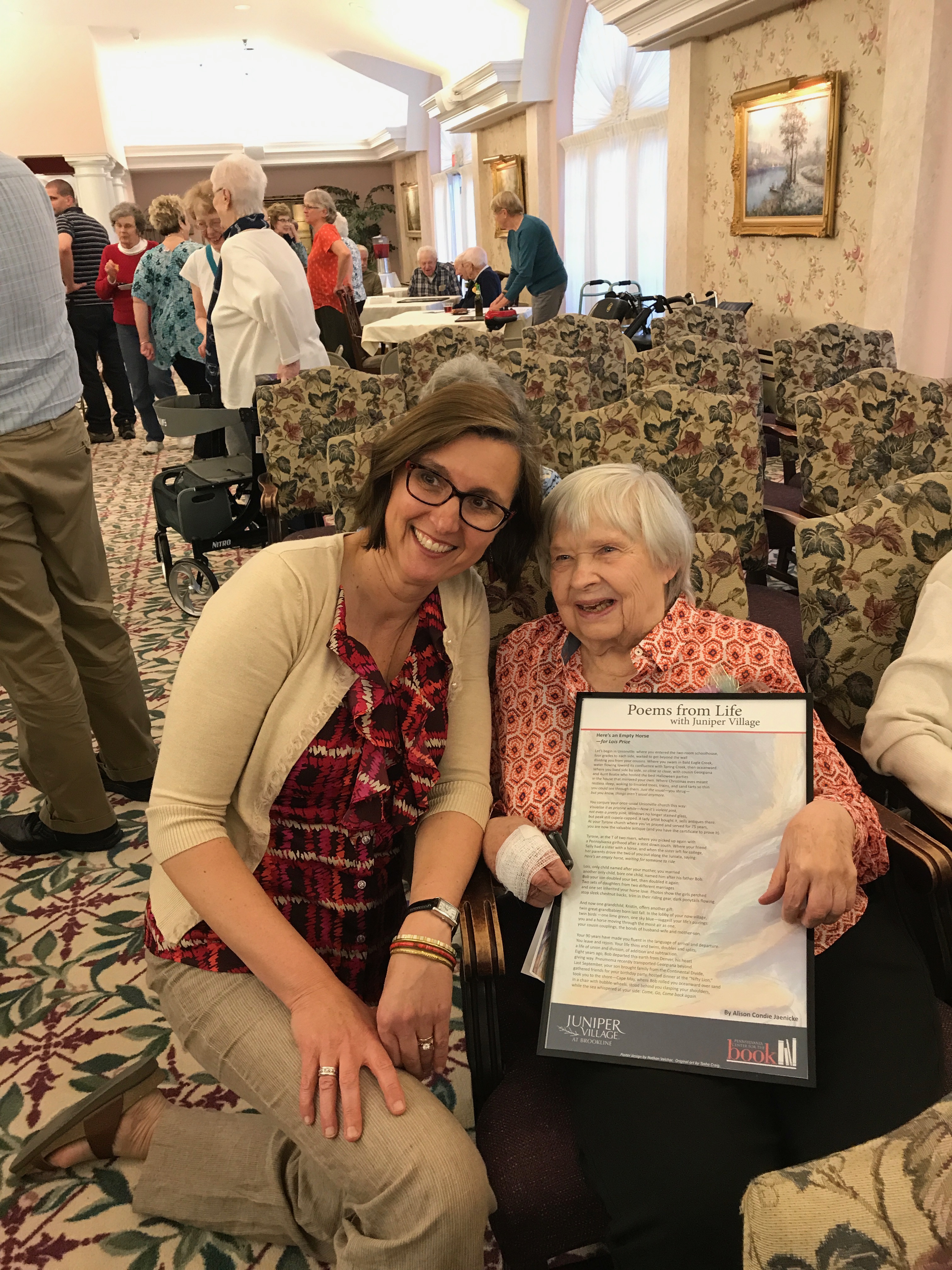
2017 Poems from Life event.
In line with Juniper’s mission of “nurturing the spirit of life,” the project was named Poems from Life with Juniper Village. Now in its third consecutive year, Poems from Life yields shared stories and new friendships that foster community ties. Two of this year’s 18 participants: Joe Bueter and Dick Backastow, discovered common ground in their childhood experiences with Boy Scouts, referenced in Joe’s poem for Dick— to be unveiled Tuesday, April 9.
Poems from Life culminates in a celebratory event hosted by Juniper where poets reveal their work to residents in a reading, accompanied by poetry posters and chapbooks, among family, friends, and community members.
Steven Herb, Emeritus Director of the Pennsylvania Center for the Book, says:
“I was moved at each poem, which perfectly married literature with story, and in this case, the story of some very interesting older people. We all do live unique lives and the poetry shared those ultimately transcendent experiences beyond the walls of their rooms or houses or memories. I was quite moved, as was the entire audience.”
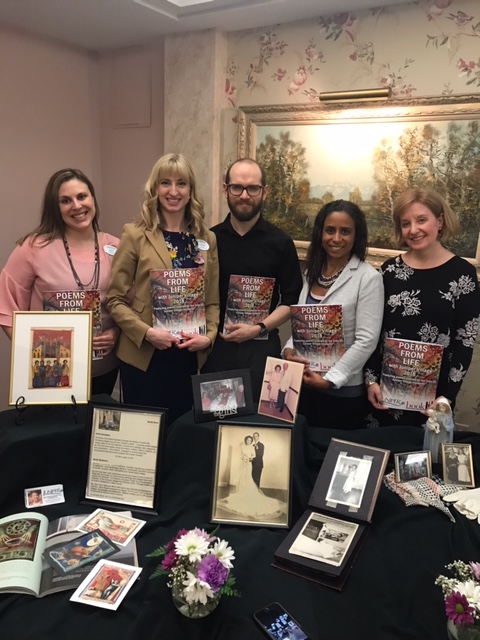
The 2019 Poems from Life with Juniper Village event will be held at 6:30pm on Tuesday, April 9, and is free and open to the public—join us!
Event Details:
Poems from Life with Juniper Village – Celebration & Reading (Free)
Drinks & Appetizers
6:30pm Tue, Apr 9
Willows Dining Hall
Juniper Village Senior Living at Brookline
1950 Cliffside Drive
State College, PA 16801
Facebook Invite
The Pennsylvania Center for the Book—sponsored by Barbara I. Dewey, dean of University Libraries and Scholarly Communications, and Penn State State University Libraries—is an affiliate of the Center for the Book at the Library of Congress. It encourages Pennsylvania’s citizens and residents to study, honor, celebrate and promote books, reading, libraries and literacy.
For more information about the Pennsylvania Center for the Book’s Poems from Life with Juniper Village project, please email Nicole Miyashiro at nmm16@psu.edu, or visit https://pabook.libraries.psu.edu/poems-life, where videos from its previous years’ celebratory readings can also be found.
Mapping Your Journey with Amanda Leftwich now available
Thanks everyone who participated in yesterday’s session. Session is linked here:
Please take the time to fill out the evaluation form here, where you can also leave comments for Amanda: https://goo.gl/forms/iGxw44os34R7g0MQ2
As always, a huge thank you to PaLA and the CRD for supporting this initiative, and for the PaLA members. Thank you Amanda for presenting, Amy for moderating, and Erin for closed captioning.
If you want to present with us, please contact anyone on the C&CS team, or fill out our form located on the C&CS page here:
https://crdpala.org/connect-communicate/
Inspire dialogue with pop-up polls
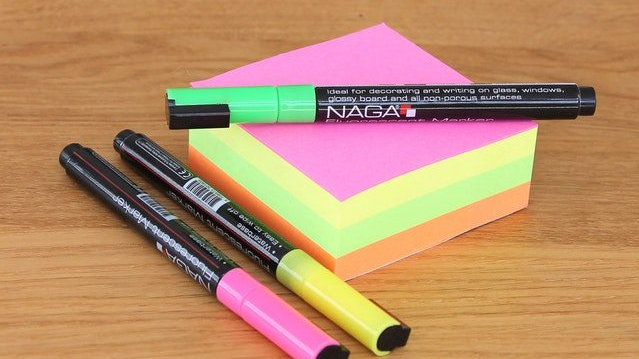
Image credit: Pexels
This semester, our library is experimenting with using pop-up polls to transform passive exhibits into interactive installations.
Pop-up polls spark informal dialogue in a social setting. They help us get feedback and gain insight from our patrons. They offer a novel way to encourage participatory learning that includes multiple voices. We hope that they contribute to a sense of community on campus. Plus, because pop-up polls are low (or zero) cost and are quick and easy to set up/tear down, they enable us to keep our displays fresh and timely.
When it comes to these kinds of interactive installations, we are inspired by the work of our colleagues in the museum studies field. In particular, an essential resource is Nina Simon’s book The Participatory Museum, which is available freely online with a Creative Commons license. Her book provides practical strategies for creating and evaluating what she calls “participatory techniques” at your institution. Simon’s focus is museums, but her techniques are transferable to libraries as well.
In the preface to her book, Simon explains why these kinds of interactive installations are so important:
How can cultural institutions reconnect with the public and demonstrate their value and relevance in contemporary life? I believe they can do this by inviting people to actively engage as cultural participants, not passive consumers. As more people enjoy and become accustomed to participatory learning and entertainment experiences, they want to do more than just “attend” cultural events and institutions. The social Web has ushered in a dizzying set of tools and design patterns that make participation more accessible than ever. Visitors expect access to a broad spectrum of information sources and cultural perspectives. They expect the ability to respond and be taken seriously. They expect the ability to discuss, share, and remix what they consume. When people can actively participate with cultural institutions, those places become central to cultural and community life.
Inspired by Simon and others, some of the pop-up polls we’ve tried so far this semester have included a “New Year, New Semester, New Goals” display; “What do you love about your library?” for Library Lovers’ Month/ Valentine’s Day; a “Where in the world will you be for spring break?” map; and “What do you feel lucky to have?” for St. Patrick’s Day. Upcoming ideas for polls include March Madness, Finals Week theme songs, suggestions for summer reading, and textbook prices for Open Access Week. Our student workers have expressed keen interest in the polls, and they have begun to suggest ideas for future questions and themes, too!
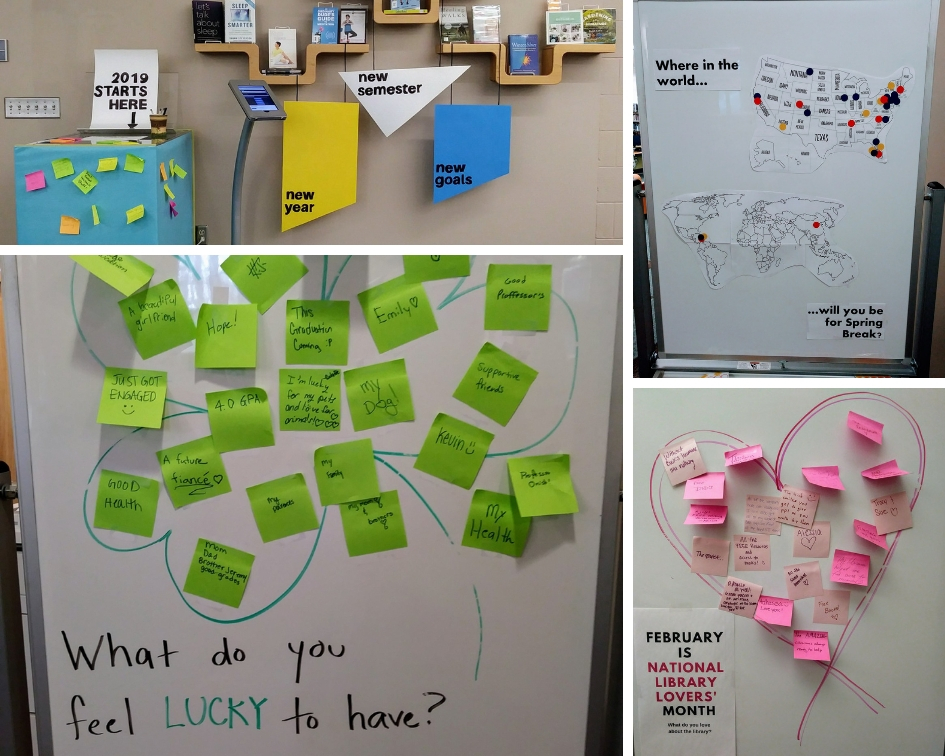
A photo collage of our interactive displays.
In some cases, our pop-up polls are freestanding. In other cases, they accompany a display of books or are incorporated into a library programming event. Supplies needed are as simple as a white board, sticky notes, dot stickers, and markers. In the future, we’re considering incorporating 3-D elements, such as having patrons use poker chips or marbles to vote. Typically, we install the displays for about two weeks—enough time to get a variety of responses but keep the displays changing frequently. We usually install them near the library entryway where there is heavy traffic. We also post pictures on our social media channels.
We’ve already had some surprises. For instance, I expected the Library Lovers’ poll to focus on our collections, but I was happy to see that the many of the responses celebrated library staff in addition to free books and DVDs.
We are on the lookout for new versions of these pop-up polls, so please share in the comments if your library has had success with these kinds of displays.
References:
Simon, N. (2010). The participatory museum. Santa Cruz, CA: Museum 2.0.
Jessica Showalter is the Student Engagement & Outreach Librarian at Penn State Altoona’s Eiche Library. Say hello on Twitter @libraryjms
ACRL Delaware Valley Chapter Spring Program: Scholarly Communication: From Understanding to Engagement
Scholarly Communication: From Understanding to Engagement Penn State Great Valley
Date: April 26, 2019 9:00 AM EDT
REGISTER
ACRL Delaware Valley Chapter
Spring 2019 Program
Scholarly Communication: From Understanding to Engagement
April 26, 2019
9:00AM – 4:30PM
Breakfast and lunch included with registration.
$40 for chapter and PaLA members, $50 for non members
Penn State Great Valley Campus
Conference Center
30 E. Swedesford Rd
Malvern, PA 19355
REGISTER
Academic and research librarians increasingly recognize scholarly communication as a core competency of the profession. Whether helping researchers meet their funder’s mandates for public access and data sharing, guiding responsible copyright practice, or supporting new types of scholarship and instruction, librarians are leading change across campus and around the world.
The goal of the structured, interactive program is to equip participants with knowledge and skills to help accelerate the transformation of the scholarly communication system.
At this workshop we have asked the presenters to incorporate their latest targeted modules on the subjects of Accessibility and Open Education.
This workshop is presented by ACRL National. Presenters will include:
- Carla Myers, Assistant Professor and Coordinator of Scholarly Communications, Miami University Libraries,
- Will Cross, Director of the Copyright and Digital Scholarship Center, North Carolina State University
More information and online registration: Scholarly Communication: From Understanding to Engagement
CRD Spring Workshop: Call for Presenters!
The College and Research Division is seeking proposals for presentations at its Spring Workshop. The Workshop will be held on Thursday May 23, 2019, 8:30am – 3:30pm, at Kings College, Wilkes-Barre, PA.
The theme for the workshop is The Digital in Digital Literacy: What Are We Doing and Where Are We going?
Topics of particular interest are:
- Developing a campus-wide digital literacy framework based on the ACRL Framework
- Search strategies for Open Access Resources such as PubMed, etc.
- What open source software is best for Digital Libraries?
- Digital Rights Management
- What is it like to work in a Bookless Library?
- Digital technologies for Cultural Preservation
Sessions, including time for questions and discussion, will be one hour in length.
Please consider the following when submitting your CFP:
- Title clearly describes proposed session
- Session description is clear, concise and easy to understand
- Target Audience: Academic librarians
- Session includes: 3 clear, measurable goals / takeaways
- Session presents: 3 clear strategies for participant engagement and is likely to engage all participants
The deadline to submit a proposal is April 19, 2019. Notification will be by April 26, 2019.
Please CLICK HERE to submit your proposal.
Contact Betsy Reichart with questions at betsy.reichart@pennfoster.edu


 Adam Balcziunas
 Alex K.
 Alexandrea Glenn
 Andrea Pritt
 aprilnkelley
 Ashley Purvis
 Bethann Rea
 blj13
blj13 Brendan Johnson
 Amanda Boyer
 Bret Stiffler
 Bonnie Powers
 Christopher Lemery
 clarewithers
 clblibrarian
 Kelly Clever
 Charlotte M. Johnson
 colemanluzerne
 CRD of PaLA
 crdvirtualjournalclub
 cre5314
 csgarth
 Erin B.
 danajkerrigancv
 denisewetzel1
 Darren G. Poley
 elm43
elm43 Heather Burychka
 James D'Annibale
 Annie Jansen
 Jill Hallam-Miller
 jennifercribbs
 Jenn Monnin
 Jen Hasse
 Jessica Showalter
 johnmeier1
 Julie Durci
 Kelly Safin
 Kim Karim
 Kristen Seikaly
 Kayla Van Osten
 Cecelia Lasley
 librarianjsmith
 Linda Neyer
 mabogino1
 Matthew McNelis
 Meg Massey
 Maggie Savidakis-Dunn
 Rebecca
 miskatoniclibrarian
 Maureen Bentz
 Michele G. Anfuso
 Nicole Miyashiro
 paulmcmonigle
 Rob Sieczkiewicz
 ronlmccoll
 Sam Bardarik
 shannahollich
 smartin592
 Ula Lechtenberg