C&CS Presents
Policies, Platforms and Promotion: Social Media for Every Library
with
Emily Mross, Josefine Smith and June Houghtaling
May 9th, 2019 at 11am
Register here for the Zoom link
Libraries of all types and sizes can develop meaningful engagement with their patrons through social media. Join the 2018 Pennsylvania Library Association’s Academy of Leadership Studies (PALS) Social Media Project Team to learn how to get started with or improve your library’s presence on social media through the development of a social media policy, selecting the right platforms for your audience, and resources to help you create interesting content. This webinar will address both academic and public library contexts, and the social media considerations unique to each environment. We will also introduce new best practices documents and templates for libraries created by the team over the past year as a service project for The Pennsylvania Library Association and its members.
This project is made possible, in part, by a grant from the Institute of Museum and Library Services as administered by the Pennsylvania Department of Education through the Office of Commonwealth Libraries, and the Commonwealth of Pennsylvania, Tom Wolf, Governor.
Presenters:
-

- Emily Mross
-

- Josefine Smith
-

- June Houghtaling
Emily Mross is the Business Librarian and Library Outreach Coordinator at Penn State Harrisburg Library in Middletown, PA. Emily holds an MLIS from the University of Pittsburgh, and M. Ed. in Instructional Technology from East Stroudsburg University.
Josefine Smith is the Instruction & Assessment Librarian at Shippensburg University in Shippensburg, PA. Josefine holds an MLIS degree from the University of Pittsburgh and a Master’s in American Studies from Penn State Harrisburg.
June Houghtaling is the District Consultant for North Central Library District, based out of the James V Brown Library in Williamsport, PA. June holds an MSLS from Clarion University.
Other Team Members:
Tegan Conner-Cole is a Youth Services Librarian for the Cheltenham Township Library System in Montgomery County. Tegan holds an MLIS from the University of Pittsburgh.
Liz Kluesner is a Librarian at the Lackawanna County Children’s Library in Scranton, PA and an Adjunct Reference and Archives Librarian at Wilkes University in Wilkes-Barre, PA. Liz holds an MLS from Clarion University.
John Siegel was previously Head Librarian at Penn State DuBois. He now serves as Coordinator of Information Literacy at the University of South Carolina Upstate in Spartanburg, SC. John holds an MLS from the University of Maryland and an M. Ed. in Adult and Professional Learning from the University of Arkansas at Little Rock.
What Ever Happened To Blexting?
As much as it may sound like one, blexting is not a teen fad of the recent past. It is the concept of co-mingling a crowdsourced solution for the documenting of urban blight with the power of social media and ease of texting. The source of the idea can be traced back to a decade ago when Jerry Paffendorf, Mary Lorene Carter, and Larry Sheridan co-founded Loveland Technologies. Loveland Technologies worked with Data Driven Detroit and others on the Motor City Mapping project.
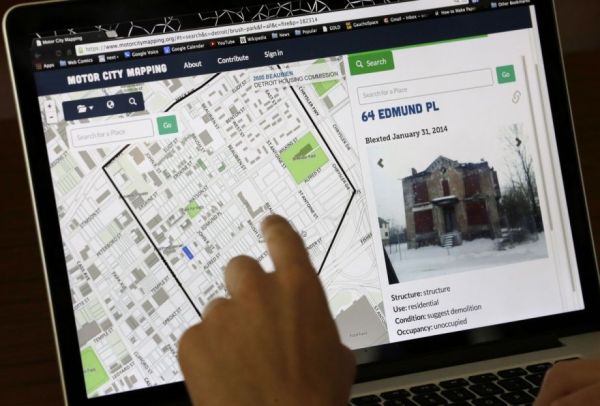
“Detroit residents can now use a ‘blexting’ app — short for blight texting — to send photos
about derelict properties to a mapping database in Detroit. (AP Photo/Carlos Osorio)”
https://nextcity.org/daily/entry/detroit-blight-blexting-houses-motor-city-mapping
The Blexting App from Loveland was a key tool that allowed a small army of everyday people in 2014 to collect data about changes such as deterioration of or improvements to the almost 400,000 properties in the city of Detroit, MI. One result, the surveying was completed in less than 2 months. Another was it empowered local government agencies to act in an informed manner. Based on the effort Detroit was awarded nearly 50 million dollars by the federal government for blight reduction.
Last year The City of Detroit unveiled it’s Open Data Portal for providing updated public record information. Perhaps the most important outcome of the inception of blexting, it provided proof of concept to a noble idea. Empower citizen-driven collection of big data to solve real problems using the tech devices that just about everyone carries around with them all the time.
Earlier this year, Loveland Technologies released its nationwide land parcel data mining site landgrid.com, that anyone can “surf,” and coming soon the Motor City Mapping survey will be updated. However, the real promise of blexting becoming a tech trend revolution in the gathering of important data about communities has yet to really blossom. Let’s hope it does.
“Detroit Getting $50 Million to Fight Blight.” Detroit News, 16 Dec. 2014, https://www.detroitnews.com/story/news/local/michigan/2014/12/16/michigan-detroit-blight-funding/20479333/
Lewan, Amanda. “Why Blexting Is The Next Tech Term To Know.” Michipreneur, 24 Feb. 2014, http://www.michipreneur.com/why-blexting-is-the-next-tech-term-to-know/
“Motor City Mapping.” Data-Smart City Solutions, Ash Center for Democratic Governance and Innovation, https://datasmart.ash.harvard.edu/solutions/motor-city-mapping
Muller, David. “‘Blexting’ (Blight+texting) App Enlists Community to Help Detroit Fight Blight.” Mlive.Com, 15 July 2014, https://www.mlive.com/news/detroit/2014/07/grant_money_available_as_commu.html
“Press Release: Loveland Technologies Releases Landgrid.Com for Nationwide Land Parcel Data.” LOVELAND, https://makeloveland.com/blog/press-release-loveland-technologies-relea
Save the date and join us!
When: April 30th, 12:00pm
What: Finding OER webinar
PALCI’s Affordable Learning PA program presents “Finding OER,” a webinar with Amanda Larson, Penn State’s Open Education Librarian, and 2017-2018 SPARC Open Education Leadership Fellow. Amanda tweets about OER at @maeverawr.
Explore best practices for searching for open educational resources, and learn:
- Searching tactics for different types of projects
- Where to search
- How to search for textbooks, images, and video
- Where to find resources to help you support faculty
- How Creative Commons licenses work
Register here: ALPa Webinar Registration Form
Instructing my First Information Literacy Classes
I only recently started my job as the part-time interlibrary loan and information services librarian with Lehigh Carbon Community College’s Rothrock Library back in October 2018. From my very first day on the job, I was handling interlibrary loans through OCLC WorldShare®, connecting with libraries all across the country in search of articles and books. After a few weeks, I was comfortable enough to staff the reference desk and to provide assistance for students and faculty. I was assured that at some point come the spring semester, I would be conducting my first (ever!) information literacy courses for ENG 105, which is our Research and Composition English course. I was actually pretty nervous about it, being that I really do not have a faculty background. I had been a substitute teacher back in the day for elementary school children, so standing up in front of a classroom really did not intimate me. But you can fool children if need be (sometimes); adults listen, catch on, judge, and know when you are a total moron. (Maybe I am underestimating elementary school-aged children and overestimating adults.) I just wanted to make sure I knew what I was talking about and how to be comfortable operating all this fancy technology with which I was not really familiar. I am not ashamed to admit that I can be old-school and tend to shun most social media platforms, save Instagram. Even those huge smart boards in the classrooms which can operate with the simple touch of my finger are absolutely amazing and intimidating to me; I feel – and probably, look and act – like Charlie Bucket winning the last Golden Ticket to visit Willy Wonka’s Chocolate Factory when I am operating one of those bad boys!
My first instruction in front of a class was supposed to happen this past Friday at one of our satellite campuses and was for our ENG 106 course, which is Introduction to Literature. Having been asked to do this well ahead of time really put me at ease. I knew I would have the time and resources to prepare my instructional lesson plan. I knew I could be prepared.
But the best-laid plans of mice and men often go awry. Two weeks prior to this scheduled instructional session – and first thing on a Monday morning, no less – one of my fellow librarians approached me with an emergency. He had two ENG 106 courses, back-to-back, which he would not be able to instruct, and he wanted to know if I could step in and cover for him.
I probably blanched completely white like one of those cartoon characters out of sheer panic. I only had an hour to prepare. I was not dressed my best. The students would notice my sparse eyebrows and my messy, unruly hair. (Its choice, not mine.) I quickly reviewed my notes which another one of my fellow librarians had provided me. I would be showing the students how to navigate Encore to search our library holdings in addition to some of our databases, in particular, Literature Online and Literature Resource Center. I had very little time to review the short stories which the students were working on, but they seemed like classic works from well-known authors, including Ernest Hemingway’s “Hills Like White Elephants,” Nathaniel Hawthorne’s “The Birthmark,” William Faulkner’s “A Rose for Emily,” and Catherine Perkins Gilman’s “The Yellow Wallpaper.”
The instructor was present for both of these classes, so at least she was able to prompt the students to think about their assignment, a short research paper dissecting various themes and symbolism within the stories. My first task was to show them how to look up materials in our library through Encore and of course, as luck would have it, our platform was down at that particular hour. I could retrieve results but when I clicked on a title for a description and summary, I got all that Java talk and errors. No doubt this would happen to me during my very first information literacy instruction! But the instruction must go on, so I delved into the database descriptions for Literature Online and Literature Resource Center. Fortunately, these databases were cooperating with me and I was able to retrieve results for demonstration. I am hoping that I was able to give a thorough understanding of how to conduct research, including on how to cite it properly, and I walked around to each student to ask if he or she needed any assistance.
Even with having displayed my contact information, not one of the students from those two classes approached me afterward to follow up with questions about their research. I see the instructor on a regular basis and she asks me if any of her students have been in touch with me, and sadly, I have to tell her no. To reiterate what Daniel De Kok’s article earlier this week entitled “Those Who Can” for this blog addressed, how do we get the students to ask for our help? What will it take? I cannot imagine that there would be no follow-up questions. It is rather disappointing and discouraging, but I take away from it that once I get more comfortable with conducting information literacy courses, I will eventually familiarize myself with the material and my enthusiasm for the subject will show, especially if it is Introduction to Literature.
For what was supposed to be my first information literacy course this past Friday, I took the time to prepare by reading a few of the short stories which the professor had included on his syllabus. Fortunately, most of them were the same as the previous two classes, being that they are both Introduction to Literature courses taught by two different professors. I was able to re-read a childhood favorite of mine – Edgar Allan Poe’s “The Cask of Amontillado,” which really got me pumped for the class. I felt much more confident and engaged in teaching this course at the satellite campus since I was more familiar with the databases. Now I know I can handle more information literacy courses as they come my way; I have gotten over the initial hump of awkwardness and shyness. I would like to know – what was your first information literacy instruction like?
Those who can…
My name is Daniel De Kok, and I’m the Reference and Special Collections Assistant at the Langston Hughes Memorial Library, Lincoln University. Lincoln is the nation’s oldest degree-granting HBCU, founded in 1854, and our alumni include Thurgood Marshall, New Jersey Lieutenant Governor Sheila Oliver, and the past presidents of several African countries. We’re a stone’s throw from US-1 on the southwestern end of Chester County, about 10 miles north of the Maryland/Pennsylvania border. I’m telling you all this because at the last conference I attended, it seemed no one knew who or where we were.
I’ve been doing a lot of thinking about patron service lately. Like you, I have had customer service experiences in my daily life that range from wonderful to wretched, and could talk about them at length. As library professionals, we take pride in the service we offer patrons, and we take great care to be thorough and precise in offering information. I would go so far as to say that all working in the library and information science field are called upon to teach. We may not have a formal classroom, but surely we have an opportunity to teach every time we remind a patron of an unpopular policy, take a struggling student through the process with citing an article in the proper style, or show someone how to access a database one more time. When we are presented with a patron with a willingness to learn, we have an obligation to teach them, and it’s a great feeling when you know you’ve helped a student untie a knotty problem.
But there can be a downside. I have noticed in many people an unwillingness to ask for help, accept instruction, or to discipline themselves sufficiently to follow a plan of action (My current students notwithstanding—who I find polite, well-spoken, and eager to learn). How often have we heard, after an exhaustive reference interview, the patron exhale a resigned sigh and “Oh, I’ll just Google it”, as though the information we help them gather is dubious at best. Whether it’s a barbecue cookbook or instructions for assembling a desk, people seem bound and determined to follow the lead of Home Improvement’s Tim Taylor, who was heard to say “real men don’t need instructions”.
There is something to be said for self-reliance—“Figuring it out yourself”—but everyone needs an independent, objective guiding hand at some point. The elementary school that our children attended had a mantra that many of the teachers used, “Ask three before me”–in other words, find three other sources of information (classmates, web or printed sources, etc.) before you ask the teacher. How do we as library professionals change patron’s hearts and minds and create a culture of trust, integrity and mutual learning? How do we get them to ask us?
I don’t claim to have all the answers. Perhaps we must accept that patron stubbornness is part of human nature and it will always be with us. Meanwhile, all we can do is our best. I’m hoping that this blog will in part assist me in becoming a better library professional. Onward.


 Adam Balcziunas
 Alex K.
 Alexandrea Glenn
 Andrea Pritt
 aprilnkelley
 Ashley Purvis
 Bethann Rea
 blj13
blj13 Brendan Johnson
 Amanda Boyer
 Bret Stiffler
 Bonnie Powers
 Christopher Lemery
 clarewithers
 clblibrarian
 Kelly Clever
 Charlotte M. Johnson
 colemanluzerne
 CRD of PaLA
 crdvirtualjournalclub
 cre5314
 csgarth
 Erin B.
 danajkerrigancv
 denisewetzel1
 Darren G. Poley
 elm43
elm43 James D'Annibale
 Annie Jansen
 Jill Hallam-Miller
 jennifercribbs
 Jenn Monnin
 Jen Hasse
 Jessica Showalter
 johnmeier1
 Kelly Safin
 Kim Karim
 Kristen Seikaly
 Kayla Van Osten
 Cecelia Lasley
 librarianjsmith
 Linda Neyer
 mabogino1
 Matthew McNelis
 Meg Massey
 Maggie Savidakis-Dunn
 Rebecca
 miskatoniclibrarian
 Maureen Bentz
 Michele G. Anfuso
 Nicole Miyashiro
 paulmcmonigle
 Rob Sieczkiewicz
 ronlmccoll
 Sam Bardarik
 shannahollich
 smartin592
 Ula Lechtenberg
 It's Academic