Are you planning to attend the Pennsylvania Library Association Annual Conference in Erie, PA, October 13-16? CRD members are eligible to apply for a conference scholarship to help defray the cost of attendance.
The final amount of the scholarships will depend on the number of successful applications, and recipients are responsible for conference-related costs beyond the amount of the scholarship. Only current CRD members will be considered, and recipients may be called upon to serve the CRD in the near future. You do not need to attend the full conference, but must register for at least one day.
Applications will be accepted until 11:59 pm on Tuesday, September 3.
Questions? Contact Emily Mross.
Figuring Out the ‘What For’ of Digital Scholarship Centers
The success of any new enterprise in a library often depends on decisive and nimble planning. But if you begin by asking the question ‘Why’ you will get either rather bland reasons such as competition or a thoroughly subjective rationale that is simply responding to a current but all too specific need. You don’t want to chuck away the opportunity to articulate a vision by simply chalking it up to broad relevance or fall victim to creating a president too hastily. Either can be disastrous.
When it comes to a cause célèbre like Digital Scholarship the agenda is often shaped solely by identifying what a library is already prepared to support, for instance: Text and data mining, Geospatial analysis, or Data visualization.
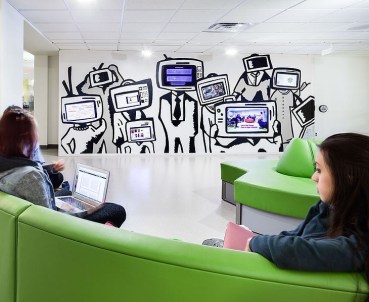
Media Wall outside The Lewis & Ruth Sherman Centre for Digital Scholarship in Mills Memorial Library at McMaster University
The ‘What’ may very well be driven by only investigating the scholarly community of practice the library serves and evaluating resources, but perhaps “a more socially directed mode” of generous thinking, that “might enable us to make possible a greater public commitment in our work which in turn might inspire a greater public commitment to our work,” is what’s called for (Cf. The Munro Lecture: “Generous Thinking” with Kathleen Fitzpatrick).
An important preliminary will be to provide a common understanding of Digital Scholarship. It would help to decide on a coherent definition of Digital Scholarship, like the one from CU Boulder University Libraries, Center for Research Data & Digital Scholarship: “Digital Scholarship extends traditional methods of research by leveraging new technologies and digital data to advance research and enhance pedagogy. While it is most commonly associated with Digital Humanities, Computational Social Science, and Data Science, Digital Scholarship is applicable to all disciplines, and it often relies on interdisciplinary collaborations.”
Mission statements that live in a drawer and are infrequently consulted in assessing day-to-day decisions cannot be a force. That it is why it is necessary to determine the values which will be at the forefront of every conversation in answer to ‘What For?’ A good example of this are the Core Tenets of Boston College Libraries Digital Scholarship Group:
- We aim to build experience and community
- We are experimental
- We are open
- We teach, support, and collaborate
Some keys to generous thinking which Kathleen Fitzpatrick describes in her Munro Lecture that may also help are to maintain a tension between “critical audacity” and “critical humility,” and when working as a group “assume positive intent” and “own negative effects.” Thus, a spirit of generosity will enrich even further the thinking around the questions to be asked.
For descriptions of Digital Scholarship programs check out the ARL’s Digital Scholarship Profiles. You be the judge. Are they asking What For?
Join us August 28th at 12pm EST
for
“The times, they are a’changing”: The Library Legacies Oral History Project
presented by Jackie Esposito
Register for the Zoom Link (online, free): here
Library Legacies, a Penn State University Libraries oral history project, was conducted to ensure that the Libraries long-distinguished University history is captured and made accessible. By interviewing 150 present and former University Libraries administrators, faculty, and staff, this project attempted to place the rich work and experiences of these individuals in the context of the immense changes in the Library industry over the past 60 years. Their memories can infuse and negotiate the meanings of the past, amplify how their actions inform the present, and establish a path forward into a strategic future. The earliest interviewee began her Library career in 1958, the most current in 2018. This presentation will discuss trends, skill set development, strategic impacts, human resource issues and effects of technology across the Library as an industry.
Jackie Esposito is the Special Projects Librarian/Archivist at Penn State University. Jackie has been actively engaged in the management and preservation of University archival and library collections for over thirty years. She began serving Penn State in the fall of 1986 as a Project Archivist and was promoted through the ranks to her current position as Full Librarian. She currently is overseeing an extensive oral history project for the University Libraries entitled Library Legacies and assisting with reference/instruction at Penn State DuBois. She is the author of numerous articles on archives management, higher education legislation and records issues as well as co-author of The Nittany Lion: An Illustrated Tale.
This session will be presented via Zoom. You will receive a login link approximately 48 hours before the session begins. We will try to provide closed captioning to the best of our abilities during the session, and will have a moderator for questions.
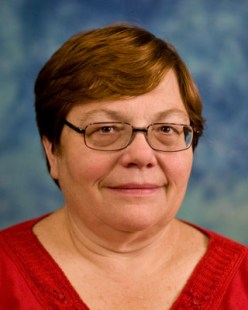
Jackie Esposito
ALA Denounces New Macmillan Library Lending Model, Urges Library Customers to Voice Objections
As I have previously mentioned in former articles, I used to serve as a textbook specialist and buyer for a community college. I held this position for nearly seven years and it was at a time when different platforms were slowly starting to emerge as alternatives to the traditional college textbook. When I started the position full-time in August 2006, textbooks were still the primary course materials required for most classes. Occasionally, an instructor would make his or her own individually crafted pamphlets or booklets to be duplicated and sold at the campus store, thereby greatly reducing the students’ cost for classroom purchases. The idea of an e-book or separate components such as access codes and loose-leaf versions of a textbook was just coming into vogue. The sales representatives would often stalk approach me and pitch me these ideas, complete with boxes of donuts or fruit baskets to soften the blows of their proposals. I would listen patiently, but all the while I knew that their cost-effective proposals and alternatives would not go over well with our students. Our students wanted to be able to have a physical textbook to sell back for cash at the end of the semester. They wanted their textbooks to be relevant for at least two years and not constantly changing editions. Loose-leaf versions of textbooks often got crinkled and ripped and many a time pages went missing, thereby deeming them undesirable for buyback. While electronic codes promised availability of an e-book version of the accompanying textbook, as well as access to the instructor’s quizzes and other assignments, these electronic codes were one-time use only. If a student ripped the tab off the electronic code to reveal it and then decided that he or she wished to drop the course, there was no way for the campus store to offer a refund on that item. (Or at least a full refund was not feasible.) When you plunk down over $200 for a textbook bundle, that is a big insult and waste of money.
It has been over six years since I left the textbook industry and I can see how publishers, like libraries, have had to evolve in order to remain relevant in an environment where technology is constantly changing the format of the once-prominent physical textbook. Last week, on July 25th, Macmillan Publishers announced its new library e-book lending model. According to Macmillan, “under the new model, a library may purchase one copy upon release of a new title in e-book format, after which the publisher will impose an eight-week embargo on additional copies of that title sold to libraries.”
“Macmillan’s new policy is unacceptable. ALA urges Macmillan to cancel the embargo.” — Wanda Brown, ALA President
As an interlibrary loan librarian working to secure journal articles for students, faculty, staff, and administrators and who pushes the OER agenda, the word “embargo,” by default, makes me cringe. While personally, this decision does not affect my academic library (as we do not purchase e-books which are used for courses), I can imagine that this has a frustrating effect on many academic and public libraries. The heat on our libraries first got cranked back in July of 2018, when Macmillan Publishers, without notice, “issued a four-month embargo applying solely to titles from the company’s Tor imprint.” Now, this eight-week embargo on all of Macmillan’s titles really puts libraries at the forefront of having to explain this to students and patrons. We will be labeled as “the bad guys” before the publishers in that we are “perceived as being unresponsive to community needs,” according to newly minted ALA president, Wanda Brown. (Flashback from my days in the campus store! We were always “the bad guys!”)
Wanda Brown has called for libraries to voice their discontent with this new model by directing expressing their disapproval to Macmillan Publishers. “Macmillan Publishers’ new model for library e-book lending will make it difficult for libraries to fulfill our central mission: ensuring access to information for all. Limiting access to new titles for libraries means limiting access for patrons most dependent on libraries. Macmillan’s new policy is unacceptable,” Brown notes. “ALA urges Macmillan to cancel the embargo.”
While Brown promises that the ALA will spend a significant amount of time trying to rectify this troubling situation, in the meantime, we can all do our part through outreach and protest. Objections can be written to:
Macmillan Publishers
Attn: Mr. John Sargent, CEO
120 Broadway Street
New York, NY 10271
Phone: 646-307-5151
Twitter: @MacmillanUSA
Additionally, Emily Wagner, the Assistant Director of Communications and the Public Policy and Advocacy Office of the ALA, asks that these communications also be sent to the ALA’s Public Policy and Advocacy Office.
I know that the publishing companies are just trying to survive as well and I empathize (to a certain extent) with that. But my relationship with them has always been volatile at best. This is a thorn in our sides as an institute eager to assist our communities of students and patrons. I am sure, however, that it is nothing that a box of donuts and a fruit basket cannot fix!
http://www.ala.org/news/press-releases/2019/07/ala-denounces-new-macmillan-library-lending-model-urges-library-customers
Upcoming Free OER Summit in State College
 Academic librarians interested in learning about OER this summer should consider the OER Summit that Affordable Learning PA (part of PALCI) is hosting on August 9th at Penn State in State College, PA.
“The Summit will bring together OER advocates from across the state to discuss shared challenges and solutions under the theme “Building Community.” The day will feature keynote presentations by Amy Hofer, Coordinator, Statewide Open Education Library Services for Oregon and Anne Osterman, Director of VIVA, as well as concurrent sessions, posters, and lightning talks by your fellow PA OER practitioners.”
This summit would be a great place to gather new ideas for the upcoming academic year. The Summit is FREE to all attendees and registration is open online at http://www.palci.org/
Register soon as spaces are limited!


 Adam Balcziunas
 Alex K.
 Alexandrea Glenn
 Andrea Pritt
 aprilnkelley
 Ashley Purvis
 Bethann Rea
 blj13
blj13 Brendan Johnson
 Amanda Boyer
 Bret Stiffler
 Bonnie Powers
 Christopher Lemery
 clarewithers
 clblibrarian
 Kelly Clever
 Charlotte M. Johnson
 colemanluzerne
 CRD of PaLA
 crdvirtualjournalclub
 cre5314
 csgarth
 Erin B.
 danajkerrigancv
 denisewetzel1
 Darren G. Poley
 elm43
elm43 James D'Annibale
 Annie Jansen
 Jill Hallam-Miller
 jennifercribbs
 Jenn Monnin
 Jen Hasse
 Jessica Showalter
 johnmeier1
 Kelly Safin
 Kim Karim
 Kristen Seikaly
 Kayla Van Osten
 Cecelia Lasley
 librarianjsmith
 Linda Neyer
 mabogino1
 Matthew McNelis
 Meg Massey
 Maggie Savidakis-Dunn
 Rebecca
 miskatoniclibrarian
 Maureen Bentz
 Michele G. Anfuso
 Nicole Miyashiro
 paulmcmonigle
 Rob Sieczkiewicz
 ronlmccoll
 Sam Bardarik
 shannahollich
 smartin592
 Ula Lechtenberg
 It's Academic