Marketing the Academic and Research Library
Some of you may have seen the viral Twitter post below. This got me thinking about the nature of scholarly publishing and the role the academic and research library plays in access to these materials.

Before I begin, I want to say I mean no disrespect to Dr. Witteman here. Dr. Witteman is clearly trying to be helpful, and promoting what she believes to be ethical access to materials. However, Dr. Witteman is incorrect here on several fronts.
First of all, as many of you are well aware, the authors are not always allowed to send their papers to students for free. This depends on publishing agreements and contracts with publishers, and many publishers write into their contracts that the publisher retains the rights to all intellectual property contained within the article. In these circumstances, authors are not allowed to send copies of their research papers for free – this would be a violation of copyright law.
Secondly, it is not the role of the author of a research paper to provide access to those materials. This is the role of the library! Many authors are extremely busy people who cannot field dozens (or hundreds) of requests for their research paper. This is where the library and a trained librarian comes in, where we can help students search for materials, find related materials, and even get access to materials we do not own through interlibrary loan and other resource sharing agreements.
It seems so obvious to me that everyone knows academic and research libraries can provide access to scholarly articles. After all, isn’t this the whole point of a library in general, to provide free access to information?
However, I see this as a challenge and an opportunity for libraries. Clearly librarians – myself included – need to do a better job of marketing library services. In today’s environment, many students are growing up all the way through their schooling, through the K-12 grades, without a school librarian. Many students never receive the kind of information literacy instruction they need in school, and then they enter the world of college and university unequipped and unprepared to conduct the kind of research they are expected to conduct.
It is our job to reach these students with this message. The days where we could assume a basic understanding of writing, research, and information literacy when a student enters college are gone. It is more important than ever, especially in a world where the complexity of information is increasing exponentially, to reach students with a basic message of what their library does, what their librarians can do to help them, and how to go about accessing information.
Something as simple as a once-per-semester announcement of library services, or a flyer or poster explaining basic library services, can do wonders to spread the message to students of what the library can do for them. I am a big fan of the ALA’s Libraries Transform campaign as a toolkit to get libraries started in marketing to their stakeholders. I am also a big believer in the “one-shot” instruction session not just as an information literacy tool, but as a library marketing tool. It is incredibly helpful for students to see the face of their librarians, to get to know their names and recognize them, so that later when they are in need of help they may think to ask a librarian.
Perhaps you can share some marketing strategies that you have found to be high-impact and helpful for your students and your community! I admit I am not an expert on marketing, but I do believe this is a great opportunity for us all to learn from one another – to not “reinvent the wheel” and to borrow what works.
How do we ensure all of our students know what the library and their librarians can do to help them? I look forward to hearing your thoughts!
C&CS Recording available of “If Not Us, Who? Privacy Literacy Instruction in Academic Libraries”
Thank you to everyone who participated in today’s session, “If Not Us, Who? Privacy Literacy Instruction in Academic Libraries” with Alex Chisholm and Sarah Hartman-Caverly.
Link to video is below:
As always, huge thanks to our presenters, Sarah and Alex, for their really interesting work. Thank you to Ronalee Ciocco for moderating and Sara Pike for closed captioning. And thank you to PaLA for continuing to support the C&CS.
Professional Development Opportunity – Virtual Conference on November 7th
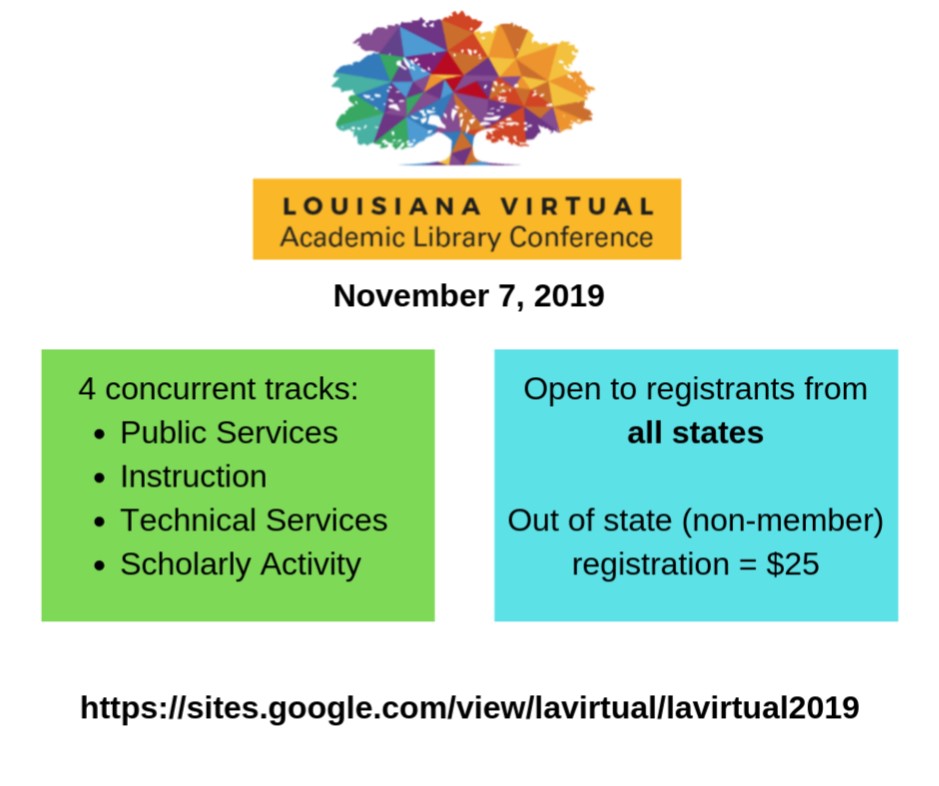
The Louisiana Library Association’s Academic Section and Louisiana chapter of the ACRL are thrilled to share the details for their upcoming 2nd annual Louisiana Virtual Academic Conference 2019. Join us on November 7, 2019 from your computer via Zoom.
The Louisiana Virtual Academic Conference was established to provide additional presentation and professional learning opportunities for academic and other librarians in Louisiana and beyond for little to no cost. This year there are four concurrent sessions: public services, instruction, technical services, and scholarly activity.
As members of PaLA, your registration fee is just $25 and will grant you access to the conference on November 7, as well as the recordings made available afterwards.
Learn more about the LA Virtual Academic Conference here: https://sites.google.com/view/lavirtual/lavirtual2019
Register here: https://sites.google.com/view/lavirtual/registration
Textbooks, Supplemental Resources, and OER

Librarians trying to encourage the adoption of Open Educational Resources (OER) on their campuses face several challenges, but none more so than faculty reliance on the various supplemental resources that publishers create and attach to their textbooks. These resources could be pre-made tests, PowerPoint slides, or video content, for example. Combined these materials create a sort of “lock in” that can make faculty reluctant to leave those textbooks. Of course, these resources also create increased costs to students, who end up paying for them in the end. When approaching faculty about adopting OER librarians may find themselves facing faculty reluctant to adopt resources without these supplemental resources. Which is problematic because most OER do not offer those kinds of supplemental material.
However, this is changing somewhat. Openstax, an OER collection from Rice University, does offer supplemental resources for their textbooks when faculty adopt them. PowerPoint slides, test questions, and course cartridges that integrate into the Canvas LMS are available for their textbooks. These are the kinds of items that faculty have come to rely on. Demonstrating that they are available for some OER may hep get faculty on board for OER adoption.
If you’ve run into this problem I highly recommend you look at the instructor resources area attached to each textbook on Openstax. You can’t see the instructor resources until you’ve been verified to be an instructor interested in using the text. This is to prevent students from accessing the questions provided. But you can see the types of material available. It might be just the thing to get faculty on board to try an OER textbook in their class.
Here is a link to all the texts available from Openstax – https://openstax.org/subjects
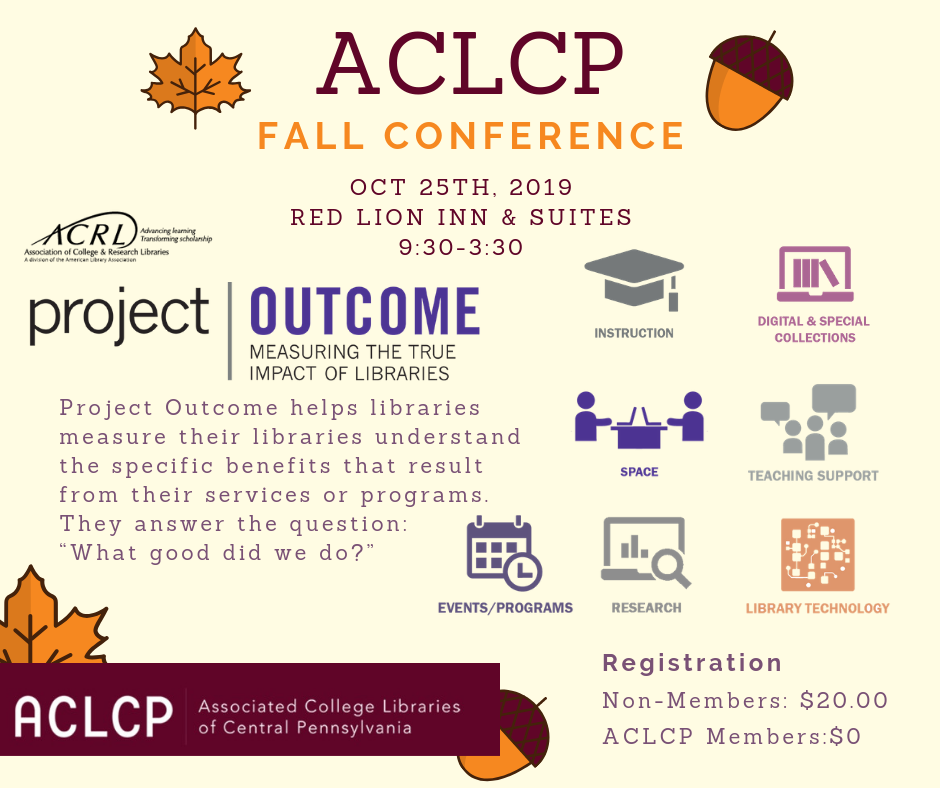
ACRL will present Project Outcome at the ACLP Fall Conference on October 25th at the Red Lion in Harrisburg.
Registration is free for ACLCP (Associated College Libraries of Central Pennsylvania) members and $20 for non-members.
Learn more about Project Outcome here: https://acrl.projectoutcome.org/
Register for the ACLCP Fall Workshop here: Register


 Adam Balcziunas
 Alex K.
 Alexandrea Glenn
 Andrea Pritt
 aprilnkelley
 Ashley Purvis
 Bethann Rea
 blj13
blj13 Brendan Johnson
 Amanda Boyer
 Bret Stiffler
 Bonnie Powers
 Christopher Lemery
 clarewithers
 clblibrarian
 Kelly Clever
 Charlotte M. Johnson
 colemanluzerne
 CRD of PaLA
 crdvirtualjournalclub
 cre5314
 csgarth
 Erin B.
 danajkerrigancv
 denisewetzel1
 Darren G. Poley
 elm43
elm43 James D'Annibale
 Annie Jansen
 Jill Hallam-Miller
 jennifercribbs
 Jenn Monnin
 Jen Hasse
 Jessica Showalter
 johnmeier1
 Kelly Safin
 Kim Karim
 Kristen Seikaly
 Kayla Van Osten
 Cecelia Lasley
 librarianjsmith
 Linda Neyer
 mabogino1
 Matthew McNelis
 Meg Massey
 Maggie Savidakis-Dunn
 Rebecca
 miskatoniclibrarian
 Maureen Bentz
 Michele G. Anfuso
 Nicole Miyashiro
 paulmcmonigle
 Rob Sieczkiewicz
 ronlmccoll
 Sam Bardarik
 shannahollich
 smartin592
 Ula Lechtenberg
 It's Academic