Migrating to a New ILS
I found out earlier this month that we will not be renewing our library’s contract with our current ILS, Sierra Innovative, when it expires in April 2022. As is the reasoning behind many a motivation for change, our decision to migrate to a new integrated library system boils down to the exuberant cost for the services. Having hired the library’s first systems librarian back in July, it seems like perfect timing for us to be considering other options. Our systems librarian has been diligently setting up promotional presentations with various vendors. Last week, we met with a representative from OCLC for WorldShare Management, and this week we sat in on a demonstration for The Library Corporation (TLC). Next month, we will be viewing what SirsiDynix has to offer. I am very open-minded with each vendor because I have used all three either currently (OCLC for interlibrary loans) or at past positions. (I used both TLC and SirsiDynix with two of the three public libraries where I was employed.) Each ILS has much to offer and terrific technical support systems.
But do I personally have a preface? It depends on how I wish to incorporate those integrated library systems’ features into my workflow. Considering I work in OCLC for my interlibrary loans in an academic setting, making the complete transition to this ILS seems the most logical approach. There are dependable technical support and numerous webinars which cover a variety of topics; not to mention the global appeal of OCLC is inviting. I also had the pleasure of working in OCLC Connexion when I was copy cataloging an assignment for the United States Military Academy at Backstage Library Works in 2016. A year later, I was also reacquainted with OCLC when I did my internship at my alma mater (DeSales University) during my final semester of graduate school. Interestingly, DeSales was in the process of making a migration from Millennium to OCLC WorldShare Management during my time there; even though the librarian who handled interlibrary loans was already working with OCLC. I enjoyed learning how to do interlibrary loans through OCLC while I was an intern there; no doubt it truly helped me make the transition to my current position, which includes processing interlibrary loans.
From a circulation viewpoint, however, I believe TLC and SirsiDynix are very user-friendly and offer a lot of bells and whistles which I believe our circulation staff will find useful. I worked with TLC at Southern Lehigh Public Library for fourteen months; I really became spoiled with its features and accessories. (Those of you who have used SPARK in public libraries might completely understand my statement!) SirsiDynix is also another user-friendly ILS for public libraries, so I am interested in seeing how these two systems work for academic libraries.
What feedback can you provide? Do you use one of these three integrated library systems? What are some advantages and disadvantages? Have you noticed a difference? While migrating to a new ILS is never an easy undertaking, it is an excellent opportunity to weed out your library’s collection and to start afresh.
Here is hoping you have a fabulous Thanksgiving! I am so thankful to be a librarian!
Connect + Communicate Online Book Discussion: December 9th
Please join the CRD’s Connect + Communicate Series for on online book discussion of Robin DiAngelo’s White Fragility: Why It’s So Hard for White People to Talk About Racism. DiAngelo, an antiracist educator, explores the ways white behavior, unconscious and conscious, continues to uphold racial inequality.
The virtual discussion will be held on Monday December 9th, at 12 pm. Our conversation will be guided by the following questions:
- White fragility is centered around white people’s discomfort with talking about race. What portion(s) of the book evoked discomfort in you?
- Can you describe a situation you encountered white fragility from a fellow LIS professional? How did you handle it? How would you handle it after reading this book?
- How does white fragility play a role in the lack of diversity in librarianship? How has this book impacted your view of diversity and equity within the profession? What can we do to disrupt white supremacy within librarianship?
Click here to register for the discussion. You do not have to be a PaLA or CRD member to attend. The Zoom link will be sent out to registered attendees prior to December 9th.
If you have any questions, please contact Erin Burns at emb28@psu.edu.
Not Just a Space: Library Services for Faculty
As anyone who works in an academic library knows, space is a premium. As libraries resources are becoming more cemented in the digital, we are able to weed print books, and reduce staffing (albeit not always voluntarily) to create space. The trick for us, as we wrap up the second decade of the twenty-first century, is keeping our spaces relevant.
How many times have we heard of unrelated departments moving their offices into the library? At Valley Forge Military Academy & College, we are still working to keep our spaces relevant for the students (adding individual study carrels and additional group study spaces), but our focus isn’t necessarily on the physical space so much as it’s on the programming that we offer in those spaces. We’ve also learned that it isn’t the students that we need to sell, rather it’s the faculty.
I wrote back in March: “what can we build (or schedule) to get them to come?” and one of the tricks that we’ve discovered is to let the faculty lead the way. In addition to promoting information literacy, and the ability to reserve other library spaces for classes, we offer programming specifically for faculty as well as students.
We run a program called “Pizza and Pedagogy” two to three times each semester during lunch, and bring pizza, and help teach faculty how to leverage ed tech, gamification, or just different subscriptions. We even offer our time to facilitate classroom activities outside of information literacy. I run escape room style activities both digitally and in the tangible world, as well as scavenger hunts, in addition to other game-show-style interactive experiences.
Another faculty-centric program is our Writers’ Retreat series. Once a month we block out three to four hours for our faculty and staff to come and work on their own scholarship, whether it’s research, writing, or prepping presentations. This is a great opportunity to remind the faculty that our resources are accessible to them as well, including interlibrary loan, and the expertise of the librarians.
Through our relationships with faculty, we are able to get students to attend workshops, to schedule research consultations, and to leverage the services provided.
It also doesn’t hurt to increase the number of small celebrations that we recognize, i.e. National Candy Corn Day or National Homemade Cookie Day, so the students are eager to stop in just to see what’s going on. And, for our student-focused workshops, getting faculty to offer extra credit for attendance is helpful, but so is a last minute reminder that contains the promise of food being available as well!
Save the date! ACRL Roadshow and CRD Spring Workshop

We look forward to seeing everyone in May for two great days of professional development.
On May 18, 2020, the College and Research Division will host the ACRL Roadshow Engaging with the ACRL Framework, facilitated by:
- Jenny Dale, Information Literacy Coordinator, University of North Carolina at Greensboro
- Kim Pittman, Information Literacy and Assessment Librarian, University of Minnesota Duluth
Learn more about the Roadshow and our presenters here: http://www.ala.org/acrl/conferences/roadshows/frameworkroadshow
On May 19, we will host our annual Spring Workshop featuring Pennsylvania librarians and an engaging keynote speakers.
More information and registration will be available soon. Stay tuned!
Google Scholar and New Wave Researchers
Commissioned by The Publishing Research Consortium, CIBER Research conducted the Harbingers Study, a 3-year longitudinal study of 100+ international Early Career Researchers (ECRs), defined as new wave researchers (junior, untenured, and postdocs). Not surprisingly they found ECRs are digital natives and possess millennial beliefs of openness, sharing and transparency. Social media and smartphone use looms large as well as “challenging the orthodoxy.”
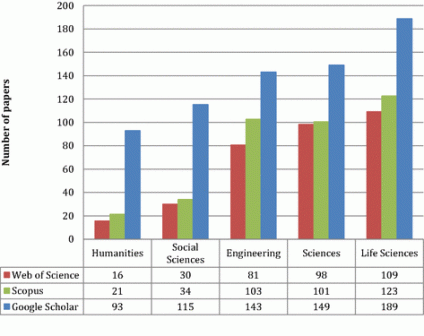
“Average number of papers per academic across five disciplines and three databases, July 2015.” Fig. 3. from Halevi, Moed, and Bar-Ilan (2017).
When it came to information discovery it confirmed the popularity of Google generally and Google Scholar specifically. “2 out of 5 ECRs use Google Scholar extensively for scholarly purposes.” The original study covered 7 countries (China, Malaysia, Poland, France, Spain, the U.K, and the U.S.).
A recently reported “interim finding” on ECR information seeking and finding based on the effort to expand the number of countries where ECRs are surveyed: 93% of ECRs in Russia are Google users and 72% actively use Google Scholar with “lower use by arts and humanities ECRs, however.”
What does this tell us? Despite many enduring concerns, Google and Google Scholar are truly embedded in emerging scholarly research practice.
Dr. Alberto Martín-Martín, a new faculty member at the University of Granada who as a PhD student “spent a summer scraping Google Scholar’s database,” said in an interview published by Nature, “Google Scholar is one of the most used academic search engines in the world” and “Google Scholar contains valuable information that is not available from any other database, but it is impractical to rely on it for large-scale analyses” (Else 2018).
The basic issues with Google Scholar highlighted by Halevi, Moed, and Bar-Ilan (2017):
- Google Scholar is constantly expanding and includes publishers content as well as content not available in controlled databases.
- Google Scholar provides citations counts that are broader than those covered by controlled databases.
- Google Scholar should be used with controlled databases especially when clinical information retrieval is required.
- Google Scholar is challenging when advanced searching is required.
- Google Scholar does not support data downloads and therefore is difficult to use as a sole bibliometric source.
- Google Scholar lacks quality control and clear indexing guidelines.
Else, Holly. “How I scraped data from Google Scholar: A researcher explains how — and why — he spent a whole summer harvesting information from the platform, which is notoriously hard to mine.” News Q&A. Nature (11 April 2018). https://www.nature.com/articles/d41586-018-04190-5
Halevi, Gali, Moed, Henk, and Bar-Ilan, Judit. “Suitability of Google Scholar as a source of scientific information and as a source of data for scientific evaluation—Review of the Literature.” Journal of Informetrics 11.3: 823-834 (2017). https://doi.org/10.1016/j.joi.2017.06.005.
Nicholas, David, et al. Early Career Researchers: The Harbingers of Change? Final Report. CIBER Research, Nov. 2018. http://ciber-research.eu/download/20181218-Harbingers3_Final_Report-Nov2018.pdf
Nicholas, David, and Tatiana Polezhajeva. The scholarly communication attitudes and behaviour of Early Career Researchers (the new wave of researchers): An international survey. Presentation, 7th NEICON International Conference, Sept. 2019. http://ciber-research.eu/download/20190923-ECR_Crete.pdf


 It's Academic