CRD Virtual Journal Club Spring Series is here!
Join the College and Research Division’s Virtual Journal Club spring series! This series we will focus on critical librarianship (#CritLib). All members of PaLA are welcomed. You can read a recap of our fall series here.
The CRD virtual journal club spring series will meet February 19, March 25, and April 22 from 1:00-2:00pm. Those interested in participating can sign up at https://forms.gle/RGYhRTYTr4yiP8R58.
For our first session, we will be reading these two articles:
Garcia, K. (n.d.). Keeping up with…critical librarianship. ACRL. http://www.ala.org/acrl/publications/keeping_up_with/critlib
Eamon, T. (2015). A decade of critical information literacy: A review of the literature. Communications in Information Literacy, 9(1), 24-43. https://files.eric.ed.gov/fulltext/EJ1089135.pdf
Prior to the February meeting, registered participants will receive an email containing a link to article we will be discussing, a list of discussion questions/prompts, and the online Zoom meeting invitation.
If you have any questions or suggestions for the planning committee, please feel free to contact us at CRDVirtualJournalClub@gmail.com.
C&CS Presents: Centering Student Voices on Feb 20th, 2020 at 11am
Centering Student Voices: Conducting Library Research with an Undergraduate
with
Hailley Fargo, Student Engagement Coordinator, Penn State University, University Park
and
Ally Mastrangelo, Undergraduate Research Assistant with Mapping the Student Engagement Journey, Penn State University, University Park
February 20th, 2020 at 11am EST
Register for the Zoom Link here
Library research is often conducted around undergraduate students, but these students usually do not have a say in the research project design. If libraries can find ways to include undergraduates in their research projects, there is potential for not only student-centered research, but also an opportunity for the library to provide a meaningful undergraduate research experience. Additionally, both the student and library benefit from this collaboration. The student learns more about the field of LIS and refines their research skills while the library benefits by learning more about how our students can use their disciplinary background in our research setting. This presentation will present the process of hiring, training, and collaborating with an undergraduate student. Specifically, this presentation is an overview of Mapping the Student Engagement Journey, an exploratory, qualitative research project on student engagement experiences. The presenters will discuss how this research project benefits from the undergraduate student, who is both a collaborator and insider, helping to strengthen the project itself to gather results.
Hailley Fargo is the Student Engagement Coordinator at Penn State University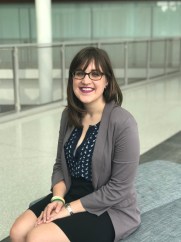 , University Park campus. This role liaises with non-academic units, collaborates with colleagues to create an aligned approach to student engagement, and explores ways to enhance library student employment. Hailley’s research interests include the library’s role in student engagement, peer-to-peer services, information literacy, and undergraduate research. Hailley is also a co-founder of The Librarian Parlor (libparlor.com), a blog dedicated to building community around LIS research. Check her out on Twitter @hailthefargoats.
 Ally Mastrangelo is the Undergraduate Research Assistant with Mapping the Student Engagement Journey. She just graduated from Penn State in Fall 2019 with degrees in Labor and Employment Relations and Psychology and she plans to begin law school in Fall 2020. Ally is intrigued by this project because of her previous research experience and involvement in student engagement opportunities at Penn State. She is a Research Assistant with the Underrepresented Perspectives Lab in the Psychology Department and was involved in various student engagement opportunities as an undergraduate, including New Student Orientation, Penn State Alternative Breaks, and the Italian Honors Society.
Addressing the Opioid Crisis
Last week, I attended my college’s Spring 2020 convocation for faculty, staff, and administration. One of the presentations really struck a solemn chord with me and had a profound effect on how I view our current opioid crisis. The presentation was titled “H.O.P.E. Heroin and Opioid Prevention Education” and given by Lisa Wolff, M.Ed, of the Center for Humanistic Change. Her focus was mainly on the prevalent use of heroin and the resulting fatal overdoses of very young people in their late teens and early twenties.
The opioid crisis is rampant in Pennsylvania. According to the National Institute on Drug Abuse, the opioid-related overdose rate in the United States is 13.3 deaths per 100,000 people. However, in Pennsylvania, the opioid overdose rate is 18.5 deaths per 100,000 people.¹ Pennsylvania opioid abuse has led to the state having a higher number of overdose deaths because of opioids than the national average. Another source found that from January 1, 2018 to December 7, 2019, there were 19,652 emergency room visits from opioid overdoses in Pennsylvania.² Another startling fact is that the Centers for Disease Control and Prevention actually lists Pennsylvania as the state with the third-highest rates of drug overdose deaths (behind West Virginia and Ohio) at 44.3 per 100,000 people with a 16.9% increase from 2016 to 2017 alone.³
Having worked in three public libraries before my current position in a community college’s library, I had heard much of the opioid crisis and had read my fair share of articles concerning librarians becoming administrators of NARCAN® (naloxone HCl), which frankly, terrified me. Fortunately, I never encountered any patrons overdosing or had to administer NARCAN®, but after listening to Wolffe’s presentation, I now wish to learn this critical and life-saving task. In my ignorance, I failed to realize that the opioid crisis can hit the very library at which I work. It never dawned on me that our students could be overdosing on heroin and other opioids in our very bathrooms. (But please do not think I am ignorant about opioids in general; sadly, I have lost close family members to opioid overdoses in Schuylkill County.)
Wolffe brought forward a lot of useful information in just why opioids such as heroin are so addictive. The science behind these harmful drugs is that they attach to parts of your brain and body to block pain and anxiety and induce a feeling of calm and euphoria. Consequently, the brain begins to produce more and more receptors to which the opioids can attach themselves, thereby creating a cycle of addiction and actually changing the way your brain works. Depravation and withdrawal from opioids will cause seriously unpleasant side effects as the brain’s receptors continue to demand their fair share of euphoria. This short YouTube video gives a more scientific analysis of just how opioids affect the brain.4
What are some of the types of popular opioids? In addition to heroin, there are the ones that are often prescribed for patients undergoing (usually major) surgical procedures, or for those in the ending stages of cancer to alleviate the pain. These are morphine, codeine, and oxycodone. Additionally, there are more easily prescribed painkillers which unfortunately are far more accessible to our youth. These are the ones such as OxyContin®, Percocet®, and Vicodin®, which are often prescribed for sports injuries or dental surgeries such as wisdom teeth removal. But one opioid has recently grown in popularity according to Wolffe, and that is fentanyl. Fentanyl is a synthetic opioid that is 80-100 times stronger than morphine. Pharmaceutical fentanyl was developed for pain management treatment of cancer patients, applied in a patch on the skin. Because of its powerful opioid properties, Fentanyl is often abused. Fentanyl is added to heroin to increase its potency, or be disguised as highly potent heroin. Many users believe that they are purchasing heroin and actually do not know that they are purchasing fentanyl – which often results in overdose deaths.5 Wolffe tragically recalled an incident which happened to a young man in his late teens; he had been doing well and had been trying to stay clean, but one night at an arena where he and his mother worked (which is only about two miles away from me), he finished his shift and went to administer to himself what he thought was heroin. He ended up injecting himself with 100% fentanyl, which instantly ended his life.
Wolffe pointed out some interesting signs which you might observe in someone who is using heroin. Besides the obvious, tell-tale sign of a person slouching over and oblivious to his or her surroundings, rocking to and fro, then swinging upright in a moment of consciousness, only to repeat the cycle, there is also a rather unusual one. An unusual amount of plastic water bottles – usually in a person’s vehicle – might point to heroin addiction. Heroin is often placed in the bottle cap of a plastic water bottle and mixed with a little bit of water. To extract the impurities out of the heroin, a tad of cotton from a q-tip is also added to the bottle cap. From there, a person is able to withdraw the mixture from the cotton with a syringe. Referring to the case above, Wolffe mentioned that the mother often had to buy her son q-tips; she just assumed he was using them for personal hygiene.
As overwhelming and tragic as these statistics can be, I am now fully aware that a person can overdose in my library. I would like to be trained on how to administer NARCAN® safely and efficiently. This part of being a librarian has always terrified me. I often used to tell myself, “I did not sign up for this when I decided to become a librarian.” I assumed that only urban (and mainly public) libraries in center city Allentown or Philadelphia have to deal with this crisis, and not a community college library in a semi-rural setting. Moving forward, I am determined to make others aware of the importance we faculty, staff, and administration can play in the lives of students dealing with opioid addiction.
-
National Institute on Drug Abuse – Pennsylvania Quick Facts
-
opendataPA – Opioid-Related Overdose Death
-
Centers for Disease Control and Prevention – Drug Overdose Deaths
-
“2-Minute Neuroscience: Opioids” YouTube, uploaded by Neuroscientifically Challenged, 16 November 2018, https://www.youtube.com/watch?v=NPlNCqBHPnE.
-
United States Drug Enforcement Association – Fentenayl Fact Sheet
The Mindful Library, continued
In my previous post, I shared some observations about three sections of the book Recipes for Mindfulness in Your Library: Supporting Resilience and Community Engagement. Here are some quick thoughts on the last section, Teaching/Research.
Chapters in this section generally focus on being “in the moment” when teaching or learning. This was timely. I’ve been in a few meetings recently where reading comprehension was discussed. Multitasking or rushing through a task just to finish it because you are looking ahead was mentioned as a deterrent to really absorbing information. We see this in ourselves and in students we work with – and being mindful of that is a good step in trying to focus.
The importance of checking in with students about what they are thinking and feeling “in the moment” is a key takeaway from the last chapter, “Overcoming Research Anxiety.” While many of us already check in during instruction or consultations – “do you have any questions about this?” – we may not get meaningful results. Instead, following the advice of this chapter, we might frame our questions to be more specific, acknowledging emotions. We can ask if the research process seems overwhelming, what part of the process students dread the most, and if any strategies helped in the past. In other words, we can try to start a conversation that might help students become more comfortable with research.
Based on the title alone, I probably don’t need to mention that Recipes for Mindfulness In Your Library is not a deep dive into theories and practices; concepts are explained just enough to highlight main ideas. This book is a good overview that provides topics to discuss with colleagues, programming ideas and ways to incorporate mindfulness into work.
CRD Virtual Journal Club Fall Wrap-Up
This past fall, the College & Research Division hosted a virtual journal club, which met online three times over the semester. The CRD Journal Club was originally established in Summer 2018, and runs in the summer, spring, and fall of each year. During the Fall 2019 series, the group discussed three scholarly articles, all examining students’ transitions from high school to college environments and how it relates to what we do in the library.
The first article discussed was “Secondary teacher perceptions and openness to change regarding instruction in information literacy skills,” by Sarah Crary and published in School Library Research. Participants discussed problems shared across both school and college/university libraries: a lack of relationships with teachers and faculty and the need to collaborate meaningfully with them to meet the students where they are in terms of information literacy skills.
The second article discussed was “Fortifying the pipeline: A quantitative exploration of high school factors impacting the information literacy of first-year college students,” by Jennifer L. Fabbi published in College & Research Libraries. This article primarily generated discussion about how to authentically assess and report on our impact on students.
The last article discussed was “Without foundations, we can’t build: Information literacy and the need for strong school library programs,” by Cara Berg, Darby Malvey, and Maureen Donohue and published by In the Library with the Lead Pipe. Participants shared their thoughts on barriers school librarians and incoming college students face, as well as ideas for building relationships between college/university and school libraries in order to make connections to better bridge gaps in information literacy skills.
Overall, this was a very illuminating series for the journal club, involving both academic and school librarians who were able to share and compare experiences. Many ideas were discussed and formulated amongst the group members, such as working closely with first-year faculty to determine and set expectations for information literacy within courses and sharing this kind of information literacy data with high school administrators, which will hopefully turn into successful projects and adaptations at individual institutions.
We look forward to our spring session, which will discuss critical librarianship. We will meet at 1:00 pm on February 19th, March 25th, and April 22nd. Participants can register for the series and attend any number of sessions that work for their schedules. Look for our upcoming emails!


 Adam Balcziunas
 Alex K.
 Alexandrea Glenn
 Andrea Pritt
 aprilnkelley
 Ashley Purvis
 Bethann Rea
 blj13
blj13 Brendan Johnson
 Amanda Boyer
 Bret Stiffler
 Bonnie Powers
 Christopher Lemery
 clarewithers
 clblibrarian
 Kelly Clever
 Charlotte M. Johnson
 colemanluzerne
 CRD of PaLA
 crdvirtualjournalclub
 cre5314
 csgarth
 Erin B.
 danajkerrigancv
 denisewetzel1
 Darren G. Poley
 elm43
elm43 James D'Annibale
 Annie Jansen
 Jill Hallam-Miller
 jennifercribbs
 Jenn Monnin
 Jen Hasse
 Jessica Showalter
 johnmeier1
 Kelly Safin
 Kim Karim
 Kristen Seikaly
 Kayla Van Osten
 Cecelia Lasley
 librarianjsmith
 Linda Neyer
 mabogino1
 Matthew McNelis
 Meg Massey
 Maggie Savidakis-Dunn
 Rebecca
 miskatoniclibrarian
 Maureen Bentz
 Michele G. Anfuso
 Nicole Miyashiro
 paulmcmonigle
 Rob Sieczkiewicz
 ronlmccoll
 Sam Bardarik
 shannahollich
 smartin592
 Ula Lechtenberg
 It's Academic