Building Citation Skills Using Instagram
I know I can’t be the only one who has had a hard time getting students to reach their “a-ha!” moment with citations. The undergraduate population at my campus, at large, has a vague understanding that “not citing is bad” but they’re not quite sure why, other than the inevitable “points off.” They know that such things as MLA and APA exist, and some even know about Chicago style (so scary), and they might even realize that different types of sources require different formats of reference entries, but the majority of undergraduate students I have worked with do not have a solid understanding of the parts of a citation or how to create a reference entry without using EasyBib, Zotero, or another web-based citation builder.
Working with a class in fall 2019, I realized that students couldn’t always identify a title of a newspaper article, had a hard time finding page numbers and dates in magazines, and did not understand the concept of the “source,” or what’s now sometimes called the “container.” This class required only popular sources, no scholarly materials, so students weren’t able to select the magic cite button in the database. When I brought physical copies of newspapers and magazines to class to practice their APA style citations, they struggled. When I gave them the format to create the citation, they struggled. These students, who ranged from freshmen to seniors in this gen-ed course, failed to find the core elements needed to cite a source.
This spring, working with the same instructor, we decided to break things down to a basic level. What are the key pieces of a citation? What are the core elements students need to be able to identify? We narrowed it down to five questions, which align to the APA’s Basic Principles of Reference List Entries with one addition: where can this be located (URL or issue, volume and page numbers). This course has very specific requirements in that the instructor gives the students the name of a popular publication they must use to find a source, weekly, but we weren’t confident that they would be able to identify these five key elements to a citation, even with the name of the source provided.
To that end, we practiced finding the core elements of a citation and creating an APA style with an Instagram post. I pulled an image from @nationalparkservice and asked the class to find
1) who posted or created this image?
2) when was it posted?
3) what is the title?
4) what platform is it posted on?
5) where can you find the URL for this post?
I had hoped that since Instagram is a platform that students use often, they’d more readily be able to locate this information than they were using a newspaper or a magazine. My hunch was correct. The classes, as a whole, stumbled a bit on how to find the URL for the direct post, and a few weren’t sure what the difference was between the caption and the location tag, but overall students successfully identified the key elements of a citation from an Instagram post.
This opened up a broader conversation about what types of materials have rules for citations, and students were shocked to learn that there were models for citing Twitter posts and comments, as well as YouTube videos and podcasts. The initial results were highly successful, as most students correctly built a citation for their first assignment.
Anticipating the future is human nature, risky and necessary. At least according to the introduction of the Horizon Report just released by EDUCAUSE, Emerging Technologies & Practices and Influential Trends, 2020. However it also acknowledges that the accuracy of predictions in past Horizon Reports are “middling” at best.
So, this year they have kept the ternary time horizon structure of past reports but adopted identifying trends which will cause departures from the past, impact the present, and help determine the future. Evidence for these trends is included. The trend categories are social, technological, economic, political and higher education.
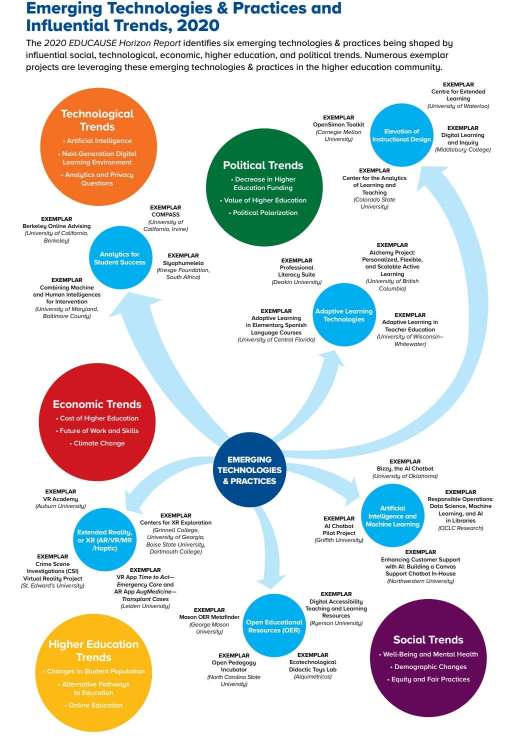
Mind Map by EDUCAUSE based on 2020 Horizon Report
They have stood by the Horizon Report’s standard of not simply making a list of “hyped technologies for the field to debate and debunk” (4). The emerging technologies and practices they do discuss on pages 13-31 are:
- elevation of instructional design, learning engineering and user-experience design
- open educational resources
- artificial intelligence/machine learning
- cross-reality technologies
- analytics for student success
- adaptive learning
The report also presents scenarios on how the future may unfold in the next 10 years: growth, constraint, collapse, or transformation. Even if growth is achieved it will be “with some unrealized goals and even some setbacks” (33). Constraint would be due to “the values of efficiency and sustainability” and “escalating financial pressures as a result of shrinking enrollments and decreased funding from state and other sources” (34). Collapse would be the result of “a new ecosystem of education” (35). Transformation considers “two primary forces: the dangers posed by climate change and the advances in digital technology” (36).
Another important new component is a series of essays responding to the findings of the Report (pages 37-55). Written by Horizon Report panelists, they touch on implications for educational and global sectors, such as U.S. Community Colleges, Australian Higher Ed, “Corporate Perspective on AI/Machine Learning,” and “Campuses Most at Risk from Climate Change.” The Report includes its methodology and roster of panelists.
Yesterdays session, “Academic Libraries and Autism Spectrum Disorder” is now available on YouTube. Link will remain available for a year. Gerry and Sebastian are wonderfully informed about the topic. Slides will be available on the C&CS page, https://crdpala.org/connect-communicate/
Special thanks to Sara Pike for doing our closed captioning and Diane Porterfield for moderating.
We also invite those who are not PaLA members to consider joining the Pennsylvania Library Association, which helps support programs like this one. If interested in becoming a member or for more information about the CRD, contact Katie Manwiller at Katie.Manwiller@desales.edu
Thanks!
- Work in close collaboration with a co-editor to manage all aspects of Pennsylvania Libraries: Research & Practice, producing 2 issues each year.
- Oversee all submissions moving through the publication process from initial submission to peer review, revision, layout, and final proofreading.
- Work closely with a volunteer editorial team including news editors, copy editors, and layout editors.
- Recruit and communicate with peer-reviewers as needed.
- Communicate and work with authors to provide feedback on submissions as well as strong editorial guidance as needed.
- Prepare updates and editorials as appropriate.
- Oversee use of Online Journal System (OJS) software platform by authors, reviewers, and editorial staff, answering questions about its functionality and recommending best practices
- Conduct or assist with training of new editorial staff
- Remain in close communication with the journal publisher, the University Library System, University of Pittsburgh and the journal sponsor, the College & Research Division (CRD) of the Pennsylvania Library Association (PaLA).
- Solicit submissions for all types of articles.
- Experience writing for professional publications.
- Significant experience working in Pennsylvania libraries.
- Current member of the Pennsylvania Library Association and the College & Research Division.
- Excellent communication skills required. Co-Editor must be willing and able to respond to numerous email messages in a timely manner.
Preferred Qualifications
- Editorial experience.
- Knowledge of issues related to open access scholarly publishing.
Submit a letter of interest and a resume to Emily Mross, PaLA College & Research Division Chair, at ELM43@psu.edu by March 31.


 Adam Balcziunas
 Alex K.
 Alexandrea Glenn
 Andrea Pritt
 aprilnkelley
 Ashley Purvis
 Bethann Rea
 blj13
blj13 Brendan Johnson
 Amanda Boyer
 Bret Stiffler
 Bonnie Powers
 Christopher Lemery
 clarewithers
 clblibrarian
 Kelly Clever
 Charlotte M. Johnson
 colemanluzerne
 CRD of PaLA
 crdvirtualjournalclub
 cre5314
 csgarth
 Erin B.
 danajkerrigancv
 denisewetzel1
 Darren G. Poley
 elm43
elm43 James D'Annibale
 Annie Jansen
 Jill Hallam-Miller
 jennifercribbs
 Jenn Monnin
 Jen Hasse
 Jessica Showalter
 johnmeier1
 Kelly Safin
 Kim Karim
 Kristen Seikaly
 Kayla Van Osten
 Cecelia Lasley
 librarianjsmith
 Linda Neyer
 mabogino1
 Matthew McNelis
 Meg Massey
 Maggie Savidakis-Dunn
 Rebecca
 miskatoniclibrarian
 Maureen Bentz
 Michele G. Anfuso
 Nicole Miyashiro
 paulmcmonigle
 Rob Sieczkiewicz
 ronlmccoll
 Sam Bardarik
 shannahollich
 smartin592
 Ula Lechtenberg
 It's Academic