Inching Closer to a National Open Access Policy
June 8th the “United States Innovation and Competition Act 2021” (S. 1260) which includes provisions endorsing public access to federally-funded research was passed by the U.S. Senate. According to Katie Steen, Manager of Public Policy & Advocacy for the Scholarly Publishing and Academic Resources Coalition (SPARC), “public access provisions in S. 1260 are from a compromise deal reached in 2017 to advance the Fair Access to Science & Technology Research (FASTR) Act out of the Senate HSGA Committee.”

Steen further related that this is the farthest that the FASTR bill has advanced in the legislative process. “The language (on page 478 in Section 2527) in the bill essentially codifies the 2013 White House Memorandum on Public Access, requiring the deposit of authors’ final manuscripts into federally owned or managed repositories, in machine readable formats, and under licenses that enable productive reuses. While it does still include an embargo period, the language also calls for articles to be made open ‘not later than 12 months after publication, preferably sooner,’ indicating a clear Senate preference for shortening embargoes.”
“Although we oppose any embargo period and intend to continue to push for a full national open access policy,” Steen said, they are “pleased to see the Senate endorse language that strongly supports providing faster access to taxpayer-funded research results.” The next step is for the bill to go to the U.S. House of Representatives. For SPARC’s fuller comments on the passage of this bill see, “SPARC Statement on Public Access Provisions in the U.S. Innovation and Competition Act.”
Streaming Video Platforms
Throughout the last year and a half, I had a variation on this conversation with many of the faculty in my liaison departments.
Faculty: Every year I put Film X on reserve for my students in the library. How can my remote students get access to Film X through the library?
Me: Unfortunately, Film X is not available in Academic Video Online (AVON), our only streaming media database, so we are not be able to provide access to Film X through the library. Here’s a link to Just Watch, a website that gives information on where Film X is available to stream. Sometimes students may already have access to a streaming service that provides access, otherwise it appears that they could rent the film for less than $5.
Faculty: I’m not comfortable asking students to pay so I guess I’ll have to figure out something else to do.
At this point the logical side of my brain would file this interaction as complete and move on. Meanwhile the people-pleasing, emotional side of my brain would keep re-running this conversation until I would wake up in the middle of the night after dreaming about a group of faculty & students protesting the library for bad service during a pandemic.
I’m not sure if this is a scenario that happened at your library (with or without the stress dreams) but I certainly wasn’t the only librarian at my library having this conversation. As a result, we are incorporating Swank & Kanopy as options for streaming video platforms starting in the fall.
We only have a limited amount of money to spend on each platform so it’s been difficult for us to decide out how to roll out these new platforms. I’d love to hear from other librarians how you manage these platforms at your school. Do you allocate a certain dollar amount or number of films to each department? Is it first come, first serve? Do you buy based on films you know that faculty use every term?
I’m also curious to hear from other traditionally residential campuses, do you think the need for streaming video will decline once we “return to normal” in the fall?
How Students Feel Matters
This past year I incorporated something very simple into my instructional sessions, a question asked at the start of class: How do you feel about research and research papers? I posed this question (or some form it) using the internet anonymous polling tool Mentimeter, which allows for quick, easy, and visible participation. Predictably, the answers to this question consistently spoke to student anxiety: including such words as dread, pain, and struggle, and always prominently displaying the words overwhelming and stress/stressed/stressful.
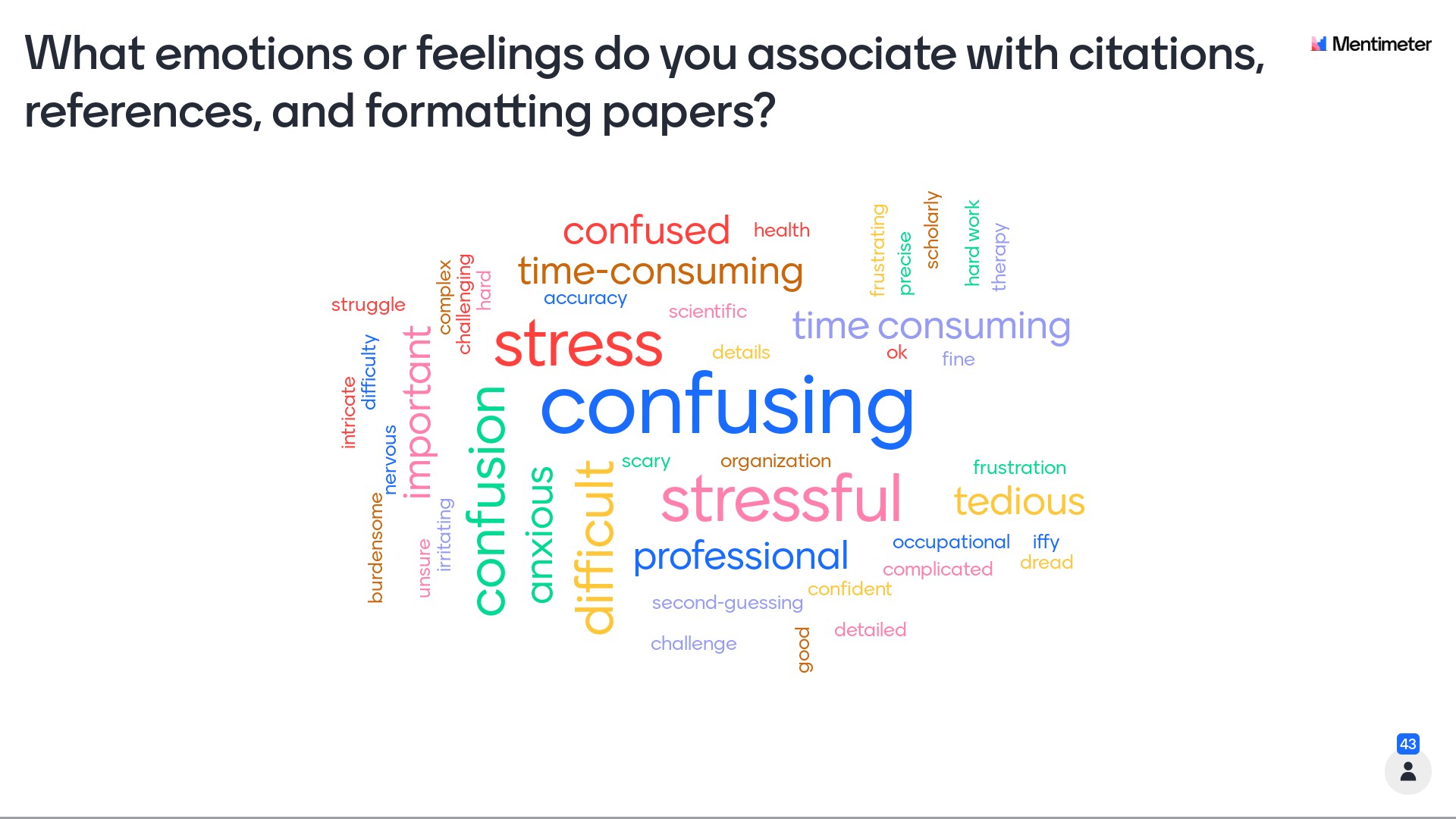
At first, I didn’t have a rationale for starting class this way and wondered whether it was a good use of class time. Still, amidst the pressures and challenges of the pandemic, taking a minute to gauge the emotional temperature in the room felt right. And as I persisted in asking this question, I came to appreciate the way it helped to build community in the room and normalize students’ feelings. Those who felt anxious or worried could literally see the evidence in front of them that they were not alone, and I, as their instructor, was situated to authentically speak to their fears and to offer encouragement, support, and help.
This past spring, attending ACRL 2020 Virtual, I was delighted to hear a pedagogical argument for this type of question in Liz Chenevey’s presentation: An Emergent Pedagogy of Presence and Care: Addressing Affect in Information Literacy Instruction. Chenevey makes the case that teaching for affect (emotions, moods, motivations, and attitudes) can positively impact not only students’ mental health but also learning, cognition, and behaviors. One way to do this she shares is through the nine principles of Emergent Strategy developed by adrienne maree brown:
- Small is good, small is all (the large is a reflection of the small)
- Change is constant (be like water)
- There is always enough time for the right work
- There is a conversation in the room that only these people that this moment can have. Find it.
- Never a failure, always a lesson
- Trust the people (if you trust the people they become trustworthy)
- Move at the speed of trust. Focus on critical connections more than critical mass
- Less prep, more presence
- What you pay attention to grows
I am only myself beginning to explore how emergence may inform or transform my teaching, but I see my seemingly inconsequential question reflected in Emergent Strategy – it’s a small but good way to find a conversation between myself and my students, it’s a conversation that happens in the moment and not one that I can entirely plan for, and it’s worth the time it takes.
Further reading:
Emergent Strategy: Shaping Change, Changing Worlds by adrienne maree brown
Planning for a Really Big Welcome
Every fall is an exciting time on campus – but this fall might be the most interesting yet.
Like many librarians supporting hybrid learning during the pandemic, we’ve given some thought to how our undergraduates have spent the past year-plus. Most rising third-year students only spent a semester and change learning on campus before March 2020. Meanwhile, incoming first-year students are probably raring to go for a steady, in-person learning experience.* And then, we have our second-year students.
The phrase “sophomore slump” comes to mind – I’ll link to some reading at the end of this post for a deeper dive. The 2021-22 year could potentially be a sharper slump, because some second-year students may not have spent much (or any) time on campus during their first year of classes. When these students arrive for fall term in a few months, they will have limited background experience to draw from.
Planning for ways to support students during this transition is on our library’s agenda this summer, particularly for the second-year group. We’ll see all the first-year students in sessions with their seminar classes, but that won’t be the case for their second-year counterparts. For all students, we want to amplify who we are and how we can help. We’re hoping to expand on some existing outreach, including:
- Promotion in the residence halls and dining hall – We’ve shared digital and print content in these spaces, so these will be simple updates to better position our services among unfamiliar students. Clear calls to action and simple design elements will be key. One example: We may revamp a past bulletin board notice that included tear-off strips with a link to our consultation scheduling page.
- Social media planning – A more consistent schedule of work-study student takeovers, faculty, staff or student book recommendations, and similar content would help build engagement and awareness of our collections and services in the fall term.
- Continued and new collaborations – These partnerships have always been important, and are even more critical now. Our creative and thoughtful colleagues across campus are eager to see more students for in-person activities and classes. By collaborating on workshops, events and instruction, we can support their work and connect with students as well.
These are just a few of the plans we’ll talk about, along with other projects. Summer will go by quickly!
If you’re interested in initiatives related to sophomores, here are a few of the many resources out there:
Black, E. L. (2019). The Credo second-year transition guide: Extending retention and student success efforts beyond the FYE. Credo Reference. http://hdl.handle.net/1811/91864
Hulseberg, A., & Twait, M. (2016). Sophomores speaking: An exploratory study of student research practices. College & Undergraduate Libraries, 23(2), 130–150. https://doi.org/10.1080/10691316.2014.981907
Kuglitsch, R., & Burge, P. (2016). Beyond the first year: Supporting sophomores through information literacy outreach. College & Undergraduate Libraries, 23(1), 79–92. https://doi.org/10.1080/10691316.2014.944636
*let it be both steady and in-person, please.
I would like to share this message from Kim Snyder-Wise of the Pennsylvania Library Association.
REMINDER: May 31, 2021 is the Deadline to Submit a Proposal for a Poster or Lightning Talk for the Pennsylvania Library Association Virtual Conference!
Poster sessions & lightning talks provide a forum for library professionals to share their findings or successful ideas or innovations with colleagues without a formal presentation. The 2021 Pennsylvania Library Association (PaLA) virtual conference to take place September 27 – 29, 2021 will provide the opportunity to engage with hundreds of library professionals in an informal, idea-sharing format.
In the virtual conference platform, these presentations will take place in a designated area with the capability to display a poster and/or video recording, upload handouts and links. Presenters will be assigned a 90-minute window on either Monday, Tuesday or Wednesday of the virtual event to be present in their session area and engage with attendees via chat or video calls. Your presentation materials will also be available at other times for viewing only, without presenter interaction.
For more information and the link to submit a proposal by May 31, visit our Posters/Lightning Talks FAQ page on the PaLA website.